

Abstract
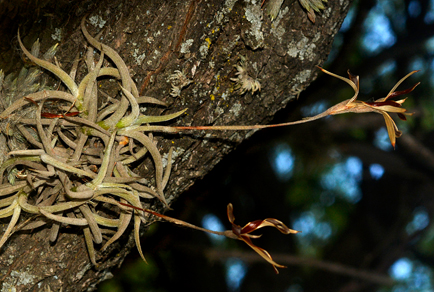
Morphological and molecular evidence, including phylogeny and plastome structural features, together with the geographic distribution and phenological data, strongly support the recognition of three distinct lineages within the traditional circumscription of Tillandsia myosura, here named T. myosura s.str. and two newly described species, T. cleistopetala and T. pachyphylla. Tillandsia myosura is redefined as a morphologically and ecologically narrower species endemic to Argentina (from the northwest to the central region), and closely related to T. andicola and T. retorta. Tillandsia cleistopetala sp. nov. instead occurs in Uruguay and central-eastern Argentina, showing an allopatric and ecologically distinct distribution compared to T. myosura s.str. Tillandsia cleistopetala sp. nov. is sister to T. crocata and is reproductively characterized by consistently cleistogamous flowers. Tillandsia pachyphylla sp. nov. is morphologically well differentiated from
T. myosura s.str. by several vegetative and reproductive characters. Tillandsia myosura s.str. and T. pachyphylla sp. nov. are partially sympatric but are phenologically differentiated. Tillandsia pachyphylla sp. nov. is distributed in central Bolivia and from northwestern to central Argentina and is part of a clade that includes T. castellanii, T. hirta, and T. mandonii. A taxonomic treatment of the two new species and T. myosura s.str. is presented, including detailed morphological descriptions, information on geographical distribution, habitat, phenology, and conservation status, along with representative photographs and illustrations of floral parts. A lectotype for Tillandsia nappii is designated.
References
- Ancona, J.J., Pinzón-Esquivel, J.P., Ruiz-Sánchez, E., Palma-Silva, C., Ortiz-Díaz, J.J., Tun-Garrido, J., Carnevali, G. & Raigoza, N.E. (2022) Multilocus data analysis reveal the diversity of cryptic species in the Tillandsia ionantha (Bromeliaceae: Tillansiodeae) complex. Plants 11: 1706. https://doi.org/10.3390/plants11131706
- André, É.-F. (1905) Le Tillandsia dianthoides et les Broméliacées aériennes de l’Uruguay. Revue Horticole 19: 463–467.
- Bachman, S., Moat, J., Hill, A.W., de la Torre, J. & Scott, B. (2011) Supporting Red List threat assessments with GeoCAT: geospatial conservation assessment tool. (Version BETA). In: Smith, V. & Penev, L. (Eds.) e-Infrastructures for data publishing in biodiversity science. ZooKeys 150: 117–126. https://doi.org/10.3897/zookeys.150.2109.figure1
- Baker, J.G. (1878) A synopsis of the species of Diaphoranthema. Journal of Botany, British and Foreign 16: 236–241.
- Baker, J.G. (1887) A synopsis of Tillandsieae. Journal of Botany, British and Foreign 25: 52–347.
- Barfuss, M.H.J., Till, W., Leme, E.M.C., Pinzón, J.P., Manzanares, J.M., Halbritter, H., Samuel, R. & Brown, G.K. (2016) Taxonomic revision of Bromeliaceae subfam. Tillandsioideae based on a multi-locus DNA sequence phylogeny and morphology. Phytotaxa 279: 1–97. https://doi.org/10.11646/phytotaxa.279.1.1
- Beer, J.G. (1854) Versuch einer Eintheilung der Familie der Bromeliaceen nach ihrem Blüthenstande. Flora 37: 346–349. https://doi.org/10.1007/bf02056234
- Bolger, A.M., Lohse, M. & Usadel, B. (2014) Trimmomatic: a flexible trimmer for illumina sequence data. Bioinformatics 30: 2114–2120. https://doi.org/10.1093/bioinformatics/btu170
- Brito, A.H. & Llano, L. (2008) Bromelias del Uruguay. Linardi y Risso, Montevideo, 228 pp.
- Brown, N.E. (1882) With a revised supplement including all the new plants and varieties to the end of the year 1880. In: Johnson, G.W. (Ed.) The gardeners’ dictionary. George Bell & sons, London, pp. 1–1026.
- Buddenhagen, C., Lemmon, A.R., Lemmon, E.M., Bruhl, J., Cappa, J., Clement, W.L., Donoghue, M.J., Edwards, E.J., Hipp, A.L., Kortyna, M., Mitchell, N., Moore, A., Prychid, C.J., Segovia-Salcedo, M.C., Simmons, M.P., Soltis, P.S., Wanke, S. & Mast, A. (2016) Anchored phylogenomics of angiosperms I: assessing the robustness of phylogenetic estimates. bioRxiv. [Preprint] https://doi.org/10.1101/086298
- Cabrera, A.L. & Willink, A. (1973) Biogeografía de America Latina. Colección de Monografías Científicas OEA Serie Biología, Monografía 13. O.E.A., Washington D.C., 120 pp.
- Castellanos, A. (1945) Bromeliaceae. In: Descole, H.R. (Ed.) Genera et species plantarum argentinarum, Vol. 3. Guillermo Kraft Ltda., Buenos Aires, pp. 105–378.
- Castresana, J. (2000) Selection of conserved blocks from multiple alignments for their use in phylogenetic analysis. Molecular Biology and Evolution 17: 540–552. https://doi.org/10.1093/oxfordjournals.molbev.a026334
- Cellini, J.M., Salomón, L. & Donadío, S. (2012) Tillandsia myosura Griseb. Ex Baker (Bromeliaceae), una nueva cita para la flora de la Provincia de Buenos Aires (Argentina). Bonplandia 21: 183–188. https://doi.org/10.30972/bon.2121306
- Culley, T.M. & Klooster, M.R. (2007) The cleistogamous breeding system: a review of its frequency, evolution, and ecology in angiosperms. The Botanical Review 73: 1–30. https://doi.org/10.1663/0006-8101(2007)73[1:TCBSAR]2.0.CO;2
- Donadío, S., Pozner, R. & Giussani, L.M. (2015) Phylogenetic relationships within Tillandsia subgenus Diaphoranthema (Bromeliaceae, Tillandsioideae) based on acomprehensive morphological dataset. Plant Systematics and Evolution 301: 387–410. https://doi.org/10.1007/s00606-014-1081-1
- Donadío, S., Till, W., Pozner, R., Barfuss, M.H.J., Giussani, L.M. & Starr, J.R. (2022) Phylogenetic relationships and evolutionary trends in Tillandsia subgenus Diaphoranthema and xerophytic species of subgenus Phytarrhiza (Bromeliaceae: Tillandsioideae). Botanical Journal of the Linnean Society 200: 541–562. https://doi.org/10.1093/botlinnean/boac020
- Font Quer, P. (2001) Diccionario de Botánica, 2a edición. Ediciones Península, Barcelona, 1280 pp.
- Gouda, E.J. (2020) Tillandsia BROMELIACEAE. In: Eggli, U. & Nyffeler, R. (Eds.) Monocotyledons-Illustrated Handbook of Succulent Plants. Springer, Berlin, Heidelberg, pp. 1107–1164. https://doi.org/10.1007/978-3-662-56486-8_96
- Gouda, E.J., Butcher, D. & Dijkgraaf, L. (2026 [continuously updated]) Encyclopaedia of Bromeliads, Version 5. University Botanic Gardens, Utrecht. Available from: http://bromeliad.nl/encyclopedia (accessed 10 April 2026)
- Granados Mendoza, C., Granados-Aguilar, X., Donadío, S., Salazar, G.A., Flores-Cruz, M., Hágsater, E., Starr, J.R., Ibarra-Manríquez, G., Fragoso-Martínez, I. & Magallón, S. (2017) Geographic structure in two highly diverse lineages of Tillandsia (Bromeliaceae). Botany 95: 641–651. https://doi.org/10.1139/cjb-2016-0250
- Greiner, S., Lehwark, P. & Bock, R. (2019) OrganellarGenomeDRAW (OGDRAW) version 1.3.1: expanded toolkit for the graphical visualization of organellar genomes. Nucleic Acids Research 47: W59–W64. https://doi.org/10.1093/nar/gkz238
- Grisebach, A.H.R. (1879) Symbolae ad Floram argentinam: Zweite Bearbeitung argentinischer Pflanzen. Abhandlungen der Königlichen Gesellschaft der Wissenschaften zu Göttingen 24: 1–345. https://doi.org/10.5962/bhl.title.9025
- Herter, G. (1930) Flora Uruguayensis, Plantae Vasculares. Estudios Botánicos en la Región Uruguaya. IV. Imprenta Nacional, Montevideo, 191 pp.
- Herter, G. (1949–1956) Flora del Uruguay. VIII. Spathiflorae. Estudios Botánicos en la Región Uruguaya XXIV. Revista Sudamericana de Botánica 9: 188–192.
- Hromadnik, L. & Schneider, P. (1988) Eine neue Tillandsia aus Argentinien. Haussknechtia 4: 39–41.
- Hromadnik, L. & Till, W. (1991) Tillandsia tenebra, spec. nov.: eine neue Kleintillandsia aus der Untergattung Diaphoranthema. Die Bromelie 2: 32–34.
- Hromadnik, L. & Till, W. (2026) Tillandsia potosina - Eine neue Art aus der Untergattung Diaphoranthema aus Bolivien und Nordargentinien. Die Bromelie 1: 4–20.
- IUCN (2012) IUCN Red List Categories and Criteria, Version 3.1. Second edition. IUCN, Gland, Switzerland and Cambridge, 32 pp.
- Jackson, B.D. (1928) A glossary of botanic terms with their derivation and accent, 4th ed., revised and enlarged. Gerald Duckworth & Co., London, 481 pp.
- Jin, J.-J., Yu, W.-B., Yang, J.-B., Song, Y., dePamphilis, C.W., Yi, T.-S. & Li, D.-Z. (2020) GetOrganelle: a fast and versatile toolkit for accurate de novo assembly of organelle genomes. Genome Biology 21: 1–31. https://doi.org/10.1186/s13059-020-02154-5
- Katoh, K. & Standley, D.M. (2013) MAFFT Multiple Sequence Alignment Software Version 7: Improvements in performance and usability. Molecular Biology and Evolution 30: 772–780. https://doi.org/10.1093/molbev/mst010
- Krömer, T., Kessler, M., Holst, B.K., Luther, H.E., Gouda, E.J., Till, W., Ibisch, P.L. & Vásquez, R. (1999) Checklist of Bolivian Bromeliaceae with notes on species distribution and levels of endemism. Selbyana 20: 201–223.
- Krömer, T., Ibisch, P.L., Vásquez, R., Kessler, M., Holst, B. & Luther, H.E. (2014) Bromeliaceae. In: Jørgensen, P.M., Nee, M.H. & Beck, S.G. (Eds.) Catálogo de las Plantas Vasculares de Bolivia. Missouri Botanical Garden Press, St. Louis, pp. 418–439.
- Linnaeus, C. von (1753) Species Plantarum. Tomus 1. Impensis Laurentii Salvii, Holmiae, Stockholm, 560 pp.
- Linnaeus, C. von (1762) Species plantarum. Editio Secunda. Tomus 1. Impensis direct. Laurentii Salvii, Stockholm, 784 pp.
- Lorentz, P.G. & Niederlein, G. (1881) Informe oficial de la Comisión Científica Agregada al Estado Mayor General de la Expedición al Rio Negro (Patagonia) realizada en los meses de Abril, Mayo y Junio de 1879, bajo las órdenes del General D. Julio A. Roca. Entrega II. Imprenta de Ostwald y Martínez, Buenos Aires, 120 pp. https://doi.org/10.5962/bhl.title.2504
- Marchesi, E. (1965) Plantas nuevas o poco conocidas de la flora Uruguaya I. Comunicaciones Botánicas del Museo de Historia Natural de Montevideo 4: 1–11.
- Mez, C. (1896) Bromeliaceae. In: De Candolle, C. (Ed.) Monographiae phanerogamarum. Vol 9. Masson & Cie, Paris, pp. i–lxxvii,1–990.
- Minh, B.Q., Schmidt, H.A., Chernomor, O., Schrempf, D., Woodhams, M.D., von Haeseler, A. & Lanfear, R. (2020) IQ-TREE 2: New models and efficient methods for phylogenetic inference in the genomic era. Molecular Biology and Evolution 37: 1530–1534. https://doi.org/10.1093/molbev/msaa015
- Morren, É. (1880) Phytarrhiza crocata sp. nov. La Belgique Horticole - Annales de Botanique et d’Horticulture 30: 87.
- Pinzón, J.P., Ramirez-Morillo, I.M., Carnevali, G., Barfuss, M.H.J, Till, W., Tun, J. & Ortiz-Díaz, J.J. (2016) Phylogenetics and evolution of the Tillandsia utriculata complex (Bromeliaceae, Tillandsioideae) inferred from three plastid DNA markers and the ETS of the nuclear ribosomal DNA. Botanical Journal of the Linnean Society 181: 362–390. https://doi.org/10.1111/boj.12425
- Prado, J., Hirai, R.Y. & Moran, R.C. (2015) Proposals concerning inadvertent lectotypifications (and neotypifications). Taxon 64: 651. https://doi.org/10.12705/643.29
- QGIS.org (2023) QGIS Geographic Information System. QGIS Association. [http://www.qgis.org] https://doi.org/10.1201/b19044-18
- Rambaut, A. (2018) FigTree ver. 1.4.4. [http://tree.bio.ed.ac.uk/software/figtree]
- Rossado, A.J., Donadio, S. & Bonifacino, J.M. (2024) A taxonomic revision of Tillandsia (Tillandsioideae, Bromeliaceae) from Uruguay. Phytotaxa 667: 1–90. https://doi.org/10.11646/phytotaxa.667.1.1
- Scharf, U. & Gouda, E.J. (2008) Bringing Bromeliaceae back to homeland Botany. Journal of the Bromeliad Society 58: 123–129.
- Simpson, M.G. (2006) Plants systematics. Elsevier Academic Press, Burlington, San Diego, London, 590 pp.
- Smith, L.B. (1933) Notas on the Bromeliaceae of Uruguay. Ostenia 359–362.
- Smith, L.B. (1934) Studies in the Bromeliaceae: V. Contributions from the Gray Herbarium of Harvard University 104: 71–82. https://doi.org/10.5962/p.336158
- Smith, L.B. (1935) Studies in the Bromeliaceae: VI. Proceedings of the American Academy of Arts and Sciences 70: 147–220.
- Smith, L.B. (1969) The Bromeliaceae of Bolivia. Rhodora 71: 35–279.
- Smith, L.B. (1972) Flora del Uruguay IV. Bromeliaceae. Comunicaciones botánicas del Museo Nacional de Historia Natural 4: 1–31.
- Smith, L.B. & Downs, R.J. (1977) Tillandsioideae (Bromeliaceae). Flora Neotropica 14: 659–1492.
- Sorarú, S.B., Ponce, M., Donadío, D. & Múlgura, M.E. (2023) Familia Bromeliaceae, Bromeliáceas. In: Burkart, A.E., Bacigalupo, N.M., Múlgura, M.E. & Ponce, M.M. (Eds.) Flora Ilustrada de Entre Ríos Argentina: Parte I. Licofitas, helechos, gimnospermas y monocotiledóneas (sin las gramíneas). Colección Científica del I.N.T.A., Tomo VI, Parte I, Instituto Nacional de Tecnología Agropecuaria (INTA), Buenos Aires, pp. 230–251.
- Stamatakis, A. (2014) RAxML version 8: A tool for phylogenetic analysis and post–analysis of large phylogenies. Bioinformatics 30: 1312–1313. https://doi.org/10.1093/bioinformatics/btu033
- Systematics Association Committee for Descriptive Biological Terminology (1962) Terminology of Simple Symmetrical Plane Shapes (Chart 1). Taxon 11: 145–156. https://doi.org/10.2307/1216718
- Subils, R. (2009) Bromeliaceae. In: Kiesling, R.B. (Ed.) Flora de San Juan, Volumen IV: Monocotiledóneas. Editorial Fundación Universidad Nacional de San Juan, San Juan, pp. 340–363.
- Thiers, B. (2026) [continuously updated] Index Herbariorum: A global directory of public herbaria and associated staff. New York Botanical Garden’s Virtual Herbarium. Available from: http://sweetgum.nybg.org/ih/ (accessed 10 February 2026)
- Till, W. (1984) Sippendifferenzierung innerhalb Tillandsia subgenus Diaphoranthema in Südamerika mit besonderer Berücksichtigung des Andenostrandes und der angrenzenden Gebiete. PhD thesis. Universität Wien, Austria, 319 pp.
- Till, W. (1992) Systematics and evolution of the tropical-subtropical Tillandsia subgenus Diaphoranthema (Bromeliaceae). Selbyana 13: 88–94.
- Till, W. & Hromadnik, L. (1984) Neue taxa von Tillandsia subgenus Diaphoranthema (Bromeliaceae) aus Bolivien und Argentinien. Plant Systematics and Evolution 147: 279–288. https://doi.org/10.1007/bf00989389
- Turland, N.J., Wiersema, J.H., Barrie, F.R., Gandhi, K.N., Gravendyck, J., Greuter, W., Hawksworth, D.L., Herendeen, P.S., Klopper, R.R., Knapp, S., Kusber, W.-H., Li, D.-Z., May, T.W., Monro, A.M., Prado, J., Price, M.J., Smith, G.F. & Zamora Señoret, J.C. (2025) International Code of Nomenclature for algae, fungi, and plants (Madrid Code). Regnum Vegetabile 162. University of Chicago Press, Chicago, 303 pp. https://doi.org/10.7208/chicago/9780226839479.001.0001
- Vera-Paz, S.I., Díaz Contreras Díaz, D.D., Jost, M., Wanke, S., Rossado, A.J., Hernández-Gutiérrez, R., Salazar, G.A., Magallón, S., Gouda, E.J., Ramírez-Morillo, I.M., Donadío, S. & Granados Mendoza, C. (2022) New plastome structural rearrangements discovered in core Tillandsioideae (Bromeliaceae) support recently adopted taxonomy. Frontiers in Plant Science 13: 1–19. https://doi.org/10.3389/fpls.2022.924922
- Vera-Paz, S.I., Granados Mendoza, C., Díaz Contreras Díaz, D.D., Jost, M., Salazar, G.A., Rossado, A.J., Monte-Azcué, C.A., Hernández-Gutiérrez, R., Magallón, S., Sánchez-González, L.A., Gouda, E.J., Cabrera, L.I., Ramírez-Morillo, I.M., Flores-Cruz, M., Granados-Aguilar, X., Martínez-García, A.L., Hornung-Leoni, C.T., Barfuss, M.H.J. & Wanke, S. (2023) Plastome phylogenomics reveals an early Pliocene North-and Central America colonization by long-distance dispersal from South America of a highly diverse bromeliad lineage. Frontiers in Plant Science 14: 1–19. https://doi.org/10.3389/fpls.2023.1205511
- Visiani, R. (1854) Di due piante nuove dell’ordine delle Bromeliacee. Coi tipi di Giovanni Cecchini, Venice, 10 pp.
- Zizka, A., Azevedo, J., Leme, E., Neves, B., Ferreira da Costa, A., Caceres, D. & Zizka, G. (2020) Biogeography and conservation status of the pineapple family (Bromeliaceae). Diversity and Distributions 26: 183–195. https://doi.org/10.1111/ddi.13004
- Zotz, G. (2013) The systematic distribution of vascular epiphytes - a critical update. Botanical Journal of the Linnean Society 171: 453–481. https://doi.org/10.1111/boj.12010
- Zuloaga, F.O., Belgrano, M.J. & Zanotti, C.A. (2019) Actualización del Catálogo de las Plantas Vasculares del Cono Sur. Darwiniana, nueva serie 7: 208–278. https://doi.org/10.14522/darwiniana.2019.72.861