

Abstract
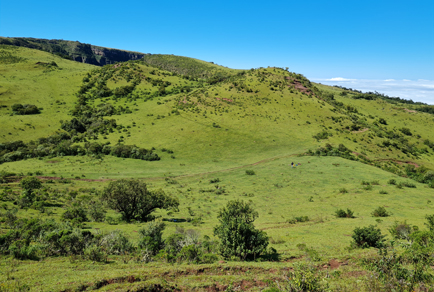
Solanum altoserranum, a new species restricted to the high-altitude grasslands of the Calilegua and Santa Ana mountain ranges, Sub-Andean mountain system, from North-western Argentina in the altitudinal range that oscillates between 2600 and 3600 m a.s.l., is described and illustrated. The new taxon is characterized by having erect stems warty from prominent leaf bases and uniseriate, simple, eglandular, antrorse-appressed trichomes, purplish-green petioles up to 1 cm long., simple leaves with elliptic to oblong, patent, shiny lamina, purple on the abaxial surface, with notable venation that gives it a bullate appearance, apparently lateral inflorescences with 10–20 flowers, articulated pedicels, deflexed, 0.7–1 cm long, campanulate corolla, greenish-white at the base and lilac distally. Photographs, distribution information, conservation status assessment, and comparisons with similar species are also provided.
References
- Anton, A.M. & Zuloaga, F.O. (2026) Flora Argentina [online]. Available from: www.floraargentina.edu.ar (accessed 24 February 2026)
- Arana, M.D., Natale, E., Oggero, A., Ferreti, N., Romano, G., Martínez, G., Posadas, P. & Morrone, J.J. (2021a) Esquema biogeográfico de la República Argentina. Opera lilloana 56. Fundación Miguel Lillo, Tucumán. [http://www.lillo.org.ar/editorial/index.php/publicaciones/catalog/book/253]
- Asesor, P.N. & Bulacio, E. (2021) Una nueva especie de Dioscorea (Dioscoreaceae) para las Yungas del noroeste argentino. Darwiniana, Nueva Serie 9 (2): 393–400. https://doi.org/10.14522/darwiniana.2021.92.985
- Aubriot, X., Singh, P. & Knapp, S. (2016) Tropical Asian species show that the Old World clade of “spiny solanums” (Solanum subgenus Leptostemonum pro-parte: Solanaceae) is not monophyletic. Botanical Journal of the Linnean Society 181: 199–223. https://doi.org/10.1111/boj.12412
- Ayarde, H. (2013) Aporte hídrico de las neblinas en las montañas húmedas del noroeste de Argentina. In: Actas I Simposio de la Reserva de Biósfera de las Yungas»10 años de experiencias y desafíos» y V Reunión de las Selvas de Montañas 1. Jujuy, pp. 13. [ISBN 978-950-721-448-6]
- Ayarde, H. & Bulacio, E. (2015) Una nueva especie de Berberis (Berberidaceae) de las montañas del Noroeste de Argentina y Sur de Bolivia”. Boletín de La Sociedad Argentina de Botánica 50 (4): 595–600. https://doi.org/10.31055/1851.2372.v50.n4.12918
- Ayarde, H. & Bulacio, E. (2016) Tillandsia mollis var. reptans (Bromeliaceae), Una novedad del noroeste de Argentina. Boletín de la Sociedad Argentina de Botánica 51 (2): 367–372. https://doi.org/10.31055/1851.2372.v51.n2.14851
- Bachman, S.P., Moat, J., Hill, A., De La Torre, J. & Scott, B. (2011) Supporting Red list threat assessments with GeoCAT: geospatial conservation assessment tool. ZooKeys 150: 117–126. https://doi.org/10.3897/zookeys.150.2109
- Barboza, G.E., Hunziker, A.T., Bernardello, G., Cocucci, A.A., Moscone, A.E. & Carrizo-García, C. (2016) Solanaceae. In: Kadereit, J.W. & Bittrich, V. (Eds.) Flowering plants. Eudicots. Springer International publishing, Switzerland, pp. 295–358. https://doi.org/10.1007/978-3-319-28534-4_29
- Beentje, H. (2016) The Kew Plant Glossary. Kew Publishing, Kew.
- Bitter, F.A.G. (1913) Solana nova vel minus cognita. XIII. Repertorium Specierum Novarum Regni Vegetabilis 12: 542–555. https://doi.org/10.1002/fedr.19130123309
- Bulacio, E. & Ayarde, H.R. (2009) Flora y Vegetación del sector alto de las Sierras de Calilegua (Jujuy). XXXII Jornadas Argentinas de Botánica, Córdoba. Boletín de la Sociedad Argentina de Botánica 44 (Supl.): 106.
- Bulacio, E. & Ayarde, H. (2014) Sobre la presencia de Tillandsia schreiteri y T. sphaerocephala (Bromeliaceae) en Argentina”. Boletín de la Sociedad Argentina de Botánica 49 (1): 79–83. https://doi.org/10.31055/1851.2372.v49.n1.7824
- D’Arcy, W.G. (1991) The Solanaceae since 1976, with a review of its biogeography. In: Hawkes, J.G., Lester, R., Nee, M. & Estrada, N. (Eds.) Solanaceae III: Taxonomy, Chemistry, Evolution. Royal Botanic Gardens, Kew, Richmond, Surrey, pp. 75–137.
- Davis, P.H. & Heywood, V.H. (1963) Principles of angiosperm taxonomy. Van Nostrand, New York, 556 pp.
- De Jussieu, A.L. (1789) Genera Plantarum. Theophilum Barrois, Paris, 498 pp. https://doi.org/10.5962/bhl.title.284
- De Queiroz, K. (2007) Species concepts and species delimitation. Systematic biology 56 (6): 879–886. https://doi.org/10.1080/10635150701701083
- Dunal, M.F. (1852) Ordo CXLII. Solanaceae. In: de Candolle, A.L.P.P. (Ed.) Prodromus Systematis Naturalis Regni Vegetabilis 13 (1). pp. 690.
- Echeverría-Londoño, S., Särkinen, T., Fenton, I.S., Purvis, A. & Knapp, S. (2020) Dynamism and context‐dependency in diversification of the megadiverse plant genus Solanum (Solanaceae). Journal of Systematics and Evolution 58 (6): 767–782.
- Eichler, A.W. (1864) Flora Brasiliensis em C.F.P. von Martius & auct. suc. (eds.). Flora Brasiliensis 13 (1): 231.
- Frodin, D. (2004) History and concepts of big plant genera. Taxon 53 (3): 753–776. https://doi.org/10.2307/4135449
- Gagnon, E., Hilgenhof, R., Orejuela, A., McDonnell, A., Sablok, G., Aubriot, X., Giacomin, L., Gouvêa, Y., Bragionis, T., Stehmann, J.R., Bohs, L., Dodsworth, S., Martine, C., Poczai, P., Knapp, S. & Särkinen, T. (2022) Phylogenomic discordance suggests polytomies along the backbone of the large genus Solanum (Solanaceae). American Journal of Botany 109: 580–601. https://doi.org/10.1002/ajb2.1827
- Grisebach, A.H.R. (1874) Plantae Lorentzianae. Abhandlungen der Königlichen Gesellschaft der Wissenschaften zu Göttingen 19: 49–279.
- Hassler, É. (1917) Solanaceae Austro-americanae imprimis paraguarienses. Annuaire du Conservatoire et du Jardin Botaniques de Genève 20: 173–189. [https://www.biodiversitylibrary.org/item/112421#page/11/mode/1up]
- Hilgenhof, R., Gagnon, E., Knapp, S., Aubriot, X., Tepe, E.J., Bohs, L., Giacomin, L., Gouvêa, Y.F., Martine, C.T., Orejuela, A., Orozco, C.I., Peralta, I.E. & Särkinen, T. (2023) Morphological trait evolution in Solanum (Solanaceae): Evolutionary lability of key taxonomic characters. Taxon 72: 811–847. https://doi.org/10.1002/tax.12990
- Hooker, W.J. & Arnott, G.A.W. (1841) Contributions towards a Flora of South America and the Islands of the Pacific. Journal of Botany, being a second series of the Botanical Miscellany 3: 19–47. [https://www.biodiversitylibrary.org/page/2917659]
- IUCN Standards and Petitions Committee (2025) Guidelines for Using the IUCN Red List Categories and Criteria. Version 16. Prepared by the Standards and Petitions Committee. [https://www.iucnredlist.org/documents/RedListGuidelines.pdf]
- Knapp, S. (2002) Solanum section Geminata (G.Don) Walpers (Solanaceae). Flora Neotropica 84: 1–405.
- Knapp, S. (2008) A revision of the Solanum havanense species group (section Geminata (G. Don) Walp. pro parte) and new taxonomic additions to the Geminata clade (Solanum, Solanaceae). Annals of the Missouri Botanical Garden 95: 405–458. https://doi.org/10.3417/2006159
- Knapp, S. (2010) New species of Solanum (Solanaceae) from Peru and Ecuador. PhytoKeys 1: 33–51. https://doi.org/10.3897/phytokeys.1.659
- Knapp, S. (2013) A revision of the Dulcamaroid Clade of Solanum L. (Solanaceae). PhytoKeys 22: 1–432. https://doi.org/10.3897/phytokeys.22.4041
- Knapp, S., Stehmann, J.R. & Giacomin, L.L. (2015) New species, additions and a key to the Brazilian species of the Geminata clade of Solanum L. (Solanaceae) in Brazil. PhytoKeys 47: 1–48. https://doi.org/10.3897/phytokeys.47.9076
- Kunth, K.S. (1817) Nova genera et species plantarum :quas in peregrinatione ad plagam aequinoctialem orbis novi collegerunt /descripserunt, partim adumbraverunt (HBK) 2:16, Lutetiae Parisiorum, Suntibus Librariae Graeco–Latino Germanicae.
- Linnaeus, C. (1753) Species plantarum, vol. 1. Salvius, Stockholm, 560 pp.
- Mallet, J. (1995) A species definition for the modern synthesis. Trends in Ecology and Evolution 10: 294–299. https://doi.org/10.1016/0169-5347(95)90031-4
- Matesevach Becerra, M., Giacomin, L. & Sthemann, J.R. (2013) Grupo I. Brevantherum. In: Anton, A.M. & Zuloaga, F.O. (Eds.) Flora Argentina 13: 158–166.
- Moonlight, P.W., Baldaszti, L., Cardoso, D., Elliott, A., Särkinen, T. & Knapp, S. (2024) Twenty years of big plant genera. Proceedings of the Royal Society B: Biological Sciences 291: 20240702. https://doi.org/10.1098/rspb.2024.0702
- Nee, M. (1999) Synopsis of Solanum in the New World. In: Nee, M., Symon, D.E., Lester, R.N. & Jessop, J.P. (Eds.) Solanaceae IV. The Royal Botanic Gardens, Kew, pp. 285–333.
- Olmstead, R.G. & Palmer, J.D. (1997) Implications for the phylogeny, classification, and biogeography of Solanum from cpDNA restriction site variation. Systematic Botany 22 (1): 19–29. https://doi.org/10.2307/2419675
- Olmstead, R.G., Bohs, L., Migid, H.A., Santiago-Valentin, E., Garcia, V.F. & Collier, S.M. (2008) A molecular phylogeny of the Solanaceae. Taxon 57 (4): 1159–1181. https://doi.org/10.1002/tax.574010
- Poczai, P., Taller, J. & Szabó, I. (2008) Analysis of phylogenetic relationships in the genus Solanum (Solanaceae) as revealed by RADP markers. Plant Systematics and Evolution 275: 59. https://doi.org/10.1007/s00606-008-0051-x
- Särkinen, T., Bohs, L., Olmstead, R.G. & Knapp, S. (2013) A phylogenetic framework for evolutionary study of the nightshades (Solanaceae): A dated 1000-tip tree. BMC Evolutionary Biology 13 (1): e214. https://doi.org/10.1186/1471-2148-13-214
- Schlechtendal, D.F.L. (1847) Plantae Leiboldianae: Dicotyleae. Linnaea 19: 234–320. [https://www.biodiversitylibrary.org/page/63576849]
- Slanis, A.C. & Bulacio, E. (2022) Caiophora vallegrandensis (Loasaceae, Loasoideae, Loaseae): Una nueva especie de Argentina. Darwiniana, Nueva Serie 10 (1): 271–278. https://doi.org/10.14522/darwiniana.2022.101.1031
- The World Flora Online Consortium (2025) World Flora Online Plant List. December 2025 (2025–12) [Data set]. Zenodo. https://doi.org/10.5281/zenodo.18007552
- Thiers, B. (2026) Index herbariorum: a global directory of public herbaria and associated staff. New York Botanical Garden's Virtual Herbarium. [http://sweetgum.nybg.org/science/ih]
- Tovar, J.D. & Giacomin, L.L. (2022) A new species and new records of Solanum (Solanaceae) from Colombia. PhytoKeys 195: 63–73. https://doi.org/10.3897/phytokeys.195.78832
- Varontsova, M.S., Stern, S., Bohs, L. & Knapp, S. (2013) African spiny Solanum (Subgenus Leptostemonum, Solanaceae): a thorny phylogenetic tangle. Botanical Journal of the Linnean Society 173: 1–176.