

Abstract
15 species of Euphorbia sect. Pithyusa are distributed in Türkiye. In this study morphological and molecular analyses were conducted on these taxa which is a study covering all Turkish species of the section Pithyusa.
ITS-based phylogenetic analyses conducted in this study, which included a total of 129 samples, clearly elucidated the evolutionary relationships among the studied taxa and enabled a more robust interpretation of species-level boundaries. A diagnostic key was prepared using morphological characters as determined through comprehensive field and herbarium investigations.
Phylogenetic analyses of Euphorbia pestalozzae, E. pisidica, E. yildirimlii and E. falcata subsp. macrostegia was done for the first time in this study. Euphorbia cassia, E. thessala and E. terracina, which have previously been studied from different countries, were analysed for the first time in this study for Turkish samples.
Seed surface characteristics aligned with phylogenetic groupings based on nrITS data examined in this study, those with smooth and non-smooth seed surfaces were in different clades, though E. petrophila, despite its pitted seed surface, deviated from this general morphological-phylogenetic correlation. It has been revealed that Turkish endemics E. pestalozzae and E. pisidica are closer to E. cheiradenia than to E. petrophila.
Extensive fieldwork across the distribution range of Euphorbia falcata, with emphasis on subsp. macrostegia, revealed distinct morphological features separating it from other infraspecific taxa. Nuclear DNA sequence analyses formed a well-supported clade corresponding to subsp. macrostegia, indicating clear genetic divergence. Based on this evidence, the subspecies warrants elevation to species rank. We propose the new name Euphorbia bornmuelleri, recognizing its distinct evolutionary lineage within the complex.
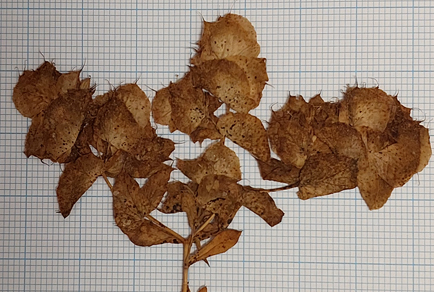
Morphological and micromorphological analyses indicate that Euphorbia yildirimlii, described in 2012, closely resembles E. macroclada. Molecular data support this resemblance, so it was decided that E. yildirimlii is a synonym of E. macroclada.
References
- Allioni, C. (1785) Flora Pedemontana. Augustae Taurinorum, excudebat Joannes Michael Briolus, Torino, 382 pp.
- Barres, L., Vilatersana, R., Molero, J., Susanna, A. & Galbany-Casals, M. (2011) Molecular phylogeny of Euphorbia subg. Esula sect. Aphyllis (Euphorbiaceae) inferred from nrDNA and cpDNA markers with biogeographic insights. Taxon 60: 705–720. https://doi.org/10.1002/tax.603007
- Bieberstein, F.A.M. (1808) Flora Taurico-Caucasica 1. Typis Academicis, Charkouiae [Kharkov], 429 pp.
- Boissier, P.E. (1844) Diagnoses Plantarum Orientalium novarum, ser. 1 (5). B. Hermann, Lipsiae [Leipzig], 91 pp.
- Boissier, P.E. (1853) Diagnoses Plantarum Orientalium novarum, ser. 1 (12). Henrici Wolfrath, Neocomi, 120 pp.
- Boissier, P.E. (1859) Diagnoses Plantarum Orientalium novarum, ser. 2 (4). B. Herrmann, Lipsiae [Leipzig], 146 pp.
- Boissier, P.E. (1862) Subordo I. Euphorbieæ. In: Candolle, A.L.P.P.de (Ed.) Prodromus Systematis Naturalis Regni Vegetabilis, 15 (2). Sumptibus Sociorum Treuttel et Würtz, Paris, pp. 3–188.
- Bolaji, A.O., Olojede, C.B., Famurewa, A.A. & Faluyi, J.O. (2014) Morphological and cytological studies of Euphorbia hyssopifolia L. and Euphorbia heterophylla L. from Ile-Ife, Nigeria. Nigerian Journal of Genetics 28: 15–18. https://doi.org/10.1016/j.nigjg.2015.06.003
- Borbás, V. (1893) A Bolgár Flóra Vonatkozása Hazánk Flórájára. Természetrajzi füzetek, az állat-, növény, ásvány- és földtan köreböl. Budapest. 16: 40–53.
- Bornmüller, J.F.N. (1908) Florula Lydiae Mit 1 Tafel. Mittheilungen des Thüringischen Botanischen Vereins 24: 1–139.
- Bruyns, P.V., Mapaya, R.J. & Hedderson, T. (2006) A new subgeneric classification for Euphorbia (Euphorbiaceae) in southern Africa based on ITS and psbA-trnH sequence data. Taxon 55: 397–420. https://doi.org/10.2307/25065587
- Carter, S. (1988) Euphorbieae. In: Polhill, R.M. (Ed.) Flora of Tropical East Africa, Euphorbiaceae (part 2). A.A. Balkema, Rotterdam, pp. 409–564.
- Carter, S. (1994) A preliminary classification of Euphorbia subgenus Euphorbia. Annals of the Missouri Botanical Garden 81: 368–379. https://doi.org/10.2307/2992103
- Curators Herbarium B (2000+) Digital specimen images at the Herbarium Berolinense. [Dataset]. Botanic Garden and Botanical Museum Berlin. Available from: http://ww2.bgbm.org/herbarium/ [http://herbarium.bgbm.org/ B100347195, image ID: 415867] (accessed 24 December 2025).
- Degen, A. & Dörfler, I. (1897) Beitrag zur Flora Albaniens und Macedoniens. Ergebnisse einer von I. Dörfler im Jahre 1893 unternohmenen Reise (mit 4 Tafeln). Denkschriften der Kaiserlichen Akademie der Wissenschaften / Mathematisch-Naturwissenschaftliche Classe 64: 701–748.
- Dorsey, B.L., Haevermans, T., Aubriot, X., Morawetz, J.J., Riina, R., Steinmann, V.W. & Berry, P.E. (2013) Phylogenetics, morphological evolution, and classification of Euphorbia subgenus Euphorbia. Taxon 62: 291–315. https://doi.org/10.12705/622.1
- Dumortier, B.C. (1827) Florula Belgica, operis majoris prodromus. Typis J. Casterman, Tornaci Nerviorum, 172 pp.
- Ekim, T. (2022) Damarlı bitkiler. In: Güner, A., Ekim, T., Kandemir, A., Menemen, Y., Yıldırım, H., Aslan, S., Çimen, A.Ö., Güner, I., Ekşi, G. & Şen, F. (eds.) Resimli Türkiye Florası (Illustrated Flora of Türkiye) 1, second edition. ANG Vakfı Nezahat Gökyiğit Botanik Bahçesi Yayınları, İstanbul, pp. 175–180.
- Formánek, E. (1896) Zweiter Beitrag zur Flora von Serbien, Macedonien und Thessalien. Verhandlungen des Naturforschenden Vereins in Brünn 34: 255–365.
- Frajman, B. & Geltman, D. (2021) Evolutionary origin and systematic position of Euphorbia normannii (Euphorbiaceae), an intersectional hybrid and local endemic of the Stavropol Heights (Northern Caucasus, Russia). Plant Systematics and Evolution 307: 1–12. https://doi.org/10.1007/s00606-021-01741-8
- Frajman, B. & Schönswetter, P. (2011) Giants and dwarfs: molecular phylogenies reveal multiple origins of annual spurges within Euphorbia subg. Esula. Molecular Phylogenetics and Evolution 61: 413–424. https://doi.org/10.1016/j.ympev.2011.06.011
- Frajman, B. & Schönswetter, P. (2017) Amphi-Adriatic distributions in plants revisited: Pleistocene trans-Adriatic dispersal in the Euphorbia barrelieri group (Euphorbiaceae). Botanical Journal of the Linnean Society 185: 240–252. https://doi.org/10.1093/botlinnean/box055
- Frajman, B., Záveská, E., Gamisch, A., Moser, T., Schönswetter, P. & Steppe Consortium (2019) Integrating phylogenomics, phylogenetics, morphometrics, relative genome size and ecological niche modelling disentangles the diversification of Eurasian Euphorbia seguieriana s.l. (Euphorbiaceae). Molecular Phylogenetics and Evolution 134: 238–252. https://doi.org/10.1016/j.ympev.2018.10.046
- Geltman, D.V. (1996) New data on distribution of Euphorbia (Euphorbiaceae) species in the Caucasus. Botanicheskii Zhurnal 81: 100–103.
- Geltman, D.V. (2005) Genus Euphorbia L. (Euphorbiaceae) in flora Tauriae, Caucasi et Asiae Minoris. III. Sectio Paralias Dumort. Novitates Systematicae Plantarum Vascularium 37: 134–151. https://doi.org/10.31111/novitates/2005.37.134
- Geltman, D.V. (2012) Fam. Euphorbiaceae Juss. In: Takhtajan, A.L. (Ed.) Konspekt Flory Kavkaza 3 (2). KMK Scientific Press, Moscow & St. Petersburg, pp. 494–513.
- Geltman, D.V. (2015) Typification of some specific and infraspecific names in Euphorbia L. (Euphorbiaceae). Novitates Systematicae Plantarum Vascularium 46: 126–133. https://doi.org/10.31111/novitates/2015.46.126
- Geltman, D.V. (2020) A synopsis of Euphorbia (Euphobiaceae) for the Caucasus. Novitates Systematicae Plantarum Vascularium 51: 43–78. https://doi.org/10.31111/novitates/2020.51.43
- Genç, İ. & Kültür, Ş. (2016) Euphorbia akmanii (Euphorbiaceae), a new species from Turkey. Phytotaxa 265: 112–120. https://doi.org/10.11646/phytotaxa.265.2.2
- Genç, İ. & Kültür, Ş. (2018) Seed morphology of perennial taxa of Euphorbia section Pithyusa (Euphorbiaceae) in Turkey. Phytotaxa 336: 263–271. https://doi.org/10.11646/phytotaxa.336.3.4
- Genç, İ. & Kültür, Ş. (2020) Karyological analysis of twelve Euphorbia species from Turkey. Caryologia 73: 13–19. https://doi.org/10.13128/10.13128/caryologia-197
- Genç, İ., Kültür, Ş. & Ecevit-Genç, G. (2018) Capsule, leaf and cyathial gland morphology of Turkish perennial taxa of Euphorbia L. section Pithyusa (Raf.) Lázaro. Trakya University Journal of Natural Sciences 19: 11–19. https://doi.org/10.23902/trkjnat.342096
- Gilbert, M.G. (1987) Two new geophytic species of Euphorbia with comments on the subgeneric grouping of its African members. Kew Bulletin 42: 231–244. https://doi.org/10.2307/4109908
- Govaerts, R., Frodin, D.G. & Radcliffe-Smith, A. (2000) World Checklist and Bibliography of Euphorbiaceae (and Pandaceae). Royal Botanic Gardens, Kew, 1621 pp.
- Graham, R. (1836) Description of several New or Rare Plants which have lately Flowered in the Neighboorhood of Edinburgh, chiefly in the Royal Botanic Garden. The Edinburgh ew Philosophical Journal 20: 412–413.
- Güner, A., Ekim, T., Kandemir, A., Menemen, Y., Yıldırım, H., Aslan, S., Çimen, A.Ö., Güner, I., Ekşi, G. & Şen, F. (eds.) (2022) Resimli Türkiye Florası (Illustrated Flora of Türkiye), Volume 1, 2nd edition. ANG Vakfı Nezahat Gökyiğit Botanik Bahçesi Yayınları, İstanbul, 900 pp.
- Hall, T.A. (1999) BioEdit: a user-friendly biological sequence alignment editor and analysis program for Windows 95/98/NT. Nucleic Acids Symposium Series 41: 95–98.
- Horn, J.W., Van Ee, B.W., Morawetz, J.J., Riina, R., Steinmann, V.W., Berry, P.E. & Wurdack, K.J. (2012) Phylogenetics and the evolution of major structural characters in the giant genus Euphorbia L. (Euphorbiaceae). Molecular Phylogenetics and Evolution 63: 305–326. https://doi.org/10.1016/j.ympev.2011.12.022
- Host, N.T. (1831) Flora Austriaca vol. 2. Sumptibus Car. Ferd. Beck, Viennae, 768 pp.
- House, H.D. (1924) Annotated List of the Ferns and Flowering Plants of New York State. Vol. 254. The University of the State of New York, Albany, 759 pp. https://doi.org/10.5962/bhl.title.7562
- Huson, D.H. & Bryant, D. (2024) The SplitsTree App: interactive analysis and visualization using phylogenetic trees and networks. Nature methods 21 (10): 1773–1774. https://doi.org/10.1038/s41592-024-02406-3
- Kerner, A.J. (1882) Schedae ad Floram Exsiccatam Austro-Hungaricum II. prostat apud G. Frick, Vindobonæ, 175 pp. https://doi.org/10.1007/BF01679583
- Ketenoğlu, O., Vural, M., Kurt, L. & Körüklü, T. (2022) Vejetasyon. In: Güner, A., Ekim, T., Kandemir, A., Menemen, Y., Yıldırım, H., Aslan, S., Çimen, A.Ö., Güner, I., Ekşi, G. & Şen, F. (eds.) Resimli Türkiye Florası (Illustrated Flora of Türkiye) 1, second edition. ANG Vakfı Nezahat Gökyiğit Botanik Bahçesi Yayınları, İstanbul, pp. 182–265.
- Khan, M.S. (1964) Taxonomic revision of Euphorbia in Turkey. Notes from the Royal Botanic Garden, Edinburgh 25: 71–161. https://doi.org/10.24823/nrbge.1964.2643
- Kryshtofowicz, A.N. (1929) Euphorbia volgensis. Izvestiya Glavnogo Botaniceskago Sada SSSR. Bulletin du Jardin (Botanique) Principal de l’URSS 28: 378.
- Kryukov, A.A., Geltman, D.V., Machs, E.M. & Rodionov, A.V. (2010) Phylogeny of Euphorbia subgenus Esula (Euphorbiaceae) inferred on the sequences of ITS1-5.8S rDNA-ITS2. Botanicheskii Zhurnal 95: 801–819.
- Lázaro, I. (1896) Compendio de la flora española [...] Tomo II. Librería de la viuda de Hernando y Companía, Madrid, 1038 pp.
- Linnaeus, C. (1753) Species plantarum. Laurentius Salvius, Stockholm, 1200 pp.
- Linnaeus, C. (1762) Species plantarum Edition 2. Laurentius Salvius, Stockholm, 784 pp.
- Lipsky, V.I. (1891) Issledovaniye Severnogo Kavkaza (1889–90) [Study of the Northern Caucasus (1889–90)]. Zapiski Kievskogo Obshchestva Estestvoispytatelei 11: 23–62.
- Lojacono Pojero, M. (1907) Flora Sicula o descrizione delle piante spontanee o indiginate in Sicilia 2 (2) (Corolliflorae—Monochlamydeae, Gymnospermae). Tipo–Litografia S. Bizzarrilli, Palermo, 428 pp.
- Madeira, F., Madhusoodanan, N., Lee, J., Eusebi, A., Niewielska, A., Tivey, A.R., Lopez, R. & Butcher, S. (2024) The EMBL-EBI Job Dispatcher sequence analysis tools framework in 2024. Nucleic acids research 52 (W1): W521–W525. https://doi.org/10.1093/nar/gkae241
- Malý, K. (1904) Beiträge zur Kenntnis der Flora Bosniens und der Herzegowina. Verhandlungen der Kaiserlich-Koniglichen Zoologisch-Botanischen Gesellschaft in Wien 54: 165–309. https://doi.org/10.5962/bhl.part.27687
- Merrick, D., Asal, D., Çimen, A.Ö., Güner, A. & Gardner, H.B. (2024) Türkiye Florası İçin İki Yeni Yabancı Bitki Kaydı: Euphorbia hirta L. ve Youngia japonica (L.) DC. Bağbahçe Bilim Dergisi 11: 13–19.
- Meyer, C.A. (1855) Kleine Beiträge zur nähern Kenntniss der Flora Russland’s. Mémoires de l’Académie impériale des sciences de St.-Pétersbourg. 6e série. Seconde partie. Sciences naturelles, Botanique 7: 1–25.
- Miller, M.A., Pfeiffer, W. & Schwartz, T. (2010) Creating the CIPRES Science Gateway for inference of large phylogenetic trees in Proceedings of the Gateway Computing Environments Workshop (GCE). New Orleans, LA, pp. 1–8. https://doi.org/10.1109/GCE.2010.5676129
- Necker, N.M.J. (1770) Enumeratio Stirpium Palatinarum annis 1768, 1769 collectarum. Historia et Commentationes Academiae Electoralis Scientiarum et Elegantiorum Litterarum Theodoro-Palatinae 2 (Phys.): 446–496.
- Necker, N.M.J. (1790) Elementa Botanica. Typis Societatis Typographicæ Neowedensis, Parisis, 460 pp.
- Öztekin, M. (2012) Euphorbia L. In: Güner, A., Aslan, S., Ekim, T., Vural, M. & Babaç, M.T. (eds.) Türkiye Bitkileri Listesi (Damarlı Bitkiler) [Turkey Plant List (Vascular Plants)]. Nezahat Gökyiğit Botanik Bahçesi ve Flora Araştırmaları Derneği Yayını, İstanbul, pp. 414–424. [in Turkish].
- Peirson, J.A., Bruyns, P.V., Riina, R., Morawetz, J.J. & Berry, P.E. (2013) A molecular phylogeny and classification of the largely succulent and mainly African Euphorbia subg. Athymalus (Euphorbiaceae). Taxon 62: 1178–1199. https://doi.org/10.12705/626.12
- Persoon, C.H. (1806) Synopsis plantarum 2 (1). [Apud Bibliopolas] Treuttel et Würtz, Paris, 272 pp.
- POWO (2025) Plants of the World Online. The Royal Botanic Gardens, Kew. Available from: https://powo.science.kew.org/ (accessed 30 April 2025).
- Prodan, I. (1935) Conspectul Florei Dobrogei part 1. Tipografia Naţională S.A., Cluj, 170 pp.
- Prokhanov, Y.I. (1933) Conspectus Systematicus Tithymalorum Asiae Mediae. Transactions of the Rubber and Guttapercha Institute, Moscow and Leningrad, 241 pp.
- Prokhanov, Y.I. (1949) Euphorbia L. In: Shishkin, B.K. & Bobrov, E.G. (eds.) Flora of the USSR 14 (Geraniales, Sapindales, Rhamnales). Botanical Institute of the Academy of Sciences of the USSR, Moskva-Leningrad.
- Radcliffe-Smith, A. (1968) Euphorbia L. In: Heywood, V.H. (ed.) Flora Europaea. Notulae systematicae ad Floram Europaeam spectantes, 7. Feddes Repertorium 79: 1–68. https://doi.org/10.1002/fedr.19680790102
- Radcliffe-Smith, A. (1982) Euphorbia L. In: Davis, P.H., Edmondson, J.R., Mill, R.R. & Kit, T. (eds.) Flora of Turkey and the East Aegean Islands 7. Edinburgh University Press, Edinburgh, pp. 571–630.
- Radcliffe-Smith, A. & Govaerts, R. (1996) A new name and new combinations in the Euphorbiaceae: Euphorbiinae. Kew Bulletin 51: 542–542. https://doi.org/10.2307/4117028
- Radcliffe-Smith, A. & Tutin, T.G. (1968) Euphorbia L. In: Tutin, T.G., Heywood, V.H., Burges, N.A., Moore, D.M., Valentine, D.H., Walters, S.M. & Webb, D.A. (eds.) Flora Europaea 2. Cambridge University Press, Cambridge, pp. 213–226.
- Rafinesque, C.S. (1817) Museum of Natural Sciences. The American Monthly Magazine and Critical Review 2 (2): 118–121.
- Rafinesque, C.S. (1836) Flora Telluriana 4. H. Probasco, Philadelphia, 135 pp. https://doi.org/10.5962/bhl.title.7751
- Rechinger, K.H. (1948) Ergebnisse einer botanischen Reise nach dem Iran, 1937. V. Teil. Annalen des Naturhistorischen Museums in Wien 56: 200–245.
- Rechinger, K.H. & Schiman-Czeika, H. (1964) Euphorbia L. In: Rechinger, K.H. (ed.) Flora Iranica 6. Akademische Druck und Verlagsanstalt, Graz, pp. 8–48.
- Riina, R., Peirson, J.A., Geltman, D.V., Molero, J., Frajman, B., Pahlevani, A., Barres, L., Morawetz, J.J., Salmaki, Y., Zarre, S., Kryukov, A., Bruyns, P.V. & Berry, P.E. (2013) A worldwide molecular phylogeny and classification of the leafy spurges, Euphorbia subgenus Esula (Euphorbiaceae). Taxon 62: 316–342. https://doi.org/10.12705/622.3
- Savi, C. (1808) Botanicon Etruscum sistens plantas in Etruria sponte crescentes I. Typis Raynerii Prosperi, Pisis, 200 pp.
- Schwarz, O. (1934) Repertorium Europaeum et Mediterraneum. Repertorium specierum novarum regni vegetabilis 36: 129.
- Sharovikj Ivanova, A., Schönswetter, P., Kostadinovski, M., Barfuss, M.H.J., Custerevska, R. & Frajman, B. (2025) Integrative taxonomy reveals cryptic diversity within the Euphorbia nicaeensis alliance (Euphorbiaceae) in the central Balkan Peninsula. Frontiers in Plant Science 16: 1558466. https://doi.org/10.3389/fpls.2025.1558466
- Soják, J. (1972) Observations on the nomenclature of Euphorbia. Casopis Narodiho Musea Ood. Prirodovendy 140: 168–178.
- Steinmann, V.W. & Porter, J.M. (2002) Phylogenetic relationships in Euphorbieae (Euphorbiaceae) based on ITS and ndhF sequence data. Annals of the Missouri Botanical Garden 89: 453–490. https://doi.org/10.2307/3298591
- Stojilkovic, V., Záveská, E. & Frajman, B. (2022) From Western Asia to the Mediterranean Basin: Diversification of the Widespread Euphorbia nicaeensis Alliance (Euphorbiaceae). Frontiers in Plant Science 13: 815379. https://doi.org/10.3389/fpls.2022.815379
- Swofford, D. (2003 [continuously updated]) PAUP*. Phylogenetic Analysis Using Parsimony (*and Other Methods) Version 4.0b10. Available from: https://phylosolutions.com/paup-test/ (accessed 22 December 2016).
- Thiers, B. (2025 [continuously updated]) Index herbariorum: a global directory of public herbaria and associated staff. New York Botanical Garden’s Virtual Herbarium. Available from: https://sweetgum.nybg.org/ih/ (accessed 2 April 2025).
- Tutin, T.G. (1968) Euphorbia L. In: Heywood, V.H. (ed.) Flora Europaea. Notulae systematicae ad Floram Europaeam spectantes, 7. Feddes Repertorium 79: 1–68. https://doi.org/10.1002/fedr.19680790102
- Wheeler, L.C. (1943) The genera of the living Euphorbieae. The American Midland Naturalist 30: 456–503. https://doi.org/10.2307/2421292
- White, T.J., Bruns, T., Lee, S. & Taylor, J. (1990) Amplification and direct sequencing of fungal ribosomal RNA genes for phylogenetics. In: Innis, M.A., Gelfand, D.H., Sninsky, J.J. & White, T.J. (eds.) PCR protocols a guide to methods and applications. Academic Press, San Diego, pp. 315–322. https://doi.org/10.1016/B978-0-12-372180-8.50042-1
- Yang, Y., Riina, R., Morawetz, J.J., Haevermans, T., Aubriot, X. & Berry, P.E. (2012) Molecular phylogenetics and classification of Euphorbia subgenus Chamaesyce (Euphorbiaceae). Taxon 61: 764–789. https://doi.org/10.3732/ajb.1000496
- Yıldırımlı, Ş. (2012) The heaven of gypsophilous phytodiversity of Turkey: Kepen, Sivrihisar, Eskişehir, Turkey, 13 taxa as new. OT Sistematik Botanik Dergisi 19 (2): 1–51.