
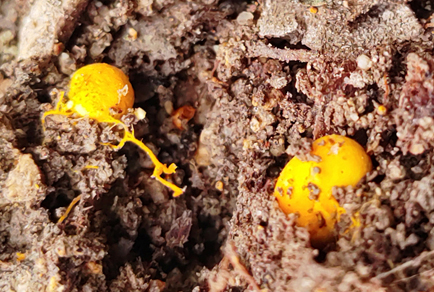

Abstract
Turmalinea flavicarpa sp. nov. (Boletaceae) is described as a new truffle species from Zhejiang Province, East China. Morphological characters of this taxon are elaborated and illustrated. It resembles the Chinese species Turmalinea chrysocarpa in its small, brightly yellow to orange basidiomata, and fusiform basidiospores with longitudinal furcate ornamentations, but differs in context odour, larger basidiospore and basidium sizes, presence of the inner layer of the peridium, and by its distribution in eastern China. Phylogenetic relationships of Turmalinea flavicarpa and other closely related species in genera Rossbeevera and Turmalinea are also analyzed based on three nuclear loci ITS-nLSU-tef-1α, two mitochondrial regions atp6-mtSSU, as well as the ITS region (excluding the minisatellite-like insertion). The novelty of the new species is supported by a combination of morphology and molecular phylogenetic analyses.
References
- Acharya, K., Tarafder, E., Dutta, A.K., Nandi, S., Pradhan, P., Sarkar, J., Paloi, S., Sikder, R. & Roy, A. (2017a) Contribution to the Macromycetes of West Bengal, India: 8–12. Research Journal of Pharmacy and Technology 10 (3): 823–832. https://doi.org/10.5958/0974-360x.2017.00155.x
- Acharya, K., Tarafder, E., Pradhan, P., Dutta, A.K., Paloi, S., Datta, M. & Roy, A. (2017) Contribution to the Macromycetes of West Bengal, India: 18–22. Research Journal of Pharmacy and Technology 10 (9): 3061. https://doi.org/10.5958/0974-360x.2017.00543.1
- Albee-Scott, S.R. (2007) Does secotioid inertia drive the evolution of false-truffles? Mycological Research 111 (9): 1030–1039. https://doi.org/10.1016/j.mycres.2007.08.008
- Benson, G. (1999) Tandem repeats finder: a program to analyze DNA sequences. Nucleic Acids Research 27 (2): 573–580. https://doi.org/10.1093/nar/27.2.573
- Bruns, T.D., Fogel, R., White, T.J. & Palmer, J.D. (1989) Accelerated evolution of a false-truffle from a mushroom ancestor. Nature 339: 140–142. https://doi.org/10.1038/339140a0
- Brunton-Martin, A., Wood, J. & Gaskett, A.C. (2024) Evidence for adaptation of colourful truffle-like fungi for birds in Aotearoa-New Zealand. Scientific Report 14: 18908. https://doi.org/10.1038/s41598-024-67333-x
- Cavanaugh, J.E. & Neath, A.A. (2018) The Akaike information criterion: background, derivation, properties, application, interpretation, and refinements. WIREs Computational Statistics 11 (3): e1640. https://doi.org/10.1002/wics.1460
- Claridge, A.W. & May, T.W. (1994) Mycophagy among Australian mammals. Australian Journal of Ecology 19 (3): 251–275. https://doi.org/10.1111/j.1442-9993.1994.tb00489.x
- Doyle, J.J. & Doyle, J.L. (1987) A rapid DNA isolation procedure for small quantities of fresh leaf tissue. Phytochemical Bulletin 19: 11–15.
- Dutta, A.K., Bera, S., Paloi, S., Rakshit, S., Tarafder, E., Sherpa, A.R. & Acharya, K. (2020) Lepiotaceous fungi of West Bengal, India: the genus Chlorophyllum. Phytotaxa 451 (2): 113–131. https://doi.org/10.11646/phytotaxa.451.2.2
- Fan, L. (2019) Flora fungornm sinicorum. Vol. 54 Lycoperdales (Lycoperdaceae Mycenastraceae). Science Press, Beijing. [In Chinese]
- Fan, L. (2023) Research advances in species diversity and phylogeny of truffle-like fungi in China. Journal of Fungal Research 21 (1–3): 65–81. [In Chinese] https://doi.org/10.13341/j.jfr.2023.1585
- Fan, L., Li, T., Xu, Y.Y. & Yan, X.Y. (2022) Species diversity, phylogeny, endemism and geography of the truffle genus Tuber in China based on morphological and molecular data. Persoonia 48: 175–202. https://doi.org/10.3767/persoonia.2023.48.05
- Feng, B. & Yang, Z.L. (2019) Ectomycorrhizal symbioses: Diversity of mycobionts and molecular mechanisms that entail the development of ectomycorrhizae. Scientia Sinica. Vitae 49 (4): 436–444. https://doi.org/10.1360/N052018-00220
- Guo, F. (2023) Taxonomic studies of hypogeous fungi in the northeastern China forest. Master Dissertation. Jilin Agricultural University, Changchun. [In Chinese] https://doi.org/10.27163/d.cnki.gjlnu.2023.000793
- Guo, L.J., Xu, Y.Y. & Fan, L. (2019) Geopora sinensis, a new truffle species from North China based on morphological and molecular data. Phytotaxa 427 (4): 270–278. https://doi.org/10.11646/phytotaxa.427.4.5
- Hall, T.A. (1999) BioEdit: a user-friendly biological sequence alignment editor and analysis program for Windows 96/98/NT. Nucleic Acids Symposium Series 41: 95–98.
- Hibbett, D.S., Pine, E.M., Langer, E., Langer, G. & Donoghue, M. (1997) Evolution of gilled mushrooms and puffballs inferred from ribosomal DNA sequences. Proceedings of the National Academy of Sciences of the United States of America 94 (22): 12002–12006. https://doi.org/10.1073/pnas.94.22.12002
- Hosen, M.I. & Yang, Z.L. (2021) Kaziboletus, a new boletoid genus of Boletaceae associated with Shorea robusta in Bangladesh. Mycological Progress 20 (9): 1145–1156. https://doi.org/10.1007/s11557-021-01723-7
- Katoh, K. & Standly, D.M. (2013) MAFFT multiple sequence alignment software version 7: improvements in performance and usability. Molecular Biology and Evolution 30 (4): 772–780. https://doi.org/10.1093/molbev/mst010
- Kohler, A., Kuo, A., Nagy, L.G., Morin, E., Barry, K.W., Buscot, F., Canbäck, B., Choi, C., Cichocki, N., Clum, A., Colpaert, J., Copeland, A., Costa, M.D., Doré, J., Floudas, D., Gay, G., Girlanda, M., Henrissat, B., Herrmann, S., Hess, J., Högberg, N., Johansson, T., Khouja, H.R., LaButti, K., Lahrmann, U., Levasseur, A., Lindquist, E.A., Lipzen, A., Marmeisse, R., Martino, E., Murat, C., Ngan, C.Y., Nehls, U., Plett, J.M., Pringle, A., Ohm, R.A., Perotto, S., Peter, M., Riley, R., Rineau, F., Ruytinx, J., Salamov, A., Shah, F., Sun, H., Tarkka, M., Tritt, A., Veneault-Fourrey, C. & Zuccaro, A. (2015) Convergent losses of decay mechanisms and rapid turnover of symbiosis genes in mycorrhizal mutualists. Nature Genetics 47: 410–415. https://doi.org/10.1038/ng.3223
- Kretzer, A.M. & Bruns, T.D. (1999) Use of atp6 in fungal phylogenetics; an example from the Boletales. Molecular Phylogenetics and Evolution 13 (3): 483–492. https://doi.org/10.1006/mpev.1999.0680
- Kuo, M. & Ortiz-Santana, B. (2020) Revision of leccinoid fungi, with emphasis on North American taxa, based on molecular and morphological data. Mycologia 112 (1): 197–211. https://doi.org/10.1080/00275514.2019.1685351
- Laessøe, T. & Hansen, K. (2007) Truffle trouble: what happened to the Tuberales? Mycological Research 111 (9): 1075–1099. https://doi.org/10.1016/j.mycres.2007.08.004
- Larsson, A. (2014) AliView: a fast and lightweight alignment viewer and editor for large data sets. Bioinformatics 30 (22): 3276–3278. https://doi.org/10.1093/bioinformatics/btu531
- Li, T., Chen, M., Xu, Y.Y. & Fan, L. (2019a) Four new species of Hydnobolites (sequestrate Pezizaceae, Ascomycota) from China. Mycological Progress 18: 405–414. https://doi.org/10.1007/s11557-018-01465-z
- Li, T., Huang, K.B., Xu, Y.Y. & Fan, Li. (2019b) Two new species of Pachyphlodes from China. Phytotaxa 411 (2): 105–115. https://doi.org/10.11646/phytotaxa.411.2.2
- Li, T., Fu, H.Y. & Fan, L. (2021) Leucogaster solidus sp. nov. (Albatrellaceae, Russulales) from China. Phytotaxa 508 (1): 85–92. https://doi.org/10.11646/phytotaxa.508.1.8
- Liu, J.W., Wan, S.F., Gong, H.D. & Yu, F.Q. (2020) Pachyphlodes atropurpurea and P. excavata, two new truffle species from Southwest China. Phytotaxa 464 (1): 85–92. https://doi.org/10.11646/phytotaxa.464.1.7
- Liu, T.Z., Yang, X.B, Liu, B., Wualantuya, Wang, K. & Wei, T.Z. (2021) Three new records of Tulostoma from China and supplement to T. striatum. Journal of Fungal Research 19 (3): 148–152. [In Chinese] https://doi.org/10.13341/j.jfr.2021.1424
- Liu, X.L. (2022) Taxonomy of molecular phylogeny of several genera of Hymenogasteraceae in China. PhD Dissertation. Jilin Agricultural University, Changchun. [In Chinese] https://doi.org/10.27163/d.cnki.gjlnu.2022.000006
- Murat, C., Payen, T., Noel, B., Kuo, A., Morin, E., Chen, J., Kohler, A., Krizsán, K., Balestrini, R., Da Silva, C., Montanini, B., Hainaut, M., Levati, E., Barry, K.W., Belfiori, B., Cichocki, N., Clum, A., Dockter, R.B., Fauchery, L., Guy, J., Iotti, M., Le Tacon, F., Lindquist, E.A., Lipzen, A., Malagnac, F., Mello, A., Molinier, V., Miyauchi, S., Poulain, J., Riccioni, C., Rubini, A., Sitrit, Y., Splivallo, R., Traeger, S., Wang, M., Žifčáková, L., Wipf, D., Zambonelli, A., Paolocci, F., Nowrousian, M., Ottonello, S., Baldrian, P., Spatafora, J.W., Henrissat, B., Nagy, L.G., Aury, J.M., Wincker, P., Grigoriev, I.V., Bonfante, P. & Martin, F.M. (2018) Pezizomycetes genomes reveal the molecular basis of ectomycorrhizal truffle lifestyle. Nature Ecology & Evoloution 2 (12): 1956–1965. https://doi.org/10.1038/s41559-018-0710-4
- Nuske, S.J., Anslan, S., Tedersoo, L., Congdon, B.C. & Abell, S.E. (2019) Ectomycorrhizal fungal communities are dominated by mammalian dispersed truffle-like taxa in north-east Australian woodlands. Mycorrhiza 29: 181–193. https://doi.org/10.1007/s00572-019-00886-2
- Nylander, J.A.A. (2004) MrModelTest v2. Program distributed by the author. University of Uppsala, Sweden: Evolutionary Biology Centre.
- Orihara, T., Healy, R., Corrales, A. & Smith, M.E. (2021) Multilocus phylogenies reveal three new truffle-like taxa and the traces of interspecific hybridization in Octaviania (Boletaceae, Boletales). IMA Fungus 12: 14. https://doi.org/10.1186/s43008-021-00066-y
- Orihara, T., Lebel, T., Ge, Z.W., Smith, M.E. & Maekawa, N. (2016) Evolutionary history of the sequestrate genus Rossbeevera (Boletaceae) reveals a new genus Turmalinea and highlights the utility of ITS minisatellite-like insertions for molecular identification. Persoonia 37: 173–198. https://doi.org/10.3767/003158516X691212
- Rambaut, A., Drummond, A.J., Xie, D., Baele, G. & Suchard, M.A. (2018) Posterior summarisation in Bayesian phylogenetics using Tracer 1.7. Systematic Biology 67 (5): 901–904. https://doi.org/10.1093/sysbio/syy032
- Rehner, S.A. & Buckley, E. (2005) A Beauveria phylogeny inferred from nuclear ITS and EF1-a sequences: evidence for cryptic diversification and links to Cordyceps teleomorphs. Mycologia 97 (1): 84–98. https://doi.org/10.3852/mycologia.97.1.84
- Ridgway, R. (1912) Color standards and color nomenclature. Robert Ridgway, Washington, DC, USA, [https://www.gutenberg.org/ebooks/63087] https://doi.org/10.5962/bhl.title.62375
- Ronquist, F., Teslenko, M., van der Mark, P., Ayres, D.L., Darling, A., Höhna, S., Larget, B., Liu, L., Suchard, M.A. & Huelsenbeck, J.P. (2012) MRBAYES 3.2: Efficient Bayesian phylogenetic inference and model selection across a large model space. Systematic Biology 61 (3): 539–542. https://doi.org/10.1093/sysbio/sys029
- Silvestro, D. & Michalak, I. (2012) raxmlGUI: A graphical front-end for RAxML. Organisms Diversity & Evolution 12: 335–337. https://doi.org/10.1007/s13127-011-0056-0
- Stamatakis, A. (2006) RAxML-VI-HPC: maximum likelihood-based phylogenetic analyses with thousands of taxa and mixed models. Bioinformatics 22 (21): 2688–2690. https://doi.org/10.1093/bioinformatics/btl446
- Tarafder, E., Dutta, A.K., Sarkar, J. & Acharya, K. (2018) A new species of Agaricus sect. Brunneopicti from Eastern India. Phytotaxa 374 (2): 139. https://doi.org/10.11646/phytotaxa.374.2.5
- Tarafder, E., Dutta, A.K. & Acharya, K. (2022) New species and new record in Agaricus subg. Minores from India. Turkish Journal of Botany 46 (2): 183–195. https://doi.org/10.55730/1300-008x.2681
- Tarafder, E., Dutta, A.K., Karunarathna, S.C., He, M.Q., Tian, F. & Acharya, K. (2023) Agaricus sect. Xanthodermatei (Agaricales) of West Bengal, India. Phytotaxa 630 (4): 245–265. https://doi.org/10.11646/phytotaxa.630.4.1
- Vaidya, G., Lohman, D.J. & Meier, R. (2011) SequenceMatrix: concatenation software for the fast assembly of multi-gene datasets with character set and codon information. Cladistics 27 (2): 171–180. https://doi.org/10.1111/j.1096-0031.2010.00329.x
- Vilgalys, R. & Hester, M. (1990) Rapid genetic identification and mapping of enzymatically amplified ribosomal DNA from several Cryptococcus species. Journal of Bacteriology 172 (8): 4238–4246. https://doi.org/10.1128/jb.172.8.4238-4246.1990
- Vernes, K. (2007) Are diverse mammal communities important for maintaining plant-fungal associations and ecosystem health? Australasian Plant Conservation 15 (4): 16–18. https://doi.org/10.5962/p.373109
- Wang, F.J., Zhuo, X.Y., Liu, J., Chang, K. & Rao, Y.C. (2020) Entoloma prasmaticum, a new record of the genus Entoloma in China. Journal of Central China Normal University (Nat. Sci.) 54 (5): 857–861. [In Chinese] https://doi.org/10.19603/j.cnki.1000-1190.2020.05.017
- Wang, R., Yu, F.Q., Moreno, J.P. & Colinas, C. (2021) A new edible Rhizopogon species from Southwest China, and its mycorrhizal synthesis with two native pines. Mycorrhiza 31: 85–89. https://doi.org/10.1007/s00572-020-00996-2
- Wang, R., Wan, S.P., Yang, J. & Yu, F.Q. (2022) Choiromyces sichuanensis sp. nov., a new species from southwest China, and its mycorrhizal synthesis with three native conifers. Diversity 14 (10): 837. https://doi.org/10.3390/d14100837
- White, T.J., Bruns, T.D., Lee, S. & Taylor, J. (1990) Amplification and direct sequencing of fungal ribosomal RNA genes for phylogenies. In: Innis, M.A., Gelfand, D.H., Sninsky, J.J. & White, T.J. (Eds.) PCR protocols, a guide to methods and applications. Academic Press, San Diego, CA, USA, pp. 315–322. https://doi.org/10.1016/B978-0-12-372180-8.50042-1
- Wu, L.Q., Xu, J.Y., Zhang, M., Chen, Z.X., Liu, Z.X. & Li, T.H. (2021) Macrofungal diversity in Danxiashan National Nature Reserve. Acta Edulis Fungi 28 (3): 135–146. [In Chinese] https://doi.org/10.16488/j.cnki.1005-9873.2021.03.017
- Xie, D.C., He, S.X., Wang, C.Q., Song, B., Zheng, Y.E. & Zhang, M. (2023) Asperosporus subterraneus, a new record species of China. Chinese Journal of Tropical Crops 44 (5): 931–936. [In Chinese] https://doi.org/10.3969/j.issn.1000-2561.2023.05.008
- Xu, W.J., Qiao, P., Wan, S.P., Gong, H.D. & Yu, F.Q. (2019) New record of Macowanites in China. Journal of West China Forestry Science 48 (3): 137–140. [In Chinese] https://doi.org/10.16473/j.cnki.xblykx1972.2019.03.022
- Xu, Y.Y., Yan, X.Y., Li, T. & Fan, Li. (2020) A taxonomic reassessment of the genus Balsamia from China. MycoKeys 67: 81–94. https://doi.org/10.3897/mycokeys.67.50068
- Yuan, T.J., Raspé, O., Li, Y.J., Wang, L., Su, K.M., Wang, Y., Su, H.Y., Xiong, H.K. & Li, S.H. (2021) Choiromyces cerebriformis (Tuberaceae), a new hypogeous species from Yunnan, China. Phytotaxa 482 (3): 251–261. https://doi.org/10.11646/phytotaxa.482.3.3
- Zhong, X.R., Zhang, L., Zhang, J.B., He, L.R. & Sun, R.X. (2023) Maxent modeling for predicting the potential geographical distribution of Castanopsis carlesii under various climate change scenarios in China. Forests 14 (7): 1397. https://doi.org/10.3390/f14071397