

Abstract
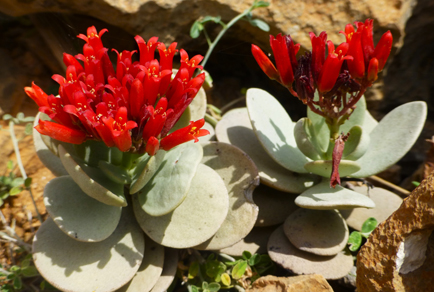
Situated in the Arabian Sea south of Yemen and east of the Gulf of Aden, the Socotra Archipelago has been finally separated from Africa for about 17 to 18 million years. The Archipelago, a UNESCO World Heritage Site, has high levels of biodiversity endemism. The genus Kalanchoe (Crassulaceae [subfam. Cotyledonoideae] tr. Kalanchoeae) is represented in the Socotra Archipelago by three species, two of which, K. farinacea and K. robusta, are included in K. sect. Socotranae, a section in the autonymic K. subg. Kalanchoe. The section is here circumscribed.
References
- Adanson, M. (1763 [July–August]) Familles des plantes. Contenant une Préface Historike fur l’état ancien & actuel de la Botanike, & une Téorie de cette Science. II. Partie. Chez Vincent, Imprimeur-Libraire de Mgr le Comte de Provence, rue S. Severin, Paris, 640 pp. [https://www.biodiversitylibrary.org/item/6958#page/794/mode/1up]
- Al-Okaishi, A. (2021 [1 April]) Exploring the historical distribution of Dracaena cinnabari using ethnobotanical knowledge on Socotra Island, Yemen. Journal of Ethnobiology and Ethnomedicine 17: a22 [14 pp]. https://doi.org/10.1186/s13002-021-00452-1
- Balfour, I.B. filius. (1882) 4. Diagnoses Plantarum novarum et imperfecte descriptarum Phanerogamarum Socotrensium ; quas elaboravit Bayley Balfour, Scientiae Doctor et in Universitate Glascuensi rerum botanicarum regius professor. Pars Prima. [49. Kalanchoe farinacea Balf.f., 50. K. robusta Balf.f; and 51. K. abrupta Balf.f, all on p. 512]. Proceedings of the Royal Society of Edinburgh 11 (110): 498–514. https://doi.org/10.1017/s0370164600047702
- Balfour, I.B. filius. (1888) Botany of Socotra. Transactions of the Royal Society of Edinburgh 31: 1–446. [https://www.biodiversitylibrary.org/item/129313?t=11021#page/15/mode/1up]
- Banfield, L.M., Van Damme, K. & Miller, A.G. (2011 [21 July]) 8. Evolution and biogeography of the flora of the Socotra archipelago (Yemen). In: Bramwell, D. & Caujapé-Castells, J. (Eds.) The biology of island floras. Cambridge University Press, Cambridge, pp. 197–225. https://doi.org/10.1017/CBO9780511844270.009
- Beentje, H. & Williamson, J. [illustrations]. (2010) The Kew plant glossary: an illustrated dictionary of plant terms. Kew Publishing, Royal Botanic Gardens Kew, Richmond, Surrey, 160 pp. https://doi.org/10.2982/0012-8317-97.2.259
- Berger, A. (1930 [Mai]) Crassulaceae. Unterfam. II. Kalanchoideae [sic, Kalanchooideae]. Unterfam. III. Cotyledonoideae. 6. Kalanchoe Adanson. 7. Kitchingia Baker. 8. Bryophyllum Salisb. In: Engler, A. & Prantl, K. (Eds.) Die natürlichen Pflanzenfamilien, edn 2, 18a. Verlag von Wilhelm Engelmann, Leipzig, pp. 378–386, 402–412. https://doi.org/10.1002/ardp.18892271911
- Christophe, A. (2005 [December]) Socotra. The lost island. Cactus & Co. Libri, place of publication not stated [distributed from Venegono Superiore, province of Varese, Italy], 64 pp.
- Culek, M. (2013) Geological and morphological evolution of the Socotra Archipelago (Yemen) from the biogeographical view. Journal of Landscape Ecology 6 (3): 84–108. https://doi.org/10.2478/jlecol-2014-0005
- Descoings, B. (2003) Kalanchoe. In: Eggli, U. (Ed.) Illustrated handbook of succulent plants: Crassulaceae. Springer Verlag, Berlin, Heidelberg, New York, pp. 143–181; whole work 458 pp. + XLVIII plates. https://doi.org/10.1007/978-3-642-55874-0_2
- Dumortier, B.C.J. (1829) Analyse des familles de plantes: avec l’indication des principaux genres qui s’y rattachent. Imprimerie de J. Casterman, Ainé, Tournay, 104 pp. https://doi.org/10.5962/bhl.title.48702
- Figueiredo, E. & Smith, G.F. (2017) Notes on the discovery and type of Kalanchoe rotundifolia (Haw.) Haw. (Crassulaceae). Bradleya 35: 106–112. https://doi.org/10.25223/brad.n35.2017.a9
- Frodin, D.G. (2001) Guide to standard floras of the world: an annotated, geographically arranged systematic bibliography of the principal floras, enumerations, checklists, and chorological atlases of different areas. 2nd Edition. The Press Syndicate of the University of Cambridge, Cambridge University Press, Cambridge, United Kingdom, 1100 [1126] pp. https://doi.org/10.1017/cbo9780511541803
- Hamet, R. (1907 [novembre]) Monographie du genre Kalanchoe. (A suivre. [To be continued]) Bulletin de l’Herbier Boissier 2me sér. 7 (11): 869–900 [also independently numbered (1)–32]. [https://www.biodiversitylibrary.org/item/105267#page/939/mode/1up]
- Hamet, R. (1908 [janvier]) Monographie du genre Kalanchoe (Suite et fin. [Continuation and end], with Errata on p. 17). Bulletin de l’Herbier Boissier 2me sér. 8 (1): 17–48 [also independently numbered (33)–64]. [https://www.biodiversitylibrary.org/item/104945#page/31/mode/1up]
- Hamet, R. (1910 [Séance du 14 Janvier]) Sur quelques Kalanchoe peu connus. (Suite.) [Refinements to Hamet’s two-part monograph of Kalanchoe of 1907 and 1908.] Bulletin de la Société Botanique de France [Tome Cinquante-Septième, Quatrième serie—Tome X] 57: 49–54. https://doi.org/10.1080/00378941.1910.10832165
- Harvey, W.H. (1862) Order LIII. Crassulaceae, D.C. VIII. Kalanchoe, Adans. In: Harvey, W.H. & Sonder, O.W. Flora capensis [being a systematic description of the plants of the Cape Colony, Caffraria, & Port Natal] 2. L. Reeve & Co., Ltd, Kent, pp. 378–380. https://doi.org/10.1017/cbo9781107051232
- Haworth, A.H. (1824 [September]) XXXI. Decas novarum Plantarum Succulentarum. (“Mr Haworth’s Decade of new Succulent Plants.”). The Philosophical Magazine and Journal 64: 184–191. https://doi.org/10.1080/14786442408644582
- Haworth, A.H. (1825 [6 July]) III. Decas quarta novarum Plantarum Succulentarum (“Mr Haworth’s Fourth Decade of new Succulent Plants.”). The Philosophical Magazine and Journal 66: 27–33. https://doi.org/10.1080/14786442508673917
- Hooker, J.D. (1901) Kalanchoe farinacea. Native of Socotra. [Nat. Ord. Crassulaceæ. Genus Kalanchoe, Adans.; (Benth. et Hook.f. Gen. Plant. vol. i. p. 659.)] Curtis’s Botanical Magazine 57 [“LVII of the third series; CXXVII of the whole work”]: t. 7769. [https://www.biodiversitylibrary.org/item/14255#page/70/mode/1up]
- IPNI. (2025+) The International Plant Names Index. Available from: https://www.ipni.org/ (accessed April 2025)
- Jacobsen, H. (1954) Handbuch der sukkulenten Pflanzen. Beschreibung und Kultur der Sukkulenten mit Ausnahme der Cactaceae. Band II. Fockea bis Zygophyllum. [Kalanchoe on pp. 810–861.] VEB Gustav Fischer Verlag, Jena, pp. 615–1124. https://doi.org/10.1086/401293
- Jacobsen, H. (1977) Lexicon of succulent plants. Short descriptions, habitats and synonymy of succulent plants other than Cactaceae. Revised and enlarged 2nd edn. [Kalanchoe on pp. 281–291.] Blandford Press, Poole, Dorset, 682 pp.
- Jacobsen, H. (1986) A handbook of succulent plants. Descriptions, synonyms and cultural details for succulents other than Cactaceae. Vol. II. Ficus to Zygophyllum. [Kalanchoe on pp. 603–633.] Blandford Press, Poole, Dorset, pp. 465–864 of 1380 pp.
- Kilian, N. & Hein, P. (2006) New and noteworthy records for the vascular plant flora of Socotra Island, Yemen. In: Kilian, N. & Hubaishan, M.A. (Eds.) Biodiversity of Socotra: forests, woodlands and bryophytes. [Englera 28.] Botanischer Garten und Botanisches Museum Berlin, Freie Universität Berlin, Berlin-Dahlem, pp. 57–77. https://doi.org/10.2307/20358183
- Kürschner, H., Hein, P., Kilian, N. & Hubaishan, M.A. (2006) Diversity and zonation of the forests and woodlands of the mountains of northern Socotra, Yemen. In: Kilian, N. & Hubaishan, M.A. (Eds.) Biodiversity of Socotra: forests, woodlands and bryophytes. [Englera 28.] Botanischer Garten und Botanisches Museum Berlin, Freie Universität Berlin, Berlin-Dahlem, pp. 11–55. https://doi.org/10.2307/20358182
- Laius, A. (2020) Socotran succulents. CactusWorld 38 (2): 123–130.
- Laius, A. (2021) A few euphorbias in Socotra. Euphorbia World 17 (1): 13–17.
- Lawrence, G.H.M. (1970) Taxonomy of vascular plants. 11th printing. The Macmillan Company, New York and Toronto, Ontario, 823 pp.
- Lemaire, [A.]C. (1852) Genre nouveau de la familie des Crassulacées. Adromischus. Jardin Fleuriste; Journal Général des Progrès et des Intérêts Horticoles et Botaniques. Ghent. [Miscellanées] 2: 58–61. [https://www.biodiversitylibrary.org/item/274797#page/292/mode/1up]
- Linnaeus, C. (1753) Species plantarum, exhibentes plantas rite cognitas, ad genera relatas, cum differentiis specificis, nominibus trivialibus, synonymis selectis, locis natalibus, secundum systema sexuale digestas. Volumes 1 and 2. Salvius, Stockholm, 560 pp. [volume 1] and 1200 pp. [total]; indices not paginated. https://doi.org/10.5962/bhl.title.669
- Little, R.J. & Jones, C.E. (1980) A dictionary of botany. Van Nostrand Reinhold Company Limited, New York, Cincinnati, Toronto, London, & Melbourne, 400 pp.
- Lodé, J. (2010 [January]) Succulent plants of Socotra. A Cactus-Adventures Handbook, place of publication not stated, 58 pp.
- Lodé, J. (2025 [3 October]) A new species of Dracaena in Socotra [D. inexpectata Lodé]. Cactus-Adventures International No 124: 28–37.
- Miller, A.G. (1996 [15 August]) Family 60. Crassulaceae. 4. Kalanchoe Adans. In: Miller, A.G., Cope, T.A. & Nyberg, J.A. Flora of the Arabian Peninsula and Socotra. Vol. 1. Edinburgh University Press in association with the Royal Botanic Garden Edinburgh and the Royal Botanic Gardens, Kew, Edinburgh, pp. 468–476. https://doi.org/10.24823/nrbge.1982.3256
- Raymond-Hamet & Marnier-Lapostolle, J. (1964) Le genre Kalanchoe au Jardin Botanique “Les Cèdres”. Archives du Muséum National d’Histoire Naturelle Septième Série, Tome VIII: 1–110; Plates I–XXXVII. [https://www.biodiversitylibrary.org/item/280857#page/21/mode/1up]
- Rodewald, S.E., Klein, D.-P., Shtein, R., Smith, G.F., Joyce, E., Morales Briones, D.F., Bernhard, S., Letsara, R., Mertes, H., Hühn, P. & Kadereit, G. (2025) A new phylogenetic framework for the genus Kalanchoe (Crassulaceae) and implications for infrageneric classification. Annals of Botany 135 (7): 1311–1328. https://doi.org/10.1093/aob/mcaf004
- Saraf, S. (2021) Preserving the perishing endangered natural biodiversity of Socotra Island. Open Journal of Ecology 11 (2): 148–162. https://doi.org/10.4236/oje.2021.112013
- Small, J.K. (1933) Manual of the southeastern flora, being descriptions of the seed plants growing naturally in Florida, Alabama, Mississippi, Eastern Louisiana, Tennessee, North Carolina, South Carolina and Georgia. [Illustrated.] The University of North Carolina Press, Chapel Hill, 1554 pp. https://doi.org/10.5962/bhl.title.696
- Smith, G.F. (2020a) The kalanchoes (Crassulaceae subfam. Kalanchooideae) of Raymond-Hamet (1890–1972). Bradleya 38: 120–140. https://doi.org/10.25223/brad.n38.2020.a15
- Smith, G.F. (2020b) Typification of the infrageneric names published in Kalanchoe (Crassulaceae subfam. Kalanchooideae) by Alwin Berger. Phytotaxa 453 (1): 52–54. https://doi.org/10.11646/phytotaxa.453.1.6
- Smith, G.F. (2023) A review of the infrageneric classifications proposed for Kalanchoe (Crassulaceae subfam. Kalanchooideae) from the earliest times up to 2000. Phytotaxa 619 (1): 1–38. https://doi.org/10.11646/phytotaxa.619.1.1
- Smith, G.F. (2024a) The unranked infrageneric names validly published in Kalanchoe (Crassulaceae subfam. Kalanchooideae) by Alwin Berger in 1930 revisited, with publication of five names at the rank of section and one at the rank of subgenus. Phytotaxa 635 (4): 276–286. https://doi.org/10.11646/phytotaxa.635.4.2
- Smith, G.F. (2024b) A review and analysis of the infrageneric classifications published or used for Kalanchoe (Crassulaceae subfam. Kalanchooideae) from 2001 to the present, with reference to those published up to 2000. Phytotaxa 635 (4): 245–275. https://doi.org/10.11646/phytotaxa.635.4.1
- Smith, G.F. & Figueiredo, E. (2017) Notes on Kalanchoe rotundifolia (Haw.) Haw. (Crassulaceae) in southern Africa: the taxonomy of a species complex. Haseltonia 23: 57–71. https://doi.org/10.2985/026.023.0109
- Smith, G.F. & Figueiredo, E. (2020) Typification of the name Kalanchoe scapigera (Crassulaceae subfam. Kalanchooideae). Phytotaxa 435 (2): 203–207. https://doi.org/10.11646/phytotaxa.435.2.7
- Smith, G.F., Figueiredo, E. & Van Wyk, A.E. (2019) Kalanchoe (Crassulaceae) in southern Africa. Classification, biology, and cultivation. Academic Press, an imprint of Elsevier, London, San Diego, Cambridge (U.S.A.), and Oxford, 328 pp. https://doi.org/10.1016/B978-0-12-814007-9.00003-7
- Smith, G.F. & Monro, A.M. (2024a) The correct name for the subfamily containing Kalanchoe is Crassulaceae subfam. Cotyledonoideae, and not Crassulaceae subfam. Kalanchooideae, with amendment of the circumscription of Crassulaceae subfam. Cotyledonoideae. Phytotaxa 672 (3): 293–298. https://doi.org/10.11646/phytotaxa.672.3.7
- Smith, G.F. & Monro, A.M. (2024b) “Parting is such sweet sorrow [...]”, or the perils of publishing papers in parts: the case of the nomenclatural novelties published by Raymond Hamet (1890–1972) in his two-part monograph (1907, 1908) of Kalanchoe (Crassulaceae subfam. Kalanchooideae), with special reference to the new names and new combinations treated (but not first published) in part 2. Phytotaxa 645 (2): 149–162. https://doi.org/10.11646/phytotaxa.645.2.4
- Smith, G.F. & Monro, A.M. (2025) A new tribal classification of Crassulaceae subfam. Cotyledonoideae: separating Kalanchoe from Adromischus, Cotyledon, and Tylecodon. Phytotaxa 716 (1): 55–64. https://doi.org/10.11646/phytotaxa.716.1.6
- Smith, G.F., Parihar, B. & Almeida, A.M.R. (2023) A review of growth form and plant duration (life cycle) in Kalanchoe (Crassulaceae subfam. Kalanchooideae) in an evolutionary and classificatory framework. Phytotaxa 592 (3): 217–254. https://doi.org/10.11646/phytotaxa.592.3.3
- Stearn, W.T. (1985) Botanical Latin. History, grammar, syntax, terminology and vocabulary. 3rd revised edition, new impression. David & Charles (Publishers) Limited, Newton Abbot and London (U.K.), North Pomfret, Vermont (Vt), U.S.A., 566 pp.
- Tölken, H.R. (1978) New taxa and new combinations in Cotyledon and allied genera. Bothalia 12 (3): 377–393. https://doi.org/10.4102/abc.v12i3.1794
- Tölken, H.R. (1985) Crassulaceae. 3164, 1. Cotyledon. 3164a, 2. Tylecodon. 3175, 3. Adromischus. 3166, 4. Kalanchoe. 3166a, and 5. Bryophyllum. In: Leistner, O.A. (Ed.) Flora of Southern Africa 14. Botanical Research Institute, Department of Agriculture and Water Supply, place of publication not stated, likely Pretoria, pp. 3–74.
- Turland, N.J., Wiersema, J.H., Barrie, F.R., Gandhi, K.N., Gravendyck, J., Greuter, W., Hawksworth, D.L., Herendeen, P.S., Klopper, R.R., Knapp, S., Kusber, W.-H., Li, D.-Z., May, T.W., Monro, A.M., Prado, J., Price, M.J., Smith, G.F. & Zamora Señoret, J.C. (2025) International Code of Nomenclature for algae, fungi, and plants (Madrid Code). Regnum Vegetabile 162. The University of Chicago Press, Chicago and London, 303 pp. https://doi.org/10.7208/chicago/9780226839479.001.0001
- Van Damme, K. & Banfield, L. (2011) Past and present human impacts on the biodiversity of Socotra Island (Yemen): implications for future conservation. Zoology in the Middle East 54: 31–88. https://doi.org/10.1080/09397140.2011.10648899
- Welwitsch, F.M.J. (1871 [August]) 17. Kalanchoe scapigera Welw., in J. Britten, 4. Kalanchoe Linn., Order L. Crassulaceae. In: Oliver, D. (Ed.) Flora of Tropical Africa (Leguminosae to Ficoideae) 2. L. Reeve & Co., London, pp. 397. [https://www.biodiversitylibrary.org/item/124#page/403/mode/1up]