

Abstract
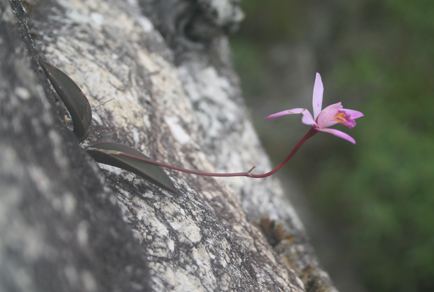
Cattleya ramosii sp. nov. is described here from the campo rupestre vegetation of the Diamantina Plateau, Minas Gerais State, Brazil. The new species is a small rupicolous taxon of Cattleya ser. Parviflorae that is morphologically close to C. haroldoi, C. porphyrascens, and C. vandenbergii. We compiled a multi-categorical dataset from cultivated specimens and quantified dissimilarity using coincidence frequency, followed by Ward clustering and Principal Coordinate Analysis, to validate phenotypic discontinuity among the four taxa. The analyses recovered four coherent clusters consistent with species boundaries, with floral characters most contributing to their separation. The species is currently known from a single locality, where it grows in rock fissures on cliffs; it flowers mainly in October–November. Given its limited distribution, the low number of individuals recorded, and evidence of anthropogenic fires affecting nearby outcrops, C. ramosii is provisionally assessed as Data Deficient (DD). An identification key and comparative notes are provided to facilitate recognition of the new taxon and its similar congeners.
References
- Ackerman, J.D., Phillips, R.D., Tremblay, R.L., Karremans, A., Reiter, N., Peter, C., Bogarin, D., Perez-Escobar, O.A. & Liu, H. (2023) Beyond the various contrivances by which orchids are pollinated: global patterns in orchid pollination biology. Botanical Journal of the Linnean Society 202: 295–324. https://doi.org/10.1093/botlinnean/boac082
- Bentham, G. (1881) Notes on Orchideae. Journal of the Linnean Society, Botany 18: 287.
- Borba, E.L., Shepherd, G.J., van den Berg, C. & Semir, J. (2002) Floral and vegetative morphometrics of five Pleurothallis (Orchidaceae) species: correlation with taxonomy, phylogeny, genetic variability and pollination systems. Annals of Botany 90: 219–230. https://doi.org/10.1093/aob/mcf168
- Caballero-Villalobos, L., Silva-Arias, G.A., Buzatto, C.R., Nervo, M.H. & Singer, R.B. (2017) Generalized food-deceptive pollination in four Cattleya (Orchidaceae: Laeliinae) species from Southern Brazil. Flora 234: 195–206. https://doi.org/10.1016/j.flora.2017.07.014
- Castro, V.P. & Menezes, E.L.F. (2015) Duas novas Orchidaceae do Estado de Minas Gerais. Boletim CAOB 97/98: 28.
- Castro, V.P. & Menezes, E.L.F. (2018) Hoffmannseggella haroldoi. Coletânea de Orquídeas Brasileiras – Novas Espécies 14: 562.
- Chase, M.W., Cameron, K.M., Freudenstein, J.V., Pridgeon, A.M., Salazar, G., van den Berg, C. & Schuiteman, A. (2015) An updated classification of Orchidaceae. Botanical Journal of the Linnean Society 177: 151–174. https://doi.org/10.1111/boj.12234
- Colli-Silva, M., Vasconcelos, T.N.C. & Pirani, J.R. (2019) Outstanding plant endemism levels strongly support the recognition of campo rupestre provinces in mountaintops of eastern South America. Journal of Biogeography 46: 1723–1733. https://doi.org/10.1111/jbi.13585
- Costa, T.R., Silva, L.A., Moura, C.C., Azevedo, C.H.S., Bueno, M.L., Mucida, D.P., Santos, T. & Gonzaga, A.P.D. (2023) Vulnerability of the Cerrado–Atlantic Forest ecotone in the Espinhaço Range Biosphere Reserve to climate change. Theoretical and Applied Climatology 151: 1151–1170. https://doi.org/10.1007/s00704-022-04321-z
- Cozzolino, S. & Widmer, A. (2005) Orchid diversity: an evolutionary consequence of deception? Trends in Ecology & Evolution 20: 487–494. https://doi.org/10.1016/j.tree.2005.06.004
- Cruz-Lustre, G., Batista, J.A.N., Radins, J.A., González, A. & Borba, E.L. (2020) Morphometric analysis of the Habenaria parviflora complex (Orchidaceae). Plant Systematics and Evolution 306: 37. https://doi.org/10.1007/s00606-020-01634-2
- Dressler, R.L. (1993) Phylogeny and Classification of the Orchid Family. Cambridge University Press, Cambridge, 314 pp.
- Fick, S.E. & Hijmans, R.J. (2017) WorldClim 2: new 1-km spatial resolution climate surfaces for global land areas. International Journal of Climatology 37: 4302–4315. https://doi.org/10.1002/JOC.5086
- Fiorini, C., Borba, L., Resende-Moreira, L., Smidt, E. & Knowles, L. (2023) Geographic isolation alone does not explain divergence of a group of orchid species across Brazil's campos rupestres sky-islands. Evolution 77: 946–958. https://doi.org/10.1093/evolut/qpad010
- Fraga, C.N., Borges, R.A.X. & Fontana, A.P. (2008) Notes on Cattleya Lindl. (Orchidaceae) from Brazil. Neodiversity 3: 21–24. https://doi.org/10.13102/neod.32.2
- Gomes, V.M., Assis, I.R., Hobbs, R.J. & Fernandes, G.W. (2021) Glomalin-related soil protein reflects the heterogeneity of substrate and vegetation in the campo rupestre ecosystem. Journal of Soil Science and Plant Nutrition 21: 733–743. https://doi.org/10.1007/s42729-020-00396-7
- IUCN (2024) Guidelines for Using the IUCN Red List Categories and Criteria, version 16. Standards and Petitions Committee, Gland, Switzerland. Available from: https://www.iucnredlist.org/resources/redlistguidelines (accessed 10 December 2025)
- Kobayashi, H. & Arditti, J. (2024) Rostellum in orchids. Lankesteriana 24: 285–318. https://doi.org/10.15517/lank.v24i3.63156
- Köppen, W. & Geiger, R. (1936) Handbuch der Klimatologie in fünf Bänden: Das geographische System der Klimate. Borntraeger-Cramer, Stuttgart, 390 pp. [https://koeppen-geiger.vu-wien.ac.at/pdf/Koppen_1936.pdf]
- Leles, B., Chaves, A., Russo, P., Batista, J. & Lovato, M. (2015) Genetic Structure Is Associated with Phenotypic Divergence in Floral Traits and Reproductive Investment in a High-Altitude Orchid from the Iron Quadrangle, Southeastern Brazil. PLoS ONE 10. https://doi.org/10.1371/journal.pone.0120645
- Lima, A.P., Silva, J.R.S., Siqueira, G.B. & Berg, C.V.D. (2024) Morphometric analyses as a tool for the delimitation of a species complex of rupicolous Cattleya orchids from the Brazilian campos rupestres of Minas Gerais and Bahia. Phytotaxa 672: 64–78. https://doi.org/10.11646/phytotaxa.672.1.4
- Lindley, J. (1824) The Collectanea Botanica; or figures and botanical illustrations of rare and curious exotic plants. Richard & Arthur Taylor for Ridgway, London, 48 pp., t. 33.
- Lindley, J. (1842) Laelia flava. Yellow Laelia. Edwards’s Botanical Register 28: t. 62.
- Loiola, P.P., Morellato, L.P.C., Camargo, M.G.G., Kamimira, V.A., Mattos, J.S., Streher, A.S. & Le Stradic, S. (2023) Shared role of vegetation types, elevation and soil affecting plant diversity in an old-tropical mountain hotspot. Journal of Mountain Science 20: 1842–1853. https://doi.org/10.1007/s11629-022-7838-z
- Machado, E.L.M. & Gonzaga, A.P.D. (2021) Paisagens e vegetação da região do Espinhaço Meridional. Regnellea Scientia 7: 162–186.
- Menezes, E.L.F. (2023) Cattleya porphyrascens, a new species (Laeliinae) of the genus Cattleya is described for Minas Gerais State, Brazil. Phytotaxa 579: 61–66. https://doi.org/10.11646/phytotaxa.579.1.7
- Menezes, E.L.F., Giordani, S.C.O. & Mendes, J.C.R. (2022) Cattleya mireileiana, a new species of Orchidaceae (Laeliinae) from the Southern Espinhaço Complex, Minas Gerais State, Brazil. Phytotaxa 541: 270–276. https://doi.org/10.11646/phytotaxa.541.3.6
- Menezes, E.L.F., Giordani, S.C.O., Pinheiro, R.A. & Gonella, P.M. (2024) Cattleya attenboroughiana (Orchidaceae: Laeliinae): a new species from the Diamantina Plateau, Minas Gerais, Brazil. Kew Bulletin 79: 597–604. https://doi.org/10.1007/s12225-024-10198-0
- Menezes, E.L.F., Giordani, S.C.O., Mendes, J.C.R., Abreu, C.M.D., Spínola-Filho, P.R.D.C. & Viotti, J. (2025) Cattleya ninae, a new species of Orchidaceae (Laeliinae) in the northern Espinhaço region of Minas Gerais, Brazil. Phytotaxa 693: 146–156. https://doi.org/10.11646/phytotaxa.693.2.3
- Mucida, D.P., Gontijo, B.M., Morais, M.S. & Fagundes, M. (2019) A degradação ambiental em narrativas de naturalistas do século XIX para a Reserva da Biosfera da Serra do Espinhaço. Caderno de Geografia 29: 465–495. https://doi.org/10.5752/P.2318-2962.2019v29n57p465-495
- Neves, D.M., Dexter, K.G., Pennington, R.T., Bueno, M.L., Miranda, P.L.S. de & Oliveira-Filho, A.T. (2018) Lack of floristic identity in campos rupestres—A hyperdiverse mosaic of rocky montane savannas in South America. Flora 238: 24–31. https://doi.org/10.1016/j.flora.2017.03.011
- Pabst, G.F.J. (1973) Additamenta Ad Orchideologiam Brasiliensem – XIV. Bradea, Boletim do Herbarium Bradeanum 1: 334.
- Pabst, G.F.J. (1975a) Additamenta Ad Orchideologiam Brasiliensem – XVIII. Bradea, Boletim do Herbarium Bradeanum 2: 24.
- Pabst, G.F.J. (1975b) Additamenta Ad Orchideologiam Brasiliensem – XXIII. Bradea, Boletim do Herbarium Bradeanum 2: 153.
- Peixoto, A.L. & Maia, L.C. (2013) Manual de procedimentos para herbários. Universitária da UFPE (Ed), Recife, 97 pp.
- Pessoa, E.M., Araújo, A.M., Barberena, F.F.V.A., Batista, J.A.N., Benelli, A.P., Bento, J.S.P., Borba, E.L., Camelo-Júnior, A.E., Cantuária, P.C., Cavalcanti, L.W., Cintra, M.C.S., Engels, M., Feitoza, L.H.J., Felix, L.P., Ferreira, A.W.C., Fiorini, C.F., Guimarães, L.R.S., Klein, V.P., Koch, A.K., Koehler, S., Krahl, A.H., Krahl, D.R.P., Leal, B.S.S., Macedo, A., Machado, I.C.S., Mauad, A.V.S.R., Mayer, J.L.S., Meneguzzo, T.E.C., Menini Neto, L., Moraes, A.P., Milet-Pinheiro, P., Nollet, F., Oliveira, E.M., Oliveira, M.S., Pansarin, E.R., Pinheiro, F., Royer, C.A., Santos, I.S., Silva-Pereira, V., Smidt, E.C., Vieira, T.L., Zandoná, L.R., Zavatin, D. & van den Berg, C. (2025) An Overview of Orchidaceae from Brazil: Advances and Shortfalls After 400 Years of Studies. Plants 14: 3520. https://doi.org/10.3390/plants14223520
- Pizzardo, R., Lughadha, E., Rando, J., Forest, F., Nogueira, A., Prochazka, L., Walker, B. & Vasconcelos, T. (2024) An assessment of methods to combine evolutionary history and conservation: A case study in the Brazilian campo rupestre. Applications in Plant Sciences 12: e11587. https://doi.org/10.1002/aps3.11587
- Pramanik, D., Dorst, N., Meesters, N., Spaans, M., Smets, E., Welten, M. & Gravendeel, B. (2020) Evolution and development of three highly specialized floral structures of bee-pollinated Phalaenopsis species. EvoDevo 11: 16. https://doi.org/10.1186/s13227-020-00160-z
- QGIS Software Team (2025) QGIS Geographic Information System, version 3.28. Open-Source Geospatial Foundation Project. Available from: https://qgis.org (accessed 12 December 2025)
- Radford, A.E., Dickison, W.C., Massey, J.R. & Bell, C.R. (1974) Vascular Plant Systematics. Harper & Row, New York, 891 pp.
- Rapini, A., Bitencourt, C., Luebert, F. & Cardoso, D. (2021) An escape-to-radiate model for explaining the high plant diversity and endemism in campos rupestres. Biological Journal of the Linnean Society 133: 481–498. https://doi.org/10.1093/biolinnean/blaa179
- R Core Team (2019) R: A language and environment for statistical computing, version 4.2.1. R Foundation for Statistical Computing, Vienna, Austria. Available from: https://www.R-project.org (accessed 23 December 2025)
- Ruchkys, U.A., Gomes, M., Santos, D.J. & Travassos, L.E.P. (2025) Montanhas de geodiversidade: explorando o Parque Nacional da Serra do Cipó – MG. Instituto Chico Mendes de Conservação da Biodiversidade (ICMBio), Brasília, 56 pp. Available from: https://www.gov.br/icmbio/pt-br/assuntos/centros-de-pesquisa/cavernas/publicacoes/20250127_tcce-ferropuro_cipo_montanhas-de-geodiversidade_web_compressed-1.pdf (accessed 23 December 2025)
- Silveira, F.A.O., Negreiros, D., Barbosa, N.P.U., Buisson, E., Carmo, F.F., Carstensen, D.W., Conceição, A.A., Cornelissen, T.G., Echternacht, L., Fernandes, G.W., Garcia, Q.S., Guerra, T.J., Jacobi, C.M., Lemos-Filho, J.P., Le Stradic, S., Morellato, L.P.C., Neves, F.S., Oliveira, R.S., Schaefer, C.E., Viana, P.L. & Lambers, H. (2016) Ecology and evolution of plant diversity in the endangered campo rupestre: A neglected conservation priority. Plant and Soil 403: 129–152. https://doi.org/10.1007/s11104-015-2637-8
- Schiestl, F.P. & Schlüter, P.M. (2009) Floral Isolation, Specialized Pollination, and Pollinator Behavior in Orchids. Annual Review of Entomology 54: 425–446. https://doi.org/10.1146/annurev.ento.54.110807.090603
- Serviço Geológico do Brasil (SGB/CPRM) & Secretaria de Estado de Meio Ambiente e Desenvolvimento Sustentável (SEMAD) (2018) Geodiversidade – Unidades geológico-ambientais. Infraestrutura de Dados Espaciais do Sistema Estadual de Meio Ambiente e Recursos Hídricos (IDE-Sisema), Belo Horizonte. Available from: https://idesisema.meioambiente.mg.gov.br/geonetwork/srv/por/catalog.search#/metadata/bcb8581b-2017-495d-8ffd-9832191490af (accessed 5 January 2026)
- Smidt, E.C., Silva-Pereira, V. & Borba, E.L. (2006) Reproductive biology of two Cattleya (Orchidaceae) species endemic to north-east Brazil. Plant Species Biology 21: 85–91. https://doi.org/10.1111/j.1442-1984.2006.00154.x
- Thiers, B. (2025) [continuously updated] Index Herbariorum: A global directory of public herbaria and associated staff. New York Botanical Garden’s Virtual Herbarium. Available from: http://sweetgum.nybg.org/science/ih/ (accessed 10 November 2025)
- van den Berg, C. (2014) Reaching a compromise between conflicting nuclear and plastid phylogenetic trees: a new classification for the genus Cattleya (Epidendreae; Epidendroideae; Orchidaceae). Phytotaxa 186: 75–86. https://doi.org/10.11646/phytotaxa.186.2.2
- van den Berg, C. (2018) Nomenclatural Notes on Laeliinae-VII. New combinations in Cattleya for species and nothospecies originally described in Hoffmannseggella (Orchidaceae). Neodiversity 11: 1–4. https://doi.org/10.13102/neod.111.1
- van den Berg, C., Higgins, W.E., Dressler, R.L., Whitten, M.W., Soto Arenas, M.A., Culham, A. & Chase, M.W. (2000) A phylogenetic analysis of Laeliinae (Orchidaceae) based on sequence data from internal transcribed spacers (ITS) of nuclear ribosomal DNA. Lindleyana 15: 96–114.
- van der Pijl, L. & Dodson, C.H. (1966) Orchid flowers: their pollination and evolution. University of Miami Press, Coral Gables.
- Vasconcelos, T.N.C., Alcantara, S., Andrino, C.O., Forest, F., Reginato, M., Simon, M.F. & Pirani, J.R. (2020) Fast diversification through a mosaic of evolutionary histories characterizes the endemic flora of ancient Neotropical mountains. Proceedings of the Royal Society B: Biological Sciences 287: 20192933. https://doi.org/10.1098/rspb.2019.2933
- Zappi, D.C., Moro, M.F., Meagher, T.R. & Nic Lughadha, E. (2017) Plant biodiversity drivers in Brazilian campos rupestres: insights from phylogenetic structure. Frontiers in Plant Science 8: 2141. https://doi.org/10.3389/fpls.2017.02141