
Abstract
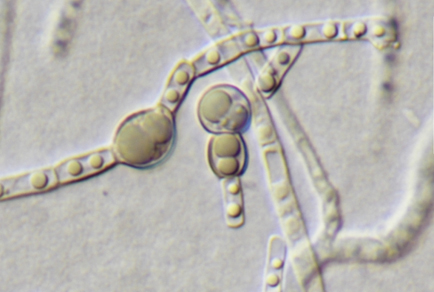
Scytalidium species are widely distributed as pathogens, endophytes, saprobes, and parasites in plant tissues, decaying wood, soil, insect guts, and even on other fungi. During a survey of endophytic fungi associated with Lindera aggregata in Anhui Province, China, a novel species was isolated from healthy roots. It was identified as Scytalidium linderae sp. nov. based on its morphological characteristics and multi-locus phylogenetic analyses of ITS, LSU, SSU, and RPB2 sequences. Scytalidium linderae differs from other species in the genus by having arthroconidia that are oblong with truncate ends; they are hyaline to brownish-yellow and occasionally septate. Its chlamydospores are pyriform, doliiform, globose to subglobose, or oval, pale brown to brown, and occur singly or in chains. Detailed morphological descriptions, illustrations, and a phylogenetic tree are provided to confirm the identification of the new species. This study enhances our understanding of fungal taxonomy and the diversity of Scytalidium species associated with L. aggregata in China.
References
- Awasthi, N., Dubey, A., Bhardwaj, S. & Rai, A. (2021) A new species of Scytalidium Pesante on Diospyros melanoxylon Roxb. from Central India. Kavaka 55: 108–111. https://doi.org/10.36460/Kavaka/55/2020/108-111
- Capella-Gutierrez, S., Silla-Martinez, J.M. & Gabaldon, T. (2009) trimAl: a tool for automated alignment trimming in large-scale phylogenetic analyses. Bioinformatics 25: 1972–1973. https://doi.org/10.10.1093/bioinformatics/btp348
- Cease, K., Blanchette, R. & Highley, T. (1989) Interactions between Scytalidium species and brown-or white-rot basidiomycetes in birch wood. Wood Science and Technology 23: 151–161. https://doi.org/10.1007/BF00350937
- Crous, P.W., Slippers, B., Wingfield, M.J., Rheeder, J., Marasas, W.F., Philips, A.J., Alves, A., Burgess, T., Barber, P. & Groenewald, J.Z. (2006) Phylogenetic lineages in the Botryosphaeriaceae. Studies in Mycology 55: 235–253. https://doi.org/10.3114/sim.55.1.235
- Dalpé, Y., Litten, W. & Sigler, L. (1989) Scytalidium vaccinii sp. nov., an ericoid endophyte of Vaccinium angustifolium roots. Mycotaxon 35: 371–377. https://doi.org/10.5962/p.431353
- de Medeiros, E.V., Notaro, K.d.A., de Barros, J.A., Duda, G.P., Moraes, M.d.C.H.d.S., Ambrósio, M.M.d.Q., Negreiros, A.M.P. & Sales Júnior, R. (2019) Soils from intercropped fields have a higher capacity to suppress black root rot in cassava, caused by Scytalidium lignicola. Journal of Phytopathology 167: 209–217. https://doi.org/10.1111/jph.12788
- Ding, H., Fang, Y.M., Yang, X.H., Yuan, F.Y., He, L.H., Yao, J.F., Wu, J., Chi, B., Li, Y., Chen, S.F., Chen, T.T. & Xu, H.G. (2016) Community characteristics of a subtropical evergreen broad-leaved forest in Huangshan, Anhui Province, East China. Biodiversity Science 24: 875–887. https://doi.org/10.17520/biods.2016108
- El-Elimat, T., Raja, H.A., Figueroa, M., Swanson, S.M., Falkinham III, J.O., Lucas, D.M., Grever, M.R., Wani, M.C., Pearce, C.J. & Oberlies, N.H. (2015) Sorbicillinoid analogs with cytotoxic and selective anti-Aspergillus activities from Scytalidium album. The Journal of antibiotics 68: 191–196. https://doi.org/10.1038/ja.2014.125
- Ellis, M.B. (1971) Dematiaceous Hyphomycetes. Commonwealth Mycological Institute, Kew, Surrey, England, 608 pp.
- Gakuubi, M.M., Munusamy, M., Liang, Z.X. & Ng, S.B. (2021) Fungal endophytes: A promising frontier for discovery of novel bioactive compounds. Journal of fungi 7: 786. https://doi.org/10.3390/jof7100786
- Hsi, H.-Y., Hsiao, G., Wang, S.-W., Huang, S.-J. & Lee, T.-H. (2025) Chemical constituents from marine medicinal brown alga-derived Scytalidium lignicola SC228. Phytochemistry 229: 114289. https://doi.org/10.1016/j.phytochem.2024.114289
- Jeong, Y.-S., Lim, S.-K., Nam, S.-W., Ten, L.N., Lee, S.-Y. & Jung, H.-Y. (2025) Scytalidium terrigenum sp. nov., a new species isolated from soil in Korea. Mycobiology 53: 295–304. https://doi.org/10.1080/12298093.2025.2479241
- Katoh, K., Rozewicki, J. & Yamada, K.D. (2019) MAFFT online service: multiple sequence alignment, interactive sequence choice and visualization. Briefings in Bioinformatics 20: 1160–1166. https://doi.org/10.1093/bib/bbx108
- Kirk, P., Cannon, P., Minter, D. & Stalpers, J. (2008) Dictionary of the fungi. CABI, Wallingford.
- Klingstrom, A. & Beyer, L. (1965) Two new species of Scytalidium with antagonistic properties to Fomes annosus (Fr.) Cke. Svensk Botanisk Tidskrift 59: 30–36.
- Klingstrom, A. & Johansson, S. (1973) Antagonism of Scytalidium isolates against decay fungi. Phytopathology 63: 473–479. https://doi.org/10.1094/phyto-63-473
- Li, D.W., Paine, E. & Schultes, N.P. (2025) A Scytalidium-like indoor fungus revealing polyphyletic relationships and convergent evolution in Scytalidium. Fungal Biology 130: 101691. https://doi.org/10.1016/j.funbio.2025.101691
- Li, Z. & Sun, Y. (1988) A new species of Scytalidium-Scytalidium hepiali. Acta Mycologica Sinica 7: 23–28.
- Lisdayani, L., Anna, N. & Siregar, E.B.M. (2015) Reisolasi Dan Identifikasi Fungi Pada Batang Gaharu (Aquilaria Malaccencis Lamk.) Hasil Inokulasi. Peronema Forestry Science Journal 4: 283–287.
- Lv, Y., Zou, Y., Zhang, X., Liu, B., Peng, X. & Chu, C. (2023) A review on the chemical constituents and pharmacological efficacies of Lindera aggregata (Sims) Kosterm. Frontiers in nutrition 9: 1071276. https://doi.org/10.3389/fnut.2022.1071276
- Manawasinghe, I.S., Hyde, K.D., Wanasinghe, D.N., Karunarathna, S.C., Maharachchikumbura, S.S., Samarakoon, M.C., Voglmayr, H., Pang, K.-L., Chiang, M.W.-L. & Jones, E.G. (2025) Fungal diversity notes 1818–1918: taxonomic and phylogenetic contributions on genera and species of fungi. Fungal Diversity 130: 1–261. https://doi.org/10.1007/s13225-024-00541-y
- Miller, M.A., Pfeiffer, W. & Schwartz, T. (2010) Creating the CIPRES Science Gateway for inference of large phylogenetic trees. In: 2010 gateway computing environments workshop (GCE). New Orleans, LA, pp. 1–8. https://doi.org/10.1109/GCE.2010.5676129
- Morgan-Jones, G., Gintis, B.O. & Rodriguez-Kabana, R. (1984) New species of Chalara and Scytalidium isolated from cysts of Heterodera glycines. Mycologia 76: 211–217. https://doi.org/10.2307/3793097
- Natvig, D.O., Taylor, J.W., Tsang, A., Hutchinson, M.I. & Powell, A.J. (2015) Mycothermus thermophilus gen. et comb. nov., a new home for the itinerant thermophile Scytalidium thermophilum (Torula thermophila). Mycologia 107: 319–327. https://doi.org/10.3852/13-399
- Pavlov, I.Y., Bobrov, K.S., Sumacheva, A.D., Masharsky, A.E., Polev, D.E., Zhurishkina, E.V. & Kulminskaya, A.A. (2018) Scytalidium candidum 3C is a new name for the Geotrichum candidum Link 3C strain. Journal of Basic Microbiology 58: 883–891. https://doi.org/10.1002/jobm.201800066
- Peng, W., He, X., Wang, Y., Zhang, Y., Ye, X., Jia, D., Guo, Y., Gan, B., Zheng, C. & Yang, Z. (2014) A new species of Scytalidium causing slippery scar on cultivated Auricularia polytricha in China. FEMS microbiology letters 359: 72–80. https://doi.org/10.1111/1574-6968.12564
- Pesante, A. (1957) Osservazioni su una carie del platano. Annali della Sperimentazione Agraria 11: 249–266.
- Phillips, A.J.L., Alves, A., Abdollahzadeh, J., Slippers, B., Wingfield, M.J., Groenewald, J.Z. & Crous, P.W. (2013) The Botryosphaeriaceae: genera and species known from culture. Studies in Mycology 76: 51–167. https://doi.org/10.3114/sim0021
- Rambaut, A. & Drummond, A. (2008) FigTree: Tree figure drawing tool (Version 1.2.2). Institute of Evolutionary Biology, University of Edinburgh. [http://tree.bio.ed.ac.uk/software/figtree/]
- Ristiati, N.P., Suryanti, I.A.P., Widiyanti, N.L.P.M., Sudiatmika, A.R. & Utama, A.P. (2019) Characterization of endophyt fungi in bali grapevine (vitis vinifera l. var alphonso lavalle) in Buleleng, Bali. Journal of Physics: Conference Series 1317: 012083. https://doi.org/10.1088/1742-6596/1317/1/012083
- Robinson, S.C., Weber, G., Hinsch, E., Vega Gutierrez, S.M., Pittis, L. & Freitas, S. (2014) Utilizing extracted fungal pigments for wood spalting: A comparison of induced fungal pigmentation to fungal dyeing. Journal of Coatings 2014: 759073. https://doi.org/10.1155/2014/759073
- Rowley, D.C., Kelly, S., Kauffman, C.A., Jensen, P.R. & Fenical, W. (2003) Halovirs A–E, new antiviral agents from a marine-derived fungus of the genus Scytalidium. Bioorganic & medicinal chemistry 11: 4263–4274. https://doi.org/10.1016/S0968-0896(03)00395-X
- Salleh, W. & Hakimi, W.M.N. (2020) Lindera aggregata (Sims) Kosterm: Review on phytochemistry and biological activities. Boletín Latinoamericano y del Caribe de Plantas Medicinales y Aromáticas 19: 527–541. https://doi.org/10.37360/blacpma.20.19.6.37
- Selbmann, L., De Hoog, G., Zucconi, L., Isola, D., Ruisi, S., Van Den Ende, A., Ruibal, C., De Leo, F., Urzì, C. & Onofri, S. (2008) Drought meets acid: three new genera in a dothidealean clade of extremotolerant fungi. Studies in Mycology 61: 1–20. https://doi.org/10.3114/sim.2008.61.01
- Sidhu, A.K., Darade, S.B., Bhavsar, P.P., Gaikwad, V.B. & Patil, S.N. (2017) Isolation, screening and optimization for laccase production by Scytalidium lignicola pesante under submerged fermentation. International Journal of Current Microbiology and Applied Sciences 6: 2477–2491. https://doi.org/10.20546/ijcmas.2017.604.289
- Sigler, L. & Carmichael, J. (1976) Taxonomy of Malbranchea and some other hyphomycetes with arthroconidia. Mycotaxon 4: 349–488. https://doi.org/10.5962/p.417732
- Tan, Y.P., Minns, S.A., Vuong, D., Moraitis, D., Nguyen, X.S. & Lacey, E. (2025) Index of Australian Fungi no. 63. Zenodo, pp. 1–12. Available from: https://zenodo.org (accessed 5 January 2026) https://doi.org/10.5281/zenodo.17336528
- Tao, Y., Deng, Y. & Wang, P. (2024) Traditional uses, phytochemistry, pharmacology, processing methods and quality control of Lindera aggregata (Sims) Kosterm: A critical review. Journal of Ethnopharmacology 318: 116954. https://doi.org/10.1016/j.jep.2023.116954
- Tong, S.-Q., Yang, Y.-F., Li, P., Wu, Y.-J., Sun, B.-D. & Zhang, Z.-Y. (2025) Phylogenetic assessment and taxonomic revision of Scytalidium (Helotiales, Leotiomycetes). IMA Fungus 16: e164608. https://doi.org/10.3897/imafungus.16.164608
- Vaidya, G., Lohman, D.J. & Meier, R. (2011) SequenceMatrix: concatenation software for the fast assembly of multi‐gene datasets with character set and codon information. Cladistics 27: 171–180. https://doi.org/10.1111/j.1096-0031.2010.00329.x
- Van Court, R.C., Rogers, L., Robinson, S.C. & Presley, G. (2023) Wood Coloration and Decay Capabilities of Mycoparasite Scytalidium ganodermophthorum. Journal of Fungi 9: 738. https://doi.org/10.3390/jof9070738
- Venieraki, A., Dimou, M. & Katinakis, P. (2017) Endophytic fungi residing in medicinal plants have the ability to produce the same or similar pharmacologically active secondary metabolites as their hosts. Hellenic Plant Protection Journal 10: 51–66. https://doi.org/10.1515/hppj-2017-0006
- Vilgalys, R. & Hester, M. (1990) Rapid genetic identification and mapping of enzymatically amplified ribosomal DNA from several Cryptococcus species. Journal of bacteriology 172: 4238–4246. https://doi.org/10.1128/jb.172.8.4238-4246.1990
- White, T.J., Bruns, T., Lee, S. & Taylor, J. (1990) Amplification and direct sequencing of fungal ribosomal RNA genes for phylogenetics. PCR protocols a guide to methods and applications 18: 315–322. https://doi.org/10.1016/b978-0-12-372180-8.50042-1
- Wu, Y.-M. & Zhang, T.-Y. (2010) Three new species of Scytalidium from soil. Mycotaxon 114: 205–210. https://doi.org/110.5248/114.205
- Yang, X.Y., Zhang, J.X., Ding, Q.Y., He, Z.C., Zhu, C.Y., Zhang, K.Q. & Niu, X.M. (2020) Metabolites from two dominant thermophilic fungal species Thermomyces lanuginosus and Scytalidium thermophilum. Chemistry & Biodiversity 17: e2000137. https://doi.org/10.1002/cbdv.202000137
- Ye, H.T., Luo, S.Q., Yang, Z.N., Wang, Y.S., Ding, Q., Wang, K.F., Yang, S.X. & Wang, Y. (2021) Endophytic fungi stimulate the concentration of medicinal secondary metabolites in houttuynia cordata thunb. Plant Signaling & Behavior 16: 1929731. https://doi.org/10.1080/15592324.2021.1929731
- Zhang, J.-Y., Chen, M.-L., Boonmee, S., Wang, Y.-X. & Lu, Y.-Z. (2023) Four new endophytic Apiospora species isolated from three Dicranopteris species in Guizhou, China. Journal of Fungi 9: 1096. https://doi.org/10.3390/jof9111096