

Abstract
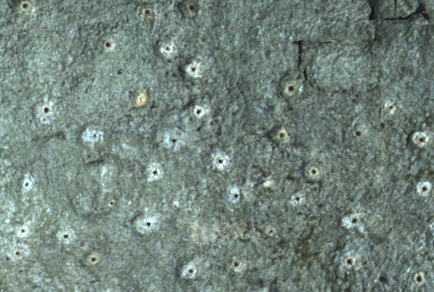
This study describes a new lichenized species, Thelotrema maharashtrense, from the Western Ghats of Maharashtra, India, integrating morphological, chemical, and phylogenetic methods. Thelotrema maharashtrense is characterised by a loosely corticate thallus, prominent apothecia with an only rarely apically free, basally I+ amyloid exciple, 1-spored asci producing large, muriform ascospores, and lack of lichen substances. Analyses based on a concatenated mtSSU, LSU and rpb2 data set placed T. maharashtrense in a well-supported monophyletic clade allied to T. adjectum. This is the first molecular phylogenetic study of Thelotrema from India.
References
- Acharius, E. (1803) Methodus qua omnes detectos lichenes secundum organa carpomorpha ad genera, species et varietates redigere atque observationibus illustrare tentavit. Erik Acharius, Stockholm, 394 pp. https://doi.org/10.5962/bhl.title.79411
- Ansil, P.A., Rajeshkumar, K.C., Lücking, R., Gaikwad, S. & Sharma, B. (2025) Resolving the phylogeny of Diorygma aeolum, along with its photobiont Trentepohlia species from the Western Ghats, India. Studies in Fungi 10 (1): 1–10. https://doi.org/10.48130/sif-0025-0022
- Ansil, P.A., Rajeshkumar, K.C., Lücking, R., Paraparath, S.O. & Sharma, B. (2024) Molecular studies of Allographa effusosoredica sp. nov. (Graphidaceae) along with its Trentepohlia photobiont and a comprehensive checklist for Indian Allographa. Phytotaxa 664 (1): 31–45. https://doi.org/10.11646/phytotaxa.664.1.3
- Ansil, P.A., Rajeshkumar, K.C., Sharma, B., Lücking, R. & Hawksworth, D.L. (2023a) Phylogenetic placement and reappraisal of Diorygma karnatakense including the new synonym Diorygma dandeliense, from Maharashtra, India. The Lichenologist 55 (2): 59–67. https://doi.org/10.1017/S0024282923000087
- Ansil, P.A., Rajeshkumar, K.C., Sruthi, O.P., Gaikwad, S. & Sharma, B. (2023b) Decoding the evolutionary association among lichen symbionts in Dyplolabia afzelii from the Western Ghats, India. Microbial Biosystems 8 (2): 17–24. https://doi.org/10.21608/mb.2023.241013.1084
- Dumortier, B.C.J. (1822) Commentationes botanicae. Tournay, 116 pp.
- Katoh, K., Rozewicki, J. & Yamada, K.D. (2019) MAFFT online service: multiple sequence alignment, interactive sequence choice and visualization. Briefings in Bioinformatics 20 (4): 1160–1166. https://doi.org/10.1093/bib/bbx108
- Kraichak, E., Lücking, R., Aptroot, A., Beck, A., Dornes, P., John, V., Lendemer, J.C., Nelsen, M.P., Neuwirth, G., Nutakki, A., Parnmen, S., Sohrabi, M., Tønsberg, T. & Lumbsch, H.T. (2015) Hidden diversity in the morphologically variable script lichen (Graphis scripta) complex (Ascomycota, Ostropales, Graphidaceae). Organisms Diversity and Evolution 15: 447–458. https://doi.org/10.1007/s13127-015-0219-5
- Kuraku, S., Zmasek, C.M., Nishimura, O. & Katoh, K. (2013) Leaves facilitates on-demand exploration of metazoan gene family trees on MAFFT sequence alignment server with enhanced interactivity. Nucleic Acids Research 41 (W1): W22–W28. https://doi.org/10.1093/nar/gkt389
- Larsson, A. (2014) AliView: a fast and lightweight alignment viewer and editor for large datasets. Bioinformatics 30 (22): 3276–3278. https://doi.org/10.1093/bioinformatics/btu531
- Lumbsch, H.T., Mangold, A., Martín, M.P. & Elix, J.A. (2008) Species recognition and phylogeny of Thelotrema species in Australia (Ostropales, Ascomycota). Australian Systematic Botany 21 (3): 217–227. https://doi.org/10.1071/SB07049
- Mangold, A., Elix, J. & Lumbsch, H.T. (2009) Thelotremataceae. In: Flora of Australia, Vol. 57, Lichens 5. CSIRO Publishing, Melbourne, pp. 195–310.
- Mangold, A., Martin, M.P., Lücking, R. & Lumbsch, H.T. (2008) Molecular phylogeny suggests synonymy of Thelotremataceae within Graphidaceae (Ascomycota: Ostropales). Taxon 57 (2): 476–486.
- Matsumoto, T. (2000) Taxonomic studies of the Thelotremataceae (Graphidales, lichenized Ascomycota) in Japan (1) genus Thelotrema. Journal of the Hattori Botanical Laboratory 88: 1–50. https://doi.org/10.18968/jhbl.88.0_1
- Morgulis, A., Coulouris, G., Raytselis, Y., Madden, T.L., Agarwala, R. & Schäffer, A.A. (2008) Database indexing for production MegaBLAST searches. Bioinformatics 24 (16): 1757–1764. https://doi.org/10.1093/bioinformatics/btn322
- Nylander, J.A.A. (2004) MrModeltest 2.3. Program distributed by the author. Evolutionary Biology Centre, Uppsala University. Available from: http://www.abc.se/~nylander/ (accessed 29 March 2024)
- Nylander, W. (1873) Lichenes insularum Andaman. Bulletin de la Société Linnéenne de Normandie 7: 162–182.
- Nylander, W. (1890) Lichenes Japoniae. Accedunt observationibus lichenes insulae Labuan. Paris, 122 pp.
- Orange, A., James, P.W. & White, F.J. (2001) Microchemical methods for the identification of lichens. British Lichen Society, London, 101 pp.
- Rivas Plata, E., Lücking, R. & Lumbsch, H.T. (2012) A new classification for the family Graphidaceae (Ascomycota: Lecanoromycetes: Ostropales). Fungal Diversity 52 (1): 107–121. https://doi.org/10.1007/s13225-011-0135-8
- Rivas Plata, E., Lücking, R., Sipman, H.J.M., Mangold, A., Kalb, K. & Lumbsch, H.T. (2010) A world-wide key to the thelotremoid Graphidaceae, excluding the Ocellularia—Myriotrema—Stegobolus clade. The Lichenologist 42 (2): 139–185. https://doi.org/10.1017/S0024282909990491
- Rambaut, A. (2014) FigTree. Available from: http://tree.bio.ed.ac.uk/software/figtree/ (accessed 28 October 2025)
- Ronquist, F., Teslenko, M., Van Der Mark, P., Ayres, D.L., Darling, A., Höhna, S., Larget, B., Liu, L., Suchard, M.A. & Huelsenbeck, J.P. (2012) MrBayes 3.2: efficient Bayesian phylogenetic inference and model choice across a large model space. Systematic Biology 61 (3): 539–542. https://doi.org/10.1093/sysbio/sys029
- Sinha, G.P., Nayaka, S. & Mishra, G.K. (2024) A comprehensive checklist of lichens from India—2024. Cryptogam Biodiversity and Assessment 8 (2): 1–34.
- Stamatakis, A. (2006) RAxML-VI-HPC: maximum likelihood-based phylogenetic analyses with thousands of taxa and mixed models. Bioinformatics 22 (21): 2688–2690. https://doi.org/10.1093/bioinformatics/btl446
- Stamatakis, A., Hoover, P. & Rougemont, J. (2008) A rapid bootstrap algorithm for the RAxML web servers. Systematic Biology 57: 758–771. https://doi.org/10.1080/10635150802429642
- Stizenberger, E. (1862) Beitrag zur Flechtensystematik. Bericht über die Thätigkeit der St. Gallischen Naturwissenschaftlichen Gesellschaft 1861–1862: 124–182.
- Trifinopoulos, J., Nguyen, L.T., von Haeseler, A. & Minh, B.Q. (2016) W-IQ-TREE: a fast online phylogenetic tool for maximum likelihood analysis. Nucleic Acids Research 44 (W1): W232–W235. https://doi.org/10.1093/nar/gkw256
- Vilgalys, R. & Hester, M. (1990) Rapid genetic identification and mapping of enzymatically amplified ribosomal DNA from several Cryptococcus species. Journal of Bacteriology 172 (8): 4238–4246. https://doi.org/10.1128/jb.172.8.4238-4246.1990
- Weerakoon, G., Wijeyaratne, S.C., Wolseley, P.A., Rivas Plata, E., Lücking, R. & Lumbsch, H.T. (2012) Six new species of Graphidaceae from Sri Lanka. The Bryologist 115: 74–83. https://doi.org/10.1639/0007-2745-115.1.74
- Zoller, S., Scheidegger, C. & Sperisen, C. (1999) PCR primers for the amplification of mitochondrial small subunit ribosomal DNA of lichen-forming ascomycetes. The Lichenologist 31 (5): 511–516. https://doi.org/10.1006/lich.1999.0220