
Abstract
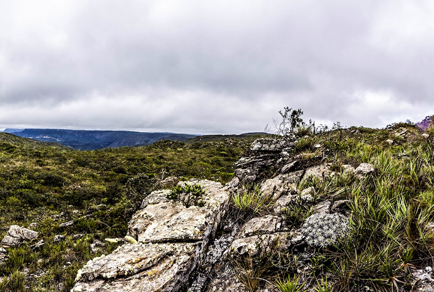
A new species, Encholirium deodorinae, endemic to the Campos Rupestres of the Espinhaço Mountain Range (municipality of Itacambira, Minas Gerais State, Brazil), is described, illustrated, and compared with four morphologically similar species: E. viridicentrum, E. agavoides, E. magalhaesii, and E. irwinii. The new species is distinguished from other species of the genus by a unique combination of characters, including recurved to reflexed leaves, the central ones grayish-green and the older ones turning reddish; inflorescence with subsessile, densely arranged flowers; bicolored sepals (green basally and brown apically); exserted stamens and stigma, the stigma positioned below the anthers; brown floral bracts; a short fertile portion of the inflorescence in relation to the peduncle length (approximately 1:4–9); and floral bracts and sepals frequently bearing dendritic trichomes—an unusual feature in the genus. It differs from E. viridicentrum, the morphologically most similar species, by its shorter fertile portion of the inflorescence and longer peduncle; brown to stramineous floral bracts (vs. green to stramineous); bicolored sepals (green proximally and brown distally vs. uniformly green or green or with light brown apical spot); and the stigma positioned below the anthers at anthesis (vs. above the anthers). According to IUCN criteria, the species is preliminarily assessed as Critically Endangered (CR) due to its extremely narrow endemism and exposure to severe environmental pressures including habitat degradation and climate change impacts.
References
- Baker, J.G. (1889) Handbook of the Bromeliaceae. G. Bell & Sons, London, 264 pp. https://doi.org/10.5962/bhl.title.5168
- BFG (The Brazil Flora Group) (2015) Growing knowledge: an overview of seed plant diversity in Brazil. Rodriguésia 66: 1085–1113. https://doi.org/10.1590/2175-7860201566411
- BFG (The Brazil Flora Group) (2025 [cont. updated]) Flora e Funga. In: Flora e Funga do Brasil. Jardim Botânico do Rio de Janeiro. Available from: http://floradobrasil.jbrj.gov.br/ (accessed 23 October 2025)
- Braun, P.J. & Tank, K.-H. (2021) Xeromorphic Bromeliads from Brazil (VII): Dyckia altoana, a new succulent species from Goiás and two new combinations in Encholirium. Die Bromelie 2021: 100–108.
- Büneker, H.M. (2021) Revisão taxonômica do complexo Dyckia selloa (Bromeliaceae, Pitcairnioideae) baseada em caracteres morfológicos. Master’s dissertation, Instituto de Biociências, Universidade Federal do Rio Grande do Sul, Porto Alegre, 290 pp.
- CRIA (Centro de Referência e Informação Ambiental) (2025 [cont. updated]) speciesLink network. Available from: https://specieslink.net/ (accessed 23 October 2025)
- Forzza, R.C. (2005) Revisão taxonômica de Encholirium Mart. ex Schult. & Schult. f. (Pitcairnioideae – Bromeliaceae). Boletim de Botânica da Universidade de São Paulo 23: 1–49. https://doi.org/10.11606/issn.2316-9052.v23i1p1-49
- Forzza, R.C., Costa, A.F., Maciel, J.R., Kessous, I.M., Monteiro, R.F., Faria, A.P.G., Tardivo, R.C., Büneker, H.M., Saraiva, D.P., Moreira, B.A., Jacques, S.S.A., Almeida, M.M., Santos-Silva, F., Louzada, R.B., Moura, R.L., Couto, D.R., Neves, B., Oliveira, F.M.C., Araújo, C.C., Gonçalves-Oliveira, R.C., Versieux, L.M., Romanini, R.P., Machado, T.M., Silva, R.S.A.d., Paixão Souza, B., Gomes-da-Silva, J., Uribbe, F.P., Guarçoni, E.A.E., Sousa, L.O.F., Pontes, R.A.S., Nogueira, M.G.C., Sousa, G.M., Koch, A.K., Picanço, W.L., Cardoso, P.H., Martins, S.E., Barbosa-Silva, R.G. & Wanderley, M.G.L. (2025 [cont. updated]) Bromeliaceae. In: Flora e Funga do Brasil. Jardim Botânico do Rio de Janeiro. Available from: https://floradobrasil.jbrj.gov.br/FB66 (accessed 23 October 2025)
- Forzza, R.C. & Zappi, D. (2011) Side by side: two remarkable new species of Encholirium Mart. ex Schult. & Schult. f. (Bromeliaceae) found in the Cadeia do Espinhaço, Minas Gerais, Brazil. Kew Bulletin 66: 281–287. https://doi.org/10.1007/s12225-011-9283-y
- Givnish, T.J., Barfuss, M.H., Van Ee, B., Riina, R., Schulte, K., Horres, R., Gonsiska, P.A., Jabaily, R.S., Crayn, D.M., Smith, J.A., Winter, K., Brown, G.K., Evans, T.M., Holst, B.K., Luther, H., Till, W., Zizka, G., Berry, P.E. & Sytsma, K.J. (2011) Phylogeny, adaptive radiation, and historical biogeography in Bromeliaceae: insights from an eight-locus plastid phylogeny. American Journal of Botany 98: 872–895. https://doi.org/10.3732/ajb.1000059
- Gomes-da-Silva, J., Santos-Silva, F. & Forzza, R.C. (2019) Does nomenclatural stability justify para/polyphyletic taxa? A phylogenetic classification in the xeric clade Pitcairnioideae (Bromeliaceae). Systematics and Biodiversity 17: 467–490. https://doi.org/10.1080/14772000.2019.1646834
- Gouda, E.J., Butcher, D. & Dijkgraaf, L. (2025 [cont. updated]) Encyclopaedia of Bromeliads, Version 5. Utrecht University Botanic Gardens. Available from: http://bromeliad.nl/encyclopedia/ (accessed 20 October 2025)
- Guarçoni, E.A.E., Santos-Silva, F. & Forzza, R.C. (2025 [cont. updated]) Dyckia in Flora e Funga do Brasil. Jardim Botânico do Rio de Janeiro. Available from: https://floradobrasil.jbrj.gov.br/FB6046 (accessed 20 October 2025)
- IUCN (2012) IUCN Red List Categories and Criteria, version 3.1, 2nd edition. IUCN Species Survival Commission, Gland, Switzerland and Cambridge, UK. Available from: [www.iucnredlist.org/technical-documents/categories-and-criteria]
- IUCN Standards and Petitions Committee (2024) Guidelines for Using the IUCN Red List Categories and Criteria. Version 16. Prepared by the Standards and Petitions Committee. Available from: [https://www.iucnredlist.org/documents/RedListGuidelines.pdf]
- Jorge, J.S., Rocha, L.H.S., Jorge, J.P.S., Sousa, P.H.P., Santos, R.L. & Freire, E.M.X. (2018) Floral visitors and potential pollinators of a rupicolous bromeliad (Pitcairnioideae) in the Brazilian semiarid. Neotropical Biology and Conservation 13: 101–110. https://doi.org/10.4013/nbc.2018.132.02
- Krapp, F., Pinangé, D.S.B., Benko-Iseppon, A.M., Leme, E.M.C. & Weising, K. (2014) Phylogeny and evolution of Dyckia (Bromeliaceae) inferred from chloroplast and nuclear sequences. Plant Systematics and Evolution 300: 1591–1614. https://doi.org/10.1007/s00606-014-0985-0
- Leme, E.M.C., Souza, E.H.D., Till, W., Barfuss, M.H.J., Filho, J.A.S., Kollmann, L.J., Couto, D.R., Fraga, C.N.D., Fontana, A.P., Farias-Castro, A.S. & Silva, J.B.F.D. (2025) Twenty miscellaneous new species and one new nothogenus and nothospecies in Brazilian Bromeliaceae. Phytotaxa 692: 1–60. https://doi.org/10.11646/phytotaxa.692.1.1
- Leme, E.M.C., Till, W., Kollmann, L.J.C., Moura, R.L. & Ribeiro, O.B.C. (2014) Miscellaneous new species of Brazilian Bromeliaceae–III. Phytotaxa 177: 61–100. https://doi.org/10.11646/phytotaxa.177.2.1
- Martinelli, G. (1994) Reproductive biology of Bromeliaceae in the Atlantic rainforest of Southeastern Brazil. PhD thesis, University of St. Andrews, Scotland.
- Mez, C. (1894) Bromeliaceae—Tribus II. Pitcairniae. In: Martius, C.F.P., Eichler, A.G. & Urban, I. (Eds.) Flora brasiliensis III. Lipsiae apud Fried. Fleischer in Comm., München, pp. 429–510.
- Mez, C. (1896) Bromeliaceae In: Candolle, A.P.P. de & Candolle, A.C.P. de (Eds.) Monographiae phanerogamarum. Masson & Cie., Paris, vol. 9, pp. 1–990.
- Oliveira, L.F.A. (2017) Flora vascular dos campos rupestres: composição florística, esforço amostral e riqueza de espécies. Master’s dissertation, Universidade Federal de Uberlândia, Uberlândia, 187 pp. https://doi.org/10.14393/ufu.di.2019.1326
- Pinangé, D.S.B., Krapp, F., Zizka, G., Silvestro, D., Leme, E.M.C., Weising, K. & Benko-Iseppon, A.M. (2017) Molecular phylogenetics, historical biogeography and character evolution in Dyckia (Bromeliaceae, Pitcairnioideae). Botanical Journal of the Linnean Society 183: 39–56. https://doi.org/10.1111/boj.12489
- Pita, P.B. (1997) Estudo anatômico dos órgãos vegetativos de Dyckia Schultz f. e Encholirium Mart. ex Schultz f. (Bromeliaceae) da Serra do Cipó-MG. Master’s dissertation, Universidade de São Paulo, São Paulo.
- Queiroz, J.A., Quirino, Z.G.M., Lopes, A.V. & Machado, I.C. (2016) Vertebrate mixed pollination system in Encholirium spectabile: a bromeliad pollinated by bats, opossum and hummingbirds in a tropical dry forest. Journal of Arid Environments 125: 21–30. https://doi.org/10.1016/j.jaridenv.2015.09.015
- Rosa, J.G. (1956) Grande Sertão: Veredas. José Olympio, Rio de Janeiro.
- Santos-Silva, F., Saraiva, D.P., Monteiro, R.F., Pita, P., Mantovani, A. & Forzza, R.C. (2013) Invasion of the South American dry diagonal: what can the leaf anatomy of Pitcairnioideae (Bromeliaceae) tell us about it? Flora 208: 508–521. https://doi.org/10.1016/j.flora.2013.08.003
- Schultes, J.A. & Schultes, J.H. (1830) Classis VL, Hexandria. In: Roemer, J.J. & Schultes, J.A. (Eds.) Systema Vegetabilium 7. Cottaem, Stuttgart, pp. 755–1287. https://doi.org/10.5962/bhl.title.825
- Schütz, N., Krapp, F., Wagner, N. & Weising, K. (2016) Phylogenetics of Pitcairnioideae s.s. (Bromeliaceae): Evidence from nuclear and plastid DNA sequence data. Botanical Journal of the Linnean Society 181: 323–342. https://doi.org/10.1111/boj.12403
- Silveira, F.A.O., Negreiros, D., Barbosa, N.P.U., Buisson, E., Carmo, F.F., Carstensen, D.W., Conceição, A.A., Cornelissen, T.G., Echternacht, L., Fernandes, G.W., Garcia, Q.S., Guerra, T.J., Jacobi, C.M., Lemos-Filho, J.P., Le Stradic, S., Morellato, L.P.C., Neves, F.S., Oliveira, R.S., Schaefer, C.E., Viana, P.L. & Lambers, H. (2016) Ecology and evolution of plant diversity in the endangered campo rupestre: a neglected conservation priority. Plant and Soil 403: 129–152. https://doi.org/10.1007/s11104-015-2637-8
- Smith, L.B. (1966) Notes on Bromeliaceae, XXIII. Phytologia 13: 84–161. https://doi.org/10.5962/bhl.part.21846
- Smith, L.B. (1970) Notes on Bromeliaceae, XXX. Phytologia 19: 281–290. https://doi.org/10.5962/bhl.part.14773
- Smith, L.B. & Downs, R.J. (1974) Pitcairnioideae (Bromeliaceae). Flora Neotropica Monograph 14 (1): 1–662.
- Versieux, L.M. & Wendt, T. (2007) Bromeliaceae diversity and conservation in Minas Gerais State, Brazil. Biodiversity and Conservation 16: 2989–3009. https://doi.org/10.1007/s10531-007-9157-7