

Abstract
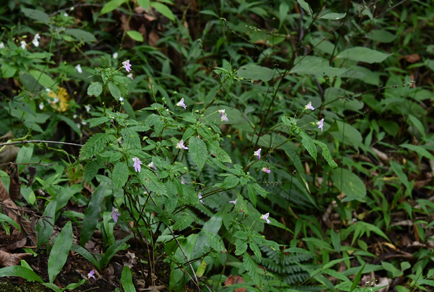
Impatiens zayuensis (Balsaminaceae), from Cibagou National Nature Reserve in southeastern Xizang, China, is described. Based on molecular evidence, I. zayuensis is assigned to I. sect. Racemosae. Morphologically, it is close to I. margaritifera and I. casseabriae in having spurless flowers, but differs in upper stem with glands, ovate lateral sepals, dentate margin of lateral sepals, sub-dolabriform or oblong lower petal, and oblique mouth of lower sepal. Phylogenetically, the new species does not cluster with the other two similar spurless species, indicating that the spurless character may have evolved several times within the I. sect. Racemosae.
References
- Aublet, F. (1775) Histoire des plantes de la Guiane Françoise: rangées suivant la méthode sexuelle, avec plusieurs mémoires sur différens objects intéressans, relatifs à la culture & au commerce de la Guiane Françoise, & une notice des plantes de l’Isle-de-France. P. F. Didot jeune, Londres, 621 pp. https://doi.org/10.5962/bhl.title.674
- Borah, D., Singh, R.K. & Taram, M. (2022) Impatiens pasighatensis (Balsaminaceae), a new species from Arunachal Pradesh, Northeast India. Indian Forester 148 (2): 233–235. https://doi.org/10.36808/if/2022/v148i2/156569
- Chen, Y.L. (2001) Balsaminaceae. In: Chen, Y.L. (Ed.) Flora Reipublicae Popularis Sinica, Vol. 47 (2). Science Press, Beijing, pp. 1–231.
- Chen, Y.L., Akiyama, S. & Ohba, H. (2007) Balsaminaceae. In: Wu, Z.Y., Raven, P.H. & Hong, D.Y. (Eds.) Flora of China, Vol. 12. Science Press, Beijing & Missouri Botanical Garden Press, St. Louis, pp. 43–114.
- Doyle, J.J. & Doyle, J.L. (1987) A rapid DNA isolation procedure for small quantities of fresh leaf tissue. Phytochemical Bulletin 19 (1): 11–15.
- Du, C., Liu, J., Ye, W. & Liao, S. (2024) Annual report on new taxa and nomenclatural changes for Chinese plants. Biodiversity Science 32 (11): 120–132. https://doi.org/10.17520/biods.2024253
- Grey-Wilson, C. (1980) Impatiens of Africa. A.A. Balkema, Rotterdam, 235 pp.
- Guindon, S., Dufayard, J.F., Lefort, V., Anisimova, M., Hordijk, W. & Gascuel, O. (2010) New algorithms and methods to estimate maximum-likelihood phylogenies: assessing the performance of PhyML 3.0. Systematic Biology 59 (3): 307–321. https://doi.org/10.1093/sysbio/syq010
- Handel-Mazzetti, H. (1933) Symbolae Sinicae, Vol. 7. Julius Springer, Vienna, pp. 1–1450.
- Hooker, J.D. (1908) Les espèces du genre Impatiens dans l’herbier du muséum de Paris. Nouvelles Archives du Muséum d’Histoire Naturelle, sér. 4, 10: 233–272.
- Hooker, J.D. (1913) Hooker’s Icones Plantarum, Vol. 30. Dulau & Co., London, tabula 2901–3000.
- Hooker, J.D. & Thomsom, T. (1859) Præcursores ad floram Indicam: Balsamineæ. Botanical Journal of the Linnean Society 4: 106–157. https://doi.org/10.1111/j.1095-8339.1859.tb01160.x
- Huang, S.H., Shui, Y.M. & Chen, W.H. (2004) Correction of “New taxa of Impatiens L. from Yunnan”. Acta Botanica Yunnanica 26 (5): 569–580.
- Jin, J.J., Yu, W.B., Yang, J.B., Song, Y., DePamphilis, C.W., Yi, T.S. & Li, D.Z. (2020) GetOrganelle: a fast and versatile toolkit for accurate de novo assembly of organelle genomes. Genome Biology 21 (1): 241. https://doi.org/10.1186/s13059-020-02154-5
- Janssens, S., Geuten, K., Yuan, Y.M., Küpfer, P. & Smets, E. (2006) Phylogenetics of Impatiens and Hydrocera using plastid atpB-rbcL spacer sequences. Systematic Botany 31 (1): 171–180. https://doi.org/10.1600/036364406775971796
- Katoh, K. & Standley, D.M. (2013) MAFFT multiple sequence alignment software version 7: improvements in performance and usability. Molecular Biology and Evolution 30 (4): 772–780. https://doi.org/10.1093/molbev/mst010
- Larsson, A. (2014) AliView: a fast and lightweight alignment viewer and editor for large datasets. Bioinformatics 30 (12): 3276–3278. https://doi.org/10.1093/bioinformatics/btu531
- Lanfear, R., Calcott, B., Ho, S.Y. & Guindon, S. (2012) PartitionFinder: combined selection of partitioning schemes and substitution models for phylogenetic analyses. Molecular Biology and Evolution 29 (6): 1695–1701. https://doi.org/10.1093/molbev/mss020
- Lanfear, R., Frandsen, P.B., Wright, A.M., Senfeld, T. & Calcott, B. (2017) PartitionFinder 2: new methods for selecting partitioned models of evolution for molecular and morphological phylogenetic analyses. Molecular Biology and Evolution 34 (3): 772–773. https://doi.org/10.1093/molbev/msw260
- Liang, Y.F., Xue, T.T., Gadagkar, S.R., Qin, F., Janssens, S.B. & Yu, S.X. (2025) Phylogenomic conflict analyses of plastid and mitochondrial genomes of Impatiens (Balsaminaceae) reveal its complex evolutionary history. Molecular Phylogenetics and Evolution 206: 108325. https://doi.org/10.1016/j.ympev.2025.108325
- Linnaeus, C. (1753a) Species plantarum 2. Salvius, Stockholm, pp. 561–1200.
- Linnaeus, C. (1753b) Species plantarum 1. Salvius, Stockholm, pp. 1–560.
- Marquand, C.V.B. (1929) The Botanical Collection made by Captain F. Kingdon Ward in the Eastern Himalaya and Tibet in 1924–25. Journal of the Linnean Society. Botany 48: 149–229. https://doi.org/10.1111/j.1095-8339.1929.tb00587.x
- Minh, B.Q., Nguyen, M.A. & von Haeseler, A. (2013) Ultrafast approximation for phylogenetic bootstrap. Molecular Biology and Evolution 30 (5): 1188–1195. https://doi.org/10.1093/molbev/mst024
- Nguyen, L.T., Schmidt, H.A., von Haeseler, A. & Minh, B.Q. (2015) IQ-TREE: a fast and effective stochastic algorithm for estimating maximum-likelihood phylogenies. Molecular Biology and Evolution 32 (1): 268–274. https://doi.org/10.1093/molbev/msu300
- Ronquist, F., Teslenko, M., van der Mark, P., Ayres, D.L., Darling, A., Höhna, S., Larget, B., Liu, L., Suchard, M.A. & Huelsenbeck, J.P. (2012) MrBayes 3.2: efficient Bayesian phylogenetic inference and model choice across a large model space. Systematic Biology 61 (3): 539–542. https://doi.org/10.1093/sysbio/sys029
- Stöver, B.C. & Müller, K.F. (2010) TreeGraph 2: combining and visualizing evidence from different phylogenetic analyses. BMC Bioinformatics 11: 7. https://doi.org/10.1186/1471-2105-11-7
- Thiers, B. (2025, continuously updated) Index Herbariorum: a global directory of public herbaria and associated staff. New York Botanical Garden’s Virtual Herbarium. Available from: http://sweetgum.nybg.org/ih/ (accessed 25 April 2025)
- Tian, J., Yuan, T.H., Peng, S., Yang, Z.Z., Hu, G.W. & Wang, Q.F. (2024) A new species of Impatiens (Balsaminaceae) from Southern Xizang, China with supplementary knowledge on I. leptocarpa Hook. f. Phytotaxa 661 (1): 47–62. https://doi.org/10.11646/phytotaxa.661.1.3
- Wick, R.R., Schultz, M.B., Zobel, J. & Holt, K.E. (2015) Bandage: interactive visualization of de novo genome assemblies. Bioinformatics 31 (20): 3350–3352. https://doi.org/10.1093/bioinformatics/btv383
- Wight, R. & Walker-Arnott, G.A. (1834) Prodromus Florae Peninsulae Indiae Orientalis: containing abridged descriptions of the plants found in the peninsula of British India, arranged according to the natural system 1. Parbury, Allen & Co., London, 480 pp. https://doi.org/10.5962/bhl.title.252
- Yang, B., Zhou, S.S., Maung, K.W. & Tan, Y.H. (2017) Two new species of Impatiens (Balsaminaceae) from Putao, Kachin State, northern Myanmar. Phytotaxa 321 (1): 103–113. https://doi.org/10.11646/phytotaxa.321.1.4
- Yu, S.X. (2012) Balsaminaceae of China. Peking University press, Beijing, 215 pp.
- Yu, S.X., Janssens, S.B., Zhu, X.Y., Lidén, M., Gao, T.G. & Wang, W. (2016) Phylogeny of Impatiens (Balsaminaceae): integrating molecular and morphological evidence into a new classification. Cladistics 32 (2): 179–197. https://doi.org/10.1111/cla.12119
- Yuan, T.H., Li, M.J., Ren, L.Y., Huang, R.X., Chen, Y. & Bai, X.X. (2022) A dataset on the diversity and geographical distributions of wild Impatiens in China. Biodiversity Science 30: 22019. https://doi.org/10.17520/biods.2022019
- Yuan, Y.M., Song, Y., Geuten, K., Rahelivololona, E., Wohlhauser, S., Fischer, E., Smets, E. & Küpferr, P. (2004) Phylogeny and biogeography of Balsaminaceae inferred from ITS sequences. Taxon 53 (2): 391–403. https://doi.org/10.2307/4135617
- Zhang, D., Gao, F., Jakovlić, I., Zou, H., Zhang, J., Li, W.X. & Wang, G.T. (2020) PhyloSuite: an integrated and scalable desktop platform for streamlined molecular sequence data management and evolutionary phylogenetics studies. Molecular Ecology Resources 20 (1): 348–355. https://doi.org/10.1111/1755-0998.13096