
Abstract
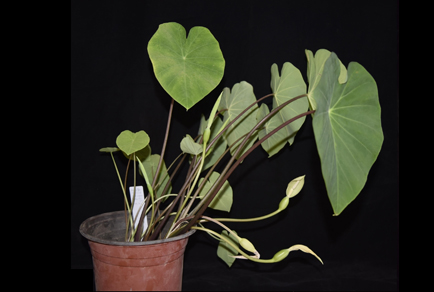
The Alocasia–Colocasia group (Araceae) has an intricate taxonomic history, with traditional generic circumscriptions of the two major genera, Alocasia and Colocasia, being challenged by phylogenetic evidence. Current phylogenetic and morphological evidence together confirm that the two lineages—Alocasia evrardii-A. vietnamensis and Colocasia affinis-C. fallax—are distinct and coherent groups whose current generic placements in the tribe Colocasieae stand in contrast to the established classification. We here formally describe two new genera to accommodate this situation: Vandua and Cryptocasia. Vandua is characterised by its tuberous, epiphytic or lithophytic habit; production of bulbiliferous stolons; a pistillate zone flanked by two clusters of pistillodes, with the basal cluster specialised into a basal sterile zone; absence of interspersed staminodes; ovaries with 4–5 ovules in parietal placentation; and single-seeded berries. Cryptocasia differs from Colocasia sensu stricto by its small plant size, the presence of a basal sterile zone, and a pistillate zone lacking interspersed staminodes. Recognition of these genera resolves long-standing inconsistencies between phylogenetic and morphological evidence, providing a preliminary circumscription of Alocasia and Colocasia and a firmer basis for establishing a natural systematic framework for the tribe.
References
- Bogner, J. & Nicolson, D.H. (1991) A revised classification of Araceae with dichotomous keys. Willdenowia 21: 35–50.
- Borowiec, M.L. (2016) AMAS: a fast tool for alignment manipulation and computing of summary statistics. PeerJ 4: e1660. https://doi.org/10.7717/peerj.1660
- Boyce, P.C. & Sookchaloem, D. (2012) Araceae–Colocasia. In: Smitinand, T. & Larsen, K. (Eds.) Flora of Thailand. Vol. 11, Part 2. The Forest Herbarium, Bangkok, pp. 112–118.
- Boyce, P.C., Croat, T.B. & Hay, A. (2025) The Überlist of Araceae: Totals for published and estimated number of species in aroid genera. Published on the Internet. Available from: https://www.aroid.org/ueberlist/ (accessed 6 November 2025)
- Buchet, S. (1939) Un nouveau genre malgache d'Aracées. Bulletin de la Société Botanique de France 86: 23–24. https://doi.org/10.1080/00378941.1939.10834145
- Cabrera, L.I., Salazar, G.A., Chase, M.W., Mayo, S.J., Bogner, J. & Dávila, P. (2008) Phylogenetic relationships of aroids and duckweeds (Araceae) inferred from coding and noncoding plastid DNA. American Journal of Botany 95: 1153–1165. https://doi.org/10.3732/ajb.0800073
- Cai, X.Z., Long, C.L. & Liu, K.M. (2006) Colocasia yunnanensis (Araceae), a new species from Yunnan, China. Annales Botanici Fennici 43: 139–142.
- Cao, L.M. & Long, C.L. (2003) Colocasia bicolor (Araceae), a new species from Yunnan, China. Annales Botanici Fennici 40: 283–286.
- Capella-Gutiérrez, S., Silla-Martínez, J.M. & Gabaldón, T. (2009) TrimAl: A tool for automated alignment trimming in large-scale phylogenetic analyses. Bioinformatics 25: 1972–1973. https://doi.org/10.1093/bioinformatics/btp348
- Croat, T.B. & Ortiz, O.O. (2020) Distribution of Araceae and the diversity of life forms. Acta Societatis Botanicorum Poloniae 89: 1–23. https://doi.org/10.5586/asbp.8939
- Croat, T.B. (1990) Ecology and life forms of Araceae. Aroideana 11: 1–55.
- Cusimano, N., Bogner, J., Mayo, S.J., Boyce, P.C., Wong, S.Y., Hesse, M., Hetterscheid, W.L.A., Keating, R.C. & French, J.C. (2011) Relationships within the Araceae: Comparison of morphological patterns with molecular phylogenies. American Journal of Botany 98: 654–668. https://doi.org/10.3732/ajb.1000158
- Don, D. (1825) Prodromus florae Nepalensis : sive Enumeratio vegetabilium quae in itinere per Nepaliam proprie dictam et regiones conterminas, ann. 1802–1803. Detexit atque legit d. d. Franciscus Hamilton, (olim Buchanan) Accedunt plantae a. d. Wallich nuperius missae. Veneunt Apud J. Gale, Bruton-Street, London, 256 pp. https://doi.org/10.5962/bhl.title.86
- Don, G. (1839) Sweet's Hortus Britannicus: or, a catalogue of all the plants indigenous or cultivated in the gardens of Great Britain, arranged according to the natural system / by Robert Sweet. 3d. ed., greatly enl. and improved. James Ridgeway, London.
- Engler, A. & Krause, K. (1920) Araceae–Colocasioideae. Das Pflanzenreich 70–71 [IV.23 E]: 1–139.
- Engler, A. (1876) Vergleichende Untersuchungen über die morphologischen Verhältnisse der Araceae. I. Theil. Natürliches System der Araceae. Nova acta Academiae Caesareae Leopoldino-Carolinae Germanicae Naturae Curiosorum 39: 133–155.
- Engler, A. (1877) Vergleichende Untersuchungen über die morphologischen Verhältnisse der Araceae. Nova acta Academiae Caesareae Leopoldino-Carolinae Germanicae Naturae Curiosorum 39: 157–232.
- Engler, A. (1879) LXVI. Colocasia. In: de Candolle, A. & de Candolle, C. (Eds.) Monographiae Phanerogamarum. Vol. 2. Sumptibus G. Masson, Paris, pp. 490–495.
- Engler, A. (1898) Beiträge zur Kenntnis der Araceae. VII. Botanische Jahrbücher für Systematik, Pflanzengeschichte und Pflanzengeographie 25: 1–28.
- French, J.C., Chung, M.G. & Hur, Y.K. (1995) Chloroplast DNA phylogeny of Ariflorae. In: Rudall, P.J., Cribb, P.J., Cutler, D.F. & Humphries, C.J. (Eds.) Monocotyledons: Systematics and Evolution. Royal Botanic Gardens, Kew, London, pp. 255–275.
- Gagnepain, F. (1941) Aracées Nouvelles Indochinoises. Notulae Systematicae 9: 116–140.
- Gagnepain, F. (1942) Aracées. In: Gagnepain, F. (Ed.) Flore générale de l’Indo-Chine 6. Masson et Cie, Paris, pp. 1075–1196.
- Gogoi, R. & Borah, S. (2013) Two new species and a new record for Colocasia (Araceae: Colocasieae) from Arunachal Pradesh, Northeast India. Gardens’ Bulletin Singapore 65: 27–37.
- Graham, J. (1839) A catalogue of the plants growing in Bombay and its vicinity, spontaneous, cultivated or introduced, as far as they have been ascertained. The Government Press, Bombay. https://doi.org/10.5962/bhl.title.45206
- Haigh, A.L., Gibernau, M., Maurin, O., Bailey, P., Carlsen, M.M., Hay, A., Leempoel, K., McGinnie, C., Mayo, S., Morris, S., Pérez-Escobar, O.A., Wong, S.Y., Zuluaga, A., Zuntini, A.R., Baker, W.J. & Forest, F. (2023) Target sequence data shed new light on the infrafamilial classification of Araceae. American Journal of Botany 110: e16117. https://doi.org/10.1093/molbev/msx281
- Hay, A. & Prameswara. (2023) Alocasia tandurusa Prameswara & A.Hay, a new (bi)pinnatifid‑leaved species from Sulawesi (Araceae, tribe Alocasieae (Schott) A.Hay), with notes on tribal classification for the paraphyletic grade of ‘Old World Colocasioids’. Aroideana 46: 388–405.
- Hay, A. & Wise, R. (1991) The genus Alocasia (Araceae) in Australasia. Blumea 35: 499–545.
- Hay, A. (1996) A new Bornean species of Colocasia Schott (Araceae: Colocasieae), with a synopsis of the genus in Malesia and Australia. Sandakania 7: 31–48.
- Hay, A., Boyce, P.C. & Hein, K.Z. (2022) On the identity of Arum montanum Roxb. and Alocasia gageana Engl. & K.Krause—two earlier names pertaining to Englerarum Nauheimer & P.C.Boyce (Araceae). Aroideana 45: 138–147.
- Hoang, D.T., Chernomor, O., von Haeseler, A., Minh, B.Q. & Vinh, L.S. (2018) UFBoot2: Improving the ultrafast bootstrap approximation. Molecular Biology and Evolution 35: 518–522. https://doi.org/10.1002/ajb2.16117
- Hooker, J.D. (1894) The flora of British India. Vol. 6. L. Reeve & Co., London, 792 pp.
- Hu, S.Y. (1968) 41. Araceae (Studies in the flora of Thailand 41–48). Dansk Botanisk Arkiv Udgivet af Dansk Botanisk Forening 23: 411–457.
- Huang, C.-T. (2015) Paraphyly study of Remusatia vivipara (Roxb.) Schott (Araceae) by morphology, molecular and bulbil development traits. Doctoral dissertation, National Taiwan University, Taipei.
- Kalyaanamoorthy, S., Minh, B.Q., Wong, T.K., Von Haeseler, A. & Jermiin, L.S. (2017) ModelFinder: fast model selection for accurate phylogenetic estimates. Nature Methods 14: 587–589. https://doi.org/10.1038/nmeth.4285
- Katoh, K. & Standley, D.M. (2013) MAFFT multiple sequence alignment software version 7: Improvements in performance and usability. Molecular Biology and Evolution 30: 772–780. https://doi.org/10.1093/molbev/mst010
- Koch, C. (1862) Steudnera colocasiaefolia C. Koch, eine neue Aroidee. Wochenschrift des Vereines zur Beförderung des Gartenbaues in den Königlich Preussischen Staaten für Gärtnerei und Pflanzenkunde 5: 114–116.
- Lemaire, C. (1869) Planche 585. Alocasia jenningsii. L'Illustration Horticole 16: 585.
- Li, H. & Boyce, P.C. (2010) Colocasia. In: Wu, C.-Y. & Raven, P.H. (Eds.) Flora of China. Vol. 23. Science Press & Missouri Botanical Garden Press, Beijing & St. Louis, pp. 73–75.
- Li, H. & Hay, A. (1992) Note on the classification of genera Remusatia and Gonatanthus in Araceae. Acta Botanica Yunnanica Supplement V: 27–33.
- Li, H. & Wei, Z.-X. (1993) Colocasia heterochroma, a new species of Colocasia from Araceae. Acta Botanica Yunnanica 15: 16–17.
- Li, H. (1979a) Colocasia. In: Institute of Botany, Chinese Academy of Sciences (Ed.) Flora Yunnanica. Vol. 2. Science Press, Beijing, pp. 775–780.
- Li, H. (1979b) Colocasia. In: Wu, C.-Y. & Li, H. (Eds.) Flora Reipublicae Popularis Sinicae. Vol. 13 (2). Science Press, Beijing, pp. 67–74.
- Li, H. (1987) Colocasia fallax and C. affinis. In: Chinese Academy of Sciences Qinghai–Tibet Plateau Comprehensive Scientific Expedition Team (Ed.) Flora Xizangica. Vol. 5. Science Press, Beijing.
- Li, H. (1992) Formation of distribution area of Remusatia (Araceae) and its disjunction. Acta Botanica Yunnanica 14: 317–322.
- Li, H. & Long, C.-L. (1999) A new species of (Araceae) from Mts. Gaoligong, China. Feddes Repertorium 110: 423–424. https://doi.org/10.1002/fedr.19991100513
- Li, R., Yi, T. & Li, H. (2012) Is Remusatia (Araceae) monophyletic? Evidence from three plastid regions. International Journal of Molecular Sciences 13: 71–83. https://doi.org/10.3390/ijms13010071
- Link, J.H.F., Klotzsch, J.F. & Otto, C.F. (1841) Icones Plantarum Rariorum Horti Regii Botanici Berolinensis. Vol. 1. Verlag von Veit und Comp., Berlin, 123 pp.
- Linnaeus, C. (1753) Species plantarum : exhibentes plantas rite cognitas ad genera relatas, cum diferentiis specificis, nominibus trivialibus, synonymis selectis, locis natalibus, secundum systema sexuale digestas. Vol. 2. Laurentii Salvii, Homiae.
- Long, C.L. & Liu, K.M. (2001) Colocasia lihengiae (Araceae: Colocasieae), a new species from Yunnan, China. Botanical Bulletin of Academia Sinica 42: 313–317.
- Lý, N.-S., Wong, S.Y., Haevenmans, T., Nguyen, V.D. & Boyce, P.C. (2017) Vietnamocasia, a new genus from Central Vietnam belonging to the Alocasia–Colocasia clade (Araceae). Phytotaxa 303: 253–263. https://doi.org/10.11646/phytotaxa.303.3.5
- Ma, Z. (2025) Schismatoglottis lihengiana (Araceae: Schismatoglottideae), a remarkable new species from the Sino-Vietnamese border. Aroideana 48: 152–162.
- Matthews, P.J., Nguyen, V.D., Fang, Q. & Long, C.-L. (2022) Colocasia spongifolia sp. nov. (Araceae) in southern China and central Vietnam. Phytotaxa 541: 1–15. https://doi.org/10.11646/phytotaxa.541.1.1
- Mayo, S.J., Bogner, J. & Boyce, P.C. (1997) The Genera of Araceae. Royal Botanic Gardens, Kew, 370 pp.
- Minh, B.Q., Schmidt, H.A., Chernomor, O., Schrempf, D., Woodhams, M.D., von Haeseler, A. & Lanfear, R. (2020) IQ-TREE 2: New models and efficient methods for phylogenetic inference in the genomic era. Molecular Biology and Evolution 37: 1530–1534. https://doi.org/10.1093/molbev/msaa015
- Nauheimer, L. & Boyce, P.C. (2014) Englerarum (Araceae, Aroideae): A new genus supported by plastid and nuclear phylogenies. Plant Systematics and Evolution 300: 709–715. https://doi.org/10.1007/s00606-013-0914-7
- Nauheimer, L., Boyce, P.C. & Renner, S.S. (2012b) Giant taro and its relatives: A phylogeny of the large genus Alocasia (Araceae) sheds light on Miocene floristic exchange in the Malesian region. Molecular Phylogenetics and Evolution 63: 43–51. https://doi.org/10.1016/j.ympev.2011.12.011
- Nauheimer, L., Metzler, D. & Renner, S.S. (2012a) Global history of the ancient monocot family Araceae inferred with models accounting for past continental positions and previous ranges based on fossils. New Phytologist 195: 938–950. https://doi.org/10.1111/j.1469-8137.2012.04220.x
- Nguyen, V.D. (2017) Alocasia–Colocasia. In: Nguyen, V.T., La, D.N., Vu, X.P., Duong, D.H. & Nguyen, K.K. (Eds.) Flora of Vietnam. Vol. 16. Science & Technics Publishing House, Hanoi, pp. 168–191.
- Nguyen, V.D., Croat, T.B., Luu, H.T., Lee, C.Y., Lee, J. & De Kok, R. (2013) Two new species of Alocasia (Araceae, Colocasieae) from Vietnam. Willdenowia 43 (2): 293–299. https://doi.org/10.3372/wi.43.43209
- Noltie, H.J. (1994) Flora of Bhutan, including a record of plants from Sikkim and Darjeeling. Vol. 3 [1]. Royal Botanic Garden Edinburgh, Edinburgh.
- Prain, D. (1903) Bengal Plants: a list of the phanerogams, ferns and fern-allies indigenous to, or commonly cultivated in, the Lower provinces and Chittagong, with definitions of the natural orders and genera, and keys to the genera and species.Calcutta, India. Vol. 2. Botanical Survey of India, Calcutta. https://doi.org/10.5962/bhl.title.50150
- Promprom, W., Munglue, P., Pasorn, P., Lanorsavanh, S. & Chatan, W. (2026) Colocasia sookchaloemiae (Araceae), a new species from northeastern Thailand. PhytoKeys 269: 131–140. https://doi.org/10.3897/phytokeys.269.175203
- Renner, S.S. & Zhang, L.B. (2004) Biogeography of the Pistia clade (Araceae): based on chloroplast and mitochondrial DNA sequences and Bayesian divergence time inference. Systematic Biology 53: 422–432. https://doi.org/10.1080/10635150490445904
- Roxburgh, W. (1814) Hortus Bengalensis, or a Catalogue of the Plants Growing in the Honourable East India Company's Botanical Garden at Calcutta. The Mission Press, Serampore, 434 pp.
- Roxburgh, W. (1832) Flora Indica, or, Descriptions of Indian plants. Vol. 3. W. Thacker & Co., Calcutta. https://doi.org/10.5962/bhl.title.590
- Sasikala, K., Vajravelu, E. & Daniel, P. (2019) Colocasia. In: Nair, V.J. & Singh, P. (Eds.) Fascicles of flora of India: Fascicle 29. Araceae. Botanical Survey of India, pp. 163–176.
- Sasikala, K., Vajravelu, E. & Daniel, P. (2024) Araceae–Colocasia. In: Sharief, M.U., Hameed, S.S., Vivek, C.P., Gogoi, R. & Mao, A.A. (Eds.) Flora of India. Vol. 28. Botanical Survey of India, Calcutta, pp. 82–87.
- Schott, H.W. (1832) Classis Aroideae. In: Schott, H. & Endlicher, S. (Eds.) Meletemata Botanica. Vindobonae, Vienna, pp. 15–22. https://doi.org/10.5962/bhl.title.40101
- Schott, H.W. (1856) Synopsis Aroidearum. Vindobonae, Vienna, pp. 43. https://doi.org/10.5962/bhl.title.118535
- Schott, H.W. (1857b) Botanische Notiz. Oesterreichisches Botanisches Wochenblatt 7: 133–134. https://doi.org/10.1007/BF02059950
- Schott, H.W. (1857a) Leucocasia, eine Gattung der Colocasinae. Oesterreichisches Botanisches Wochenblatt 7: 33–35. https://doi.org/10.1007/BF02058968
- Schott, H.W. (1858) Genera Aroidearum Exposita. Vindobonae, Vienna. https://doi.org/10.5962/bhl.title.42216
- Schott, H.W. (1859) Aroideenskizzen. Bonplandia 7: 26–31.
- Schott, H.W. (1860) Colocasia. In: Prodromus systematis Aroidearum. Mechitarist Congregation, Vienna, pp. 137–140.
- Schott, H.W. (1862) Aroideologisches. Bonplandia 10: 148.
- Schott, H.W. (1983) Colocasia affinis & C. fallax. Icones Aroideae et Reliquiae, Microfiche 74: R432, R453, 1685, and 1722–1724.
- Schott, H.W., Nicolson, D.H. & Riedl, H. (1984) Icones aroideae et reliquiae: Alphabetical index. Inter Documentation Co. AG, pp. 1–29.
- Veitch, J.G. (1869) Plant portraits: Alocasia jenningsii. The Gardeners' Chronicle and Agricultural Gazette 1869: 136.
- Wang, Y.H., Yin, J.T. & Xu, Z.F. (2005) Alocasia hypnosa (Araceae), a new species from Yunnan, China. Annales Botanici Fennici 42: 395–398.
- Yin, J.T. (2006) Colocasia tibetensis (Araceae, Colocasieae), a new species from southeast Tibet, China. Annales Botanici Fennici 43: 53–56.
- Yin, J.-T., Huang, J.-P. & Xiao, W.-Q. (2024) Colocasia xui (Araceae), a new species from Xizang, China. In: Son, L. (Ed.) Contemporary Research and Perspectives in Biological Science. Vol. 2. BP International, Kolkata, pp. 165–172. https://doi.org/10.9734/bpi/crpbs/v2/2369
- Zhou, S.-S., Quan, R.-C., Li, R., Liu, Q. & Yin, J.-T. (2020) Colocasia kachinensis, a new species of Araceae from Myanmar. In: Jin, X.-H., Xia, N.-H. & Tan, Y.-H. (Eds.) Plant Diversity of Southeast Asia—II. PhytoKeys 138: 41–47. https://doi.org/10.3897/phytokeys.138.36769