

Abstract
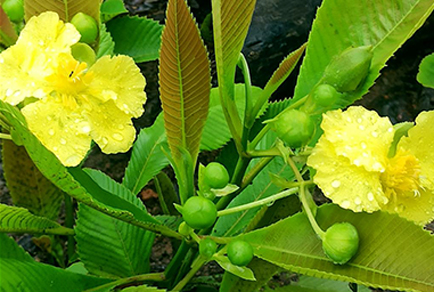
Dillenia nagalim (Dilleniaceae), a new species, has been described from Manipur, Northeast India. The newly described species shows close morphological similarity to D. pentagyna and D. hookeri but differs from the latter in having a short habit of 2–4 feet tall, an amplexicaul short petiole, leaves with double serrate margins, an acuminate leaf apex, showy flowers, numerous stamens, and 7–8 carpels. We have highlighted the diagnostic morphological characters, colour photographs, phenology, conservation status, and artificial keys for easy identification. Molecular phylogenetic analysis based on the rbcL gene supports it as a new species. The discovery of this new species highlights the phytogeographical importance of the region situated within the Indo-Burma biodiversity hotspot, where anthropogenic activities are intense and considered as “vulnerable (VU D2)” under the IUCN Red List Categories and Criteria.
References
- Agrawala, D.K., Gogoi, R., Dash, S.S., Jalal, J.S., Krishna, G., Kumar, A., Odyuo, N., Sharma, H.N., Bharadwaj, P.K., Hepuni, L., Kar, A., Tham, B.B.T. & Meitei, L.R. (2023) Flora of Manipur: A pictorial guide. Botanical Survey of India, Kolkata, and Institute of Bioresources and Sustainable Development, Manipur, 745 pp.
- Ahmed, G.F., Abd El-Kader, E.M. & Issa, M.Y. (2025) Dillenia species: Insight into managing neurodegenerative diseases. Egyptian Journal of Chemistry 68: 503–519. https://doi.org/10.21608/ejchem.2025.322266.10487
- Altschul, S.F., Gish, W., Miller, W., Myers, E.W. & Lipman, D.J. (1990) Basic local alignment search tool. Journal of Molecular Biology 215 (3): 403–410. https://doi.org/10.1016/S0022-2836(05)80360-2
- Bell, K.L., Loeffler, V.M. & Brosi, B.J. (2017) An rbcL reference library to aid in the identification of plant species mixtures by DNA metabarcoding. Applications in Plant Sciences 5 (3): 1600110. https://doi.org/10.3732/apps.1600110
- Boratyn, G.M., Schäffer, A.A., Agarwala, R., Altschul, S.F., Lipman, D.J. & Madden, T.L. (2012) Domain enhanced lookup time accelerated BLAST. Biology Direct 7 (1): 12.
- Braukmann, T.W., Kuzmina, M.L., Sills, J., Zakharov, E.V. & Hebert, P.D. (2017) Testing the efficacy of DNA barcodes for identifying the vascular plants of Canada. PLoS One 12: e0169515. https://doi.org/10.1371/journal.pone.0169515
- Bridson, D. & Forman, L. (1989) The herbarium handbook. Royal Botanic Gardens, Kew, United Kingdom, 290 pp.
- CBOL Plant Working Group (2009) A DNA barcode for land plants. Proceedings of the National Academy of Sciences of the United States of America 106 (31): 12794–12797. https://doi.org/10.1073/pnas.0905845106
- Choudhary, R.K., Van Nong, L., Quang, B.H., Lee, Y.M., Park, S.H., Lee, C. & Lee, J. (2012) Dillenia tetrapetala (Dilleniaceae), a new species from HonBa Nature Reserve, Vietnam. Annales Botanici Fennici 49 (5): 369–376. https://doi.org/10.5735/085.049.0608
- Don, D. (1825) Prodromus Florae Nepalensis, sive Enumeratio Vegetabilium, quae in Itinere per Nepaliam Proprie Dictam et Rgiones Conterminas, Ann. 1802-1803. Detexit atque legit D.D.Franciscus Hamilton, (olim Buchanan) M.D., London, 226 pp.
- Doyle, J.J. & Doyle, J.L. (1987) A rapid DNA isolation procedure for small quantities of fresh leaf tissue. Phytochemical Bulletin 19: 11–15.
- Felsenstein, J. (1985) Confidence limits on phylogenies: An approach using the bootstrap. Evolution 39 (4): 783–791. https://doi.org/10.1111/j.1558-5646.1985.tb00420.x
- Fouad, A.S., Hamed, A.B., Amer, W.M. & Hafez, R.M. (2022) Barcoding of some plant species using the rbcL gene in the Mediterranean Oolitic Sand dunes West of Alexandria, Egypt. Egyptian Journal of Botany 62 (1): 159–168. https://doi.org/10.21608/ejbo.2021.74134.1683
- Gandhi, D. & Mehta, P. (2013) Dillenia indica Linn. and Dillenia pentagyna Roxb.: Pharmacognostic, phytochemical and therapeutic aspects. Journal of Applied Pharmaceutical Science 3 (11): 134–142. https://doi.org/10.7324/JAPS.2013.31124
- Hoogland, R.D. (1952) A revision of the genus Dillenia. Blumea 7 (1): 1–145.
- IUCN. (2012) IUCN Red List Categories and Criteria: Version 3.1. Gland, Switzerland & Cambridge, UK.
- IUCN. (2024) Guidelines for using the IUCN Red List categories and criteria: Version 16. International Union for Conservation of Nature. Available from: https://www.iucnredlist.org/resources/redlistguidelines (accessed 20 November 2025)
- Jain, S.K. & Rao, R.R. (1977) A handbook of the field and herbarium methods. Today and Tomorrow’s Printers and Publishers, New Delhi, 158 pp.
- Jain, S.K., Rao, A.S., Panigrahi, G., Nair, N.C., Nayar, M.P., Deb, D.B. & Thothathri, K. (1979) Fascicles of Flora of India, Fascicle 2. Botanical Survey of India, Howrah, 17 pp.
- Kumar, S., Stecher, G., Suleski, M., Sanderford, M., Sharma, M. & Tamura, K. (2024) MEGA12: Molecular Evolutionary Genetic Analysis version 12 for adaptive and green computing. Molecular Biology and Evolution 41 (12): 1–9. https://doi.org/10.1093/molbev/msae263
- Linnaeus, C. (1753) Species Plantarum (Vol. 1). Holmiae, Impensis Laurentii Salvii, 535 pp.
- Mullis, K.B. & Faloona, F.A. (1987) Specific synthesis of DNA in vitro via a polymerase-catalyzed chain reaction. Methods in Enzymology 155: 335–350. https://doi.org/10.1016/0076-6879(87)55023-6
- Myers, N., Mittermeier, R.A., Mittermeier, C.G., Fonseca, G.A.D. & Kent, J. (2000) Biodiversity hotspots for conservation priorities. Nature 403: 853–858. https://doi.org/10.1038/35002501
- Nahar, L., Habibi, E., Khuniad, C., Kalieva, K., Wang, D., Arabnozari, H. & Sarker, S.D. (2025) Bioactive phytochemicals, pharmacological, and therapeutic potential of Dillenia indica: A comprehensive review of current research. Chinese Herbal Medicines 17: 628–642. https://doi.org/10.1016/j.chmed.2025.09.001
- Parkinson, C.E. (1935) Indian and Burmese Dillenias. Indian Forester 61 (7): 447–453.
- Paul, P., Dhar, S., Das, D. & Chowdhury, M. (2020) Herbarium Technique. Orange Books Publication, India.
- POWO (2025) Plants of the World Online. Facilitated by the Royal Botanic Gardens, Kew. Available from: https://powo.science.kew.org/ (accessed 20 November 2025)
- Roxburgh, W. (1795) Plants of the Coast of Coromandel (Vol. 1). W. Bulmer and Co., London, 68 pp.
- Roxburgh, W. (1814) Hortus Bengalensis. Mission Press, Serampore, 105 pp.
- Sabandar, C.W., Jalil, J., Ahmat, N. & Aladdin, N.A. (2017) Medicinal uses, chemistry and pharmacology of Dillenia species (Dilleniaceae). Phytochemistry 134: 6–25. https://doi.org/10.1016/j.phytochem.2016.11.010
- Sharma, B.D., Balakrishnan, N.P., Rao, R.R. & Hajra, P.K. (1993) Flora of India, Volume 1, Ranunculaceae – Barclayaceae. Botanical Society of India, Calcutta, 467 pp.
- Smith, J.E. (1806) Exotic Botany, vol. 2. R. Taylor and Co., London, 122 pp.
- Swamy, J., Rasingam, L., Nagaraju, N. & Mane, P.R. (2020) A new species of Dillenia (Angiosperms: Dilleniaceae) from the Eastern Ghats of Andhra Pradesh, India. Journal of Threatened Taxa 12: 16636–16640. https://doi.org/10.11609/jott.5529.12.11.16636-16640
- Tamura, K. & Nei, M. (1993) Estimation of the number of nucleotide substitutions in the control region of mitochondrial DNA in humans and chimpanzees. Molecular Biology and Evolution 10: 512–526. https://doi.org/10.1093/oxfordjournals.molbev.a040023
- Tan, A.L. & Latiff, A. (2014) A taxonomic study of Dillenia L. (Dilleniaceae) in Peninsular Malaysia. Malayan Nature Journal 66: 338–353.
- Thooptianrat, T., Chaveerach, T.A., Sudmoon, R. & Tanee, T. (2017) DNA profiles to identify Dillenia species (Dilleniaceae) in Thailand. Phytotaxa 296: 239–252. https://doi.org/10.11646/phytotaxa.296.3.3
- Thunberg, C.P. (1791) Observations on the genus Dillenia. Transactions of the Linnean Society of London 1: 198–202. https://doi.org/10.1111/j.1096-3642.1791.tb00401.x
- Wallich, N. (1830) Plantae Asiaticae Rariores: or, Descriptions and figures of a select number of unpublished East Indian plants. Treuttel and Würtz, London, 20 pp.
- Wight, R. (1840) Icones Plantarum Indiae Orientalis (Vol. 2). J.B. Pharoah, Madras, 118 pp.
- Will, K.W., Mishler, B.D. & Wheeler, Q.D. (2005) The perils of DNA barcoding and the need for integrative taxonomy. Systematic Biology 54: 844–851. https://doi.org/10.1080/10635150500354878
- Yazan, L.S. & Armania, N. (2014) Dillenia species: A review of the traditional uses, active constituents and pharmacological properties from pre-clinical studies. Pharmaceutical Biology 52: 890–897. https://doi.org/10.3109/13880209.2013.872672