
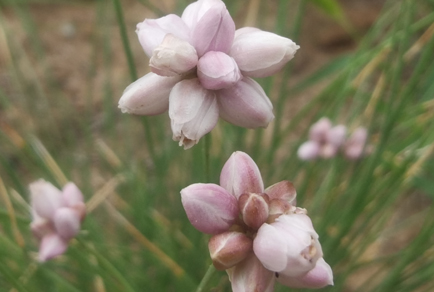

Abstract
This study formally reinstates Allium edentatum as an independent species from the Helan Mountains based on comprehensive morphological and molecular phylogenetic evidence, and treats A. brevipedicellatum as its later synonym. Morphological comparison reveals that A. edentatum closely resembles A. bidentatum but can be clearly distinguished by several key characters, including extremely short or nearly absent pedicels, ovate and toothless inner filaments at the basal half, a subglobose ovary with a tuberculate outer wall, and leaves with prominent longitudinal grooves and fine ridges. Phylogenetic analyses of 160 nuclear ribosomal ITS sequences strongly support A. edentatum as a monophyletic clade sister to A. bidentatum and A. bellulum within section Rhizomatosa. Integrating morphological and molecular data, we clarify the systematic position of A. edentatum and resolve its taxonomic status. Furthermore, we hypothesize that A. edentatum originated through geographic isolation and local adaptation during multiple climatic cycles of the Pleistocene, with its current distribution representing a potential relict of interglacial refugia. This study not only confirms the taxonomic validity of A. edentatum as an independent species but also refines the classification of sect. Rhizomatosa by providing an exhaustive identification key for all constituent taxa.
References
- Chytrý, M., Horsák, M., Danihelka, J., Ermakov, N., German, D., Hájek, M., Hájková, P., Kočí, M., Kubešová, S., Lustyk, P., Nekola, J., Pavelkova Ricankova, V., Preislerová, Z., Resl, P. & Valachovič, M. (2018) A modern analogue of the Pleistocene steppe-tundra ecosystem in southern Siberia. Boreas 48: 37–53. https://doi.org/10.1111/bor.12338
- Darriba, D., Taboada, G.L., Doallo, R. & Posada, D. (2012) jModelTest 2: more models, new heuristics and parallel computing. Nature Methods 9: 772. https://doi.org/10.1038/nmeth.2109
- Egorova, T.V. (1977) Allium L. In: Junatov, A.A. & Ikonnikov, S.S. (Eds.) Rastitel'nost' Tsentral'noĭ Azii, 7. Izdatel’stvo Nauka, Leningrad, pp. 57–90.
- Fitriah, Sripujiyanti, A., Nurul Ilmi, A. & Hariani, N. (2025) Allium spp. as a Source of Bioactive Antibacterials: A Review of Compounds, Mechanisms, and Effectiveness. Biota: Jurnal Ilmiah Ilmu-Ilmu Hayati 10: 213–221. https://doi.org/10.24002/biota.v10i2.10858
- Friesen, N., Fritsch, R.M. & Blattner, F.R. (2006) Phylogeny and new intrageneric classification of Allium (Alliaceae) based on nuclear ribosomal DNA ITS sequences. Aliso 22: 372–395. https://doi.org/10.5642/aliso.20062201.31
- Friesen, N., German, D., Hurka, H., Herden, T., Batlai, O. & Neuffer, B. (2016) Dated phylogenies and historical biogeography of Dontostemon and Clausia (Brassicaceae) mirror the palaeogeographical history of the Eurasian steppe. Journal of Biogeography 43: 738–749. https://doi.org/10.1111/jbi.12658
- Friesen, N., Smirnov, S., Shmakov, A., Herden, T., Batlai, O. & Hurka, H. (2020) Allium species of section Rhizomatosa, early members of the Central Asian steppe vegetation. Flora 263: 151536. https://doi.org/10.1016/j.flora.2019.151536
- Friesen, N., Smirnov, S.V., Leweke, M., Seregin, A.P. & Fritsch, R.M. (2021) Taxonomy and phylogenetics of Allium section Decipientia (Amaryllidaceae): morphological characters do not reflect the evolutionary history revealed by molecular markers. Botanical Journal of the Linnean Society 197: 190–228. https://doi.org/10.1093/botlinnean/boab023
- Fritsch, R.M. & Friesen, N. (2002) Evolution, domestication and taxonomy. In: Rabinowitch, H.D. & Currah, L. (Eds.) Allium Crop Science. CABI, Wallingford, pp. 5–30. https://doi.org/10.1079/9780851995106.0005
- Fu, X. (2023) Morphology, phylogeny and plastome research of Allium Subg. Rhizirideum and related taxa in China (Masters, etc). Sichuan University, Chendu, pp. 63–72.
- Govaerts, R., Kington, S., Friesen, N., Fritsch, R., Snijman, D.A., Marcucci, R., Silverstone-Sopkin, P.A. & Brullo, S. (2021) World checklist of Amaryllidaceae. Royal Botanic Gardens, Kew, Richmond.
- Hanelt, P. (1994) New sections in Allium. Kew Bulletin 49: 560. https://doi.org/10.2307/4114484
- Hsu, Y.P. (1987) Allium edentatum, a new species from the Helan Mountains, Inner Mongolia. Acta Botanica Boreali-Occidentalia Sinica 7: 258–260.
- Katoh, K., Kuma, K., Toh, H. & Miyata, T. (2005) MAFFT version 5: improvement in accuracy of multiple sequence alignment. Nucleic Acids Research 33: 511–518. https://doi.org/10.1093/nar/gki198
- Khan, N., Friesen, N., Sultan, A., Fritsch, R.M., Khan, T. & Ishaq, K. (2022) Allium sulaimanicum: A new Allium species and section from Pakistan. Frontiers in Plant Science 13: 1020440. https://doi.org/10.3389/fpls.2022.1020440
- Koch, W.D.J. (1837) Synopsis florae Germanicae et Helveticae. Gebhardt & Reisland, Frankfurt, pp. 693–732.
- Kumar, S., Stecher, G., Li, M., Knyaz, C. & Tamura, K. (2018) MEGA X: molecular evolutionary genetics analysis across computing platforms. Molecular Biology and Evolution 35: 1547–1549. https://doi.org/10.1093/molbev/msy096
- Li, Q.Q., Zhou, S.D., He, X.J., Yu, Y., Zhang, Y.C. & Wei, X.Q. (2010) Phylogeny and biogeography of Allium (Amaryllidaceae: Allieae) based on nuclear ribosomal internal transcribed spacer and chloroplast rps16 sequences, focusing on the inclusion of species endemic to China. Annals of Botany 106: 709–733. https://doi.org/10.1093/aob/mcq177
- Li, Q.Q., Zhou, S.D., Huang, D.Q., He, X.J. & Wei, X.Q. (2016) Molecular phylogeny, divergence time estimates and historical biogeography within one of the world's largest monocot genera. AoB Plants 8: plw041. https://doi.org/10.1093/aobpla/plw041
- Linnaeus, C. (1753) Species Plantarum. Laurentii Salvii, Holmiae, pp. 294–302.
- Meyer, C.A. (1831) Dontostemon Andrz. In: Ledebour, C.F. (Ed.) Flora Altaica scripsit Carolus Fridericus a Ledebour, adjectis itinerum comitibus C.A. Meyer et Al. a Bunge, vol. 3. G. Reimer, Berolini, pp. 118.
- Nguyen, N.H., Driscoll, H.E. & Specht, C.D. (2008) A molecular phylogeny of the wild onions (Allium; Alliaceae) with a focus on the western North American center of diversity. Molecular Phylogenetics and Evolution 47: 1157–1172. https://doi.org/10.1016/j.ympev.2007.12.006
- Prokhanov, J.I. & Ikonnikov-Galitzky, N.P. (1929) New species of plants from Mongolia. Matériaux de la Commission pour l’Étude de la République Mongole et de la République Tannou-Touva 2: 83.
- Prokhanov, J.I. (1930) Allium bellulum Prokh. Izvestiya Glavnogo Botanicheskogo Sada S.S.S.R. 29: 568.
- Ronquist, F., Teslenko, M., van der Mark, P., Ayres, D.L., Darling, A., Höhna, S., Larget, B., Liu, L., Suchard, M.A. & Huelsenbeck, J.P. (2012) MrBayes 3.2: efficient Bayesian phylogenetic inference and model choice across a large model space. Systematic Biology 61: 539–542. https://doi.org/10.1093/sysbio/sys029
- Singh, N., Gusain, A., Nigam, M. & Mishra, A. (2025) The pharmacological and therapeutic versatility of Allium species: a comprehensive exploration of bioactive constituents and biological activities. Discover Applied Sciences 7: 5. https://doi.org/10.1007/s42452-025-06800-0
- Sinitsyna, T.A., Herden, T. & Friesen, N. (2016) Dated phylogeny and biogeography of the Eurasian Allium section Rhizirideum (Amaryllidaceae). Plant Systematics and Evolution 302: 1–18. https://doi.org/10.1007/s00606-016-1333-3
- Stamatakis, A. (2014) RAxML version 8: a tool for phylogenetic analysis and post-analysis of large phylogenies. Bioinformatics 30: 1312–1313. https://doi.org/10.1093/bioinformatics/btu033
- Sun, J. & Windley, B. (2015) Onset of aridification by 34 Ma across the Eocene-Oligocene transition in Central Asia. Geology 43: G37161–37165. https://doi.org/10.1130/G37165.1
- Turland, N.J., Wiersema, J.H., Barrie, F.R., Gandhi, K.N., Gravendyck, J., Greuter, W., Hawksworth, D.L., Herendeen, P.S., Klopper, R.R., Knapp, S., Kusber, W.H., Li, D.Z., May, T.W., Monro, A.M., Prado, J., Price, M.J., Smith, G.F. & Zamora Señoret, J.C. (2025) International Code of Nomenclature for algae, fungi, and plants (Madrid Code). Regnum Vegetabile 162. Chicago: University of Chicago Press. https://doi.org/10.7208/chicago/9780226839479.001.0001
- Tzagolova, V.G. (1974) Allium ser. Tenuissima Tzag. Botanicheskie Materialy Gerbariya Instituta Botaniki Akademii Nauk Kazakhskoi S.S.R. 8: 18.
- Wendelbo, P. (1969) New combinations in Allium. Botaniska Notiser 122: 25.
- White, T.J., Bruns, T., Lee, S. & Taylor, J. (1990) Amplification and direct sequencing of fungal ribosomal RNA genes for phylogenetics. In: Innis, M.A., Gelfand, D.H., Sninsky, J.J. & White, T.J. (Eds.) PCR Protocols: A Guide to Methods and Applications. Academic Press, San Diego, pp. 315–322. https://doi.org/10.1016/B978-0-12-372180-8.50042-1
- Xu, J.M. & Kamelin, R.V. (2000) Allium. In: Wu, Z.Y. & Raven, P.H. (Eds.) Flora of China 24. Science Press, Beijing & Missouri Botanical Garden Press, St. Louis, pp. 165–202.
- Yang, B., Wang, W., Dai, R., Xu, H., Alima, Hao, S., Fan, Y., Liang, Y. & Li, X. (2025) Allium brevipedicellatum (Amaryllidaceae), a new species from the Helan Mountains in China. Phytotaxa 732: 91–98. https://doi.org/10.11646/phytotaxa.732.1.9