

Abstract
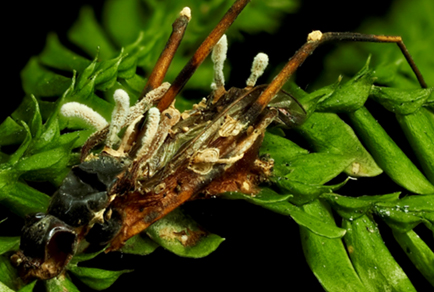
Pleurocordyceps is a group of hyperparasites that infects invertebrates, plants, and other fungi. It belongs to the family Polycephalomycetaceae, a newly established family separated from Ophiocordycipitaceae, order Hypocreales which includes several genera such as Dingleyomyces, Paradingleyomyces, Perennicordyceps, Pleurocordyceps, and Polycephalomyces. Pleurocordyceps currently comprises 26 species reported from South American and Asian regions In Asia, Malaysia has diverse forest ecosystems and rich fungal diversity; however, no previous studies have been reported on the occurrence of Pleurocordyceps species. The aim of the study is to explore the Pleurocordyceps diversity tropical rainforests of Malaysia using morpho-molecular analyses. During a fungal survey in Malaysia, fungicolous fungus associated with ants and cicadas nymphs were collected and subjected to morphological and molecular assessments. Two genetic loci—the internal transcribed spacer (ITS) region and the translation elongation factor 1-alpha (TEF-1α) gene—were used to construct both individual and concatenated phylogenetic trees. The study describes a new species, Pleurocordyceps cornusynnemata sp. nov. (BORH/F03651) from an ant, and two new records of P. aurantiaca (BORH/F03651), and P. nipponica (UTHM-CEF003.1) from Diptera and cicada nymph, respectively. These findings expand the knowledge of the geographic distribution of Pleurocordyceps and provide the first baseline data for the genus in Malaysia, thereby improving understanding of the diversity and evolutionary relationships within Polycephalomycetaceae.
References
- Ban, S. (2016) Re-classification of family Ophiocordyipitaceae, the entomopathogenic fungi. Microbial Resource Systems 32 (2): 105–113. https://doi.org/10.60369/microresys.32.2_105
- Ban, S., Sakane, T. & Nakagiri, A. (2015) Three new species of Ophiocordyceps and overview of anamorph types in the genus and the family Ophiocordyceptaceae. Mycological progress 14 (1): 1017. https://doi.org/10.1007/s11557-014-1017-8
- Castlebury, L.A., Rossman, A.Y., Gi-Ho, S.U.N.G., Hyten, A.S. & Spatafora, J.W. (2004) Multigene phylogeny reveals new lineage for Stachybotrys chartarum, the indoor air fungus. Mycological research 108 (8): 864–872. https://doi.org/10.1017/S0953756204000607
- Cheak, C.C., Shin, T.Y. & Sathiya Seelan, J.S. (2024) Discovery of a rare medicinal mushroom, Lignosus hainanensis (Polyporaceae, Basidiomycota) in Sabah (Northern Borneo), Malaysia. Malayan Nature Journal 76 (3). https://doi.org/10.62613/mnj.24763.03
- Crous, P.W., Wingfield, M.J., Burgess, T.I., Carnegie, A.J., Hardy, G., Smith, D. & Rodríguez-Andrade, E. (2017) Fungal Planet description sheets: 625–715. Persoonia: Molecular Phylogeny and Evolution of Fungi 39: 270. https://doi.org/10.3767/persoonia.2017.39.11
- Dong, Q.Y., Zeng, N.K., Zhou, J.N., Gao, S.Y., Xu, C.D. & Wang, Z.J. (2026) Molecular phylogeny and morphology reveal two novel entomopathogenic species of Hypocreales (Polycephalomycetaceae and Cordycipitaceae), from China. MycoKeys 127: 109. https://doi.org/10.3897/mycokeys.127.176090
- Hopple Jr, J.S. & Vilgalys, R. (1999) Phylogenetic relationships in the mushroom genus Coprinus and dark-spored allies based on sequence data from the nuclear gene coding for the large ribosomal subunit RNA: divergent domains, outgroups, and monophyly. Molecular phylogenetics and evolution 13 (1): 1–19. https://doi.org/10.1006/mpev.1999.0634
- Jaihan, P., Sangdee, K. & Sangdee, A. (2021) Combined multiple genes phylogenetic analysis and morphological characteristic description of entomopathogenic fungi infecting cicada nymph from northeast of Thailand. Biologia 76: 1635–1650. https://doi.org/10.1007/s11756-021-00719-8
- Johnston, P.R. & Park, D. (2023) Dingleyomyces lloydii (Hypocreales, Polycephalomycetaceae), gen. nov., comb. nov. New Zealand Journal of Botany 1–8. https://doi.org/10.1080/0028825X.2022.2052914
- Kadam, S.K., Youn, J.S., Tamboli, A.S., Yang, J., Pak, J.H. & Choo, Y.S. (2024) Complete chloroplast genome sequence of Artemisia littoricola (Asteraceae) from Dokdo Island Korea: genome structure, phylogenetic analysis, and biogeography study. Functional & Integrative Genomics 24 (5): 181. https://doi.org/10.1007/s10142-024-01464-2
- Kalyaanamoorthy, S., Minh, B.Q., Wong, T.K., Von Haeseler, A. & Jermiin, L.S. (2017) ModelFinder: fast model selection for accurate phylogenetic estimates. Nature methods 14 (6): 587–589. https://doi.org/10.1007/s10142-024-01464-2
- Kepler, R., Ban, S., Nakagiri, A., Bischoff, J., Hywel-Jones, N., Owensby, C.A. & Spatafora, J.W. (2013) The phylogenetic placement of hypocrealean insect pathogens in the genus Polycephalomyces: An application of One Fungus One Name. Fungal Biology 117 (9): 611–622. https://doi.org/10.1016/j.funbio.2013.06.002
- Kobayasi, Y. (1939) On the genus Cordyceps and its allies on cicadae from Japan. Bulletin of the Biogeographical Society of Japan 9: 145–176.
- Kobayasi, Y. (1941) The genus Cordyceps and its allies. Cabidigitallibrary. org, 53–260.
- Kobayasi, Y. (1982) Keys to the taxa of the genera Cordyceps and Torrubiella. Transactions of the mycological Society of Japan 23 (2): 329–364.
- Konopická, J., Skoková Habuštová, O., Jánová, N., Žurovcová, M., Doležal, P. & Zemek, R. (2024) Isolation and identification of entomopathogenic fungi strains for Colorado potato beetle (Leptinotarsa decemlineata) control. Journal of Applied Microbiology 135 (9): lxae213. https://doi.org/10.1093/jambio/lxae213
- Larget, B. & Simon, D.L. (1999) Markov chain Monte Carlo algorithms for the Bayesian analysis of phylogenetic trees. Molecular biology and evolution 16 (6): 750–759. https://doi.org/10.1093/oxfordjournals.molbev.a026160
- Larsson, A. (2014) AliView: a fast and lightweight alignment viewer and editor for large datasets. Bioinformatics 30 (22): 3276–3278. https://doi.org/10.1093/bioinformatics/btu531
- Liu, Z., Lu, Y., Tang, D., Zhu, J., Luo, L., Chen, Y. & Yu, H. (2024) Molecular Phylogenetic and Comparative Genomic Analysis of Pleurocordyceps fusiformispora sp. nov. and Perennicordyceps elaphomyceticola in the Family Polycephalomycetaceae. Journal of Fungi 10 (4): 297. https://doi.org/10.3390/jof10040297
- Luangsa-Ard, J., Tasanatai, K., Mongkolsamrit, S. & Hywel-Jones, N. (2008) Atlas of Invertebrate-Pathogenic Fungi of Thailand. National Center for or Genetic Engineering and Biotechnology, National Science and Technology Development Agency.
- Maharachchikumbura, S.S., Hyde, K.D., Jones, E.G., McKenzie, E.H.C., Bhat, J.D., Dayarathne, M.C. & Wijayawardene, N.N. (2016) Families of sordariomycetes. Fungal diversity 79 (1): 1–317. https://doi.org/10.1007/s13225-016-0369-6
- Masoudi, A., Wang, M., Zhang, X., Wang, C., Qiu, Z., Wang, W. & Liu, J. (2020) Meta-analysis and evaluation by insect-mediated baiting reveal different patterns of hypocrealean entomopathogenic fungi in the soils from two regions of China. Frontiers in Microbiology 11: 1133. https://doi.org/10.3389/fmicb.2020.01133
- Mongkolsamrit, S., Noisripoom, W., Tasanathai, K., Khonsanit, A., Thanakitpipattana, D., Lamlertthon, S. & Luangsa-Ard, J.J. (2024) Uncovering cryptic species diversity of Ophiocordyceps (Ophiocordycipitaceae) associated with Coleoptera from Thailand. Fungal Systematics and Evolution 14 (1): 223–250. https://doi.org/10.3114/fuse.2024.14.15
- Saltamachia, S.J. & Araújo, J.P. (2020) Ophiocordyceps desmidiospora, a basal lineage within the “Zombie-Ant Fungi” clade. Mycologia 112 (6): 1171–1183. https://doi.org/10.1080/00275514.2020.1732147
- Sangdee, K., Nakbanpote, W. & Sangdee, A. (2015) Isolation of the entomopathogenic fungal strain Cod-MK1201 from a cicada nymph and assessment of its antibacterial activities. International journal of Medicinal Mushrooms 17 (1). https://doi.org/10.1615/IntJMedMushrooms.v17.i1.60
- Sangdee, K., Seephonkai, P., Buranrat, B., Surapong, N. & Sangdee, A. (2016) Effects of ethyl acetate extracts from the Polycephalomyces nipponicus isolate Cod-MK1201 (Ascomycetes) against human pathogenic bacteria and a breast cancer cell line. International Journal of Medicinal Mushrooms 18 (8). https://doi.org/10.1615/IntJMedMushrooms.v18.i8.90
- Shrestha, B., Tanaka, E., Hyun, M.W., Han, J.G., Kim, C.S., Jo, J.W. & Sung, G.H. (2017) Mycosphere Essay 19. Cordyceps species parasitizing hymenopteran and hemipteran insects. Mycosphere 8 (9): 1424–1442. https://doi.org/10.5943/mycosphere/8/9/8
- Song, Y., Du, X., Li, A., Fan, A., He, L., Sun, Z. & Qiao, Y. (2023) Assembly and analysis of the complete mitochondrial genome of Forsythia suspensa (Thunb.) Vahl. BMC genomics 24 (1): 708. https://doi.org/10.1186/s12864-023-09821-4
- Surapong, N., Sangdee, A., Chainok, K., Pyne, S.G. & Seephonkai, P. (2019) Production and antifungal activity of cordytropolone and (-)-Leptosphaerone A from the fungus Polycephalomyces nipponicus. Natural Product Communications 14 (5): 1934578X19844120. https://doi.org/10.1177/1934578X19844120
- Thammawat, S., Sangdee, K. & Sangdee, A. (2017) Time-kill profiles and cell-surface morphological effects of crude Polycephalomyces nipponicus Cod-MK1201 mycelial extract against antibiotic-sensitive and-resistant Staphylococcus aureus. Tropical Journal of Pharmaceutical Research 16 (2): 407–412. https://doi.org/10.4314/tjpr.v16i2.20
- Vilgalys, R. & Hester, M. (1990) Rapid genetic identification and mapping of enzymatically amplified ribosomal DNA from several Cryptococcus species. Journal of bacteriology 172 (8): 4238–4246. https://doi.org/10.1128/jb.172.8.4238-4246.1990
- Vinit, K., Doilom, M., Wanasinghe, D.N., Bhat, D.J., Brahmanage, R.S., Jeewon, R. & Hyde, K.D. (2018) Phylogenetic placement of Akanthomyces muscarius, a new endophyte record from Nypa fruticans in Thailand. Current Research in Environmental & Applied Mycology 8 (3): 404–417. https://doi.org/10.5943/cream/8/3/10
- Wang, D., Xing, P.X., Diao, H.L., Zhou, W.W., Li, X.W., Zhang, L.J. & Ma, R.Y. (2023) Pathogenicity characteristics of the entomopathogenic fungus Cordyceps javanica IJ-tg19 to Acyrthosiphon pisum. BioControl 68 (4): 447–458. https://doi.org/10.1007/s10526-023-10203-8
- Wang, L., Li, H.H., Chen, Y.Q., Zhang, W.M. & Qu, L.H. (2014) Polycephalomyces lianzhouensis sp. nov., a new species, co-occurs with Ophiocordyceps crinalis. Mycological Progress 13: 1089–1096. https://doi.org/10.1007/s11557-014-0996-9
- Wang, Y.B., Wang, Y., Fan, Q., Duan, D.E., Zhang, G.D., Dai, R.Q. & Yu, H. (2020) Multigene phylogeny of the family Cordycipitaceae (Hypocreales): new taxa and the new systematic position of the Chinese cordycipitoid fungus Paecilomyces hepiali. Fungal Diversity 103: 1–46. https://doi.org/10.1007/s13225-020-00457-3
- Wang, Y.B., Yu, H., Dai, Y.D., Chen, Z.H., Zeng, W.B., Yuan, F. & Liang, Z.Q. (2015) Polycephalomyces yunnanensis (Hypocreales), a new species of Polycephalomyces parasitizing Ophiocordyceps nutans and stink bugs (hemipteran adults). Phytotaxa 208 (1): 34–44. https://doi.org/10.11646/phytotaxa.208.1.3
- Wang, Y.H., Ban, S., Wang, W.J., Li, Y., Wang, K., Kirk, P.M. & Yao, Y.J. (2021) Pleurocordyceps gen. nov. for a clade of fungi previously included in Polycephalomyces based on molecular phylogeny and morphology. Journal of Systematics and Evolution 59 (5): 1065–1080. https://doi.org/10.1111/jse.12705
- Wanhao, C. & Yanfeng, H. (2024) Taxonomy, Phylogeny and Genetics of Cordyceps. In: Advances in Cordyceps Research, CRC Press, pp. 33–56. https://doi.org/10.1201/9781003466420-4
- White, T.J., Bruns, T., Lee, S.J.W.T. & Taylor, J. (1990) Amplification and direct sequencing of fungal ribosomal RNA genes for phylogenetics. PCR protocols: a guide to methods and applications 18 (1): 315–322. https://doi.org/10.1016/B978-0-12-372180-8.50042-1
- Xiao, Y.P., Wang, Y.B., Hyde, K.D., Eleni, G., Sun, J.Z., Yang, Y. & Wen, T.C. (2023) Polycephalomycetaceae, a new family of clavicipitoid fungi segregates from Ophiocordycipitaceae. Fungal Diversity 120 (1): 1–76. https://doi.org/10.1007/s13225-023-00517-4
- Xiao, Y.P., Yang, Y., Jayawardena, R.S., Gentekaki, E., Peng, X.C., Luo, Z.L. & Lu, Y.Z. (2024) Four novel Pleurocordyceps (Polycephalomycetaceae) species from China. Frontiers in Microbiology 14: 1256967. https://doi.org/10.3389/fmicb.2023.1256967
- Xiao, Y.-P., Wen, T.-C., Hongsanan, S., Jeewon, R., Luangsa-Ard, J.J., Brooks, S., Wanasinghe, D.N., Long, F.-Y. & Hyde, K.D. (2018) Multigene phylogenetics of Polycephalomyces (Ophiocordycipitaceae, Hypocreales), with two new species from Thailand. Scientific Reports 8 (1): 18087. https://doi.org/10.1038/s41598-018-36792-4
- Yang, X., Song, Y., Liang, T., Wang, Q., Li, R. & Liu, W. (2021) Application of laser capture microdissection and PCR sequencing in the diagnosis of Coccidioides spp. infection: A case report and literature review in China. Emerging Microbes & Infections 10 (1): 331–341. https://doi.org/10.1080/22221751.2021.1889931
- Zhang, X., Peng, X.C., Wei, D.P., Wang, Y., Norphanphoun, C., Hongsanan, S. & Wen, T.C. (2026) Reappraisal of the phylogenetic relationships of hirsutella-like fungi across Ophiocordycipitaceae and Polycephalomycetaceae (Hypocreales, Sordariomycetes), and the description of seven new species. IMA fungus 17: e171084. https://doi.org/10.3897/imafungus.17.171084