
Abstract
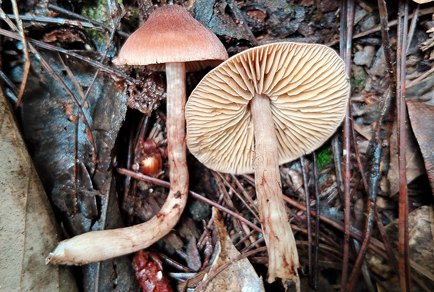
During a field survey conducted in the mountainous regions of Shigu Village, Lijiang, Yunnan Province, China, two fungal specimens resembling Inosperma were collected. Morphological comparisons coupled with phylogenetic analyses based on the internal transcribed spacer (ITS) and the nuclear ribosomal large subunit (LSU) regions revealed that the specimen represents a novel species of Inosperma, herein described as I. lijiangense. This species is distinguished by a light reddish white to reddish brown, dry, fibrillose pileus; adnate to slightly sinuate, milk white to grayish orange lamellae; and a solid, cylindrical stipe that is slightly swollen at the base and lacks both an annulus and odor. The basidiospores are ellipsoid to ovoid, smooth, and pale yellowish brown. Phylogenetic analysis indicates that the new species, I. lijiangense, represented by specimens GMB-W1237 (holotype) and GMB-W1238 (paratype), constitutes a distinct lineage within Inosperma. A comprehensive description, accompanying illustrations, and results of the phylogenetic analysis are provided.
References
- Aïgnon, H.L., Fan, Y.G., De Kesel, A., Bahram, M., Ryberg, M. & Yorou, N.S. (2023) A new species of Inosperma, and first record of I. afromelliolens (Inocybaceae, Fungi) from West Africa. PLoS One 18: e0290894. https://doi.org/10.1371/journal.pone.0290894
- Aïgnon, H.L., Jabeen, S., Naseer, A., Yorou, N.S. & Ryberg, M. (2021) Three new species of Inosperma (Agaricales, Inocybaceae) from Tropical Africa. MycoKeys 77: 97–116. https://doi.org/10.3897/mycokeys.77.60084
- Bandini, D., Oertel, B. & Eberhardt, U. (2021) Noch mehr risspilze (2): Dreizehn neue arten der familie Inocybaceae. Mycologia Bavarica 21: 27–98.
- Bau, T. & Fan, Y.G. (2018) Three new species of Inocybe sect. Rimosae from China. Mycosystema 37 (6): 693–702. https://doi.org/10.13346/j.mycosystema.180033
- Cervini, M., Carbone, M. & Bizio, E. (2021) Inosperma vinaceum, una nuova specie distinta da I. rhodiolum e I. adaequatum. Rivista di Micologia 63 (3): 215–241.
- Chia, P., Han, M.Y., Karunarathna, S.C., Zheng, D.G., Lu, W.H., Pitakpattanakul, C., Bunphan, J., Dai, D.Q., Chukeatirote, E. & Tibpromma, S. (2025) Morphology and multi-locus phylogeny reveal Cordana puerensis sp. nov., a coffee-associated saprobic fungus from Pu'er, Yunnan, China. Phytotaxa 725 (2): 144–158. https://doi.org/10.11646/phytotaxa.725.2.2
- Crous, P.W., Akram, W., Albuquerque, G.M.R., Alfenas, A.C., Alfenas, R.F., Altés, A., Alvarado, P., Amirmijani, A.R., Arumugam, E., Asif, M., Bandini, D., Barreto, G.G., Barreto, R.W., Batista, V.E.C., Bezerra, J.D.P., Bilański, P., Bizio, E., Castañeda-Ruiz, R.F., Chaves, J., Condé, T.O., Costa, M.M., Custódio, F.A., Courty, P.-E., Czachura, P., Damm, U., Darmostuk, V., Dearnaley, J., De la Peña-Lastra, S., Delgado, G., de Silva, N.I., Dovana, F., Drummond-Herdman, A., Eberhardt, U., Esteve-Raventós, F., Ferisin, G., Ferreira, R.J., Ferro, L.O., Firmino, A.L., Flakus, A., Fournier, J., Gardiennet, A., Gerbeau-Pissot, P., Ghobad-Nejhad, M., Gruhn, G., Guard, F.E., Harms, K., Heilmann-Clausen, J., Hongsanan, S., Hülsewig, T., Inokuti, E.M., Jankowiak, R., Kaliyaperumal, M., Kehlet, T., Lacerda, S.R., Larsson, E., Leão, A.F., Lebel, T., Lima, A.A., López-Villalba, Á., Maciá-Vicente, J.G., Mateos, A., Mejía, L.C., Mendes, D.R., Möller, L., Mombert, A., Monteiro, M.B.N., Moreno, G., Nagy, L., Niskanen, T., Nogueira, P.T.S., Oliveira, J.A., Oliveira, P.H.F., Ortiz, D.A., Pancorbo, F., Paz, A., Pazmiño, D.A., Pereira, O.L., Piątek, M., Plata, O., Pordel, A., Raaijmakers, J.M., Ralaiveloarisoa, A.B., Ramos, D.O., Ravikumar, S., Rigueiro-Rodríguez, A., Rivas-Torres, G.F., Rodrigues, J.G., Rodriguez-Flakus, P., Romero, M., Saba, M., Sánchez, A., Sánchez-Dueñas, G., Santana, J.S., Serrano, M., Silva, J.A.S., Stępniewska, H., Stryjak-Bogacka, M., Tennakoon, D.S., van ‘t Hof, P., van Vuuren, N.I., Varga, T., Vauras, J., Vieira, B.S., Visagie, C.M., Wipf, D., Woods, R., & Groenewald, J.Z. (2026) Fungal planet description sheets: 1868–1920. Persoonia-Molecular Phylogeny and Evolution of Fungi 56: 1–173. https://doi.org/10.3114/persoonia.2026.56.01
- Chandrasekharan, B., Pradeep, C.K. & Vrinda, K.B. (2020) Inocybe poisoning from Kerala–a case study. Journal of Mycopathological Research 57: 255–258.
- Deng, L.S., Kang, R., Zeng, N.K., Yu, W.J., Chang, C., Xu, F., Deng, W.Q., Qi, L.L., Zhou, Y.L. & Fan, Y.G. (2021) Two new Inosperma (Inocybaceae) species with unexpected muscarine contents from tropical China. MycoKeys 85: 87–108. https://doi.org/10.3897/mycokeys.85.71957
- Deng, L.S., Yu, W.J., Zeng, N.K., Zhang, Y.Z., Wu, X.P., Li, H.J., Xu, F. & Fan, Y.G. (2022) A new muscarine-containing Inosperma (Inocybaceae, Agaricales) species discovered from one poisoning incident occurring in tropical China. Frontiers in Microbiology 13: e923435. https://doi.org/10.3389/fmicb.2022.923435
- Du, T.Y., Tibpromma, S., Hyde, K., Wang, Y., Jeewon, R., Mapook, A., Zhang, X., Lu, W.H., Chen, X.M., Alfagham, A.T., Elgorban, A.M., Kumla, J., Dai, D.Q., Suwannarach, N. & Karunarathna, S.C. (2025) Fungal community composition associated with the agarwood-producing tree, Aquilaria sinensis. Mycosphere 16 (1): 2776–2847. https://doi.org/10.5943/mycosphere/16/1/18
- Esteve-Raventós, F., Larsson, E., Pancorbo, F., Bizio, E., Altés, A., Turégano, Y., Moreno, G. & Olariaga, I. (2024) A Taxonomic and phylogenetic contribution on Inosperma section Inosperma (Agaricales, Inocybaceae) in Europe: Calamistratum and Geraniodorum groups. Journal of Fungi 10: e374. https://doi.org/10.3390/jof10060374
- Feng, B. & Yang, Z. (2018) Studies on diversity of higher fungi in Yunnan, southwestern China: A review. Plant Diversity 40: 165–171. https://doi.org/10.1016/j.pld.2018.07.001
- Glez-Peña, D., Gómez-Blanco, D., Reboiro-Jato, M., Fdez-Riverola, F. & Posada, D. (2010) AL-TER: Program-oriented conversion of DNA and protein alignments. Nucleic Acids Research 38: 14–18. https://doi.org/10.1093/nar/gkq321
- Han, M.Y., Karunarathna, S.C., Lu, L., Zheng, D.G., Dai, D.Q., Suwannarach, N., Kumla, J., Elgorban, A.M., Zhang, L.J., Chukeatirote, E. & Tibpromma, S. (2025) Pseudodictyosporium yunnanensis sp. nov. (Dictyosporiaceae, Pleosporales) from dead twigs of Coffea arabica in China. Phytotaxa 711 (1): 28–42. https://doi.org/10.11646/phytotaxa.711.1.2
- Han, M.Y., Yang, J.Y., Karunarathna, S.C., Kumla, J., Lu, L., Zheng, D.G., Elgorban, A.M., Alfagham, A.T., Yu, F.Q., Dai, D.Q., Zhang, L.J., Suwannarach, N. & Tibpromma, S. (2026) Two new Neohelicomyces species (Tubeufiaceae, Tubeufiales) associated with Coffea arabica L. in Yunnan Province, China. MycoKeys 127: 343–362. https://doi.org/10.3897/mycokeys.127.173937
- Hall, T. (2004) BioEdit. Ibis Therapeutics, Carlsbad, CA, 92008, USA. [http://www.mbio.ncsu.edu/BioEdit/bioedit.html]
- Hu, Y.W., Karunarathna, S.C., Li, H., Galappaththi, M.C., Zhao, C.L., Kakumyan, P. & Mortimer, P.E. (2022) The impact of drying temperature on basidiospore size. Diversity 14: e239. https://doi.org/10.3390/d14040239
- Hoang, D.T., Chernomor, O., Von Haeseler, A., Minh, B.Q. & Vinh, L.S. (2018) UFBoot2: improving the ultrafast bootstrap approximation. Molecular Biology and Evolution 35: 518–522. https://doi.org/10.1093/molbev/msx281
- Horak, E., Matheny, P.B., Desjardin, D.E. & Soytong, K. (2015) The genus Inocybe (Inocybaceae, Agaricales, Basidiomycota) in Thailand and Malaysia. Phytotaxa 230 (3): 201–238. https://doi.org/10.11646/phytotaxa.230.3.1
- Hyde, K.D., Noorabadi, M.T., Thiyagaraja, V., He, M.Q., Johnston, P.R., Wijesinghe, S.N. & Dissanayake, L.S. (2024) The 2024 outline of Fungi and fungus-like taxa. Mycosphere 15: 5146–6239. https://doi.org/10.5943/mycosphere/15/1/25
- Katoh, K., Rozewicki, J. & Yamada, K. (2019) MAFFT online service: Multiple sequence alignment, interactive sequence choice and visualization. Briefings in Bioinformatics 20: 1160–1166. https://doi.org/10.1093/bib/bbx108
- Kirk, P.M., Cannon, P.F., Minter, D.W. & Stalpers, J.A. (2008) Dictionary of the Fungi. 10th ed. Wallingford, UK: CAB International.
- Kornerup, A. & Wanscher, J. (1978) Methuen Handbook of Colour. 3rd edn, Methuen London Ltd., London, pp. 144–148.
- Kosentka, P., Sprague, S.L., Ryberg, M., Gartz, J., May, A.L., Campagna, S.R. & Matheny, P.B. (2013) Evolution of the toxins muscarine and psilocybin in a family of mushroom-forming fungi. PLoS One 8: e64646. https://doi.org/10.1371/journal.pone.0064646
- Kropp, B.R., Matheny, P.B. & Hutchison, L.J. (2013) Inocybe section Rimosae in Utah: phylogenetic affinities and new species. Mycologia 105: 728–747. https://doi.org/10.3852/12-185
- Latha, K.P.D. & Manimohan, P. (2016) Five new species of Inocybe (Agaricales) from tropical India. Mycologia 108: 110–122. https://doi.org/10.3852/14-358
- Latha, K.P.D. & Manimohan, P. (2017) Inocybes of Kerala. Calicut: SporePrint Books. Department of Botany, University of Calicut, Kerala, India.
- Latha, S.S., Shivanna, N., Naika, M., Anilakumar, K.R., Kaul, A. & Mittal, G. (2020) Toxic metabolite profiling of Inocybe virosa. Scientific Reports 10: e13669. https://doi.org/10.1038/s41598-020-70196-7
- Larsson, E., Ryberg, M., Moreau, P.A., Mathiesen, A.D. & Jacobsson, S. (2009) Taxonomy and evolutionary relationships within species of section Rimosae (Inocybe) based on ITS, LSU and mtSSU sequence data. Persoonia 23: 86–98. https://doi.org/10.3767/003158509X475913
- Li, H.J., Zhang, Y.Z., Zhang, H.S., Zhou, J., Liang, J.Q, Yin, Y., He, Q., Jiang, S.F., Zhang, Y.T., Yuan, Y., Lang, N., Cheng, B.W., Wang, M. & Sun, C.Y. (2023) Mushroom poisoning outbreaks—China, 2022. China CDC Weekly 5: 45–50. https://doi.org/10.46234/ccdcw2023.009
- Li, S.N., Xu, F., Long, P., Liu, F., Zhang, P., Fan, Y.G. & Chen, Z.H. (2022) Five new species of Inosperma from China: Morphological characteristics, phylogenetic analyses, and toxin detection. Frontiers in Microbiology 13: e1021583. https://doi.org/10.3389/fmicb.2022.1021583
- Liu, R.M., Xu, R.F., Elgorban, A.M., Xu, J.C., Dai, D.Q., Suwannarach, N., Karunarathna, S.C. & Tibpromma, S. (2025) Morphology and multigene phylogeny unveil Waltergamsia xishuangbannaensis sp. nov. (Bionectriaceae, Hypocreales), associated with Pará rubber (Hevea brasiliensis) from Yunnan Province, China. Phytotaxa 682: 138–150. https://doi.org/10.11646/phytotaxa.682.2.2
- Liu, R.M., Wang, H.H., Zhang, G.Q., Dai, D.Q., Elgorban, A.M., Karunarathna, S.C. & Tibpromma, S. (2024) Amphisphaeria hongheensis sp. nov. (Amphisphaeriaceae, Amphisphaeriales) from Yunnan Province, China. Phytotaxa 670: 273–284. https://doi.org/10.11646/phytotaxa.670.4.5
- Li, W.W., Pires, S.M., Liu, Z.T., Liang, J.J., Wang, Y.F., Chen, W., Liu, C.W., Liu, J.K., Han, H.H., Fu, P. & Guo, Y.C. (2021) Mushroom poisoning outbreaks ─ China, 2010–2020. China CDC Weekly 3: 518–522. https://doi.org/10.46234/ccdcw2021.134
- Lu, L., Karunarathna, S.C., Xiong, Y.R., Han, L.S., Chen, X.M., Xu, R.F., Liu, X.F., Zeng, X.Y., Dai, D.Q., Elgorban, A.M., Jayawardena, R.S., Hyde, K.D. & Tibpromma, S. (2025) Taxonomy and systematics of micro-fungi associated with Coffea in southern China and northern Thailand. Fungal Diversity 135 (1): 469–743. https://doi.org/10.1007/s13225-025-00566-x
- Lu, W.H., Alfagham, A.T., Tibpromma, S., Suwannarach, N., Kumla, J., Dai, D.Q., Elgorban, A.M., Chukeatirote, E. & Karunarathna, S.C. (2025) Hidden in the daylight: A polyphasic approach reveals two bioluminescent Mycenaceae species from Yunnan Province, China (Basidiomycota, Agaricales). Biodiversity Data Journal 13: e168858. https://doi.org/10.3897/BDJ.13.e168858
- Lu, W.H., Nutaratat, P., Kumla, J., Tibpromma, S., Elgorban, A.M., Karunarathna, S.C. & Suwannarach, N. (2024) Morphological and molecular identification of two new Marasmiellus species (Omphalotaceae, Agaricales) from Thailand. MycoKeys 109: 31–48. https://doi.org/10.3897/mycokeys.109.129791
- Maharachchikumbura, S.S.N., Hyde, K.D., Jones, E.B.G., McKenzie, E.H.C., Huang, S.K., Abdel-Wahab, M.A., Daranagama, D.A., Dayarathne, M., D’souza, M.J., Goonasekara, I.D. & Hongsanan, S. (2015) Towards a natural classification and backbone tree for Sordariomycetes. Fungal Diversity 72: 199–301. https://doi.org/10.1007/s13225-015-0331-z
- Malone, M.H., Robichaud, R.C., Tyler, Jr.V & Brady, L.R (1962) Relative muscarinic content of thirty Inocybe species. Lloydia 25: 231–237.
- Matheny, P.B. (2005) Improving phylogenetic inference of mushrooms with RPB1 and RPB2 nucleotide sequences (Inocybe; Agaricales). Molecular Phylogenetic Evolution 35: 1–20. https://doi.org/10.1016/j.ympev.2004.11.014
- Matheny, P.B., Henkel, T.W., Sene, O., Korotkin, H.B, Dentinger, B.T.M. & Aime, M.C. (2017) New species of Auritella (Inocybaceae) from Cameroon, with a worldwide key to the known species. IMA Fungus 8: 287–298. https://doi.org/10.5598/imafungus.2017.08.02.06
- Matheny, P.B., Hobbs, A.M. & Esteve-Raventós, F. (2020) Genera of Inocybaceae: New skin for the old ceremony. Mycologia 112: 83–120. https://doi.org/10.1080/00275514.2019.1668906
- Matheny, P.B. & Kudzma, L.V. (2019) New species of Inocybe (Inocybaceae) from eastern North America 1. Journal of the Torrey Botanical Society 146: 213–235. https://doi.org/10.3159/TORREY-D-18-00060.1
- Miller, M.A., Pfeiffer, W. & Schwartz, T. (2012) The CIPRES Science Gateway: Enabling High-impact Science for Phylogenetics Researchers with Limited Resources. In: Proceedings of the 1st Conference of the Extreme Science and Engineering Discovery Environment: Bridging from the Extreme to the campus and beyond. Association for Computing Machinery, New York, pp. 1–8. https://doi.org/10.1145/2335755.2335836
- Naseer, A., Khalid, A.N. & Smith, M.E. (2017) Inocybe shawarensis sp. nov. in the Inosperma clade from Pakistan. Mycotaxon 132 (4): 909–918. https://doi.org/10.5248/132.909
- Nguyen, L.T., Schmidt, H.A., Von Haeseler, A. & Minh, B.Q. (2015) IQ-TREE: a fast and effective stochastic algorithm for estimating maximum-likelihood phylogenies. Molecular Biology and Evolution 32: 268–274. https://doi.org/10.1093/molbev/msu300
- Nylander, J.A.A. (2004) MrModeltest 2.0. Program distributed by the author. Evolutionary Biology Centre, Uppsala University.
- Pradeep, C.K., Vrinda, K.B., Varghese, S.P., Korotkin, H.B. & Matheny, P.B. (2016) New and noteworthy species of Inocybe (Agaricales) from tropical India. Mycological Progress 15: e24. https://doi.org/10.1007/s11557-016-1174-z
- Parnmen, S., Nooron, N., Leudang, S., Sikaphan, S., Polputpisatkul, D., Pringsulaka, O., Binchai, S. & Rangsiruji, A. (2021) Foodborne illness caused by muscarine-containing mushrooms and identification of mushroom remnants using phylogenetics and LC-MS/MS. Food Control 128: 108182. https://doi.org/10.1016/j.foodcont.2021.108182
- Putra, I.P., Riffiani, R., Nurhayat, O.D. & Toemon, A.I. (2023) First record of Inosperma subsphaerosporum (Inocybaceae) in Indonesia. Turczaninowia 26: 103–113. https://doi.org/10.14258/turczaninowia.26.2.8
- Rambaut, A. & Drummond, A.J. (2012) FigTree version 1.4.0. Available from: http://tree.bio.ed.ac.uk/software/figtree (accessed 2 April 2026)
- Rannala, B. & Yang, Z. (1996) Probability distribution of molecular evolutionary trees: a new method of phylogenetic inference. Journal of Molecular Evolution 43: 304–311. https://doi.org/10.1007/BF02338839
- Rathnayaka, A.R., Tennakoon, D.S., Jones, G.E., Wanasinghe, D.N., Bhat, D.J., Priyashantha, A.H., Stephenson, S.L., Tibpromma, S. & Karunarathna, S.C. (2025) Significance of precise documentation of hosts and geospatial data of fungal collections, with an emphasis on plant-associated fungi. New Zealand Journal of Botany 63: 462–489. https://doi.org/10.1080/0028825X.2024.2381734
- Ronquist, F., Teslenko, M., Van Der Mark, P., Ayres, D.L., Darling, A., Höhna, S., Larget, B., Liu, L., Suchard, M.A. & Huelsenbeck, J.P. (2012) MrBayes 3.2: efficient Bayesian phylogenetic inference and model choice across a large model space. Systematic Biology 61: 539–542. https://doi.org/10.1093/sysbio/sys029
- Ryberg, M. & Matheny, P.B. (2012) Asynchronous origins of ectomycorrhizal clades of Agaricales. Proceedings of the royal Society B: Biological Sciences 279 (1735): 2003–2011. https://doi.org/10.1098/rspb.2011.2428
- Ryberg, M., Nilsson, R.H., Kristiansson, E., To pel, M., Jacobsson, S. & Larsson, E. (2008) Mining metadata from unidentified ITS sequences in GenBank: A case study in Inocybe (Basidiomycota). BMC Evolutionary Biology 8: 50. https://doi.org/10.1186/1471-2148-8-50
- Sailatha, S., Naveen, S., Naika, M., Anilakumar, K.R. & Singh, M. (2014) Toxicological evaluation of Inocybe virosa. In: Proceedings of the 8th International Conference on Mushroom Biology and Mushroom Products (icmbmp8). Volume II. Papers presented in 8th ICMBMP, NASC, New Delhi (India) Yugantar Prakashan Pvt. ltd., pp. 467–472.
- Sana, Kiran, M. & Ali, W. (2025) Inosperma pakistanicum sp. nov. (Inocybaceae, Agaricales) from Swat, Pakistan. Phytotaxa 690: 77–88. https://doi.org/10.11646/phytotaxa.690.1.6
- Schoch, C.L., Robbertse, B., Robert, V., Vu, D., Cardinali, G., Irinyi, L., Meyer, W., Nilsson, R.H., Hughes, K., Miller, A.N. & Kirk, P.M. (2014) Finding needles in haystacks: linking scientific names, reference specimens and molecular data for Fungi. Database 2014: p.bau061.
- Si, J., Zhang, Y.Z., Liang, J.Q. & Li, H.J. (2023) Morphology and phylogeny identify two new species and one new subspecies of Podoscypha from Yunnan Province, Southwest China. Frontiers in Microbiology 14: e1151365. https://doi.org/10.3389/fmicb.2023.1151365
- Tian, X.G., Bao, D.F., Han, J., Dai, D.Q., Lu, Y., Han, M.Y., Zheng, D.G., Entaj, T., Acharya, K., Suwannarach, N., Kumla, J., Liu, R.M., Li, Q., Yang, J.Y., Karunarathna, S.C. & Tibpromma, S. (2026) Morphology and multi-locus phylogeny reveal 23 fungal taxa from terrestrial habitats. Mycology 1–73. https://doi.org/10.1080/21501203.2025.2594942
- Vilgalys, R. & Hester, M. (1990) Rapid genetic identification and mapping of enzymatically amplified ribosomal DNA from several Cryptococcus species. Journal of Bacteriology 172: 4238–4246. https://doi.org/10.1128/jb.172.8.4238-4246.1990
- Wanasinghe, D.N., Phookamsak, R., Dissanayake, L.S. & Xu, J. (2025) Unexplored microfungal diversity from dead woody litter in the dry-hot valleys of Honghe (Yunnan, China). Studies in Fungi 10 (1): e017. https://doi.org/10.48130/sif-0025-0016
- White, T.J., Bruns, T., Lee, S.J.W.T. & Taylor, J. (1990) Amplification and direct sequencing of fungal ribosomal RNA genes for phylogenetics. In: Innis, M.A., Gelfand, D.H., Sninsky, J.J. & White, T.J. (Eds.) PCR protocols: a guide to methods and applications, Academic Press, New York, pp. 315–322. https://doi.org/10.1016/B978-0-12-372180-8.50042-1
- Zhaxybayeva, O. & Gogarten, J.P. (2002) Bootstrap, Bayesian probability and maximum likelihood mapping: Exploring new tools for comparative genome analyses. BMC Genomics 3: e4. https://doi.org/10.1186/1471-2164-3-4
- Zheng, D.G., Tibpromma, S., Lu, W.H., Han, M.Y., Suwannarach, N., Elgorban, A.M., Alfagham, T.T., Yu, F.Q., Dai, D.Q., Zhang, L.J., Karunanayake, C., Kumla, J. & Karunarathna, S.C. (2026) Two novel species belonging to Psathyrella sections Atomatae and Hydrophilae (Psathyrellaceae, Agaricales) from Yunnan Province, China, based on morphological and multi-locus phylogenetic analyses. MycoKeys 129: 1–22. https://doi.org/10.3897/mycokeys.129.179449
- Zhou, Y.L., Deng, L.S., Yang, S.D., Liu, C.F., Fan, Y.G. & Yu, W.J. (2023) Phylogenetic analysis, morphological studies, element profiling, and muscarine detection reveal a new toxic Inosperma (Inocybaceae, Agaricales) species from tropical China. Frontiers in Microbiology 14: e1326253. https://doi.org/10.3389/fmicb.2023.1326253