
Abstract
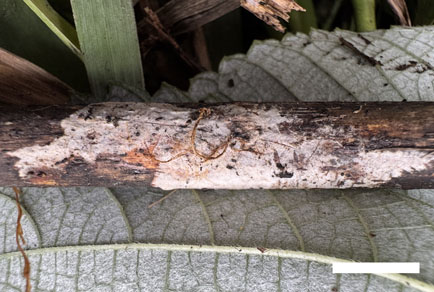
Asterostroma arundinicola sp. nov., found on Arundo donax in Zhejiang Province, Eastern China, is described based on morphology and phylogeny inferred from combined ITS and nLSU sequence data. The new species is characterized by resupinate, membranaceous basidiomata with cottony to hypochnoid, flesh-pink hymenophore, distinct hyphal strands, a monomitic hyphal system with simple-septate generative hyphae, abundant asterosetae and asterohyphidia which are weakly dextrinoid, echinulate, subglobose to globose basidiospores measuring 4.5–7 × 4.2–6.5 µm, and growing on a monocotyledon (Arundo donax). Phylogenetically, the new species is closely related to Asterostroma fimbriatum and A. medium, but A. fimbriatum is differentiated from A. arundinicola by its thin-walled basidiospores; A. medium differs from A. arundinicola by having a cream to light ochraceous hymenial surface and thin-walled basidiospores. A description, illustrations, and phylogenetic analysis results of the new species are provided along with comparisons with closely related taxa.
References
- Anonymous. (1969) Flora of British Fungi. Colour identification chart. Her Majesty´s Stationery Office, London.
- Bresadola, G. (1920) Selecta mycologica. Annales Mycologici 18 (1–3): 26–70.
- Capella-Gutierrez, S., Silla-Martinez, J.M. & Gabaldon, T. (2009) Bioinformatics. Bioinformatics 25: 1972–1973. https://doi.org/10.1093/bioinformatics/btp348
- Cui, B.K., Li, H.J., Ji, X., Zhou, J.L., Song, J., Si, J., Yang, Z.L. & Dai, Y.C. (2019) Species diversity, taxonomy and phylogeny of Polyporaceae (Basidiomycota) in China. Fungal Diversity 97: 137–392. https://doi.org/10.1007/s13225-019-00427-4
- Dai, Y.C., Yang, Z.L., Cui, B.K., Wu, G., Yuan, H.S., Zhou, L.W., He, S.H., Ge, Z.W., Wu, F., Wei, Y.L., Yuan, Y. & Si, J. (2021) Diversity and systematics of the important macrofungi in Chinese forests. Mycosystema 40: 770–805. https://doi.org/10.13346/j.mycosystema.210036
- Dai, Y.C. (2010) Hymenochaetaceae (Basidiomycota) in China. Fungal Diversity 45: 131–343. https://doi.org/10.1007/s13225-010-0066-9
- Deng, Y.L., Chen, M., Zhang, S.C., Wang, K.S., Liu, W.T., Qiu, Y.H., Dou, Y.T., Liu, X.F., Wijesinghe, S.N., Zhou, H.M., Jabeen, S. & Zhao, C.L. (2026) Notes, taxonomy and phylogeny of wood-inhabiting fungi in Russulales. Mycosphere 17 (e003): 1–61. https://doi.org/10.48130/mycosphere-0026-0003
- Deng, Y.L., Li, J.F., Zhao, C.L. & Zhao, J. (2024) Four new fungal species in forest ecological system from southwestern China. Journal of Fungi 10 (3, no. 194): 1–29. https://doi.org/10.3390/jof10030194
- Dong, J.H., Deng, Q.H., Chen, M.L., Chen, D.X. & Zhao, C.L. (2025a) Molecular phylogeny and morphology reveal four new wood-inhabiting fungi of Asterostroma and Radulomyces (Basidiomycota) from Southwestern China. MycoKeys 112: 35–58. https://doi.org/10.3897/mycokeys.112.137098
- Dong, J.H., Wang, L.R., Chen, D.X., Zheng, W., Wang, Y.X. & Zhao, C.L. (2024a) Morphological and molecular identification of Asterostroma roseoalbum sp. nov. (Peniophoraceae, Russulales), from southwestern China. New Zealand Journal of Botany 63 (2–3): 199–212. https://doi.org/10.1080/0028825X.2024.2415054
- Dong, J.H., Chen, M.L., Chen, M., Li, Q., Zhu, Y.J., Zhang, X.C., Zhou, C.Q., Li, W., Muhammad, A., Zhou, H.M., Jabeen, S. & Zhao, C.L. (2025b) Notes, outline, taxonomy and phylogeny of wood-inhabiting Agaricales. Mycosphere 16 (1): 2599–2711. https://doi.org/10.5943/mycosphere/16/1/16
- Dong, J.H., Li, Q., Yuan, Q., Luo, Y.X., Zhang, X.C., Dai, Y.F., Zhou, Q., Liu, X.F., Deng, Y.L., Zhou, H.M., Muhammad, A. & Zhao, C.L. (2024b) Species diversity, taxonomy, molecular systematics and divergence time of wood-inhabiting fungi in Yunnan-Guizhou Plateau, Asia. Mycosphere 15 (1): 1110–1293. https://doi.org/10.5943/mycosphere/15/1/10
- Hallenberg, N. & Eriksson, J. (1985) The Lachnocladiaceae and Coniophoraceae of North Europe. Fungiflora, Oslo, pp. 1–96.
- Han, M.L., Vlasák, J. & Cui, B.K. (2015) Daedalea americana sp. nov. (Polyporales, Basidiomycota) evidenced by morphological characters and phylogenetic analysis. Phytotaxa 204: 277–286. https://doi.org/10.11646/phytotaxa.204.4.4
- Hibbett, D.S. & Binder, M. (2002) Evolution of complex fruiting-body morphologies in homobasidiomycetes. Proceedings of the Royal Society B-biological Sciences 269 (1504): 1963–1969. https://doi.org/10.1098/rspb
- Hopple, J.S.Jr. & Vilgalys, R. (1999) Phylogenetic relationships in the mushroom genus Coprinus and dark-spored allies based on sequence data from the nuclear gene coding for the large ribosomal subunit RNA: divergent domains, outgroups, and monophyly. Molecular Phylogenetics and Evolution 13: 1–19. https://doi.org/10.1006/mpev.1999.0634
- Katoh, K. & Standley, D.M. (2013) MAFFT multiple sequence alignment software version 7: improvements in performance and usability. Molecular Phylogenetics and Evolution 30: 772–780. https://doi.org/10.1093/molbev/mst010
- Larsson, A. (2014) AliView: A fast and lightweight alignment viewer and editor for large data sets. Bioinformatics (Oxford, England) 30 (22): 3276–3278. https://doi.org/10.1093/bioinformatics/btu531
- Larsson, E. & Larsson, K.H. (2003) Phylogenetic relationships of russuloid basidiomycetes with emphasis on aphyllophoralean taxa. Mycologia 95: 1037–1065. https://doi.org/10.2307/3761912
- Larsson, K.H. (2007) Re-thinking the classification of corticioid fungi. Mycological Research 111 (9): 1040–1063. https://doi.org/10.1016/j.mycres.2007.08.001
- Larsson, K.H. & Ryvarden, L. (2021) Corticioid fungi of Europe: volume 1 – Acanthobasidium-Gyrodontium. Synopsis Fungorum 43: 1–266.
- Liu, S.L., Tian, Y., Nie, T., Thawthong, A., Hyde, K.D., Xu, L.L. & He, S.H. (2017) Updates on East Asian Asterostroma (Russulales, Basidiomycota): new species and new records from Thailand and China. Mycological Progress 16 (6): 667–676. https://doi.org/10.1007/s11557-017-1301-5
- Maddison, W.P. & Maddison, D.R. (2017) Mesquite: A Modular System for Evolutionary Analysis, Version 3.2. [http://mesquiteproject.org]
- Mao, W.L., Wu, Y.D., Liu, H.G., Yuan, Y. & Dai, Y.C. (2023) A contribution to Porogramme (Polyporaceae, Agaricomycetes) and related genera. IMA Fungus 14: 5. https://doi.org/10.1186/s43008-023-00110-z
- Massee, G.E. (1889) A monograph of the Thelephoraceae. Part I. Journal of the Linnean Society. Botany 25: 107–155. https://doi.org/10.1111/j.1095-8339.1889.tb00794.x
- Miller, S.L., Larsson, E., Larsson, K.H., Verbeken, A. & Nuytinck, J. (2006) Perspectives in the new Russulales. Mycologia 98 (6): 960–970. https://doi.org/10.1080/15572536.2006.11
- Miller, M.A., Pfeiffer, W. & Schwartz, T. (2010) Creating the CIPRES Science Gateway for inference of large phylogenetic trees. In: Proceedings of the Gateway Computing Environments Workshop (GCE). New Orleans, LA, pp. 1–8. https://doi.org/10.1109/GCE.2010.5676129
- Parmasto, E. (1971) The Lachnocladiaceae of the Soviet Union. With a key to the boreal species. Institute of zoology and botany, Academy of sciences of the Estonian S.S.R, Tartu, 167 pp.
- Petersen, J.H. (1996) The Danish mycological society´s colour-chart. Foreningen til Svampekundskabens Fremme, Greve.
- Rathnayaka, A.R., Tennakoon, D.S., Jones, G.E.B., Wanasinghe, D.N., Bhat, D.J., Priyashantha, A.K.H., Stephenson, S.L. & Tibpromma, S. & Karunarathna, S.C. (2025) Significance of precise documentation of hosts and geospatial data of fungal collections, with an emphasis on plant-associated fungi. New Zealand Journal of Botany 63 (2–3): 462–489. https://doi.org/10.1080/0028825X.2024.2381734
- Ronquist, F. & Huelsenbeck, J.P. (2003) Mrbayes 3: bayesian phylogenetic inference under mixed models. Bioinformatics 19: 1572–1574. https://doi.org/10.1093/bioinformatics/btg180
- Sayers, E.W., Cavanaugh, M., Clark, K., Pruitt, K.D., Sherry, S.T., Yankie, L. & Karsch-Mizrachi, I. (2024) GenBank 2024 Update. Nucleic Acids Research 52 (5): 134–137. https://doi.org/10.1093/nar/gkad903
- Suhara, H., Maekawa, N., Ushijima, S., Kinjo, K. & Hoshi, Y. (2010) Asterostroma species (Basidiomycota) from mangrove forests in Japan. Mycoscience 51: 75–80. https://doi.org/10.1007/s10267-009-0006-2
- Thiers, B. (2018) Index herbariorum: a global directory of public herbaria and associated staff. New York Botanical Garden’s Virtual Herbarium, New York. [http://sweetgum.nybg.org/science/ih/]
- Wagner, T. (2001) Phylogenetic relationships of Asterodon and Asterostroma (Basidiomycetes), two genera with Asterosetae. Mycotaxon 79: 235–246.
- Wang, C.G., Dai, Y.C., Kout, J., Gates, G.M., Liu, H.G., Yuan, Y. & Vlasák, J. (2024) Multi-gene phylogeny and taxonomy of Physisporinus (Polyporales, Basidiomycota). Mycosphere 15: 1455–1521. https://doi.org/10.1080/21501203.2024.2379476
- Wang, C.G., Wu, Y.D., Zhang, X., Dai, Y.C., Li, Z.H. & Yuan, Y. (2025) Studies in phylogeny and divergence times of Irpicaceae and Meripilaceae (Polyporales, Basidiomycota), with an emphasis on Ceriporia and Meripilus including ten new species. IMA Fungus 16: e161336. https://doi.org/10.3897/imafungus.16.161336
- Wang, C.G., Zhao, H., Liu, H.G., Zeng, G.Y., Yuan, Y. & Dai, Y.C. (2023) A multi‑gene phylogeny clarifies species diversity, taxonomy, and divergence times of Ceriporia and other related genera in Irpicaceae (Polyporales, Basidiomycota). Mycosphere 14 (1): 1665–1729. https://doi.org/10.5943/mycosphere/17/1/9
- Wang, Y.R., Wu, Y.D., Vlasák, J., Yuan, Y. & Dai, Y.C. (2021) Phylogenetic analysis demonstrating four new species in Megasporoporia sensu lato (Polyporales, Basidiomycota). Mycosphere 12 (1): 1012–1037. https://doi.org/10.5943/mycosphere/12/1/11
- White, T.J., Bruns, T., Lee, S. & Taylor, J. (1990) Amplification and direct sequencing of fungal ribosomal RNA genes for phylogenetics. In: Innis, M.A., Gelfand, D.H., Sninsky, J.J. & White, T.J. (Eds.) PCR protocols, a guide to methods and applications. Academic Press, New York, pp. 315–322. https://doi.org/10.1038/srep34568
- Wu, F., Zhou, L.W., Vlasák, J. & Dai, Y.C. (2022) Global diversity and systematics of Hymenochaetaceae with poroid hymenophore. Fungal Diversity 113: 1–192. https://doi.org/10.1007/s13225-021-00496-4
- Yang, C.L., Xu, X.L., Zeng, Q., Liu, L.J., Liu, F., Deng, Y., Wang, F.H., Sun, Q.R., Jeewon, R., Hyde, K.D., Jayawardena, R.S., McKenzie, E.H.C., Wanasinghe, D.N., Liu, Y.G., Xiao, Q.G., Han, S., Yang, H., Li, S.J., Liu, L. & Xie, J.L. (2024) Bambusicolous mycopathogens in China with an update on taxonomic diversity, novel species, pathogenicity, and new insights. Mycosphere 15 (1): 4788–4918. https://doi.org/10.5943/mycosphere/15/1/21
- Yang, Y., Xu, Y., Wang, L., Jiang, Q.Q., Su, J.Q., Li, R., Zhou, H.M. & Zhao, C.L. (2025) Multigene phylogeny of seven wood-inhabiting fungal orders in Basidiomycota, and proposal of a new genus and thirteen new species. Mycosphere 16 (1): 245–295. https://doi.org/10.5943/mycosphere/16/1/4
- Yu, X.D., Zhang, S.N., Liang, X.D., Zhu, J.T., Hyde, K.D. & Liu, J.K. (2024) Bambusicolous fungi from Southwestern China. Mycosphere 15 (1): 5038–5145. https://doi.org/10.5943/mycosphere/15/1/24
- Zhang, Q.Y., Liu, H.G., Papp, V., Zhou, M., Dai, Y.C. & Yuan, Y. (2023) New insights into the classification and evolution of Favolaschia (Agaricales, Basidiomycota) and its potential distribution, with descriptions of eight new species. Mycosphere 14: 777–814. https://doi.org/10.5943/mycosphere/14/1/10
- Zhang, Q.Y., Liu, H.G., Zeng, G.Y. & Dai, Y.C. (2024) Polyporus miscanthi (Polyporaceae, Basidiomycota), a new polypore on Miscanthus (Poaceae) from Guangxi, South China. Phytotaxa 655 (3): 249–260. https://doi.org/10.11646/phytotaxa.655.3.3
- Zhou, H.M., Gu, Z.R. & Zhao, C.L. (2024) Molecular phylogeny and morphology reveal a new species of Asterostroma from Guizhou Province, China. Phytotaxa 635 (2): 173–181. https://doi.org/10.11646/phytotaxa.635.2.7
- Zhou, M., Dai, Y.C., Vlasák, J., Liu, H.G. & Yuan, Y. (2023) Updated systematics of Trichaptum s.l. (Hymenochaetales, Basidiomycota). Mycosphere 14 (1): 815–917. https://doi.org/10.5943/mycosphere/14/1/11