
Abstract
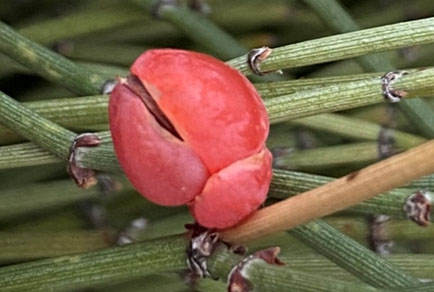
We present the results of a taxonomic study of the genus Ephedra in Croatia, based on field and herbarium research. Several Ephedra species were previously reported from this territory, however their occurrence was in many cases controversial due to misidentifications resulting from the use of morphological characters, not always diacritically valid. Our investigations confirmed that some Ephedra species were absent, while others were mentioned doubtfully or taxonomically critical. The only two species that are undoubtedly present in Croatia are E. foeminea (often identified as E. campylopoda) and E. procera. The former is widespread from sea level to 800 m of altitude, where it is mainly localized in rupestrian habitats. The latter, often attributed to E. nebrodensis or E. major, shows a scattered distribution within the same area as the previous one, but growing in open and sunny rocky environments. Furthermore, for comparative purposes, we also investigated E. nebrodensis, a species with a western Mediterranean distribution, and E. distachya, both to be excluded from the flora of Croatia. To clarify the nomenclatural aspects and the morphological, phenological, ecological, and chorological peculiarities of the investigated species, we provide detailed iconographies of the vegetative and reproductive structures based on living material, as well as information on the micromorphology of the seed testa and pollen grains.
References
- Amaral Franco do, J. (1986) Ephedra L. In: Castroviejo, S., Lainz, M., Lòpez Gonzàlez, G., Monteserrat, P., Muñoz Garmendia, F., Paiva, J. & Villar, L. (eds.) Flora Iberica, 1. Real Jardin Botanico, Madrid, pp. 192–195.
- Barthlott, W. (1981) Epidermal and seed surface character of plants: Systematic applicability and some evolutionary aspects. Nordic Journal of Botany 1: 345–355. https://doi.org/10.1111/j.1756-1051.1981.tb00704.x
- Baytop, Ö.T. (1950) Ephedra campylopoda C.A. Mey morphological, anatomical and chemical characteristics. Doktora Tezi, Istanbul Üniversitesl Tip Fakültesi n. 4, 39 pp. [in Turkish]
- Bertoloni, A. (1854) Flora Italica, vol. 10. Ex Typographeo Haeredum Richardi Masii, Bononiae, 639 pp.
- Blečić, V. & Horvatić, S. (1967) II. Subsection Gymnospermae. In: Horvatić, S. (Ed.) Analytic flora of Yugoslavia, vol. 1. Tisak Grafičkog Zavoda Hrvatske, Zagreb, pp. 157–180. [in Croatian]
- Bobrov, E.G. (1968) Ephedraceae. In: Komarov, V.L. (Ed.) Flora of the USSR, Vol. 1. Israel Program for Scientific Translations, Jerusalerm, pp. 154–160.
- Bolinder, K., Humphreys, A.M., Ehrlén, J., Alexandersson, R., Ickert-Bond, M. & Ryden, C. (2016a) From near extinction to diversification by means of a shift in pollination mechanism in the gymnosperm relict Ephedra (Ephedraceae, Gnetales). Botanical Journal of the Linnean Society 180: 461–477. https://doi.org/10.1111/boj.12380
- Bolinder, K., Niklas, K.J. & Rydin, C. (2015) Aerodynamics and pollen ultrastructure in Ephedra (Gnetales). American Journal of Botany 102: 457–470. https://doi.org/10.3732/ajb.1400517
- Bolinder, K., Norbäck Ivarsson, L., Humphreys, A.M., Ickert-Bond, S.M., Han, F., Hoorn, C. & Rydin, C. (2016b) Pollen morphology of Ephedra (Gnetales) and its evolutionary implications. Grana 55 (1): 24–51. https://doi.org/10.1080/00173134.2015.1066424
- Bornmüller, J. (1928) Beiträge zur Flora Macedoniens. III. Sammlungen in den Kriegsjahren 1916–1918. Botanische Jahrbücher für Systematik 60 (Beiblatt 140): 1–195.
- Boulos, L. (1999) Flora of Egypt, Vol. 1. (Azollaceae—Oxalidaceae). Al Hadara Publishing, Cairo, 419 pp.
- Brullo, S., Brullo, C., Cambria, S., Ilardi, V., Siracusa, G. & Giusso del Galdo, G. (2022a) Ephedra aurea (Ephedraceae), a new species from Sicily. Phytotaxa 530 (1): 1–20. https://doi.org/10.11646/phytotaxa.530.1.1
- Brullo, S., Brullo, C., Cambria, S., Ilardi, V., Siracusa, G., Minissale, P. & Giusso del Galdo, G. (2022b) Ephedra strongylensis (Ephedraceae), a new species from Aeolian islands (Sicily). Phytotaxa 576 (3): 250–264. https://doi.org/10.11646/phytotaxa.576.3.2
- Brullo, S., Cambria, S., Accogli, R.A., Costanzo, E. & Tomaselli, V. (2024) Considerazioni morfologiche, ecologiche, corologiche e fenologiche su Ephedra foeminea Forssk. (Ephedraceae) in Italia. Notiziario della Società Botanica Italiana 8 (2): 97–99.
- Brullo, S. & Del Guacchio, E. (2021) (2804) Proposal to reject the name Ephedra major (Ephedraceae). Taxon 70 (2): 431–432. https://doi.org/10.1002/tax.12479
- Camarda, I. & Valsecchi, F. (2008) Alberi e arbusti spontanei della Sardegna. Delphino Carlo, Sassari, 480 pp.
- Christensen, K.I. (1986) Ephedra L. In: Strid, A. (Ed.) Mountain flora of Greece, 1. Cambridge University Presse, Cambridge, pp. 49–50.
- Christensen, K.I. (1997) Ephedra L. In: Strid, A. & Tan, K. (Eds.) Flora Hellenica, 1. Koeltz. Königtein, pp. 15–17.
- Clusius, C. (1601) Rarioram plantam historia. Ex officina Plantiniana Apud Ioannem Moretum, Antverpiae, 364 pp.
- De Visiani, R. (1842) Flora Dalmatica, vol. 1. F. Hofmeister, Lipsiae, 252 pp.
- De Visiani, R. (1872) Florae Dalmaticae Supplementum. Opus suum novis curis castigante et augente. Typis Josephi Antonelli, Venetiis, 546 pp.
- Degen, A.von. (1936) Flora Velebitica, vol. 1. Ungarischen Akademie der Wissenschaften, Budapest, 662 pp.
- Del Guacchio, E., Cambria, S. & Brullo, S. (2021) Typification of the name Ephedra nebrodensis (Ephedraceae). Phytotaxa 496 (1): 90–92. https://doi.org/10.11646/phytotaxa.496.1.5
- Desfontain, R.L. (1799) Flora atlantica: sive historia plantarum quae in Atlante, agro tunetano et algeriensi crescunt, vol. 1. L.G. Desgranges, Parisiis, 444 pp.
- Dimopoulos, P., Raus, Th., Bergmeier, E., Constantinidis, Th., Iatrou, G., Kokkini, S., Strid, A. & Tzanoudakis, D. (2013) Vascular plants of Greece: An annotated checklist. Englera 31: 1–372. https://doi.org/10.3372/en.31
- Domac, R. (1994) Flora Hrvatske—Priručnik za određivanje bilja. Školska knjiga, Zagreb, 504 pp.
- Dufour, L. (1861) Diagnoses et observations critiques su quelques plantes d’Espagne mal connues o nouvelles. Bulletin de la Société Botanique de France 7: 441–448. https://doi.org/10.1080/00378941.1860.10829473
- Dumortier, B.C. (1829) Analyse des Familles des planttes, avec l’indication des principaux genres qui s’y rattachent. Imprimerie de J.Castermas, Ainé, Tournay, 104 pp. https://doi.org/10.5962/bhl.title.443
- Fischer, F.E.L., Meyer, C.A. & Ave-Lallemant, J.L. (1845) Index decimus seminum, quae Hortus Botanicus Imperialis Petropolitanus pro mutual commutation offert. Accedunt animadversions botanicae nonnullae. Ex Typis privilegio ornatis, G.Fischeri, Petropoli, 60 pp.
- Forsskål, P. (1775) Flora Aegyptiaco-Arabica: sive descriptiones plantarum quas per Aegyptum inferiorem et Arabiam felicem detexit. Ex officina Mölleri, Hauniae, 219 pp. https://doi.org/10.5962/bhl.title.6625
- Freitag, H. & Maier-Stolte, M. (1989) The Ephedra-species of P. Forsskål: identity and typification. Taxon 38: 545–556. https://doi.org/10.2307/1222629
- Freitag, H. & Maier-Stolte, M. (1993) Ephedra L. In: Tutin, T.G., Burges, N.A., Chater, A.O., Edmondson, J.R., Heywood, V.H., Moore, D.M., Valentine, D.H., Walters, S.M. & Webb, D.A. (Eds.) Flora Europaea (2nd ed.), vol. 1. Cambridge University Press, Cambridge, pp. 49.
- Gontcharova, S.B., Gontcharov, A.A., Yakubov, V.V. & Kondo, K. (2009) Seed surface morphology in some representatives of the genus Rhodiola sect. Rhodiola (Crassulaceae) in the Russian Far East. Flora 204: 17–24. https://doi.org/10.1016/j.flora.2008.01.009
- Grenier, M. & Godron, M. (1855) Flore de France; ou, Description des plantes qui croissent naturellement en France et en Corse. Vol. 3. J. B. Baillire, Paris, 779 pp.
- Greuter, W., Burdet, H.M. & Long, G. (1984) Med-Checklist, vol. 1. Emprimerie Atar S.A., Géneve, 330 pp.
- Gussone, G. (1844) Florae siculae synopsis 2 (2). Ex Typis Tramater, Neapoli [Naples], pp. 530–668.
- Hayek, A. (1924) Prodromus Florae Peninsulae Balcanicae, vol. 1. Repertorium specierum novarum regni vegetabilis 30 (1): 1–352.
- Hesse, M., Halbritter, H., Zetter, R., Weber, M., Buchner, R., FroschRadivo, A. & Ulrich, S. (2009) Pollen terminology. An illustrated handbook. Springer, Wein—New York, 264 pp.
- Hirc, D. (1904) Revision of the Croatian flora. Rad Jugoslavenske Akademije i Umejtnosti 159: 86–165. [in Croatian]
- Hirc, D. (1910) Flora of Marjan. Glasnik hrvatskog naravoslovnog drustva 22: 3–47. [in Croatian]
- Host, N.T. (1831) Flora Austriaca, vol. 2. Sumptibus Frider Beck Bibliop. Univers., Viennae, 767 pp. https://doi.org/10.7208/chicago/9780226839479.001.0001
- Ickert-Bond, S.M. & Rydin, C. (2011) Micromorphology of the seed envelope of Ephedra L. (Gnetales) and its relevance for the timing of evolutionary events. International Journal of Plant Sciences 172 (1): 36–48. https://doi.org/10.1086/657299
- IUCN (2024) Guidelines for Using the IUCN Red List Categories and Criteria, version 16. Prepared by the Standards and Petitions Committee. Available from: https://www.iucnredlist.org/documents/RedListGuidelines.pdf (accessed 31 January 2026)
- Jalas, J. & Suominen, J. (1973) Atlas Florae Europaeae. Distribution of vascular plants in Europe. 2. Gymnospermae (Pinaceae to Ephedraceae). The Committee for Mapping the Flora of Europe and Societas Biologica Fennica Vanamo, Helsinki, 40 pp.
- Košanin, N. (1926) Nove vrste u flori južne Srbije. Glas Srpske Kralevske Akademije 119: 19–29.
- Kušan, F. & Martinis, Z. (1964) Das Verbreitungszentrum von Ephedra nebrodensis Tin. in Kroatien. Informationes Botanicae 3: 10–16.
- Linnaeus, C. (1753) Species Plantarum, vol. 2. Laurentii Salvii, Holmiae, pp. 561–1200.
- Markgraf, F. (1964) Ephedraceae. In: Heywood, V.H. (Ed.) Notulae Systematicae ad Floram Europaeam spectantes no. 5. Feddes Repertorium 70 (1): 4. https://doi.org/10.1002/fedr.19650700103
- Meyer, C.A. (1845) Versuch einer Monographie der Gattung Ephedra durch Abbildungen erläutert. Extrait. Bulletin de la Classe Physico-Mathematique de l‘Academie Imperiale des Sciences de Saint-Pétersbourg 5: 33–36. https://doi.org/10.5962/bhl.title.7212
- Meyer, C.A. (1846) Versuch einer Monographie der Gattung Ephedra durch Abbildungen erläutert. Mémoires de l’Académie Impériale des Sciences de St. Pétersbourg, 6 série 5: 35–108. https://doi.org/10.5962/bhl.title.7212
- Mohr, O.W.P. & Meeuse, A.D.J. (1991) Note on some characteristics of Ephedra campylopoda C.A. Mey. Israel Journal of Botany 40 (4): 315–322.
- Nelson, J. (1866) Pinaceae: The handbook of the firs and the pines. Hatchard and Co., London, 223 pp. https://doi.org/10.5962/bhl.title.50457
- Niketić, M. (2018) The first record of Ephedra distachya L. (Ephedraceae, Gnetophyta) in Serbia—Biogeography, coenology, and conservation. Botanica Serbica 42 (1): 123–138.
- Nikolić, T. (1994) Flora Croatica: Index Florae Croaticae Pars 1. Natura Croatica 3 (Suppl. 2): 1–116.
- Nikolić, T. (2020) Flora Croatica—Vaskularna flora Republike Hrvatske, vol. 2. Alfa d.d., Zagreb, 854 pp.
- Nikolić, T., Bogdanović, S., Vuković, N. & Šegota, V. (Eds.) (2025) Flora Croatica Database. Department of Botany, Faculty of Science, University of Zagreb. Available from: http://hirc.botanic.hr/fcd (accessed 7 November 2025)
- Nouviant, J. (1996) Recherches sur Ephedra in Europe I: Typification de Ephedra distachya. Bulletin de la Murithienne 114: 127–134.
- Nouviant, J. (1998) Recherches sur Ephedra en Europe IV: critique de Ephedra nebrodensis. Bulletin de la Murithienne 116: 69–79.
- Parlatore, F. (1868) Gnetaceae. In: de Candolle, A. (ed.) Prodromus systematis naturalis regni vegetabilis, vol. 16 (2). Sumptibus Victoris Masson et filii, Parisiis, pp. 347–360.
- Porsch, O. (1910) Ephedra campylopoda C.A. Mey., eine entomophile Gymnosperme. Berichte der Deutschen Botanischen Gesellschaft 28: 404–412. https://doi.org/10.1111/j.1438-8677.1910.tb06911.x
- POWO (2025) Plants of the World online. Royal Botanical Garden Kew. [accessed 10 November 2025]
- Punt, W., Hoen, P.P., Blackmore, S., Nilsson, S. & Le Thomas, A. (2007) Glossary of pollen and spore terminology. Review of Palaeobotany and Palynology 143: 1–81. https://doi.org/10.1016/j.revpalbo.2006.06.008
- Raab-Straube, E. von (2022 onwards) Ephedraceae. In: Euro+Med Plantbase—the information resource for Euro-Mediterranean plant diversity. Available from: https://europlusmed.org/ (accessed 26 March 2026)
- Reichenbach, H.G.L. (1849) Icones florae Germanicae et Helveticae. Vol. 10 (1). Apud Friedericum Hofmeister, Lipsiae, 32 pp.
- Richard, A. (1826) Commentatio botanica de conifereis et cycadeis, characteres genericos singulorum utriusque familiae, et figuris analyticis eximiè ab autore ipso ad naturam delineatis ornatos complectens. Ex Typographia Pauli Renouardi Parisini, Stutgardiae, 212 pp.
- Richter, K. (1890) Plantae Europeae, vol. 1. Von Wilhelm Engelmann, Leipzig, 320 pp.
- Riedl, H. (1993) “Ephedra major”: zur Behandlung der Gattung Ephedra bei Clusius und Host. Linzer Biologische Beitrage 25 (2): 649–655.
- Rohlena, J. (1942) Conspectus Florae Montenegrinae. Preslia 20-21: 1–506.
- Ruščić, M. (2003) Urban flora of Split. Magistarski rad, Prirodoslovno-matematički fakultet, Sveučilište u Zagrebu, Zagreb, 148 pp. [in Croatian]
- Rydin, C., Blokzijl, R., Thureborn, O. & Wikström, N. (2021) Node ages, relationships, and phylogenomic incongruence in an ancient gymnosperm lineage. Phylogeny of Ephedra revisited. Taxon 70: 701–719. https://doi.org/10.1002/tax.12493
- Rydin, C. & Bolinder, K. (2015) Moonlight pollination in the gymnosperm Ephedra (Gnetales). Biology Letters 11: 20140993. https://doi.org/10.1098/rsbl.2014.0993
- Rydin, C., Khodabandeh, A. & Endress, P.K. (2010) The female reproductive unit of Ephedra (Gnetales): comparative morphology and evolutionary perspectives. Botanical Journal of the Linnean Society 163: 387–430. https://doi.org/10.1111/j.1095-8339.2010.01066.x
- Rydin, C. & Korall, P. (2009) Evolutionary relationships in Ephedra (Gnetales), with implications for seed plant phylogeny. International Journal of Plant Sciences 170: 1031–1043. https://doi.org/10.1086/605116
- Schlosser, J.C. & Farkaš-Vukotinović, L. (1869) Flora Croatica. Apud Fr. Župan, Zagrabiae, 1362 pp.
- Stapf, O. (1889) Die Arten der Gattung Ephedra. Denkschriften der Mathematisch-Naturwissenschaftlichen Classe der Kaiserlichen Akademie der Wissenschaften 56 (2): 1–112.
- Stork, A.L., Snogerup, S. & Wuest, J. (1980) Seed characters in Brassica section Brassica and some related groups. Candollea 35: 421–450.
- Tan, K., Panitsa, M. & Zieliński, J. (2024) The genus Ephedra (Ephedraceae) in Greece. Phytologia Balcanica 30 (3): 289–298. https://doi.org/10.7546/PhB.30.1.2024.3
- Thiers, B. (Ed.) (2025 [Continuously updated]) Index Herbariorum: A global directory of public herbaria and associated staff. New York Botanical Garden’s Virtual Herbarium. Available from: http://sweetgum.nybg.org/science/ih/ (accessed 1 December 2025)
- Turland, N.J., Wiersema, J.H., Barrie, F.R., Gandhi, K.N., Gravendyck, J., Greuter, W., Hawksworth, D.L., Herendeen, P.S., Klopper, R.R., Knapp, S., Kusber, W.-H., Li, D.-Z., May, T.W., Monro, A.M., Prado, J., Price, M.J., Smith, G.F. & Zamora Señoret, J.C. (2025) International Code of Nomenclature for algae, fungi, and plants (Madrid Code), 2025 Edition. Regnum Vegetabile 162, The University of Chicago Press, 303 pp.
- Vidaković, M. & Franjić, J. (2004) Gymnospermae. Sveučilište u Zagrebu, Šumarski fakultet, Zagreb, 823 pp. [in Croatian]
- Vukojičić, S., Jakovljević, K., Đurović, S., Kuzmanović, N., Janković, I. & Stevanović, V. (2014) Typification of the plant names described by Nedeljko Košanin from the Balkan Peninsula. Phytotaxa 163 (2): 104–112. https://doi.org/10.11646/phytotaxa.163.2.4
- Wagensommer, R.P. (2023) Floristic studies in the light of biodiversity knowledge and conservation. Plants 12 (16): 2973. https://doi.org/10.3390/plants12162973
- Wettstein, R.V. (1907) Über das Vorkommen zweigeschlechtiger Infloreszenzen bei Ephedra. Festschrift des Naturwissenschaftlichen Vereines an der Universität Wien 1907: 21–28.
- Zohary, M. (1966a) Flora Palaestina. Part 1., Plates. The Israel Academy of Sciences and Humanities, Jerusalem.
- Zohary, M. (1966b) Flora Palaestina. Part 1., Text. Equisetacae to Moringaceae. The Israel Academy of Sciences and Humanities, Jerusalem, 364 pp.