
Abstract
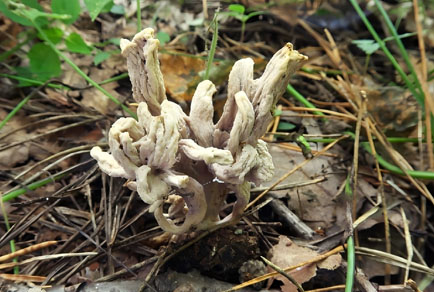
The species diversity of Clavulina (Hydnaceae) is concentrated in tropical and subtropical regions, whereas comparatively few species are known in temperate regions. Based on morphological and molecular evidence, a new coralloid species, Clavulina tumida, is described from specimens collected in Northeast China. Phylogenetic analysis of a combined dataset of ITS, LSU, and RPB2 sequences employing Maximum likelihood and Bayesian inference methods revealed that the newly collected samples formed a distinct lineage within the Clavulina clade, supporting their identification as a new species. The new species is primarily characterized by basidiomata branches that become swollen and thickened with age. We provide photographs, line drawings, and phylogenetic analysis for the new species, together with a key to all known Clavulina species in China. The holotype was deposited in the Mycological Herbarium of Hunan Normal University (MHHNU).
References
- Ben Ali, M.B.H., Boekhout, T. & Thorn, R.G. (2017) Assemblages of fungi associated with cork oak forests in northwestern Tunisia. Nova Hedwigia 105 (1–2): 121–134. https://doi.org/10.1127/nova_hedwigia/2016/0378
- Campo, E., Franchi, P. & Marchetti, M. (2023) Clavulina perplexa, una nuova specie trovata in Friuli-Venezia Giulia. Rivista di Micologia 66: 81–95.
- Chevallier, F.F. (1826) Flore Générale des Environs de Paris. 1. Ferra Jeune, 270 pp.
- Corner, E.J.H. (1950) A Monograph of Clavaria and Allied Genera. Oxford University Press, London, UK, 740 pp.
- Corner, E.J.H. (1957) Some Clavarias from Argentina. Instituto de Botánica Darwinion 11 (2): 193–206.
- Corner, E.J.H. (1970) Supplement to “A monograph of Clavaria and allied genera”. eihefte zur Nova Hedwigia 33: 1–299.
- Crous, P.W., Wingfield, M.J., Lombard, L., Roets, F., Swart, W.J., Alvarado, P., Carnegie, A.J., Moreno, G., Luangsa-Ard, J., Thangavel, R., Alexandrova, A.V., Baseia, I.G., Bellanger, J.-M., Bessette, A.E., Bessette, A.R., Delapeña-Lastra, S., García, D., Gené, J., Pham, T.H.G., Heykoop, M., Malysheva, E., Malysheva, V., Martín, M.P., Morozova, O.V., Noisripoom, W., Overton, B.E., Rea, A.E., Sewall, B.J., Smith, M.E., Smyth, C.W., Tasanathai, K., Visagie, C.M., Adamčík, S., Alves, A., Andrade, J.P., Aninat, M.J., Araújo, R.V.B., Bordallo, J.J., Boufleur, T., Baroncelli, R., Barreto, R.W., Bolin, J., Cabero, J., Caboň, M., Cafà, G., Caffot, M.L.H., Cai, L., Carlavilla, J.R., Chávez, R., Decastro, R.R.L., Delgat, L., Deschuyteneer, D., Dios, M.M., Domínguez, L.S., Evans, H.C., Eyssartier, G., Ferreira, B.W., Figueiredo, C.N., Liu, F., Fournier, J., Galli-Terasawa, L.V., Gil-Durán, C., Glienke, C., Gonçalves, M.F.M., Gryta, H., Guarro, J., Himaman, W., Hywel-Jones, N., Iturrieta-González, I., Ivanushkina, N.E., Jargeat, P., Khalid, A.N., Khan, J., Kiran, M., Kiss, L., Kochkina, G.A., Kolařík, M., Kubátová, A., Lodge, D.J., Loizides, M., Luque, D., Manjón, J.L., Marbach, P.A.S., Massolajr, N.S., Mata, M., Miller, A.N., Mongkolsamrit, S., Moreau, P.-A., Morte, A., Mujic, A., Navarro-Ródenas, A., Németh, M.Z., Nóbrega, T.F., Nováková, A., Olariaga, I., Ozerskaya, S.M., Palma, M.A., Petters-Vandresen, D.A.L., Piontelli, E., Popov, E.S., Rodríguez, A., Requejo, Ó., Rodrigues, A.C.M., Rong, I.H., Roux, J., Seifert, K.A., Silva, B.D.B., Sklenář, F., Smith, J.A. & Sousa, J.O. (2019) Fungal Planet description sheets: 951–1041. Persoonia 43: 223–425. https://doi.org/10.3767/persoonia.2019.43.06
- De Meiras-Ottoni, A. & Gibertoni, T.B. (2023) Clavarioid fungi from Brazil: novelties in Clavulina (Cantharellales). Mycological Progress 22: 25. https://doi.org/10.1007/s11557-023-01873-w
- Deng, P.T., Liu, X.F., Yan, J., Chen, Z.H. & Zhang, P. (2024) Update on the taxonomy of Clavulina in China Ⅱ: description of four new species from Hainan Island. Mycological Progress 23: 48. https://doi.org/10.1007/s11557-024-01988-8
- Deng, P.T., Zhong, J., Wu, C.L. & Zhang, P. (2022) Revision of the taxonomic rank of Clavulina rugosa var. tropica. Journal of Fungal Research 20: 292–297. https://link.cnki.net/doi/10.13341/j.jfr.2022.1555
- Deng, Y.L., Yang, R.C., Liu, W.T., Chen, M., Wang, K.S., Chen, D.X., Zhou, C.Q., Zhang, S.H. & Zhao, C.L. (2026) Clavulina mollis, sp. nov. (Hydnaceae, Cantharellales), a new fungal species from Southwest China revealed by morphology and phylogenetic analyses. New Zealand Journal of Botany 64: e70007. https://doi.org/10.1002/nzb2.70007
- Donk, M.A. (1933a) Revision der Niederländischen Homobasidiomycetae-Aphyllophoraceae. Mededelingen van het Botanisch Museum en Herbarium van de Rijksuniversiteit te Utrecht 9 (1): 1–278.
- Donk, M.A. (1933b) Revision der Niederländischen Homobasidiomycetae-Aphyllophoraceae. Teil II. Mededeelingen van de Nederlandsche Mycologische Vereeniging 22: 1–278.
- Feng, B., Wang, X.H., Ratkowsky, D., Gates, G., Lee, S.S., Grebenc, T. & Yang, Z.L. (2016) Multilocus phylogenetic analyses reveal unexpected abundant diversity and significant disjunct distribution pattern of the hedgehog mushrooms (Hydnum L.). Scientific Reports 6: 25586. https://doi.org/10.1038/srep25586
- Franchi, P. & Marchetti, M. (2018) Due nuove specie italiane del genere Clavulina. Rivista di Micologia 61: 3–21.
- Gao, Y., Tong, X., Zhou, H., Wang, H.Q., Li, C. & Hou, C.L. (2024) Three new species of the genus Clavulina (Hydnaceae, Cantharellales) from North China based on morphological and phylogenetic analysis. MycoKeys 108: 75–94. https://doi.org/10.3897/mycokeys.108.124004
- Gardes, M. & Bruns, T.D. (1993) ITS primers with enhanced specificity for basidiomycetes-application to the identification of mycorrhizae and rusts. Molecular Biology 2: 113–118. https://doi.org/10.1111/j.1365-294X.1993.tb00005.x
- Grebenc, T., Martín, M.P. & Kraigher, H. (2009) Ribosomal ITS diversity among the European species of the genus “Hydnum” (Hydnaceae). An del Jardín Botánico Madrid 66: 121–132. https://doi.org/10.3989/ajbm.2221
- Gäumann, E. (1926) Vergleichende Morphologie der Pilze. Verlag von Gustav Fischer, Jena, 495 pp.
- He, G., Chen, S.L. & Yan, S.Z. (2016) Morphological and molecular evidence for a new species in Clavulina from southwestern China. Mycoscience 57: 255–263. https://doi.org/10.1016/j.myc.2016.03.002
- Henkel, T.W., Meszaros, R., Aime, M.C. & Kennedy, A. (2005) New Clavulina species from the Pakaraima mountains of Guyana. Mycological Progress 4: 343–350. https://doi.org/10.1007/s11557-006-0140-6
- Henkel, T.W., Aime, M.C., Uehling, J.K. & Smith, M.E. (2011) New species and distribution records of Clavulina (Cantharellales, Basidiomycota) from the Guiana Shield. Mycologia 103: 883–894. https://doi.org/10.3852/10-355
- Hu, Y., Karunarathna, S.C., Li, H., Galappaththi, M.C., Zhao, C.L., Kakumyan, P. & Mortimer, P.E. (2022) The impact of drying temperature on basidiospore size. Diversity 14 (4): 239. https://doi.org/10.3390/d14040239
- Huang, X.X., Chen, Y.X., Lin, Z.J., Liang, Y.S. & Qiu, L.H. (2023) Three new Clavulina species from Baiyun mountain, Guangzhou, China. Mycological Progress 22: 85. https://doi.org/10.1007/s11557-023-01929-x
- Kornerup, A. & Wanscher, J.H. (1978) Methuen handbook of colour. Methuen, London.
- Li, Y., Li, T.H., Yang, Z.L., Bau, T. & Dai, Y.C. (2015) Atlas of Chinese macrofungal resources. Central China Publish, Zhengzhou.
- Olariaga, I. & Salcedo, I. (2012) New combinations and notes in clavarioid fungi. Mycotaxon 121: 37–44. https://doi.org/10.5248/121.37
- Linnaeus, C. (1753) Species Plantarum. Laurentius Salvius, Stockholm, pp. 1178.
- Liu, X.F., Deng, P.T., Yan, J. & Zhang, P. (2024a) Update on the taxonomy of Clavulina in China Ⅰ: description of three new species and one newly recorded species. Mycological Progress 23: 45. https://doi.org/10.1007/s11557-024-01980-2
- Liu, X.F., Deng, P.T., Wang, X.Y. & Zhang, P. (2024b) A new edible Clavulina species from Hunan Province, China. Phytotaxa 661 (2): 169–180. https://doi.org/10.11646/phytotaxa.661.2.4
- Nylander, J.A.A. (2004) MrModeltest v2.0. Evolutionary Biology Centre, Uppsala, Sweden.
- Olariaga, I., Jugo, B.M., García-Etxebarria, K. & Salcedo, I. (2009) Species delimitation in the European species of Clavulina (Cantharellales, Basidiomycota) inferred from phylogenetic analyses of ITS region and morphological data. Mycological Research 113 (11): 1261–1270. https://doi.org/10.1016/j.mycres.2009.08.008
- Pérez-Pazos, E., Villegas-Ríos, M., Garibay-Orijel, R. & Salas-Lizana, R. (2019) Two new species of Clavulina and the first record of Clavulina reae from temperate Abies religiosa forests in central Mexico. Mycological Progress 18: 1187–1200. https://doi.org/10.1007/s11557-019-01516-z
- Persoon, C.H. (1799) Observationes Mycologicae. Wolf, Leipzig, pp. 95.
- Petersen, R.H. (1988) The clavarioid fungi of New Zealand. DSIR Science Information Publishing, Wellington, New Zealand.
- Phookamsak, R., Hyde, K.D., Jeewon, R., Bhat, D.J., Jones, E.B.G., Maharachchikumbura, S.S.N., Raspe, O., Karunarathna, S.C., Wanasinghe, D.N., Hongsanan, S., Doilom, M., Tennakoon, D.S., Machado, A.R., Firmino, A.L., Ghosh, A., Karunarathna, A., Mesic, A., Dutta, A.K., Thongbai, B., Devadatha, B., Norphanphoun, C., Senwanna, C., Wei, D.P., Pem, D., Ackah, F.K., Wang, G.N., Jiang, H.B., Madrid, H., Lee, H.B., Goonasekara, I.D., Manawasinghe, I.S., Kusan, I., Cano, J., Gene, J., Li, J.F., Das, K., Acharya, K., Raj, K.N.A., Latha, K.P.D., Chethana, K.W.T., He, M.Q., Duenas, M., Jadan, M., Martin, M.P., Samarakoon, M.C., Dayarathne, M.C., Raza, M., Park, M.S., Telleria, M.T., Chaiwan, N., Matocec, N., de Silva, N.I., Pereira, O.L., Singh, P.N., Manimohan, P., Uniyal, P., Shang, Q.J., Bhatt, R.P., Perera, R.H., Alvarenga, R.L.M., Nogal-Prata, S., Singh, S.K., Vadthanarat, S., Oh, S.Y., Huang, S.K., Rana, S., Konta, S., Paloi, S., Jayasiri, S.C., Jeon, S.J., Mehmood, T., Gibertoni, T.B. & Nguyen, T.T.T. (2019) Fungal diversity notes 929–1035: taxonomic and phylogenetic contributions on genera and species of fungi. Fungal Diversity 95: 1–273. https://doi.org/10.1007/s13225-019-00421-w
- Rambaut, A. (2012) FigTree v1.4. University of Edinburgh, Edinburgh, UK, 575. http://tree.bio.ed.ac.uk/software/figtree
- Rathnayaka, A.R., Tennakoon, D.S., Jones, G.E., Wanasinghe, D.N., Bhat, D.J., Priyashantha, A.H. & Stephenson, S.L. & Tibpromma, S. (2025) Significance of precise documentation of hosts and geospatial data of fungal collections, with an emphasis on plant-associated fungi. New Zealand Journal of Botany 63 (2–3): 462–489. https://doi.org/10.1080/0028825X.2024.2381734
- Ridgway, R. (1912) Color Standards and Color Nomenclature. Published by the author, Washington, DC, USA, 252 pp. https://doi.org/10.5962/bhl.title.144788
- Roberts, P. (1999) Clavarioid Fungi from Korup National Park, Cameroon. Kew Bulletin 54 (3): 517–539. https://doi.org/10.2307/4110853
- Ronquist, F., Teslenko, M., vander Mark, P., Ayres, D.L., Darling, A., Höhna, S., Larget, B., Liu, L. & Huelsenbeck, J.P. (2012) MrBayes 3.2: efficient Bayesian phylogenetic inference and model choice a cross a large model space. Systematic Biology 61: 539–542. https://doi.org/10.1093/sysbio/sys029
- Salas-Lizana, R., Villegas-Ríos, M., Alvarez-Manjarrez, J., Pérez-Pazos, E., Farid, A., Franck, A. & Garibay-Orijel, R. (2023) Neotropical Clavulina: two new species from Mexico and a re-evaluation of Clavulina floridana. Mycologia 1–18. https://doi.org/10.1080/00275514.2022.2148191
- Schröter, J. (1888) Pilze Cohn F (Ed.) Kryptogamen-Flora von Schlesien 1 (4).
- Stamatakis, A. (2006) RAxML-VI-HPC: maximum likelihoodbased phylogenetic analyses with thousands of taxa and mixed models. Bioinformatics 22: 2688–2690. https://doi.org/10.1093/bioinformatics/btl446
- Stamatakis, A., Ludwig, T. & Meier, H. (2005) RAxML-III: a fast program for maximum likelihood—based inference of large phylogenetic trees. Bioinformatics 21: 456–463. https://doi.org/10.1093/bioinformatics/bti191
- Stamatakis, A., Hoover, P. & Rougemont, J. (2008) A rapid bootstrap algorithm for the raxml web servers. Systematic Biology 57: 758. https://doi.org/10.1080/10 635150802429642
- Tedersoo, L., Jairus, T., Horton, B.M., Abarenkov, K., Suvi, T., Saar, I. & Kõljalg, U. (2008) Strong host preference of ectomycorrhizal fungi in a Tasmanian wet sclerophyll forest as revealed by DNA barcoding and taxon-specific primers. New Phytologist 180: 479–490. https://doi.org/10.1111/j.1469-8137.2008.02561.x
- Teng, S.C. (1963) Fungi of China. Science Press, Beijing.
- Thacker, J.R. & Henkel, T.W. (2004) New species of Clavulina from Guyana. Mycologia 96: 650–657. https://doi.org/10.2307/3762182
- Tibpromma, S., Hyde, K.D., Jeewon, R., Maharachchikumbura, S.S.N., Liu, J.K., Bhat, D.J., Jones, E.B.G., McKenzie, E.H.C., Camporesi, E., Bulgakov, T.S., Doilom, M., Santiago, A.L.C.M.D., Das, K., Manimohan, P., Gibertoni, T.B., Lim, Y.W., Ekanayaka, A.H., Thongbai, B., Lee, H.B., Yang, J.B., Kirk, P.M., Sysouphanthong, P., Singh, S.K., Boonmee, S., Dong, W., Raj, K.N.A., Latha, K.P.D., Phookamsak, R., Phukhamsakda, C., Konta, S., Jayasiri, S.C., Norphanphoun, C., Tennakoon, D.S., Li, J.F., Dayarathne, M.C., Perera, R.H., Xiao, Y.P., Wanasinghe, D.N., Senanayake, I.C., Goonasekara, I.D., de Silva, N.I., Mapook, A., Jayawardena, R.S., Dissanayake, A.J., Manawasinghe, I.S., Chethana, K.W.T., Luo, Z.L., Hapuarachchi, K.K., Baghela, A., Soares, A.M., Vizzini, A., MeirasOttoni, A., Mesic, A., Dutta, A.K., de Souza, C.A.F., Richter, C., Lin, C.G., Chakrabarty, D., Daranagama, D.A., Lima, D.X., Chakraborty, D., Ercole, E., Wu, F., Simonini, G., Vasquez, G., da Silva, G.A., Plautz, H.L., Ariyawansa, H.A., Lee, H., Kusan, I., Song, J., Sun, J., Karmakar, J., Hu, K., Semwal, K.C., Thambugala, K.M., Voigt, K., Acharya, K., Rajeshkumar, K.C., Ryvarden, L., Jadan, M., Hosen, M.I., MiksiK, M., Samarakoon, M.C, Wijayawardene, N.N., Kim, N.K., Matocec, N., Singh, P.N., Tian, Q., Bhatt, R.P., de Oliveira, R.J.V., Tulloss, R.E., Aamir, S., Kaewchai, S., Marathe, S.D., Khan, S., Hongsanan, S., Adhikari, S., Mehmood, T., Bandyopadhyay, T.K., Svetasheva, T.Y., Nguyen, T.T.T., Antonin, V., Li, W.J., Wang, Y., Indoliya, Y., Tkalcec, Z., Elgorban, A.M., Bahkali, A.H., Tang, A.M.C., Su, H.Y. & Zhang, H. (2017) Fungal diversity notes 491–602: taxonomic and phylogenetic contributions to fungal taxa. Fungal Diversity 83: 1–261. https://doi.org/10.1007/s13225-017-0378-0
- Uehling, J.K., Henkel, T.W., Aime, M.C., Vilgalys, R. & Smith, M.E. (2012a) New species and distribution records for Clavulina (Cantharellales, Basidiomycota) from the Guiana Shield, with a key to the lowland neotropical taxa. Fungal Biology 116: 1263–1274. https://doi.org/10.1016/j.funbio.2012.09.004
- Uehling, J.K., Henkel, T.W., Aime, M.C., Vilgalys, R. & Smith, M.E. (2012b) New species of Clavulina with effused or resupinate basidiomata from the Guiana Shield. Mycologia 104: 547–556. https://doi.org/10.3852/11-130
- Uehling, J.K., Henkel, T.W., Vilgalys, R. & Smith, M.E. (2012c) Membranomyces species are common ectomycorrhizal symbionts in Northern Hemisphere forests. Mycorrhiza 22: 577–581. https://doi.org/10.1007/s00572-012-0457-8
- Vaidya, G., Lohman, D.J. & Meier, R. (2011) Sequencematrix: concatenation software for the fast assembly of multi-gene datasets with character set and codon information. Cladistics 27: 171–180. https://doi.org/10.1111/j.1096-0031.2010.00329.x
- Vilgalys, R. & Hester, M. (1990) Rapid genetic identification and mapping of enzymatically amplified ribosomal DNA from several Cryptococcus species. Journal of Bacteriology 172: 4238–4246. https://doi.org/10.1128/jb.172.8.4238-4246.1990
- Wu, C.L., He, Y., Yan, J. & Zhang, P. (2019) Two new species of Clavulina (Cantharellales) from southwestern China based on morphological and molecular evidence. Mycological Progress 18: 1071–1078. https://doi.org/10.1007/s11557-019-01506-1
- Yuan, H.S., Lu, X., Dai, Y.C, Hyde, K.V.D., Kan, Y.H., Kusan, I., He, S.H., Liu, N.G, Sarma, V.V., Zhao, C.L., Cui, B.K., Yousaf, N., Sun, G.Y., Liu, S.Y., Wu, F., Lin, C.G., Dayarathne, M.C., Gibertoni, T.B., Conceicao, L.B., Garibay-Orijel, R., Villegas-Rios, M., Salas-Lizana, R., Wei, T.Z., Qiu, J.Z, Yu, Z.F., Phookamsak, R.T., Zeng, M., Paloi, S., Bao, D.F., Abeywickrama, P.D., Wei, D.P., Yang, J., Manawasinghe, I.S., Harishchandra, D., Brahmanage, R.S., de Silva, N.I., Tennakoon, D.S., Karunarathna, A., Gafforov, Y., Pem, D., Zhang, S.N., Santiago, A.L.C.M.D., Bezerra, J.D.P., Dima, B., Acharya, K., Alvarez-Manjarrez, J., Bahkali, A.H., Bhatt, V.K., Brandrud, T.E, Bulgakov, T.S., Camporesi, E, Cao, T., Chen, Y.X., Chen, Y.Y., Devadatha, B., Elgorban, A.M., Fan, L.F., Du, X., Gao, L., Goncalves, C.M., Gusmao, L.F.P., Huanraluek, N., Jadan, M., Jayawardena, R.S., Khalid, A.N., Langer, E., Lima, D.X., de Lima-Junior, N.C., de Lira, C.R.S., Liu, J.K., Liu, S., Lumyong, S., Luo, Z.L., Matocec, N., Niranjan, M., Oliveira, J.R.C., Papp, V., Perez-Pazos, E., Phillips, A.J.L., Qiu, P.L., Ren, Y.H., Ruiz, R.F.C., Semwal, K.C., Soop, K., de Souza, C.A.F., SouzaMotta, C.M., Sun, L.H., Xie, M.L., Yao, Y.J., Zhao, Q. & Zhou, L.W. (2020) Fungal diversity notes 1277–1386: taxonomic and phylogenetic contributions to fungal taxa. Fungal Diversity 104: 1–266. https://doi.org/10.1007/s13225-020-00461-7
- Zang, M., Li, B. & Xi, J.X. (1996) Fungi of the Hengduan mountains. Science Press, Beijing.