
Abstract
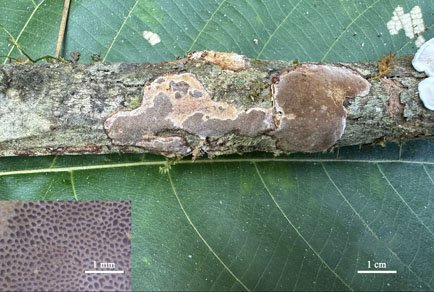
A new species and a new record of Fuscoporia species were discovered in the Xizang Autonomous Region, China, through integrated morphological and molecular phylogenetic analyses. The new species, described as Fuscoporia medogensis, was characterized by annual, resupinate basidiomata, sinuous pores (7–9 per mm), and cylindrical basidiospores measuring 4.5–5.5 × 1.5–2.0 μm. The new record, identified as Fuscoporia viticola, was determined based on five specimens collected on Pinus yunnanensis. Phylogenetic analyses of combined ITS and nLSU rDNA sequences strongly support the distinct status of these taxa within the genus Fuscoporia. Our study contributes to the taxonomy of Fuscoporia by raising the number of known Chinese species to 29 and providing a diagnostic key, thereby enhancing knowledge of fungal diversity in high-altitude ecosystems.
References
- Anonymous. (1969) Flora of British fungi. Colour identification chart. Her Majesty´s Stationery Office, London.
- Chen, Q., Chen, H., Luo, C.H. & Lai, X.H. (2024) Molecular phylogeny and morphology of the genus Fuscoporia (Hymenochaetales, Basidiomycota) and reveal three new species of the F. ferrea group. Mycokeys 111: 21–40. https://doi.org/10.3897/mycokeys.111.126446
- Chen, Q., Chen, H., Luo, C.H. & Zhang, D.S. (2025) A new species of Fuscoporia (Hymenochaetales, Basidiomycota) from Southwest China by the morphological and molecular phylogenetic analyses. New Zealand Journal of Botany 63 (5): 1600–1613. https://doi.org/10.1080/0028825X.2025.2517406
- Chen, Q. & Dai, Y.C. (2019) Two new species of Fuscoporia (Hymenochaetales, Basidiomycota) from southern China based on morphological characters and molecular evidence. Mycokeys 61: 75–89. https://doi.org/10.3897/mycokeys.61.46799
- Chen, Q., Du, P., Vlasák, J., Wu, F. & Dai, Y.C. (2020) Global diversity and phylogeny of Fuscoporia (Hymenochaetales, Basidiomycota). Mycosphere 11 (1): 1477–1513. https://doi.org/10.5943/mycosphere/11/1/10
- Chen, Q., Luo, H.D., Cheng, N. & Zhang, D.S. (2023) Morphological and molecular evidence for a new species of Fuscoporia (Hymenochaetales, Basidiomycota) from tropics. Phytotaxa 619 (3): 219–231. https://doi.org/10.11646/phytotaxa.619.3.2
- Chen, Q., Wu, F., Ji, X.H., Si, J., Zhou, L.W., Tian, X.M., Vlasák, J. & Dai, Y.C. (2019) Phylogeny of the genus Fuscoporia and taxonomic assessment of the F. contigua group. Mycologia 111: 1–22. https://doi.org/10.1080/00275514.2019.1570749
- Chen, Q. & Yuan, Y. (2017) A new species of Fuscoporia (Hymenochaetales, Basidiomycota) from southern China. Mycosphere 8: 1238–1245. https://doi.org/10.5943/mycosphere/8/6/9
- Cui, B.K., Li, H.J., Ji, X., Zhou, J.L., Song, J., Si, J., Yang, Z.L. & Dai, Y.C. (2019) Species diversity, taxonomy and phylogeny of Polyporaceae (Basidiomycota) in China. Fungal Diversity 97: 137–392. https://doi.org/10.1007/s13225-019-00427-4
- Cui, B.K. & Zhao, C.L. (2012) Morphological and molecular evidence for a new species of Perenniporia (Basidiomycota) from Tibet, southwestern China. Mycoscience 53: 365–372. https://doi.org/10.1007/s10267-011-0180-x
- Cunningham, G.H. (1948) New Zealand Polyporaceae 2. The genus Fuscoporia. Bulletin of the New Zealand Department of Industrial Research 73: 1–14.
- Dai, Y.C., Cui, B.K., Yuan, H.S. & Li, B.D. (2007) Pathogenic wood-decaying fungi in China. Forest Pathology 37: 105–120. https://doi.org/10.1111/j.1439-0329.2007.00485.x
- Deveci, E., Tel-Çayan, G., Duru, M.E. & Öztürk, M. (2019) Isolation, characterization, and bioactivities of compounds from Fuscoporia torulosa mushroom. Food Biochem 43 (12): e13074. https://doi.org/10.1111/jfbc.13074
- Dong, J.H., Li, Q., Yuan, Q., Luo, Y.X., Zhang, X.C., Dai, Y.F., Zhou, Q., Liu, X.F., Deng, Y.L., Zhou, H.M. & Muhammad, A. & Zhao, C.L. (2024) Species diversity, taxonomy, molecular systematics and divergence time of wood-inhabiting fungi in Yunnan-Guizhou Plateau, Asia. Mycosphere 15: 1110–1293. https://doi.org/10.5943/mycosphere/15/1/10
- Duong, T.H. & Dang, N.Q. (2022) Total phenolic, flavonoid content and antioxidative, α-amylase inhibitory activity of Phellinus gilvus fruiting body extracts. Journal of Science: Natural Sciences Technology. https://doi.org/10.25073/2588-1140/vnunst.5171
- Felsenstein, J. (1985) Confidence intervals on phylogenetics: an approach using bootstrap. Evolution 39: 783–791.
- Fiasson, J.L. & Niemelä, T. (1984) The Hymenochaetales: a revision of the European poroid taxa. Karstenia 24: 14–28. https://doi.org/10.29203/ka.1984.224
- Gilbertson, R.L. (1979) The genus Phellinus (Aphyllophorales: Hymenochaetaceae) in western North America. Mycotaxon 9: 51–89. https://doi.org/10.5962/p.417197
- Hall, T.A. (1999) Bioedit: a user-friendly biological sequence alignment editor and analysis program for Windows 95/98/NT. Nucleic Acids Symposium Series 41: 95–98. https://doi.org/10.1021/bk-1999-0734.ch008
- Kalyaanamoorthy, S., Minh, B.Q., Wong, T.K.F., von Haeseler, A. & Jermiin, L.S. (2017) ModelFinder: Fast model selection for accurate phylogenetic estimates. Nature Methods 14 (6): 587–589. https://doi.org/10.1038/nmeth.4285
- Katoh, K., Rozewicki, J. & Yamada, K.D. (2017) MAFFT online service: Multiple sequence alignment, interactive sequence choice and visualization. Briefings in Bioinformatics 20 (4): 1160–1166. https://doi.org/10.1093/bib/bbx108
- Larsen, M.J. & Cobb-Poulle, L.A. (1990) Phellinus (Hymenochaetaceae). A survey of the world taxa. Synopsis Fungorum 3: 1–206. https://doi.org/10.2307/3760175
- Liu, Z.B., Wu, Y.D., Zhao, H., Lian, Y.P., Wang, Y.R., Wang, C.G., Mao, W.L. & Yuan, Y. (2022) Outline, divergence times, and phylogenetic analyses of Trechisporales (Agaricomycetes, basidiomycota). Frontiers in Microbiology 13. https://doi.org/10.3389/fmicb.2022.818358
- Lowe, J.L. (1966) Polyporaceae of North America. The genus Poria. Technical Publication of the State University College of Forestry at Syracuse University 90: 1–183.
- Luana, G., Fabiano, S., Fabio, G. & Paolo, G. (2015) Comparing visual inspection of trees and molecular analysis of internal wood tissues for the diagnosis of wood decay fungi. Forestry 88 (4): 465–470. https://doi.org/10.1093/forestry/cpv015
- Murrill, W.A. (1907) Polyporaceae, Part 1. North American Flora 9: 1–72.
- Overholts, L.D. (1953) The Polyporaceae of the United States, Alaska and Canada. University of Michigan Press, Ann Arbor.
- Panconesi, A., Santini, A. & Casini, N. (1994) Phellinus torulosus on Cupressus sem-pervirens in Italy. Forest Pathology 24 (4): 238–240. https://doi.org/10.1111/j.1439-0329.1994.tb00990.x
- Petersen, J.H. (1996) Farvekort. The Danish Mycological Society’s colour-chart. Greve: Foreningen til Svampekundskabens Fremme, Greve, pp. 1–6.
- Rambaut, A. (2018) Molecular evolution, phylogenetics and epidemiology. FigTree ver. 1.4.4 software. [accessed October 2022]
- Ronquist, F. & Huelsenbeck, J.P. (2003) MrBayes 3: Bayesian phylogenetic inference under mixed models. Bioinformatics 19: 1572–1574. https://doi.org/10.1093/bioinformatics/btg180
- Ryvarden, L. & Gilbertson, R.L. (1994) European polypores 2. Synopsis Fungorum 7: 394–743. https://doi.org/10.1093/bioinformatics/btl446
- Si, J., Zhang, Y.Z., Liang, J.Q. & Li, H.J. (2023) Morphology and phylogeny identify two new species and one new subspecies of Podoscypha from yunnan province, southwest China. Front. Microbiol 14. https://doi.org/10.3389/fmicb.2023.1151365
- Silvestro, D. & Michalak, I. (2012) raxmlGUI: a graphical front-end for RAxML. Organisms Diversity and Evolution 12: 335–337. https://doi.org/10.1007/s13127-011-0056-0
- Song, J. & Cui, B.K. (2017) Phylogeny, divergence time and historical biogeography of Laetiporus (Basidiomycota, Polyporales). BMC Evolutionary Biology 17: 102. https://doi.org/10.1186/s12862-017-0948-5
- Swofford, D.L. (2002) PAUP*: Phylogenetic analysis using parsimony (*and other methods). Version 4.0b10. Massachusetts: Sinauer Associates. https://doi.org/10.1111/j.0014-3820.2002.tb00191
- Thompson, J.D., Gibson, T.J., Plewniak, F., Jeanmougin, F. & Higgins, D.G. (1997) The clustal_X windows interface: Flexible strategies for multiple sequence alignment aided by quality analysis tools. Nucleic Acids Research 25: 4876–4882. https://doi.org/10.1093/nar/25.24.4876
- Vilgalys, R. & Hester, M. (1990) Rapid genetic identification and mapping of enzymatically amplified ribosomal DNA from several Cryptococcus species. Journal of Bacteriology 172: 4238–4246. https://doi.org/10.1128/jb.172.8.4238-4246.1990
- Vlasák, J., Kout, J., Chen, Q. & Dai, Y.C. (2020) Fuscoporia caymanensis sp. nov. (Basidiomycota, Hymenochaetaceae), a new species from tropical America. Phytotaxa 472: 135–146. https://doi.org/10.11646/phytotaxa.472.2.4
- Vlasák, J., Vlasák, J. Jr. & Ryvarden, L. (2012) Four new polypore species from the western United States. Mycotaxon 119: 217–231. https://doi.org/10.5248/119.217
- Wagner, T. & Fischer, M. (2001) Natural groups and a revised system for the European poroid Hymenochaetales (Basidiomycota) supported by nLSU rDNA sequence data. Mycological Research 105: 773–782. https://doi.org/10.1017/S0953756201004257
- Wagner, T. & Fischer, M. (2002) Proceedings towards a natural classification of the worldwide taxa Phellinus s.l. and Inonotus s.l., and phylogenetic relationships of allied genera. Mycologia 94: 998–1016. https://doi.org/10.1080/15572536.2003.11833156
- Wang, C.G., Dai, Y.C., Kout, J., Gates, G.M., Liu, H.G., Yuan, Y. & Vlasák, J. (2024) Multi-gene phylogeny and taxonomy of Physisporinus (Polyporales, Basidiomycota). Mycosphere 15 (1): 1455–1521. https://doi.org/10.5943/mycosphere/15/1/12
- Wang, K., Liu, L.S., Liu, Z.X., Hong, P., Wei, W.H., Wang, Y., Dorji, P. & Zhou, W.L. (2025) Catalogue of fungi in China 3. New taxa of macrofungi from southern Xizang, China. Mycology 16 (1): 91–123. https://doi.org/10.1080/21501203.2024.2392014
- White, T.J., Bruns, T.D., Lee, S. & Taylor, J. (1990) “Amplification and direct sequencing of fungal ribosomal RNA genes for phylogenetics,” In: Innis, M.A., Gelfand, D.H., Sninsky, J.J. & White, T.J. (Eds.) PCR protocols: a guide to methods and applications, pp. 315–322. https://doi.org/10.1016/B978-0-12-372180-8.50042-1
- Wu, F., Zhou, L.W., Vlasák, J. & Dai, Y.C. (2022) Global diversity and systematics of Hymenochaetaceae with poroid hymenophore. Fungal Diversity 113: 1–192. https://doi.org/10.21203/rs.3.rs-719853/v1
- Xu, M.T., Wu, M.D., Gao, N., Liu, S. & Sun, F.Y. (2025) Species diversity, taxonomic classification and ecological habits of polypore fungi in China. Mycology 16 (2): 419–544. https://doi.org/10.1080/21501203.2024.2384567
- Yuan, H.S., Lu, X., Dai, Y.C., Hyde, K.V.D., Kan, Y.H., Kušan, I., He, S.H., Liu, N.G., Sarma, V.V., Zhao, C.L., Cui, B.K., Yousaf, N., Sun, G.Y., Liu, S.Y., Wu, F., Lin, C.G., Dayarathne, M.C., Gibertoni, T.B., Conceiçao, L.B., Garibay-Orijel, R., Villegas-Ríos, M., Salas-Lizana, R., Wei, T.Z., Qiu, J.Z., Yu, Z.F., Phookamsak, R.T., Zeng, M., Paloi, S., Bao, D.F., Abeywickrama, P.D., Wei, D.P., Yang, J., Manawasinghe, I.S., Harishchandra, D., Brahmanage, R.S., de Silva, N.I., Tennakoon, D.S., Karunarathna, A., Gafforov, Y., Pem, D., Zhang, S.N., Santiago, A.L.C.M.D., Bezerra, J.D.P., Dima, B., Acharya, K., Alvarez-Manjarrez, J., Bahkali, A.H., Bhatt, V.K., Brandrud, T.E., Bulgakov, T.S., Camporesi, E., Cao, T., Chen, Y.X., Chen, Y.Y., Devadatha, B., Elgorban, A.M., Fan, L.F., Du, X., Gao, L., Gonçalves, C.M., Gusmao, L.F.P., Huanraluek, N., Jadan, M., Jayawardena, R.S., Khalid, A.N., Langer, E., Lima, D.X., de Lima-Júnior, N.C., de Lira, C.R.S., Liu, J.K., Liu, S., Lumyong, S., Luo, Z.L., Matocec, N., Niranjan, M., Oliveira, J.R.C., Papp, V., Pérez-Pazos, E., Phillips, A.J.L., Qiu, P.L., Ren, Y.H., Ruiz, R.F.C., Semwal, K.C., Soop, K., de Souza, C.A.F., Souza-Motta, C.M., Sun, L.H., Xie, M.L., Yao, Y.J., Zhao, Q. & Zhou, L.W. (2020) Fungal diversity notes 1277–1386: taxonomic and phylogenetic contributions to fungal taxa. Fungal Diversity 104 (1): 1–266. https://doi.org/10.1007/s13225-020-00461-7
- Zhao, C.L., Qu, M.H., Huang, R.X. & Karunarathna, S.C. (2023) Multi‐gene phylogeny and taxonomy of the wood‐rotting fungal genus Phlebia sensu lato (Polyporales, Basidiomycota). Journal of Fungi 9: 1–41. https://doi.org/10.3390/jof9030320
- Zhang, D., Gao, F., Jakovlić, I., Zou, H., Zhang, J., Li, W.X. & Wang, G.T. (2020) PhyloSuite: An integrated and scalable desktop platform for streamlined molecular sequence data management and evolutionary phylogenetics studies. Molecular Ecology Resources 20: 348–355. https://doi.org/10.1111/1755-0998.13096
- Zhang, Q.Y., Liu, Z.B., Liu, H.G. & Si, J. (2023) Two new corticioid species of Phanerochaetaceae (Polyporales, Basidiomycota) from southwest China. Frontiers in Cellular and Infection Microbiology 13. https://doi.org/10.3389/fcimb.2023.1105918
- Zhou, H.M., Baum, T. & Si, J. (2023) Morphological and phylogenetic evidence reveal three new Pseudohydnum (Auriculariales, Basidiomycota) species from north China. Frontiers in Cellular and Infection Microbiology 13. https://doi.org/10.3389/fcimb.2023.1139449
- Zhou, M.H., Zhang, C.X., Li, J.T., Wu, F. & Zhao, C.L. (2024) Morphological characteristics and phylogenetic analyses revealed four new wood inhabiting fungi (Agaricomycetes, Basidiomycota) in Xizang Autonomous Region, China. MycoKeys 106: 201–224. https://doi.org/10.3897/mycokeys.113.140932
- Zhu, L., Song, J., Zhou, J.L., Si, J. & Cui, B.K. (2019) Species diversity, phylogeny, divergence time and biogeography of the genus Sanghuangporus (Basidiomycota). Frontiers in Microbiology 10: 812. https://doi.org/10.3389/fmicb.2019.00812