
Abstract
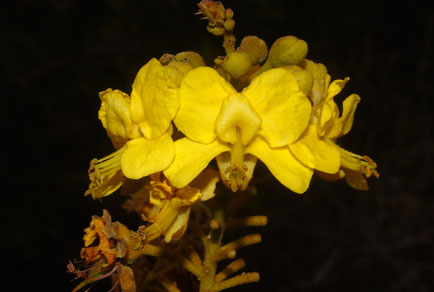
Cenostigma lewisii, a new species from northeastern Brazil, within the Caatinga phytogeographic domain, is here described and illustrated. The new species is morphologically similar to Cenostigma microphyllum, with which it is often confused, but can be distinguished by its glabrous leaf buds (vs. pubescent in C. microphyllum), leaves with 3–6(–7) pairs of pinnae + terminal pinna (vs. 7–13 pairs + terminal pinna), median leaflets 6–10(–16) × 4–7(–10) mm (vs. median leaflets 2–5.1 × 1.2–3.3 mm), inflorescences 7.8–18 cm long (vs. 4.2–7.8 cm long), and glabrescent to sparsely velutinous fruits; glands very sparse when present and non-sticky (vs. sparsely pubescent and densely glandular, sticky fruits). Cenostigma lewisii occurs in sandy Caatinga areas along the Tucano-Jatobá biogeographic district, in the states of Bahia and Pernambuco, and is assessed as Least Concern (LC).
References
- Aecyo, P., Costa, L., Jacobina, U.P., Harand, W., Leal, I.R., Souza, G. & Pedrosa-Harand, A. (2024) Integrative evidence on the hybridization between Cenostigma microphyllum and C. pyramidale (Leguminosae) in the Caatinga dry forest. Plant Biology. [Early View] https://doi.org/10.1111/plb.13753
- Bachman, S., Moat, J., Hill, A.W., Torre, J. & Scott, B. (2011) Supporting red list threat assessments with GeoCAT: Geospatial conservation assessment tool. ZooKeys 150: 117–126. https://doi.org/10.3897/zookeys.150.2109
- Biodiversity Heritage Library (2025) Biodiversity Heritage Library. Biodiversity Heritage Library consortium, Washington, D.C., United States. Available from: http://www.biodiversitylibrary.org/ (accessed 4 July 2025).
- Bisby, F.A. & Coddington, J. (1995) Biodiversity from a taxonomic and evolutionary perspective. In: Heywood, V.H. & Watson, R.T. (Eds.) Global biodiversity assessment. Cambridge University Press, Cambridge, pp. 27–56.
- Bruneau, A., Queiroz, L.P., Ringelberg, J.J., Lewis, G.P. & Hughes, C.E. (2024) Introduction—Classification of subfamily Caesalpinioideae. In: Bruneau, A., Queiroz, L.P. & Ringelberg, J.J. (Eds.) Advances in Legume Systematics 14. Classification of Caesalpinioideae. Part 2: Higher-level classification. PhytoKeys 240: 7–31. https://doi.org/10.3897/phytokeys.240.101716
- Candolle, A.P. (1825) Leguminosae. Prodromus Systematis Naturalis Regni Vegetabilis 2: 483.
- Castro, N., Mata-Sucre, Y., Carvalho-Sobrinho, J., Marques, A., Queiroz, R.T. & Souza, G. (2023) Genomic stability in CenostigmaTul. (Caesalpinioideae, Fabaceae): causes and consequences. Botanical Journal of the Linnean Society 204: 137–151. https://doi.org/10.1093/botlinnean/boad043
- CRIA (2025) speciesLink. Centro de Referência em Informação Ambiental (CRIA), Campinas, Brazil. Available from: https://specieslink.net/ (accessed 4 July 2025).
- Don, G. (1832) Leguminosae. A General History of the Dichlamydeous Plants 2: 431.
- Du Rietz, G.E. (1930) The fundamental units of biological taxonomy. Svensk Botanisk Tidskrift 24: 333–428.
- Ducke, W.A. (1915) Plantes nouvelles ou peu connues de la région amazonienne. Archivos do Jardim Botânico do Rio de Janeiro 1: 29.
- Fernandes, M.F., Cardoso, D. & Queiroz, L.P. (2020) An updated plant checklist of the Brazilian Caatinga seasonally dry forests and woodlands reveals high species richness and endemism. Journal of Arid Environments 174: 104079. https://doi.org/10.1016/j.jaridenv.2019.104079
- Gaem, P.H. (2025) Cenostigma in Flora e Funga do Brasil. Jardim Botânico do Rio de Janeiro. Available from: https://floradobrasil.jbrj.gov.br/FB78635 (accessed 27 May 2025)
- Gagnon, E., Bruneau, A., Hughes, C.E., Queiroz, L.P. & Lewis, G.P. (2016) A new generic system for the pantropical Caesalpinia group (Leguminosae). PhytoKeys 71: 1–160. https://doi.org/10.3897/phytokeys.71.9203
- Gagnon, E., Clark, R.P., Ringelberg, J.J. & Lewis, G.P. (2024) 6. Tribe Caesalpinieae. In: Bruneau, A., Queiroz, L.P. & Ringelberg, J.J. (Eds.) Advances in Legume Systematics 14. Classification of Caesalpinioideae. Part 2: Higher-level classification. PhytoKeys 240: 103–145. https://doi.org/10.3897/phytokeys.240.101716
- GBIF.org (2025) GBIF Home Page. Available from: https://www.gbif.org (accessed 4 July 2025)
- Don, G.F.L.S. (1832) Caesalpinia. A General History of the Dichlamydeous Plants 2: 431.
- IUCN (2025) The IUCN Red List of Threatened Species. Version 2025-1. Available from: https://www.iucnredlist.org (accessed 27 May 2025)
- JSTOR Global Plants (2025) JSTOR Global Plants Database. Available from: https://plants.jstor.org (accessed 4 July 2025)
- Legume Phylogeny Working Group (LPWG) (2024) 1. Subfamily Caesalpinioideae. In: Bruneau, A., Queiroz, L.P., Ringelberg, J.J. (Eds.) Advances in Legume Systematics 14. Classification of Caesalpinioideae. Part 2: Higher-level classification. PhytoKeys 240: 32–54. https://doi.org/10.3897/phytokeys.240.101716
- Lewis, G.P. (1987) Legumes of Bahia. Royal Botanic Gardens, Kew, Richmond, 369 pp.
- Lewis, G.P. (1998) A revision of the Poincianella–Erythrostemon group (Leguminosae: Caesalpinioideae: Caesalpinieae). Royal Botanic Gardens, Kew, Richmond, 184 pp.
- Moro, M.F., Amorim, V.O., Queiroz, L.P., Costa, L.R.F., Maia, R.P., Taylor, N.P. & Zappi, D.C. (2024) Biogeographical Districts of the Caatinga Dominion: A Proposal Based on Geomorphology and Endemism. The Botanical Review 90: 376–429. https://doi.org/10.1007/s12229-024-09304-5
- Oliveira, F.G., Lima, C.L. & Queiroz, L.P. (2023) Flora da Bahia: Leguminosae–Cenostigma (Caesalpinioideae: Caesalpinieae). Sitientibus série Ciências Biológicas 23. https://doi.org/10.13102/scb9824
- Polhill, R. & Vidal, J. (1981) Caesalpinieae. In: Polhill, R. & Raven, P.H. (Eds.) Advances in Legume Systematics, Part 1. Royal Botanic Gardens, Kew, Richmond, UK, pp. 81–95.
- Queiroz, L.P. (2006) The Brazilian Caatinga: phytogeographical patterns inferred from distribution data of the Leguminosae. In: Pennington, R.T., Lewis, G.P. & Ratter, J.A. (Eds.) Neotropical Savannas and Dry Forests: Diversity, Biogeography, and Conservation. CRC Press, Boca Raton, pp. 113–149. https://doi.org/10.1201/9781420004496-6
- Queiroz, L.P. (2009) Leguminosas da Caatinga. Universidade Estadual de Feira de Santana, Feira de Santana, 443 pp.
- Queiroz, L.P., Cardoso, D., Fernandes, M.F. & Moro, M. (2017) Diversity and evolution of flowering plants of the Caatinga domain. In: Silva, J.C., Leal, I. & Tabarelli, M. (Eds.) Caatinga: the largest tropical dry forest region in South America. Springer, Cham, pp. 23–63. https://doi.org/10.1007/978-3-319-68339-3_2
- Reflora-Herbário Virtual (2025) Available from: https://floradobrasil.jbrj.gov.br/reflora/herbarioVirtual/ (accessed 4 July 2025)
- Shorthouse, D.P. (2010) SimpleMappr, an online tool to produce publication-quality point maps. Available from: https://www.simplemappr.net (accessed 7 March 2026)
- Stearn, W.T. (1983) Botanical Latin: History, grammar, syntax, terminology and vocabulary. Hafner Publishing Company, New York, 566 pp.
- Thiers, B. (2025 [continuously updated]) Index Herbariorum: A global directory of public herbaria and associated staff. New York Botanical Garden’s Virtual Herbarium. Available from: http://sweetgum.nybg.org/science/ih/ (accessed 27 May 2025)
- Tulasne, L.R. (1843) Cenostigma. Annales des Sciences Naturelles; Botanique, sér. 2, 20: 140.
- Tulasne, L.R. (1844) Légumineuses arborescentes de L’Amérique du Sud. Archives du Muséum d’Histoire Naturelle Paris 4: 137.
- Warwick, M.C. & Lewis, G.P. (2009) A revision of Cenostigma (Leguminosae: Caesalpinioideae: Caesalpinieae), a genus endemic to Brazil. Kew Bulletin 64: 135–146. https://doi.org/10.1007/s12225-008-9091-1