
Abstract
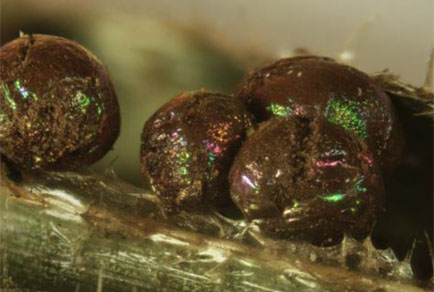
Nivicolous myxomycetes are ephemeral and often elusive organisms that form sporocarps at the edge of melting snow. They were previously associated exclusively with mountainous and rough terrains. Recently, some authors have recorded them in the lowlands as well. This work presents the first long-term research on the species diversity of nivicolous myxomycetes in the Prioksko‐Terrasny State Nature Biosphere Reserve. This is the southernmost point of the central part of the Eastern European Plain where this group of organisms has been recorded. Investigation resulted in records of 20 species belonging to 5 genera. For the first time 9 species are found in lowland habitats: Diderma cf. europaeum, D. meyerae, Lamproderma cristatum, L. cucumer, L. ovoideum, L. pulchellum, L. cf. pulveratum, L. splendidissimum, Meriderma cribrarioides. For each species recorded, descriptions of morphological features, images of sporocarps, spores, and capillitium, and photographs of microstructures, obtained on a scanning electron microscope, are given. The biotopes studied and the data on substrate preferences are also described.
References
- Azirakhmet, Z., Shchepin, O.N., Inoue, M., Kussainova, A., Bersimbaev, R. & Schnittler, M. (2025) First records of nivicolous myxomycetes (Amoebozoa) from Kazakhstan. European Journal of Protistology 100: 126161. https://doi.org/10.1016/j.ejop.2025.126161
- Bozonnet, J., Meyer, M. & Poulain, M. (1991) Especes nivales de Myxomycetes. Bulletin de la Societe d’histoire naturelle du pays de Montbeliard 1991: 51–72.
- Camino, M., Stephenson, S.L., Krivomaz, T., Wrigley de Basanta, D., Lado, C. & Estrada‐Torres, A. (2008) Biodiversity survey for Myxomycetes in the mountains of central Cuba. Revista Mexicana de Micología 27: 39–51.
- Dagamac, N.H.A., Bauer, B., Woyzichovski, J., Shchepin, O.N., Novozhilov, Yu.K. & Schnittler, M. (2021) Where do nivicolous myxomycetes occur?—Modeling the potential worldwide distribution of Physarum albescens. Fungal Ecology 53: 101079. https://doi.org/10.1016/j.funeco.2021.101079
- Denisova, L.V., Alekseev, Yu.E. & Sycheva, T.A. (2018) Vascular Plants of the Prioksko‐Terrasny Biosphere Reserve. Scientific Publishers Association KMK, Moscow, 115 pp.
- Erastova, D.A. & Novozhilov, Yu.K. (2015) Nivicolous myxomycetes of the lowland landscapes of the North‐West of Russia. Mycology and Phytopathology 49 (1): 9–18.
- Erastova, D.A. (2015) Nivicolous myxomycetes (Myxomycetes) Nord‐West part of Russia and Nord‐West of Caucasus. Ph.D. thesis. BIN RAS, St. Petersburg, 158 pp.
- Erastova, D.A., Novozhilov, Yu.K. & Schnittler, M. (2016) Nivicolous myxomycetes of the Khibiny Mountains, Kola Peninsula, Russia. Nova Hedwigia 104 (1–3): 85–110. https://doi.org/10.1127/nova_hedwigia/2015/0274
- Gmoshinskiy, V.I. & Kireeva, N.I. (2023) First data on nivicolous myxomycetes in the “Bitsevsky forest” natural and historical park (Moscow, Russia). Mycology and Phytopathology 57 (5): 372–377. https://doi.org/10.31857/S0026364823050045
- Grossart, H.-P., Wurzbacher, C., James, T.Y. & Kagami, M. (2016) Discovery of dark matter fungi in aquatic ecosystems demands a reappraisal of the phylogeny and ecology of zoosporic fungi. Fungal Ecology 19: 28–38. https://doi.org/10.1016/j.funeco.2015.06.004
- Ing, B. (1998) Alpine myxomycetes in Scotland. Botanical Journal of Scotland 50 (1): 47–53. https://doi.org/10.1080/03746609808684902
- Ing, B. (1999) The myxomycetes of Britain and Ireland. The Richmond Publishing Co. Ltd., London, 247 pp.
- Janik, P. & Ronikier, A. (2016) Meriderma species (Myxomycetes) from the Polish Carpathians: a taxonomic revision using SEM-visualized spore ornamentation. Acta Societatis Botanicorum Poloniae 85 (1): 3492. https://doi.org/10.5586/asbp.3492
- Johannesen, E.W. & Vetlesen, P. (2020) New and rare myxomycetes (Mycetozoa, Myxogastria) in Norway, including a complete checklist of Norwegian myxomycete species. Agarica 40: 1–138. https://doi.org/10.5617/agarica.11172
- Keller, H.W., Everhatr, S.E. & Kilgore, C.M. (2022) The myxomycetes: introduction, basic biology, life cycles, genetics, and reproduction. In: Stephenson, S.L. & Rojas, C. (Eds.) The Myxomycetes. Biology, Systematics, Biogeography and Ecology. Second edition. Academic Press, London, pp. 1–46. https://doi.org/10.1016/B978-0-12-824281-0.00003-8
- Kowalski, D.T. (1975) The myxomycetes taxa described by Charles Meylan. Mycologia 67 (3): 448–494. https://doi.org/10.1080/00275514.1975.12019774
- Kuhnt, A. (2009) Nivicole Myxomyceten aus Deutschland (unter besonderer Berücksichtigung der bayerischen Alpen). Teil IV. Zeitschrift für Mykologie 75 (2): 189–230.
- Kuhnt, A. (2017) Bemerkenswerte Myxomycetenfunde: Neue Arten, Neukombinationen und Nachweise seltenerArten. Berichte der Bayerischen Botanischen Gesellschaft 87: 93–128.
- Kuhnt, A. (2019) Bemerkenswerte Myxomycetenfunde: Neue Arten, Neukombinationen und Nachweise seltener Arten, Teil 2. Berichte der Bayerischen Botanischen Gesellschaft 89: 139–222.
- Lado, C. (2005–2025) An on line nomenclatural information system of Eumycetozoa. Real Jardin Botanico, CSIC. Madrid, Spain. Available from: http://www.nomen.eumycetozoa.com (accessed 15 December 2025)
- Lado, C. & Ronikier, A. (2008) Nivicolous myxomycetes from the Pyrenees: notes on taxonomy and species diversity. Part 1. Physarales and Trichiales. Nova Hedwigia 87 (3–4): 337–360. https://doi.org/10.1127/0029-5035/2008/0087-0337
- Lado, C. & Ronikier, A. (2009) Nivicolous myxomycetes from the Pyrenees: notes on the taxonomy and species diversity. Part. 2. Stemonitales. Nova Hedwigia 89 (1–2): 131–145. https://doi.org/10.1127/0029-5035/2009/0089-0131
- López-Villalba, Á. (2021) Taxonomic and molecular contribution to the study of the Iberian nivicolous myxobiota. PhD thesis. Universidad de Alcalá, Alcalá, 454 pp.
- López-Villalba, Á., Moreno, G. & Tapia, M. (2022) Nivicolous myxomycetes from the Navarran and French Pyrenees. Mycotaxon 137 (2): 359–369. https://doi.org/10.5248/137.359
- Martin, G.W. & Alexopoulos, C.J. (1969) The Myxomycetes. Univercity Iowa Press, Iowa, 479 pp.
- Meyer, M., Nowotny, W. & Poulain, M. (1994) Une espèce nouvelle du genre Lamproderma Rost. (Myxomycètes). Bulletin Mycologique et Botanique Dauphiné‐Savoie 132: 34–38.
- Meylan, C. (1908) Contributions a la connaissance des myxomycetes du Jura. Bulletin de la Société Vaudoise des Sciences Naturelles 44 (164): 285–302.
- Moreno, G., Singer, H., Illana, C. & Sánchez, A. (2003) SEM‐studies on nivicolous Myxomycetes. The Diderma niveum complex in Europe. Crytogamie Mycologie 24: 39–58.
- Moreno, G., Villalba, A.L. Castillo, A. & Stephenson, S.L. (2018a) Some nivicolous species of Lamproderma and Meriderma from Himalayan Mountains of northwestern India. Phytotaxa 373 (3): 221–230. https://doi.org/10.11646/phytotaxa.373.3.5
- Moreno, G., Sánchez, M., Meyer, M., López-Villalba, Á. & Castillo, A. (2018b) Revision of the nivicolous species of the genus Lepidoderma. Bulletin Sociedad Micológica de Madrid 42: 39–77.
- Moreno, G., López‐Villalba, Á. & Castillo, A. (2019) Some nivicolous Myxomycetes from Colorado and New Mexico (USA) sent by Ted Stampfer. Bulletin Sociedad Micológica de Madrid 43: 5–15.
- Moroz, E.L., Gmoshinskiy, V.I., Shchepin, O.N. & Novozhilov, Y.K. (2024) The systematics and phylogeny of Myxomycetes: yesterday, today, and tomorrow. Doklady Biological Sciences 519 (1): 356–369. https://doi.org/10.1134/S0012496624701242
- Müller, H. (2002) Beitrag zur Kenntnis und Verbreitung nivicoler Myxomyceten im Thuringer Wald. Zeitschrift fur Mykologie 68 (2): 199–208.
- Neubert, H., Nowotny, W., Bauman, K. & von Heidi, M.M. (1995) Die Myxomyceten Deutschlands und des angrenzenden Alpenraumes unter besonderer Berücksichtigung Österreichs. Band 2. Physarales. Velag Gomaringen, Berlin, 368 pp.
- Neubert, H., Nowotny, W. & Baumann, K. (2000) Die Myxomyceten Deutschlands und des angrenzenden Alpenraumes unter besonderer Berücksichtigung Österreichs. Bd.3: Stemonitales. Karlheinz Baumann Verlag, Gomaringen, 391 pp.
- Nikolaev, N.S. & Ableeva, V.A. (2015) Characteristics of climatic indicators of the Prioksko‐Terrasny Reserve for the period 1973–2014. Annales of the Prioksko‐Terrasny Zapovednik 6: 11–23.
- Novozhilov, Yu.K. (1986) Nivicolous myxomycetes of Leningrad region. Novosti Sistematiki Nizhikh Rasteniy 23: 146–149.
- Novozhilov, Yu.K., Schnittler, M. & Zemlianskaia, I.V. (2005) Synecology of Myxomycetes in desert of the Northwestern Caspian lowland. Mycology and Phytopathology 39 (4): 40–52.
- Novozhilov, Yu.K. & Schnittler, M. (2008) Nivicole myxomycetes of the Khibine mountains (Kola peninsula). Nordic Journal of Botany 16 (5): 549–561. https://doi.org/10.1111/j.1756-1051.1996.tb00269.x
- Novozhilov, Yu.K., Schnittler, M., Erastova, D.A., Okun, M.V., Schepin, O.N. & Heinrich, E. (2013) Diversity of nivicolous myxomycetes of the Teberda State Biosphere Reserve (Northwestern Caucasus, Russia). Fungal Diversity 59: 109–130. https://doi.org/10.1007/s13225-012-0199-0
- Novozhilov, Yu.K., Shchepin, O.N., Gmoshinskiy, V.I. & Schnittler, M. (2020) Myxomycetes of boreal forests of the Laplandskiy State Nature Biosphere Reserve (Kola Peninsula, Russia). Karstenia 58 (2): 292–315. https://doi.org/10.29203/ka.2020.501
- Novozhilov, Y.K., Shchepin, O.N., Prikhodko, I. & Schnittler, M. (2022) A new nivicolous species of Diderma (Myxomycetes) from Kamchatka, Russia. Nova Hedwigia 114 (1–2): 181–196. https://doi.org/10.1127/nova_hedwigia/2022/0670
- Poulain, M. & Meyer, M. (2005) Les Lamproderma (Myxomycota, Stemonitales) du groupe ovoideum. Bulletin Mycologique et Botanique Dauphiné‐Savoie 176: 13–30.
- Poulain, M., Meyer, M. & Bozonnet, J. (2002) Lamproderma carestiae (Ces. & de Not.) Meyl. et Lamproderma aeneum sp. nov. Bulletin de la Société d’histoire naturelle du pays de Montbéliard 119: 47–54.
- Poulain, M., Meyer, M. & Bozonnet, J. (2011a) Les Myxomycétes. Tome 1, Guide de determination. Mycologique et botanique Dauphiné‐Savoie, Sévrier, 568 pp., pl. 15.
- Poulain, M., Meyer, M. & Bozonnet, J. (2011b) Les Myxomycétes. Tome 2, Atlas. Mycologique et botanique Dauphiné‐Savoie, Sévrier, 544 pp.
- Poulain, M., Meyer, M. & Bozonnet, J. (2014) Lamproderma splendissimum, une nouvelle espéce nivicole de myxomycéte. Bulletin Mycologique et Botanique Dauphiné‐Savoie 213: 5–16.
- Putzke, J., Pereira, A.B. & Putzke, M.T.L. (2004) New record of Myxomycetes to the Antarctica Buenos Aires. In: Actas del V Simposio Argentino y I Latinoamericano de Investigaciones Antarticas. IAA, Buenos Aires, pp. 1–4.
- Rammeloo, J. (1974) Structure of the epispore in the Trichiaceae (Trichiales, Myxomycetes), as seen with the scanning electron microscope. Bulletin de la Société Royale de Botanique de Belgique 107: 353–359.
- Rammeloo, J. (1975) Structure of the epispore in the Stemonitales (Myxomycetes) as seen with the scanning electron microscope. Bulletin du Jardin Botanique National de Belgique 45 (3–4): 301–306. https://doi.org/10.2307/3667483
- Rojas, C., Schnittler, M., Biffi, D. & Stephenson, S.L. (2008) Microhabitat and niche separation in species of Ceratiomyxa. Mycologia 100 (6): 843–850.
- Ronikier, A. (2022) Revision of the Donald T. Kowalski`s collection of Lamproderma (Myxomycetes, Amoebozoa) reveals twice higher species diversity. Phytotaxa 531 (3): 175–210. https://doi.org/10.11646/phytotaxa.531.3.2
- Ronikier, A. & Lado, C. (2015) Nivicolous Stemonitales from the Austral Andes: analysis of morphological variability, distribution and phenology as a first step toward testing‐ the large‐scale coherence of species and biogeographical properties. Mycologia 107 (2): 258–283.
- Ronikier, A. & Ronikier, M. (2009) How ‘alpine’ are nivicolous myxomycetes? A worldwide assessment of altitudinal distribution. Mycologia 101 (1): 1–16.
- Schinner, F. (1983) Myxomycetes aus dem Gebiet des Torne Träsk (Abisko) in Schwedisch Lappland. Sydowia 36: 269–276.
- Schnittler, M., Erastova, D.A., Shchepin, O.N., Heinrich, E. & Novozhilov, Yu.K. (2015) Four years in the Caucasus—observations on the ecology of nivicolous myxomycetes. Fungal Ecology 14: 105–115. https://doi.org/10.1016/j.funeco.2015.01.003
- Schnittler, M., Dagamac, N.H.A., Woyzichovski, J. & Novozhilov, Yu.K. (2022) Biogeographical patterns in myxomycetes In: Rojas, C. & Stephenson, S.L. (Eds.) Myxomycetes: Biology, Sysematics, Biogeography and Ecology. Academic Press, Oxford, pp. 377–416.
- Schnittler, M., Leontyev, D., Yatsiuk, I. & Ronikier, A. (2025) Species descriptions in myxomycetes—can we settle on rules for good taxonomic practice? IMA Fungus 16: e141199. https://doi.org/10.3897/imafungus.16.141199
- Shchepin, O.N., Schnittler, M., Erastova, D.A., Prikhodko, I.S., Borg Dahl, M., Azarov, D.V., Chernyaeva, E.N. & Novozhilov, Y.K. (2019) Community of dark-spored myxomycetes in ground litter and soil of taiga forest (Nizhne-Svirskiy Reserve, Russia) revealed by DNA metabarcoding. Fungal Ecology 39: 80–93. https://doi.org/10.1016/j.funeco.2018.11.006
- Singer, H., Moreno, G. & Illana, C. (2005) Mountainous and nivicolous myxomycetes described by Charles Meylan. A SEM‐study. Österreichische Zeitschrift für Pilzkunde 14: 11–29.
- Smirnov, P.A. (1958) Flora of the Prioksko‐Terrasny State Reserve. Annales of the Prioksko‐Terrasny Zapovednik 2: 1–246.
- Stephenson, S.L. (2021) Secretive Slime Moulds. Myxomycetes of Australia. ABRS, Canberra; CSIRO Publishing, Melbourne, 375 pp. https://doi.org/10.1071/9781486314140
- Tamayama, M., Poulain, M. & Meyer, M. (2018) Lamproderma yamamotoi (Stemonitales), une nouvelle espèce nivicole de myxomycete. Bulletin Mycologique et Botanique Dauphiné‐Savoie 228: 27–33.
- Yajima, Y., Inaba, S., Degawa, Y., Tamotsu, Y. & Norio, K. (2013) Ultrastructure of cyst-like fungal bodies in myxomycete fruiting bodies. Karstenia 53 (1–2): 55–65. https://doi.org/10.29203/ka.2013.458
- Yamamoto, Y. (2006) Supplement of “The Myxomycete Biota of Japan”. Fukui Botanical Garden. Fukui, 124 pp.
- Yamamoto, Y. (2021) Biota of Japanese Myxomycetes. Committee for the publication of Biota of Japanese Myxomycetes, Ibaraki (Japan), 1136 pp.
- Yatsiuk, I., Leontyev, D., Lόpez-Villalba, A., Schnittler, M. & Kŏljalg, U. (2023) A new nivicolous species of Lamproderma (Myxomycetes) from lowland and mountainous regions of Europe. Nova Hedwigia 116 (1–2): 105–136. https://doi.org/10.1127/nova_hedwigia/2023/0807
- Yatsiuk, I. & Leontyev, D.V. (2020) Two species of nivicolous myxomycetes that formed fruiting bodies during three spring seasons in the lowlands of the Eastern Ukraine. Phytotaxa 437 (3): 147–155. https://doi.org/10.11646/phytotaxa.437.3.3
- Wrigley de Basanta, D. & Estrada-Torres, A. (2022) Techniques for recording and isolating myxomycetes: updated. In: Rojas, C. & Stephenson, S.L. (Eds.) Myxomycetes: Biology, Sysematics, Biogeography and Ecology. Academic Press, Oxford, pp. 417–451. https://doi.org/10.1016/B978-0-12-824281-0.00015-4