

Abstract
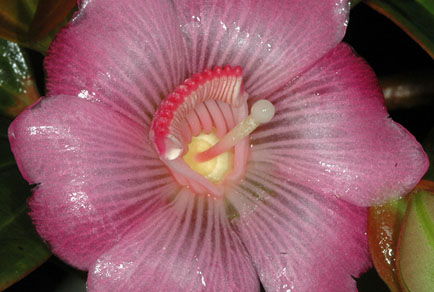
Blakea alatibracteata is described as a new species from Chocó and Valle del Cauca, Colombia. This novelty is readily distinguished from closely related species within the wet bud clade by its long-decurrent, winged outer floral bracts. Only two other members of the genus, B. attenboroughii and B. mcphersonii, have similar outer floral bracts, but neither have calyx lobes and calyx tubes with anastomosing veins, anther connective appendages that are paired, elongate humps, nor capitate stigmas, all of which are putative synapomorphies of the wet bud clade. For B. alatibracteata, an illustration, photo plate, distribution map, recommended conservation assessment, and discussion of related species based on morphological similarities are provided. A thorough description of the Blakea wet bud clade morphological characteristics, and a key to its 11 species, are also included.
References
- Almeda, F. (2001) Three new Mesoamerican species of Topobea (Melastomataceae). Brittonia 53: 157–166. https://doi.org/10.1007/BF02805409
- Almeda, F., Mendoza-Cifuentes, H., Penneys, D.S., Michelangeli, F.A. & Alvear, M. (2015) Melastomataceae. Pp. 3–5. In: Bernal, R., Gradstein, S.R. & Celis, M. (Eds.) New names and new combinations for the catalogue of the plants and lichens of Colombia. Phytoneuron 22: 1–6.
- Almeda, F., Mendoza-Cifuentes, H., Penneys, D.S., Michelangeli, F.A. & Alvear, M. (2016) Melastomataceae. In: Bernal, R., Gradstein, S.R. & Celis, M. (Eds.) Catálogo de plantas y líquenes de Colombia, Vol. II. Instituto de Ciencias Naturales, Universidad Nacional de Colombia, Bogotá, pp. 1585–1664, 2537–2538. [http://catalogoplantasdecolombia.unal.edu.co]
- Aublet, J.B.C.F. (1775) Histoire des plantes de la Guiane francoise. 4 vols. London & Paris.
- Bachman, S., Moat, J., Hill, A.W., de la Torre, J. & Scott, B. (2011) Supporting Red List threat assessments with GeoCAT: Geospatial conservation assessment tool. ZooKeys 150: 117–126. https://doi.org/10.3897/zookeys.150.2109
- Barrett, S.C., Jesson, L.K. & Baker, A.M. (2000) The evolution and function of stylar polymorphisms in flowering plants. Annals of Botany 85 (suppl_1): 253–265. [https://www.jstor.org/stable/42770693]
- Beentje, H.J. (2016) The Kew plant glossary: an illustrated dictionary of plant terms, 2nd ed. Kew Publishing, Royal Botanic Gardens, Kew, pp. 1–192.
- Bentham, G., Hinds, R.B. & Belcher, E. (1844) The botany of the voyage of H. M. S. Sulphur, under the command of Captain Sir Edward Belcher, during the years 1836-42. Published under the authority of the Lords Commissioners of the Admiralty. Smith, Elder. Springer, Berlin. https://doi.org/10.5962/bhl.title.908
- Brazil Flora Group (2022) Brazilian Flora 2020: Leveraging the power of a collaborative scientific network. Taxon 71: 178–198. https://doi.org/10.1002/tax.12640
- Browne, P. (1756) The civil and natural history of Jamaica in three parts. Browne, London, pp. 1–323. https://doi.org/10.5962/bhl.title.10826
- Diels, L. (1938) Neue Arten aus Ecuador. Notizblatt Des Königl. Botanischen Gartens Und Museums Zu Berlin 14: 25–44. https://doi.org/10.2307/3994928
- Fernandez-Hilario, R., Pillaca-Huacre, L., Villanueva-Espinoza, R., Riva-Regalado, S., Gonzales, R.R., Goldenberg, R. & Michelangeli, F.A. (2024) Taxonomic and chorological novelties in Blakea (Melastomataceae: Pyxidantheae) from Peru with a list of species for the country. Phytotaxa 635: 1–42. https://doi.org/10.11646/phytotaxa.635.1.1
- Gleason, H.A. (1945) On Blakea and Topobea. Bulletin of the Torrey Botanical Club 72: 385–393. https://doi.org/10.2307/2481538
- Harris, J.G. & Harris, M.W. (2004) Plant identification terminology: an illustrated glossary 2nd ed. Spring Lake Publishing, Spring Lake, Utah, pp. 1–198.
- Heslop-Harrison, Y. & Shivanna, K.R. (1977) The receptive surface of the angiosperm stigma. Annals of Botany 41: 1233–1258. [https://www.jstor.org/stable/42765288]
- Hickey, L.J. (1973) Classification of the architecture of dicotyledonous leaves. American Journal of Botany 60: 17–33. [https://www.jstor.org/stable/2441319]
- IUCN Standards and Petitions Committee (2024) Guidelines for using the IUCN Red List Categories and Criteria. Version 16. Prepared by the Standards and Petitions Subcommittee. Available from: http://www.iucnredlist.org/documents/RedListGuidelines.pdf (accessed 1 November 2025)
- Key Biodiversity Areas Partnership (2025) Key Biodiversity Areas factsheet: Los Paraguas Mountain Range. Extracted from the World Database of Key Biodiversity Areas. Developed by the Key Biodiversity Areas Partnership: BirdLife International, IUCN, American Bird Conservancy, Amphibian Survival Alliance, Conservation International, Critical Ecosystem Partnership Fund, Global Environment Facility, Re:wild, NatureServe, Rainforest Trust, Royal Society for the Protection of Birds, World Wildlife Fund and Wildlife Conservation Society. Available from: https://keybiodiversityareas.org/ (accessed 1 November 2025)
- Markgraf, Fr. (1934) Neue andine Melastomataceen. Notizblatt Des Königl. Botanischen Gartens Und Museums Zu Berlin 12: 177–182. https://doi.org/10.2307/3995038
- Penneys, D.S. & Almeda, F. (2022) An overview of the tribe Pyxidantheae. In: Goldenberg, R., Michelangeli, F.A. & Almeda, F. (Eds.) Systematics, Evolution, and Ecology of Melastomataceae. Springer Nature, Cham, Switzerland, pp. 291–305. https://doi.org/10.1007/978-3-030-99742-7_13
- Penneys, D.S. & Jost, L. (2009) Blakea attenboroughii (Melastomataceae: Blakeeae): a new species from Ecuador. Proceedings of the California Academy of Sciences 60: 69–72.
- Penneys, D.S. & Judd, W.S. (2011) Phylogenetics and morphology in the Blakeeae (Melastomataceae). International Journal of Plant Sciences 172: 78–106. https://doi.org/10.1086/657284
- Penneys, D.S. & Judd, W.S. (2013a) Combined molecular and morphological phylogenetic analyses of the Blakeeae (Melastomataceae). International Journal of Plant Sciences 174: 802–817. https://doi.org/10.1086/670011
- Penneys, D.S. & Judd, W.S. (2013b) A revised circumscription for the Blakeeae (Melastomataceae) with associated nomenclatural adjustments. PhytoKeys 20: 17–32. https://doi.org/10.3897/phytokeys.20.4344
- Penneys, D.S., Almeda, F., Reginato, M., Michelangeli, F.A., Goldenberg, R., Fritsch, P.W. & Stone, R.D. (2022) A new Melastomataceae classification informed by molecular phylogenetics and morphology. In: Goldenberg, R., Michelangeli, F.A. & Almeda, F. (Eds.) Systematics, Evolution, and Ecology of Melastomataceae. Springer Nature, Cham, Switzerland, pp. 109–165. https://doi.org/10.1007/978-3-030-99742-7_5
- QGIS Development Team (2025) QGIS Geographic Information System. Open Source Geospatial Foundation Project. Available from: http://qgis.org (accessed 1 November 2025)
- Thiers, B.M. (2025) Index Herbariorum: A global directory of public herbaria and associated staff. New York Botanical Garden’s Virtual Herbarium. Available from: http://sweetgum.nybg.org/ih/ (accessed 1 October 2025)
- Triana, J. (1872) Les Mélastomacées. Transactions of the Linnean Society of London 28 (1): 1–188. https://doi.org/10.1111/j.1096-3642.1871.tb00222.x
- Ulloa Ulloa, C., Almeda, F., Goldenberg, R., Kadereit, G., Michelangeli, F.A., Penneys, D.S., Stone, R.D. & Veranso-Libalah, C. (2022) Melastomataceae: Global Diversity, Distribution, and Evolution. In: Goldenberg, R., Michelangeli, F.A. & Almeda, F. (Eds.) Systematics, Evolution, and Ecology of Melastomataceae. Springer, Cham, Switzerland, pp. 321–343. https://doi.org/10.1007/978-3-030-99742-7_1
- Urrea, J., Mendoza-Cifuentes, H. & García, N. (2023) Taxonomic novelties and synopsis of the genus Blakea (Melastomataceae, Pyxidantheae) in the Eastern Cordillera, Colombia. Acta Botánica Mexicana 130: 1–27. https://doi.org/10.21829/abm130.2023.2172
- Wootton, J.T. & Sun, I.F. (1990) Bract liquid as a herbivore defense mechanism for Heliconia wagneriana inflorescences. Biotropica 22: 155–159. [https://www.jstor.org/stable/2388408]
- Wurdack, J.J. (1979) Certamen Melastomataceis XXX. Phytologia 43: 339–355. [http://www.biodiversitylibrary.org/bibliography/12678]
- Wurdack, J.J. (1986) Atlas of hairs for Neotropical Melastomataceae. Smithsonian Contributions to Botany 63: 1–80. https://doi.org/10.5479/si.0081024X.63