

Abstract
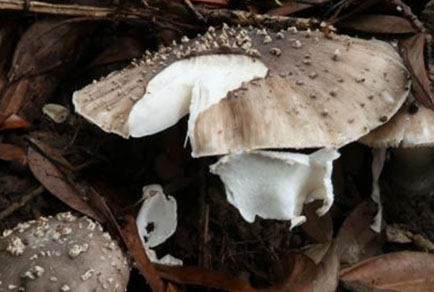
Amanita subradiata is described and illustrated as a new species from China based on morphological and molecular evidence. It is characterized by a medium to large-sized, with pyramidal to subconical volval remnants and a slightly striate, appendiculate margin; stipe with a clavate to subglobose basal bulb and a collar-like volval structure at the bulb-stipe junction. Annulus persistent, subapical, membranous, and broadly ellipsoid to elongate basidiospores. Molecular phylogenetic analyses based on multigene sequences (ITS + nrLSU + rpb2 +tef1-α) support the new species within the genus Amanita sect. Validae as a sister to A. radiata.
References
- Bas, C. (1969) Morphology and subdivision of Amanita and a monograph of its section Lepidella. Persoonia 5 (4): 285–573.
- Cai, Q., Cui, Y.Y. & Yang, Z.L. (2016) Lethal Amanita species in China. Mycologia 108 (5): 993–1009. https://doi.org/10.3852/16-008
- Cai, Q., Tulloss, R.E., Tang, L.P., Tolgor, B., Zhang, P., Chen, Z.H. & Yang, Z.L. (2014) Multi-locus phylogeny of lethal amanitas: implications for species diversity and historical biogeography. BMC Evolutionary Biology 14 (1): 143. https://doi.org/10.1186/1471-2148-14-143
- Cai, Q., Tang, L.P. & Yang, Z.L. (2012) DNA Barcoding of economically important mushrooms: A case study on lethal Amanitas from China. Plant Diversity and Resources 34 (6): 614–622. [in Chinese] https://doi.org/10.3724/SP.J.1143.2012.12140
- Cui, Y.Y., Cai, Q., Tang, L.P., Liu, J.W. & Yang, Z.L. (2018) The family Amanitaceae: molecular phylogeny, higher-rank taxonomy and the species in China. Fungal Diversity 91 (1): 5–230. https://doi.org/10.1007/s13225-018-0405-9
- Cui, Y.Y., Hao, Y.J., Guo, T., Yang, Z.L. & Cai, Q. (2023) Species diversity of Amanita section Vaginatae in Eastern China, with a description of four new species. Journal of Fungi 9 (8): 862. https://doi.org/10.3390/jof9080862
- Cui, Y.Y., Yang, Z.L. & Cai, Q. (2022) Amanita pallidoverruca, a new species of Amanita section Validae from the Hengduan Mountains, southwestern China. Phytotaxa 542 (1): 73–82. https://doi.org/10.11646/phytotaxa.542.1.6
- Gardes, M. & Bruns, T.D. (1993) ITS primers with enhanced specificity for basidiomycetes‐application to the identification of mycorrhizae and rusts. Molecular Ecology 2 (2): 113–118. https://doi.org/10.1111/j.1365-294x.1993.tb00005.x
- Huang, T., Su, L.J., Zeng, N.K., Lee, S.M.L., Lee, S.S., Thi, B.K., Zhang, W.H., Ma, J., Huang, H.Y., Jiang, S. & Tang, L.P. (2023) Notes on Amanita section Validae in Hainan Island, China. Frontiers in Microbiology 13: 1087756. https://doi.org/10.3389/fmicb.2022.1087756
- Jenkins, D.T. (1984) A new species of Amanita IV. Mycotaxon 20 (2): 315–317. https://doi.org/10.5962/p.418772
- Kalyaanamoorthy, S., Minh, B.Q., Wong, T.K., Von Haeseler, A. & Jermiin, L.S. (2017) ModelFinder: fast model selection for accurate phylogenetic estimates. Nature Methods 14 (6): 587–589. https://doi.org/10.1038/nmeth.4285
- Kaoh, K. & Standley, D.M. (2013) MAFFT multiple sequence alignment software version 7: improvements in performance and usability. Molecular Biology and Evolution 30 (4): 772–780. https://doi.org/10.1093/molbev/mst010
- Kornerup, A. & Wanscher, J.H. (1978) Methuen Handbook of Colour. Eyre Methuen, London, 196–265 pp.
- Kumar, S., Stecher, G., Suleski, M., Sanderford, M., Sharma, S. & Tamura, K. (2024) MEGA12: Molecular evolutionary genetic analysis version 12 for adaptive and green computing. Molecular Biology and Evolution 41 (12): msae263. https://doi.org/10.1093/molbev/msae263
- Lupala, A.S., Kim, D., Cho, Y., Suh, H., Seo, C.W., Jo, J.W. & Lim, Y.W. (2025) Species diversity of the Amanita section Caesareae in South Korea. Mycological Progress 24 (1): 29. https://doi.org/10.1007/s11557-025-02032-z
- Matheny, P.B. (2005) Improving phylogenetic inference of mushrooms with RPB1 and RPB2 nucleotide sequences (Inocybe; Agaricales). Molecular Phylogenetics and Evolution 35 (1): 1–20. https://doi.org/10.1016/j.ympev.2004.11.014
- Minh, B.Q., Nguyen, M.A.T. & Von Haeseler, A. (2013) Ultrafast approximation for phylogenetic bootstrap. Molecular Biology and Evolution 30 (5): 1188–1195. https://doi.org/10.1093/molbev/mst024
- Mu, M., Huang, H.Y., Zhang, W.H. & Tang, L.P. (2021) A new species with pink lamellae of Amanita section Caesareae from China. Phytotaxa 478 (1): 141–150. https://doi.org/10.11646/phytotaxa.478.1.10
- Nguyen, L.T., Schmidt, H.A., Von Haeseler, A. & Minh, B.Q. (2015) IQ-TREE: a fast and effective stochastic algorithm for estimating maximum-likelihood phylogenies. Molecular Biology and Evolution 32 (1): 268–274. https://doi.org/10.1093/molbev/msu300
- Rehner, S.A. & Buckley, E. (2005) A Beauveria phylogeny inferred from nuclear ITS and EF1-α sequences: evidence for cryptic diversification and links to Cordyceps teleomorphs. Mycologia 97 (1): 84–98. https://doi.org/10.3852/mycologia.97.1.84
- Ronquist, F., Teslenko, M., Van Der Mark, P., Ayres, D.L., Darling, A., Höhna, S. & Huelsenbeck, J.P. (2012) MrBayes 3.2: efficient Bayesian phylogenetic inference and model choice across a large model space. Systematic Biology 61 (3): 539–542. https://doi.org/10.1093/sysbio/sys029
- Thongbai, B., Tulloss, R.E., Miller, S.L., Hyde, K.D., Chen, J., Zhao, R. & Raspe, O. (2016) A new species and four new records of Amanita (Amanitaceae; Basidiomycota) from Northern Thailand. Phytotaxa 286 (4): 211–231. https://doi.org/10.11646/phytotaxa.286.4.1
- van der Heijden, M.G., Klironomos, J.N., Ursic, M., Moutoglis, P., Streitwolf-Engel, R., Boller, T. & Sanders, I.R. (1998) Mycorrhizal fungal diversity determines plant biodiversity, ecosystem variability and productivity. Nature 396 (6706): 69–72. https://doi.org/10.1038/23932
- Vilgalys, R. & Hester, M. (1990) Rapid genetic identification and mapping of enzymatically amplified ribosomal DNA from several Cryptococcus species. Journal of Bacteriology 172 (8): 4238–4246. https://doi.org/10.1128/jb.172.8.4238-4246.1990
- Wang, X.H., Cai, Q., Yu, F.M., Yang, Z.L., Zhou, S.Y., Wang, Z.R. & Zhao, Q. (2025) New and notable taxa of Basidiomycota on the Qinghai-Xizang Plateau and its surrounding areas. Fungal Diversity 133 (1): 235–437. https://doi.org/10.1007/s13225-025-00558-x
- White, T.J., Bruns, T., Lee, S.B. & Taylor, J. (1990) Amplification and direct sequencing of fungal ribosomal RNA genes for phylogenetics. In: Innis, M.A., Gelfand, D.H., Sninsky, J.J. & White, T.J. (Eds.) PCR Protocols: A Guide to Methods and Applications. Academic Press, New York, pp. 315–322. https://doi.org/10.1016/b978-0-12-372180-8.50042-1
- Xiang, C.Y., Gao, F., Jakovlić, I., Lei, H.P., Hu, Y., Zhang, H. & Zhang, D. (2023) Using PhyloSuite for molecular phylogeny and tree‐based analyses. Imeta 2 (1): e87. https://doi.org/10.1002/imt2.87
- Yang, Z.L. (1997) Die Amanita-Arten von Su¨dwestchina. Bibliotheca Mycologica 170: 1–240.
- Yang, Z.L. (2005) Flora fungorum sinicorum. Vol. 27. Amanitaceae. Science Press, Beijing, 258 pp. [in Chinese]
- Yang, Z.L. (2015) Atlas of the Chinese species of Amanitaceae. Science Press, Beijing, 213 pp. [in Chinese]
- Yang, K.L., Lin, J.Y., Li, G.M. & Yang, Z.L. (2025) New and interesting fungi from Guangzhou City, South China. Phytotaxa 707 (1): 1–95. https://doi.org/10.11646/phytotaxa.707.1.1
- Yang, Z.L. (2004) Two new species of Amanita (Basidiomycota) from China. In: Agerer, R., Piepenbring, M. & Blanz, P. (Eds.) Frontiers in Basidiomycote Mycology. IHW-Verlag, Eching, pp. 315–324.
- Yang, Z.L., Weiß, M. & Oberwinkler, F. (2004) New species of Amanita from the eastern Himalaya and adjacent regions. Mycologia 96 (3): 636–646. https://doi.org/10.1080/15572536.2005.11832959
- Zhang, M., Xie, D.C., Wang, C.Q., Deng, W.Q. & Li, T.H. (2022) New insights into the genus Gyroporus (Gyroporaceae, Boletales), with establishment of four new sections and description of five new species from China. Mycology 13 (3): 223–242. https://doi.org/10.1080/21501203.2022.2094012
- Zhang, D., Gao, F., Jakovlić, I., Zou, H., Zhang, J., Li, W.X. & Wang, G.T. (2020) PhyloSuite: An integrated and scalable desktop platform for streamlined molecular sequence data management and evolutionary phylogenetics studies. Molecular Ecology Resources 20 (1): 348–355. https://doi.org/10.1111/1755-0998.13096
- Zhang, K.P., Zhang, Y.Z., Sun, C.Y., Zhang, H.S., Lu, J.J., Si, J. & Li, H.J. (2020) Amanita lacerosquamosa, a new species of Amanita sect. Validae from southwestern China. Phytotaxa 456 (1): 95–104. https://doi.org/10.11646/phytotaxa.456.1.7
- Zhang, W.H., Huang, T., Huang, H.Y. & Tang, L.P. (2021) Amanita annulata, a new species of Amanita section Vaginatae with an annulus from southwestern China. Phytotaxa 514 (3): 261–274. https://doi.org/10.11646/phytotaxa.514.3.6
- Zhang, Y.Z., Yao, Y., Zhang, K.P., Liang, J.Q., Zhong, J.J., Li, Z.F. & Xu, F. (2025) Toxin profiling of Amanita citrina and A. sinocitrina: First report of buiotenine detection. Toxins 17 (5): 247. https://doi.org/10.3390/toxins17050247
- Zhou, H., Guo, M.J., Zhuo, L., Yan, H.F., Sui, X.N., Gao, Y. & Hou, C.L. (2023) Diversity and taxonomy of the genus Amanita (Amanitaceae, Agaricales) in the Yanshan Mountains, Northern China. Frontiers in Plant Science 14: 1226794. https://doi.org/10.3389/fpls.2023.1226794