

Abstract
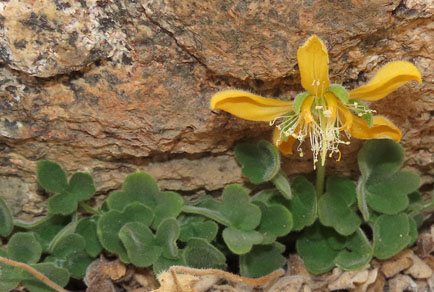
Here we describe Grausa lutea spec. nov., from the Andes of the Coquimbo Region, Chile and San Juan Province, Argentina. We carried out both molecular phylogenetic analyses and morphological studies on this taxon. Molecular analyses were carried out on a concatenated matrix including the plastid regions matK, rps16, trnL-trnF, trnS-trnG, using both Maximum Likelihood and Bayesian Inference approaches, based on a sampling of 90 species of mostly “South Andean Loasas”. These recover Grausa as small but a well-supported clade, sister to a significantly larger clade that includes Pinnasa+(Scyphanthus+Caiophora). Grausa lutea is retrieved in a small clade that includes the two other acaulescent, high-Andean species of the genus: G. acaulis and G. lateritia. These three species in turn are sister to G. gayana. Morphologically Grausa lutea can be distinguished from its closest relatives by its bright yellow corolla (unique in Grausa) and nectar scales and its usually nodding flowers with a spreading corolla. The species is restricted to rocky slopes above 3000 m in arid high-Andean habitats, representing a significant northward extension of the ecological and geographic range of Grausa. Based on its very limited geographical and ecological range, and ongoing aridification in the region, G. lutea is preliminarily assessed as Endangered (EN) under IUCN criteria.
References
- Acuña-Castillo, R., Böhnert, T., Jeiter, J. & Weigend, M. (2025) Resolving the early-diverging clades of Loasaceae subfam. Loasoideae—Segregating the new genus Prosa from the Atacama Desert genus Huidobria. Taxon 74: 101–116. https://doi.org/10.1002/tax.13289
- Acuña-Castillo, R., Cohen, D., Slanis, A., Perea, M.C., Grau, A. & Weigend, M. (2021) Loasaceae. In: Zuloaga, F.O., Belgrano, M.J. & Zanotti, C.A. (Eds.) Flora vascular de la República Argentina, vol. 19 (2). Instituto de Botánica Darwinion, Buenos Aires, pp. 263–311.
- Acuña-Castillo, R., Eyzaguirre, M.T., Santilli, L., Lavandero, N. & Cohen, D. (2024) Forgotten but not lost: notes about the status of the often overlooked Chilean desert endemic Loasa rotundifolia (Loasaceae). Gayana Botánica 81: 130–139. https://doi.org/10.4067/S0717-66432024000200130
- Acuña-Castillo, R., Fließwasser, S., Ackermann, M., Henning, T., Luebert, F. & Weigend, M. (2017) Phylogenetic relationships and generic re-arrangements in ‘South Andean Loasas’ (Loasaceae). Taxon 66: 365–378. https://doi.org/10.12705/662.5
- Acuña-Castillo, R., Luebert, F., Henning, T. & Weigend, M. (2019) Major lineages of Loasaceae subfam. Loasoideae diversified during the Andean uplift. Molecular Phylogenetics and Evolution 141: 106616. https://doi.org/10.1016/j.ympev.2019.106616
- Adanson, M. (1763) Familles des Plantes, vol. 2. Chez Vincent, Paris, 640 pp. https://doi.org/10.5962/bhl.title.271
- Arnott, G.A.W. (1831) On some new species of Loaseae. The Edinburgh journal of natural and geographical science 3: 273–275.
- Bachman, S., Moat, J., Hill, A.W., de la Torre, J. & Scott, B. (2011) Supporting Red List threat assessments with GeoCAT: geospatial conservation assessment tool. Zookeys 150: 117–126. https://doi.org/10.3897/zookeys.150.2109
- Barros, V.R., Boninsegna, J.A., Camilloni, I.A., Chidiak, M., Magrín, G.O. & Rusticucci, M. (2015) Climate change in Argentina: Trends, projections, impacts and adaptation. Wiley Interdisciplinary Reviews: Climate Change 6 (2): 151–169. https://doi.org/10.1002/wcc.316
- Cavanilles, J.A. (1799) Icones et descriptiones plantarum, quae aut sponte in Hispania crescunt, vol. 5. Regia Typographia, Madrid, 74 pp + 100 tab.
- Cravero, S.A., Bianchi, C.L., Elena, H.J. & Bianchi, A.R. (2017) Clima de la Argentina Mapas digitales mensuales de precipitaciones y precipitación menos evapotranspiración potencial: adenda del Atlas Climático digital de la República Argentina. Ediciones Inta, Salta. Available from: https://repositorio.inta.gob.ar/xmlui/handle/20.500.12123/15361 (accessed: 6 January 2026).
- Edler, D., Klein, J., Antonelli, A. & Silvestro, D. (2020) RaxmlGUI 2.0: A graphical interface and toolkit for phylogenetic analyses using RAxML. Methods in Ecology and Evolution 12: 1–5. https://doi.org/10.1101/800912
- Felsenstein, J. (1981) Evolutionary trees from DNA sequences: A maximum likelihood approach. Journal of Molecular Evolution 17: 368–376. https://doi.org/10.1007/BF01734359
- Garreaud, R., Boisier, J.P., Alvarez-Garreton, C., Christie, D.A., Carrasco-Escaff, T., Vergara, I., Chávez, R.O., Aldunce, P., Camus, P., Suazo-Álvarez, M., Masiokas, M., Castro, G., Muñoz, A., Zambrano-Bigiarini, M., Fuster, R. & Godoy, L. (2025) Hyperdroughts in central Chile: drivers, impacts, and projections. Hydrology and Earth System Sciences 29: 5347–5369. https://doi.org/10.5194/hess-29-5347-2025
- Gay, C. (1848) Historia fisica y politica de Chile, Botánica, vol. 3 (3). Claudio Gay, París, 484 pp.
- Gilg, E. (1894) Loasaceae. In: Engler, A. & Prantl, K. (Eds.) Die natürlichen Pflanzenfamilien, vol. 3 (6a). Wilhelm Engelmann, Leipzig, pp. 100–121.
- Henning, T., Mittelbach, M., Ismail, S.A., Acuña-Castillo, R. & Weigend, M. (2018) A case of behavioural diversification in male floral function—the evolution of thigmonastic pollen presentation. Scientific Reports 8: 14018. https://doi.org/10.1038/s41598-018-32384-4
- Hooker, W.J. & Arnott, G.A.W. (1833) Contributions towards a flora of South America and the islands of the Pacific. Botanical miscellany 3: 302–367.
- Hooker, W.J. & Arnott, G.A.W. (1835) Contributions towards a flora of South America and the islands of the Pacific. Companion to the Botanical magazine 1: 30–38.
- Huelsenbeck, J.P. & Ronquist, F. (2001) MrBayes: Bayesian inference of phylogenetic trees. Bioinformatics 17: 754–755. https://doi.org/10.1093/bioinformatics/17.8.754
- iNaturalist.org. (2026) Grausa observations (until early January 2026). Available from: https://www.inaturalist.org/observations?taxon_id=855483 (accessed: 7 January 2026).
- IUCN. (2024) Guidelines for using the IUCN red list categories and criteria, ver. 16. Prepared by the Standards and Petitions Subcommittee of the IUCN Species Survival Commission. Available from: https://nc.iucnredlist.org/redlist/content/attachment_files/RedListGuidelines.pdf (accessed: 6 December 2025).
- Johnson, L.A. & Soltis, D.E. (1995) Phylogenetic inference in Saxifragaceae sensu stricto and Gilia (Polemoniaceae) using matK sequences. Annals of the Missouri Botanical Garden 82: 149–175. https://doi.org/10.2307/2399875
- Jussieu, A.L. (1804) Mémoire sur le Loasa, genre de plantes qui devra constituer avec le Mentzelia, une nouvelle famille. Annales du Muséum National d’Histoire Naturelle 5: 13–27.
- Katoh, K. & Standley, D.M. (2013) MAFFT multiple sequence alignment software version 7: Improvements in performance and usability. Molecular Biology and Evolution 30: 772–780. https://doi.org/10.1093/molbev/mst010
- Katoh, K., Misawa, K., Kuma, K.I. & Miyata, T. (2002) MAFFT: A novel method for rapid multiple sequence alignment based on fast Fourier transform. Nucleic Acids Research 30: 3059–3066. https://doi.org/10.1093/nar/gkf436
- Linnaeus, C. (1753) Species Plantarum, vol. 1. Laurentii Salvii, Stockholm, 560 pp.
- Linnaeus, C. (1753) Species Plantarum, vol. 2. Laurentii Salvii, Stockholm, 639 pp.
- Luebert, F. & Pliscoff, P. (2017) Sinopsis bioclimática y vegetacional de Chile. 2nd ed. Editorial Universitaria, Santiago, 384 pp.
- Luebert, F. (2021) The two South American dry diagonals. Frontiers of Biogeography 13 (4): e51267. https://doi.org/10.21425/F5FBG51267
- Martel-Cea, A., Maldonado, A., de Porras, M.E., Muñoz, P., Maidana, N.I., Massaferro, J. & Schittek, K. (2023) A multiproxy approach to reconstruct the Late Holocene environmental dynamics of the semiarid Andes of central Chile (29° S). Frontiers in Ecology and Evolution 11: 1227020. https://doi.org/10.3389/fevo.2023.1227020
- Marticorena, C. & Quezada, M. (1985) Catálogo de la flora vascular de Chile. Gayana Botánica 42: 1–157.
- Marticorena, C., Squeo, F., Arancio, G. & Muñoz, M. (2001) Catálogo de la flora vascular de la IV Región de Coquimbo. In: Squeo, F., Arancio, G. & Gutiérrez, J.R. (Eds.) Libro rojo de la flora nativa y de los sitios prioritarios para su conservación: Región de Coquimbo. Ediciones Universidad de La Serena, La Serena, pp. 105–142.
- Mayta, C. & Maldonado, A. (2022) Climatic and ecological changes in the subtropical high Andes during the last 4,500 years. Frontiers in Earth Science 10: 833219. https://doi.org/10.3389/feart.2022.833219
- Meyen, F.J. (1834) Reise um die Erde, vol. 1. Sander’schen Buchhandlung, Berlin, 493 pp.
- Meyer, C.A. (1842) Ueber den Ginschen, insbesondere über die botanischen Charaktere desselben und der zunächst verwandten Arten der Gattung Panax; ein Nachtrag zu dem Aufsatze des Herrn Apotheke Calau. Repertorium für Pharmacie und Practische Chemie in Russland 1: 516–544.
- Novoa, J.E. & López, D. (2001) IV Región: El escenario geográfico físico. In: Squeo, F., Arancio, G. & Gutiérrez, J.R. (Eds.) Libro rojo de la flora nativa y de los sitios prioritarios para su conservación: Región de Coquimbo. Ediciones Universidad de La Serena, La Serena, pp. 13–28.
- Nylander, J.A.A. (2004) MrModeltest v2. Program distributed by the author. Available from: https://github.com/nylander/MrModeltest2 (accessed: 1 May 2025).
- Oyarzabal, M., Clavijo, J., Oakley, L., Biganzoli, F., Tognetti, P., Barberis, I., Maturo, H.M., Aragón, R., Campanello, P.I., Prado, D., Oesterheld, M. & León, R.J. (2018) Unidades de vegetación de la Argentina. Ecología Austral 28 (1): 40–63. https://doi.org/10.25260/EA.18.28.1.0.399
- Pérez-Moreau, R.L. & Crespo, S. (1988) Loasaceae. In: Correa, M.N. (Ed.) Flora Patagónica, vol. 8 (5). Colección Científica del Instituto Nacional de Tecnología Agropecuaria, Buenos Aires, pp. 199–217.
- Pérez-Moreau, R.L. & Crespo, S. (2003) Loasaceae. In: Kiesling, R. (Ed.) Flora de San Juan, vol. 2. Estudios Sigma, Buenos Aires, pp. 152–160.
- Philippi, R.A. (1872) Botánica.—Descripción de las plantas nuevas incorporadas últimamente en el herbario chileno por el doctor don R.A. Philippi. Anales de la Universidad de Chile 41: 663–746.
- Philippi, R.A. (1893a) Plantas nuevas chilenas de la familia de las Tropeóleas i Oxalídeas. Anales de la Universidad de Chile 83: 895–915.
- Philippi, R.A. (1893b) Plantas nuevas chilenas de las familias de Rosáceas, Onagrariáceas i demás familias del tomo II de Gay. Anales de la Universidad de Chile 85: 895–915.
- Planchon, J.E. (1847) Sur la nouvelle famille des Cochlospermées. The London journal of botany 6: 294–311.
- Pöppig, E.F. (1833) Fragmentum Synopseos Plantarum Phanerogamum ab Auctore Annis MDCCCXXVII ad MDCCCXXIX in Chile lectarum. Typis Elberti, Leipzig, 30 pp.
- Presl, C. (1831) Reliquiae Haenkeanae. J. G. Calvae, Prague, 152 pp.
- Rambaut, A., Drummond, A.J., Xie, D., Baele, G. & Suchard, M.A. (2018) Posterior summarization in Bayesian phylogenetics using Tracer 1.7. Systematic Biology 67: 901–904. https://doi.org/10.1093/sysbio/syy032
- Reiche, K. (1901) Estudios críticos sobre la flora de Chile: 47. Familia Loasáceas. Anales de la Universidad de Chile 108: 707–751.
- Rodríguez, R., Marticorena, C., Alarcón, D., Baeza, C., Cavieres, L., Finot, V.L., Fuentes, N., Kiessling, A., Mihoc, M., Pauchard, A. & Ruiz, E. (2018) Catálogo de las plantas vasculares de Chile. Gayana Botánica 75: 1–430. https://doi.org/10.4067/S0717-66432018000100001
- Ronquist, F., Teslenko, M., van der Mark, P., Ayres, D.L., Darling, A., Höhna, S., Larget, B., Liu, L., Suchard, M.A. & Huelsenbeck, J.P. (2012) MrBayes 3.2: Efficient Bayesian phylogenetic inference and model selection across a large model space. Systematic Biology 61: 539–542. https://doi.org/10.1093/sysbio/sys029
- Sang, T., Crawford, D.J. & Stuessy, T.F. (1997) Chloroplast DNA phylogeny, reticulate evolution, and biogeography of Paeonia (Paeoniaceae). American Journal of Botany 84: 1120–1136. https://doi.org/10.2307/2446155
- Santilli, L., Cohen, D.H. & Acuña-Castillo, R. (2020) New Insights into Grausa reinstatement, distribution and affinities of Loasa acaulis (Loasaceae, Loasoideae). Darwiniana, nueva serie 8: 372–388. https://doi.org/10.14522/darwiniana.2020.81.880
- Santilli, L., Lavandero, N., De Schrevel, C., Dandois, P. & Acuña-Castillo, R. (2022) A new endemic species of Loasa ser. Macrospermae (Loasaceae) from northern Chile. Systematic Botany 47: 1065–1079. https://doi.org/10.1600/036364422X16674054154179
- Schrader, H.A. (1825) 171. Stüd. Göttingische Gelehrte Anzeigen 1825: 1705–1712.
- SERNAGEOMIN. (2003) Mapa Geológico de Chile: versión digital. Servicio Nacional de Geología y Minería, Publicación Geológica Digital, No. 4 (CD-ROM, versión 1.0, 2003). Santiago, Chile.
- Silvestro, D. & Michalak, I. (2012) RaxmlGUI: A graphical front-end for RAxML. Organisms, Diversity & Evolution 12: 335–337. https://doi.org/10.1007/s13127-011-0056-0
- Sleumer, H. (1955) Die Loasaceen Argentiniens. Botanische Jahrbücher für Systematik, Pflanzengeschichte und Pflanzengeographie 76: 411–462.
- Stamatakis, A. (2014) Raxml version 8: A tool for phylogenetic analysis and post-analysis of large phylogenies. Bioinformatics 30: 1312–1313. https://doi.org/10.1093/bioinformatics/btu033
- Sweet, R. (1828) The British Flower Garden, vol. 3. W. Simpkin & R. Marshall, London.
- Thiers, B.M. (2026 updated continuously) Index Herbariorum. Available from: https://sweetgum.nybg.org/science/ih/ (accessed: 6 December 2025).
- Thunberg, C.P. (1781) Nova Genera Plantarum. Joh. Edman, Uppsala, 194 pp. https://doi.org/10.5962/bhl.title.88
- Urban, I. & Gilg, E. (1900) Monographia Loasacearum. Nova Acta Academiae Caesareae Leopoldino-Carolinae Germanicae Naturae Curiosorum 76: 1–368.
- Weddell, H.A. (1855) Chloris Andina, vol. 1. Chez P. Bertrand, Paris, 231 pp. + 42 tab.
- Weigend, M. (2004) Loasaceae. In: Kubitzki, K. (Ed.) The Families and Genera of Vascular Plants, vol. 6. Springer, Heidelberg, pp. 239–254. https://doi.org/10.1007/978-3-662-07257-8_27
- Weigend, M. (2006) Validating subfamily, genus and species names in Loasaceae (Cornales). Taxon 55: 463–468. https://doi.org/10.2307/25065594
- Weigend, M., Grau, J. & Ackermann, M. (2008) Loasaceae. In: Zuloaga, F.O., Morrone, O. & Belgrano, M.J. (Eds.) Catálogo de las Plantas Vasculares del Cono Sur (Argentina, Sur de Brasil, Chile, Paraguay y Uruguay). Monographs in Systematic Botany from the Missouri Botanical Garden 107: 2413–2424.
- Zuccarini, J.G. (1844) Delectus seminum in horto R. Monacensi collectorum, anno 1844. 4 pp.
- Zuloaga, F.O., Zanotti, C.A. & Salariato, D.L. (2025) Actualización del Catálogo de Plantas Vasculares del Cono Sur II. Darwiniana, nueva serie 13 (1): 189–244. https://doi.org/10.14522/darwiniana.2025.131.1301