
Abstract
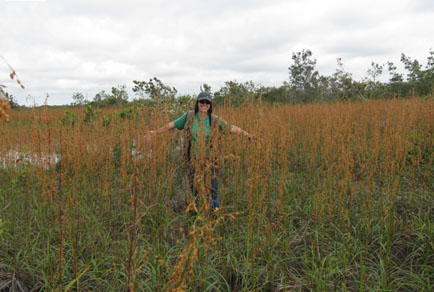
Lagenocarpus (Cyperaceae) is a Neotropical genus and currently comprises 15 species. The genus has two centers of diversity: the rocky grasslands of the Brazilian Shield and the white-sand savannas of the Guiana Shield. In the Guiana Shield, its diversity is probably underestimated and the identifications of known species are frequently mistaken. Here, we describe a new Lagenocarpus species from the Guiana Shield distinguished from L. glomerulatus and L. pendulus mainly by its inflorescence, spikelets and fruit characters.
References
- Chaves, A.L.A., Costa, A.C.G., Machado, I.C., Morokawa, R., Thomas, W.W. & Costa, S.M. (2024a) Inherit the wind: evolution of reproductive traits in Cyperaceae. Botanical Journal of the Linnean Society 205: 379–390. https://doi.org/10.1093/botlinnean/boad067
- Chaves, A.L.A., Ferreira, M.T.M., Escudero, M., Luceño, M. & Costa, S.M. (2024b) Chromosomal evolution in Cryptangieae Benth. (Cyperaceae): Evidence of holocentrism and pseudomonads. Protoplasma 261: 527–541. https://doi.org/10.1007/s00709-023-01915-w
- Chaves, A.L.A., Ferreira, S.A. & Costa, S.M. (2025) Investigating palynotaxonomy and evolutionary trends in Cryptangieae (Cyperaceae). Botanical Journal of Linnean Society boaf052. https://doi.org/10.1093/botlinnean/boaf052
- Costa, S.M., Barbosa, T.D.M., Bittrich, V. & Amaral, M.C.E. (2016) Floristic survey of herbaceous and subshrubby aquatic and palustrine angiosperms of Viruá National Park, Roraima, Brazil. PhytoKeys 58: 21–48. https://doi.org/10.3897/phytokeys.58.5178
- Costa, S.M., Morokawa, R., Bittrich, V., Thomas, W.W. & Amaral, M.C.E. (2018) What about Cryptangieae (Cyperaceae)—a molecular hypothesis about its tribal status and circumscription. Phytotaxa 347: 127–149. https://doi.org/10.11646/phytotaxa.347.2.2
- Costa, S.M., Vitta, F.A., Thomas, W.W., Muasya, A.M., Morokawa, R., Bittrich, V., Shepherd, G. & Amaral, M.C.E. (2021a) An updated generic circumscription for Cryptangieae (Cyperaceae, Poales) based on a molecular phylogeny and a morphological character reconstruction. Phytotaxa 483: 211–228. https://doi.org/10.11646/phytotaxa.483.3.2
- Costa, S.M., Amaral, M.C.E. & Thomas, W.W. (2021b) Two new species of Cephalocarpus (Cryptangieae, Cyperaceae) from the Venezuelan Guayana Highland. Brittonia 73: 160–166. https://doi.org/10.1007/s12228-021-09652-1
- Costa, S.M., Thomas, W.W. & Amaral, M.C.E. (2024) Four new species from Venezuela and identification key to Cephalocarpus (Cryptangieae, Cyperaceae). Phytotaxa 670: 119–126. https://doi.org/10.11646/phytotaxa.670.2.4
- Frasier, C.L., Albert, V.A. & Struwe, L. (2008) Amazonian lowland, white sand areas as ancestral regions for South American biodiversity: Biogeographic and phylogenetic patterns in Potalia (Angiospermae: Gentianaceae). Organisms, Diversity & Evolution 8: 44–57. https://doi.org/10.1016/j.ode.2006.11.003
- Gilly, C. (1951) Botanical exploration in Venezuela—I. Tribe Cryptangieae (Lagenocarpeae). Fieldiana Botany 28: 53–60.
- Janzen, D.H. (1974) Tropical blackwater rivers, Animals, and Mast fruiting by the Diopterocarpaceae. Biotropica 6: 69–103. https://doi.org/10.2307/2989823
- Koyama, T. (2004) A taxonomic revision of the genus Lagenocarpus (Cyperaceae)—materials for a Cyperaceae monograph of the Flora Neotropica. Part II. Makinoa 4: 1–73.
- Koyama, T. & Maguire, B. (1965) Cyperaceae tribe Lagenocarpeae. Botany of the Guayana Highland 12: 8–54.
- Larridon, I., Zuntini, A.R., Léveillé-Bourret, E., Barrett, R.L., Starr, J.R., Muasya, A.M., Villaverde, T., Bauters, K., Brewer, G.E., Bruhl, J.J., Costa, S.M., Elliott, T.L., Epitawalage, N., Escudero, M., Fairlie, I., Goetghebeur, P., Hipp, A.L., Jiménez-Mejías, P., Sabino Kikuchi, A.B., Luceño, M., Márquez-Corro, J.I., Martín-Bravo, S., Maurin, O., Pokorny, L., Roalson, E.H., Semmouri, I., Simpson, D.A., Spalink, D., Thomas, W.W., Wilson, K.L., Xanthos, M., Forest, F. & Baker, W.J. (2021) A new classification of Cyperaceae (Poales) supported by phylogenomic data. Journal of Systematics and Evolution 59: 852–895. https://doi.org/10.1111/jse.12757
- Nees von Esenbeck, C.G.D. (1835) Uebersicht der Cyperaceengattungen (Synopsis Generum Cyperacearum). Linnaea 9: 282.
- QGIS Development Team (2026) QGIS Geographic Information System. Open Source Geospatial Foundation Project. [http://qgis.org].
- Thiers, B. (2025 onwards) Index Herbariorum: A global directory of public herbaria and associated staff. New York Botanical Garden’s Virtual Herbarium, New York. Available from: http://sweetgum.nybg.org/ih/ (accessed 10 April 2025)
- Thurn, E.V. (1886) Notes on the plants observed during the Roraima expedition of 1884. Timehri 5: 115–223.
- Vitta, F.A. (2005) Revisão taxonômica e estudos morfológicos e biossistemáticos em Cryptangium Schrad. ex Nees e Lagenocarpus Nees (Cyperaceae: Cryptangieae). PhD Thesis—Programa de Pós-Graduação em Biologia Vegetal, Universidade Estadual de Campinas (UNICAMP), Campinas, São Paulo, Brazil, 294 pp.