

Abstract
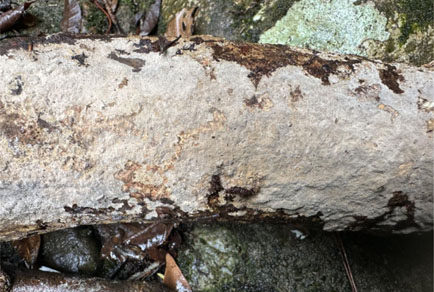
Based on morphological characteristics and molecular phylogenetic analysis of ITS+nLSU sequences, this study reports a new wood inhabiting species in Russulales, Dichostereum olivaceoluteum. It was discovered in subtropical forest of Guangxi Autonomous Region, southern China. The new species is characterized by perennial, resupinate basidiomata with olivaceous buff hymenophore, difficult to separate from substrate; microscopically it has a dimitic hyphal system with clamp connections on generative hyphae, and thick-walled, globose, ornamented basidiospores measuring 6.2–7.4 × 5.5–7.0 μm.
References
- Bernicchia, A. & Gorjón, S.P. (2010) Fungi Europaei 12. Corticiaceae s.l. Edizioni Candusso, Italia, 1008 pp.
- Boidin, J. (1967) Basidiomycètes Aphyllophorales de la zone intertropicale. Bulletin de la Société Mycologique de France 83: 1–220.
- Boidin, J. & Lanquetin, P. (1977) Le genre Dichostereum: emendatio. Bulletin de la Société Mycologique de France 93: 1–15.
- Boidin, J. & Lanquetin, P. (1980) Contribution a l’étude du genre Dichostereum Pilàt (Basidiomycetes, Lachnocladiaceae). Bulletin de la Société Mycologique de France 96: 381–406.
- Boidin, J. & Michel, H. (1998) Nouvelles contributions à l’étude des Aphyllophorales. Bulletin de la Société Mycologique de France 114: 1–30.
- Boidin, J., Lanquetin, P. & Gilles, G. (1977) Basidiomycètes aphyllophorales de l'Île de la Réunion. IV. Les genres Dichostereum Pilát et Acanthobasidium Boidin. Bulletin de la Société Mycologique de France 93: 89–100.
- Boidin, J., Lanquetin, P. & Gilles, G. (1987) Advances in the taxonomy of Aphyllophorales. Mycotaxon 29: 1–50.
- Capella-Gutierrez, S., Silla-Martinez, J.M. & Gabaldon, T. (2009) Bioinformatics 25: 1972–1973. https://doi.org/10.1093/bioinformatics/btp348
- Hallenberg, N. (1985) The Lachnocladiaceae and Coniophoraceae of North Europe. Fungiflora, Oslo, 96 pp.
- Hjortstam, K. & Ryvarden, L. (1984) Some new and noteworthy fungi (Basidiomycotina, Aphyllophorales) from Iguazú, Argentina. Mycotaxon 19: 133–151. https://doi.org/10.5962/p.418793
- Hopple, J.S.,Jr. & Vilgalys, R. (1999) Phylogenetic relationships in the mushroom genus Coprinus and dark-spored allies based on sequence data from the nuclear gene coding for the large ribosomal subunit RNA: divergent domains, outgroups, and monophyly. Molecular Phylogenetics and Evolution 13: 1–19. https://doi.org/10.1006/mpev.1999.0634
- Katoh, K. & Standley, D.M. (2013) MAFFT multiple sequence alignment software version 7: improvements in performance and usability. Molecular Phylogenetics and Evolution 30: 772–780. https://doi.org/10.1093/molbev/mst010
- Larsson, A. (2014) AliView: A fast and lightweight alignment viewer and editor for large datasets. Bioinformatics (Oxford, England) 30 (22): 3276–3278. https://doi.org/10.1093/bioinformatics/btu531
- Larsson, K.-H. (2007) Re-thinking the classification of corticioid fungi. Mycological Research 111 (9): 1040–1063. https://doi.org/10.1016/j.mycres.2007.08.001
- Larsson, K.-H. & Larsson, E. (2003) Phylogenetic relationships of russuloid basidiomycetes with emphasis on aphyllophoralean taxa. Mycologia 95 (6): 1037–1065. https://doi.org/10.1080/15572536.2004.11833020
- Liu, S.L. & He, S.H. (2018) Taxonomy and phylogeny of Dichostereum (Russulales), with descriptions of three new species from southern China. MycoKeys 40: 111–126. https://doi.org/10.3897/mycokeys.40.28700
- Liu, S.L., Zhao, Y., Dai, Y.C., Nakasone, K.K. & He, S.H. (2017) Phylogeny and taxonomy of Echinodontium and related genera. Mycologia 109: 568–577. https://doi.org/10.1080/00275514.2017.1369830
- Maddison, W.P. & Maddison, D.R. (2017) Mesquite: A Modular System for Evolutionary Analysis, Version 3.2. Available from: http://mesquiteproject.org (accessed 8 September 2025)
- Miller, M.A., Pfeiffer, W., Schwartz, T. (2010) Creating the CIPRES Science Gateway for inference of large phylogenetic trees. In: Proceedings of the Gateway Computing Environments Workshop (GCE). New Orleans, LA, pp. 1–8. https://doi.org/10.1109/GCE.2010.5676129
- Miller, S.L., McClean, T.M., Walker, J.F. & Buyck, B. (2006) A molecular phylogeny of the Russulales including agaricoid, gasteroid and pleurotoid taxa. Mycologia 98 (6): 958–967.
- Parmasto, E. (1968) Conspectus Systematis Corticiacearum. Institutum Zoologicum et Botanicum Academiae Scientiarum R.P.S.S. Estonicae, Tartu, 261 pp.
- Parmasto, E. (1970) The myco-geographical position of the genus Lachnocladium (Aphyllophorales). Folia Cryptogamica Estonica 2: 1–10.
- Reid, D.A. (1965) A monograph of the stipitate stereoid fungi. Beihefte zur Nova Hedwigia, Vaduz, 388 pp.
- Ronquist, F. & Huelsenbeck, J.P. (2003) Mrbayes 3: Bayesian phylogenetic inference under mixed models. Bioinformatics 19: 1572–1574. https://doi.org/10.1093/bioinformatics/btg180
- Sayers, E.W., Cavanaugh, M., Clark, K., Pruitt, K.D., Sherry, S.T., Yankie, L. & Karsch-Mizrachi, I. (2024) GenBank 2024 Update. Nucleic Acids Research 52 (5): 134–137. https://doi.org/10.1093/nar/gkad903
- Wang, C.G., Zhao, H., Liu, H.G., Zeng, G.Y., Yuan, Y. & Dai, Y.C. (2023) A multi-gene phylogeny clarifies species diversity, taxonomy, and divergence times of Ceriporia and other related genera in Irpicaceae (Polyporales, Basidiomycota). Mycosphere 14 (1): 1665–1729. https://doi.org/10.5943/mycosphere/14/1/19
- White, T.J., Bruns, T., Lee, S. & Taylor, J. (1990) Amplification and direct sequencing of fungal ribosomal RNA genes for phylogenetics. In: Innis, M.A., Gelfand, D.H., Sninsky, J.J. & White, T.J. (Eds.) PCR protocols, a guide to methods and applications. Academic Press, New York, pp. 315–322. https://doi.org/10.1038/srep34568
- Yang, Y., Xu, Y., Wang, L., Jiang, Q.Q., Su, J.Q., Li, R., Zhou, H.M. & Zhao, C.L. (2025) Multigene phylogeny of seven wood-inhabiting fungal orders in Basidiomycota, and proposal of a new genus and thirteen new species. Mycosphere 16 (1): 245–295. https://doi.org/10.5943/mycosphere/16/1/4
- Zhou, M., Dai, Y.C., Vlasák, J., Liu, H.G. & Yuan, Y. (2023) Updated systematics of Trichaptum s.l. (Hymenochaetales, Basidiomycota). Mycosphere 14 (1): 815–917. https://doi.org/10.5943/mycosphere/14/1/11