
Abstract
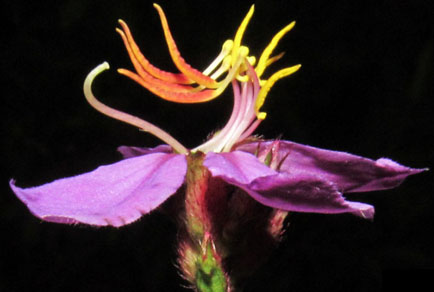
Although several floristic and taxonomic studies on Melastomataceae have been conducted in southern Brazil, most have had a regional focus, and the genus Chaetogastra—due to the difficulty in establishing its species limits—has remained largely neglected. The unpublished revision of the Brazilian Chaetogastra by the first author, combined with recent botanical efforts in montane regions of Paraná, Santa Catarina, and northern Rio Grande do Sul, has led to the recognition of distinctive new taxa within the genus. In this article, we describe six new species: Chaetogastra adpressa, C. foliosa, C. macrosepala, C. nana, C. odilioana, and C. urubiciensis. For each taxon, we provide detailed morphological descriptions, high-resolution photographs, taxonomic comparisons, distribution maps, and preliminary conservation assessments. Five of the six species are under threat according to IUCN criteria, while C. nana is categorized as Least Concern. Additionally, three of the new species were previously sampled and included in the most recent phylogeny of the genus and their phylogenetic placement is presented and discussed. These findings highlight the importance of complementary taxonomic studies in the genus even in supposedly well-explored locations, and especially in southern Brazil, where there is a greater richness of species of Chaetogastra.
References
- Abbott, R., Albach, D., Ansell, S., Arntzen, J.W., Baird, S.J.E., Bierne, N., Boughman, J., Brelsford, A., Buerkle, C.A., Buggs, R., Butlin, R.K., Dieckmann, U., Eroukhmanoff, F., Grill, A., Cahan, S.H., Hermansen, J.S., Hewitt, G., Hudson, A.G., Jiggins, C., Jones, J., Keller, B., Marczewski, T., Mallet, J., Martinez-Rodriguez, P., Most, M., Mullen, S., Nichols, R., Nolte, A.W., Parisod, C., Pfennig, K., Rice, A.M., Ritchie, M.G., Seifert, B., Smadja, C.M., Stelkens, R., Szymura, J.M., Väinola, R., Wolf, J.B.W. & Zinner, D. (2013) Hybridization and speciation. Journal of Evolutionary Biology 26: 229–246. https://doi.org/10.1111/j.1420-9101.2012.02599.x
- Alvear, M. & Almeda, F. (2019) Revision of Monochaetum (Melastomataceae: Melastomateae) in Colombia. Systematic Botany Monographs 109: 1–153.
- Aublet, J.B.C.F. (1775) Histoire des Plantes de la Guiane Françoise, vol. 1. Pierre François Didot, London, 621 pp.
- Bachman, S., Moat, J., Hill, A.W., Dela Torre, J. & Scott, B. (2011) Supporting Red List threat assessments with GeoCAT: Geospatial conservation assessment tool. ZooKeys 150: 117–126. https://doi.org/10.3897/zookeys.150.2109
- Bartling, F.G. (1830) Ordines naturales plantarum eorumque characteres et affinitates; adjecta generum enumeratione. Sumptibus Dieterichianis, Göttingen, 498 pp.
- Cai, Y., Wang, F., Tan, G., Hu, Z., Wang, Y., Lun Ng, W., Wu, W., Liu, Y. & Zhou, R. (2019) Hybridization of Bornean Melastoma: implications for conservation of endemic plants in Southeast Asia. Botany Letters 166: 117–124. https://doi.org/10.1080/23818107.2019.1585284
- Cardona, J., Lara, C. & Ornelas, J.F. (2020) Pollinator divergence and pollination isolation between hybrids with different floral color and morphology in two sympatric Penstemon species. Scientific Reports 10: 8126. https://doi.org/10.1038/s41598-020-64964-8
- Cogniaux, A.C. (1885) Melastomataceae. In: Martius, C.F.P., Eichler, A.G. & Urban, I. (Eds.) Flora Brasiliensis, vol. 14 (3). Typographia Regia, Munich, pp. 1–655.
- Cogniaux, A.C. (1888) Melastomataceae. Addenda et Emendanda. In: Martius, C.F.P., Eichler, A.G. & Urban, I. (Eds.) Flora Brasiliensis, vol. 14 (4). Typographia Regia, Munich, pp. 589–616.
- Cogniaux, A.C. (1891) Mélastomaceés. In: Candolle, A. & Candolle, C. (Eds.) Monographiae Phanerogamarum, vol. 7. Sumptibus G.Masson, Paris, pp. 1–1256.
- Counterman, B.A. (2016) Hybrid Speciation. In: Kliman, R.M. (Ed.) Encyclopedia of Evolutionary Biology. Academic Press, Cambridge, pp. 242–248. https://doi.org/10.1016/B978-0-12-800049-6.00072-X
- Couto, M.A.M.S., Teixeira, M.A., Ramalho, J.C. & Hoepers, M.A. (2023) Floral trait variation in a putative hybrid zone between specialist pollination systems: how could it impact pollinator attraction? Botanical Journal of the Linnean Society 203: 289–302. https://doi.org/10.1093/botlinnean/boad021
- De Candolle, A.P. (1828) Prodromus Systematis Naturalis Regni Vegetabilis, vol. 3. Treuttel et Würtz, Paris, pp. 99–202.
- Don, D. (1823) An illustration of the natural family of plants called Melastomataceae. Memoirs of the Wernerian Natural History Society 4: 276–329.
- Ferreira, Q.I.X. & Araújo, F.P. (2016) Economia de pólen favorecida pela heteranteria em Desmocelis villosa (Melastomataceae). Rodrigésia 67: 347–355. https://doi.org/10.1590/2175-7860201667206
- Fioravanti, C. (2011) Quando os híbridos são férteis; cruzamentos improváveis podem gerar novas espécies de plantas e animais. Pesquisa Fapesp 185. Available from: https://revistapesquisa.fapesp.br/quando-os-h%C3%ADbridos-s%C3%A3o-f%C3%A9rteis/ (accessed 3 April 2025)
- Franco, A.M., Goldenberg, R. & Varassin, I.G. (2011) Pollinator guild organization and its consequences for reproduction in three synchronopatric species of Tibouchina (Melastomataceae). Revista Brasileira de Entomologia 55: 381–388. https://doi.org/10.1590/S0085-56262011005000040
- Graham, R. (1831) Description of Several New or Rare Plants Which Have Lately Flowered in the Neighbourhood of Edinburghm and Chiefly in the Royal Botanic Garden. Edinburgh New Philosophical Journal 12: 186–187.
- Guimarães, P.J.F., Michelangeli, F.A., Sosa, K. & Gomez, J.R.S. (2019) Systematics of Tibouchina and allies (Melastomataceae: Melastomateae): a new taxonomic classification. Taxon 68: 937–1002. https://doi.org/10.1002/tax.12151
- Harrison, R.G. & Larson, E.L. (2014) Hybridization, introgression, and the nature of species boundaries. Journal of Heredity 105 (S1): 795–809.
- Hickey, M. & King, C. (2000) The Cambridge Illustrated Glossary of Botanical Terms. Cambridge University Press, Cambridge, 208 pp.
- IBGE—Instituto Brasileiro de Geografia e Estatística (2012) Manual Técnico da Vegetação Brasileira nº1, 2ª Ed. IBGE, Rio de Janeiro, 271 pp.
- ISA—Instituto Socioambiental (2025) Parque Estadual Serra da Baitaca. Available from: https://uc.socioambiental.org/arp/3189 (accessed 12 July 2025)
- IUCN—International Union for Conservation of Nature (2024) Guidelines for Using the IUCN Red List Categories and Criteria, version 16. Prepared by the Standards and Petitions Committee. Available from: https://www.iucnredlist.org/resources/redlistguidelines (accessed 24 July 2025)
- Javaheri, D. & Sunil, A. (2024) A review of pollinator interactions and their role in shaping plant hybrid zones. Journal of Student Research 13: 1–7. https://doi.org/10.47611/jsr.v13i2.2486
- Jussieu, A.L. (1789) Genera plantarum secundum ordines naturales disposita, juxta methodum in horto regio parisiensi exaratum, anno 1774. Apud viduam Herissant et Theophilum Barrois, Paris, 498 pp. https://doi.org/10.5962/bhl.title.7762
- Liu, T., Chen, Y., Chao, L., Wang, S., Wu, W., Dai, S., Wang, F., Fan, Q. & Zhou, R. (2014) Extensive hybridization and introgression between Melastoma candidum and M. sanguineum. Plos One 9: e96680. https://doi.org/10.1371/journal.pone.0096680
- Martins, A.B. & Almeda, F. (2017) A Monograph of the Brazilian endemic genus Lavoisiera (Melastomataceae: Microlicieae). Phytotaxa 315: 1–194. https://doi.org/10.11646/phytotaxa.315.1.1
- Meyer, F.S. (2016) Estudos Sistemáticos no clado de Chaetogastra DC. e gêneros aliados (Melastomataceae: Melastomeae). Phd Thesis, Instituto de Biologia Vegetal, Universidade Estadual de Campinas, Campinas, São Paulo, 325 pp. Available from: http://www.bibliotecadigital.unicamp.br/document/?code=000968781 (accessed 25 July 2025)
- Meyer, F.S. & Goldenberg, R. (2016) Four new species of Chaetogastra (Melastomeae, Melastomataceae) from Southern. Phytotaxa 282: 239–258. https://doi.org/10.11646/phytotaxa.282.4.1
- Meyer, F.S. & Goldenberg, R. (2021) Chaetogastra cogniauxiana (Melastomataceae), a new Brazilian species from the Chaetogastra gracilis complex. Phytotaxa 511: 261–274. https://doi.org/10.11646/phytotaxa.511.3.5
- Meyer, F.S. & Goldenberg, R. (2025) Nomenclatural and Taxonomic Notes on Brazilian Species of Chaetogastra (Melastomataceae). Feddes Repertorium 136: 88–113. https://doi.org/10.1002/fedr.70003
- Meyer, F.S. & Schwirkowski, P. (2019) Checklist de angiospermas da APA Municipal do Rio Vermelho/Humboldt, Santa Catarina, Brasil. Rodriguesia 70: e00632018. https://doi.org/10.1590/2175-7860201970063
- Meyer, F.S., Guimarães, P.J.F. & Goldenberg, R. (2009) Uma nova espécie de Tibouchina Aubl. (Melastomataceae) e notas taxonômicas sobre o gênero no Estado do Paraná, Brasil. Hoehnea 36: 139–147. https://doi.org/10.1590/S2236-89062009000100008
- Meyer, F.S., Reginato, M., Smidt, E.C., Gómez, J.R.S., Michelangeli, F.A. & Goldenberg, R. (2021) Phylogenetic relationship in Brachyotum and allies (Melastomataceae, Melastomateae): a reassessment of the limits of the genera. Botanical Journal of the Linnean Society 197: 170–189. https://doi.org/10.1093/botlinnean/boab014
- Meyer, F.S., Yamamoto, M.A.C.G. & Goldenberg, R. (2025) A Natural Hybrid of Pleroma (Melastomataceae) from Serra da Bocaina, Southeastern Brazil. Phytotaxa 730: 163–176. https://doi.org/10.11646/phytotaxa.730.2.4
- Michelangeli, F.A., Guimarães, P.J.F., Penneys, D.S., Almeda, F. & Kriebel, R. (2013) Phylogenetic relationships and distribution of New World Melastomeae (Melastomataceae). Botanical Journal of the Linnean Society 171: 38–60. https://doi.org/10.1111/j.1095-8339.2012.01295.x
- Naudin, C.V. (1950) Melastomacearum Monographicae Descriptiones. Annales des Sciences Naturelles; Botanique sér. 3, 14: 53–76.
- Ng, W.L., Huang, G., Wu, W., Zhou, Q., Liu, Y. & Zhou, R. (2020) Molecular confirmation of natural hybridization between Melastoma sanguineum and M. malabathricum (Melastomataceae). Gardens' Bulletin Singapore 72: 65–75. https://doi.org/10.26492/gbs72(1).2020-07
- Pacifico, R., Almeda, F., Penneys, D.S. & Fidanza, K. (2022) Systematics of the Trembleya sensu stricto clade of Microlicia (Melastomataceae, Lavoisiereae). PhytoKeys 216: 1–101. https://doi.org/10.3897/phytokeys.216.91032
- Pinheiro, F., Barros, F.de, Palma-Silva, C., Meyer, D., Fay, M.F., Suzuki, R.M., Lexer, C. & Cozzolino, S. (2010) Hybridization and introgression across different ploidy levels in the Neotropical orchids Epidendrum fulgens and E. puniceoluteum (Orchidaceae). Molecular Ecology 19: 1–14. https://doi.org/10.1111/j.1365-294X.2010.04780.x
- QGIS Development Team (2023) QGIS Geographic Information System. Open Source Geospatial Foundation. Available from: https://www.qgis.org/pt_BR/site/forusers/download.html (accessed 15 July 2025)
- Raiol, R.L., Gastauer, M., Campbell, A.J., Borges, R.C., Awade, M. & Giannini, T.C. (2021) Specialist Bee Species Are Larger and Less Phylogenetically Distinct Than Generalists in Tropical Plant—Bee Interaction Networks. Frontiers in Ecology and Evolution 26: 699649. https://doi.org/10.3389/fevo.2021.699649
- Reginato, M. & Michelangeli, F.A. (2016) Untangling the phylogeny of Leandra s.str. (Melastomataceae, Miconieae). Molecular Phylogenetics and Evolution 96: 17–32. https://doi.org/10.1016/j.ympev.2015.11.015
- Renner, S.S. (1986/1987) Reproductive Biology of Bellucia (Melastomataceae). Acta Amazonica 16/17: 197–208. https://doi.org/10.1590/1809-43921986161208
- Robertson, C. (1902) Synopsis of Halictinae. The Canadian Entomologist 34: 243–250. https://doi.org/10.4039/Ent34243-9
- Schneider, C.A., Rasband, W.S. & Eliceiri, K.W. (2012) NIH Image to ImageJ: 25 years of image analysis. Nature Methods 9: 671–675. https://doi.org/10.1038/nmeth.2089
- Soltis, P.S. & Soltis, D.E. (2009) The role of hybridization in plant speciation. Annual Review of Plant Biology 60: 561–588. https://doi.org/10.1146/annurev.arplant.043008.092039
- Souza, M.L.D. (1986) Estudo Taxonômico do gênero Tibouchina Aubl. (Melastomataceae) no Rio Grande do Sul, Brasil. Insula 16: 3–108.
- Stearn, W.T. (1985) Botanical Latin, 3ª ed. David & Charles, London, 566 pp.
- Thiers, B. (2025) Index Herbariorum: A global directory of public herbaria and associated staff. New York Botanical Garden’s Virtual Herbarium. Available from: http://sweetgum.nybg.org/science/ih/ (accessed 15 July 2025)
- Velloso, M.S.C., Brito, V.L.G., Caetano, A.P.S. & Romero, R. (2018) Anther specializations related to the division of labor in Microlicia cordata (Spreng.) Cham. (Melastomataceae). Acta Botanica Brasilica 32: 349–358. https://doi.org/10.1590/0102-33062017abb0358
- Wu, R., Zou, P., Tan, G., Hu, Z., Wang, Y., Ning, Z., Wu, W., Liu, Y., He, S. & Zhou, R. (2019) Molecular identification of natural hybridization between Melastoma malabathricum and Melastoama beccarianum in Sarawak, Malaysia. Ecology and Evolution 9: 5766–5776. https://doi.org/10.1002/ece3.5160
- Wurdack, J.J. (1962) Melastomataceae of Santa Catarina. Sellowia 14: 109–217.