

Abstract
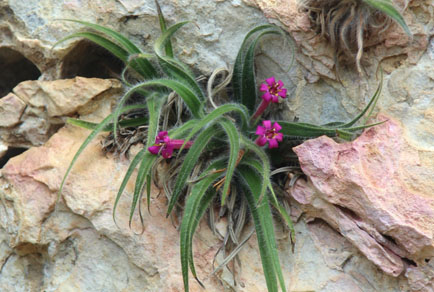
Floristic surveys near Monte Azul, Minas Gerais, have revealed a magenta-flowered Barbacenia inhabiting rocky outcrops bearing prehistoric paintings. The new species resembles B. tomentosa and B. luzulifolia in phyllotaxy and hypanthium size but differs mainly by its vivid corolla and reduced corona. Here, named Barbacenia rupestris, the new species epithet refers both to its rupicolous habitat and the prehistoric paintings.
References
- Almeda, F. & Pacifico, R. (2023) New species of Microlicia (Melastomataceae) from the espinhaço meridional and septentrional of Minas Gerais, Brazil. Phytotaxa 600: 184–194. https://doi.org/10.11646/phytotaxa.600.3.5
- Araújo, V.F.P., Barbosa, M.R.V., Araújo, J.P. & Vasconcelos, A. (2020) Spatial-temporal variation in litterfall in seasonally dry tropical forests in North-eastern Brazil. Brazilian Journal of Biology 80: 273–284. https://doi.org/10.1590/1519-6984.192113
- Assis, L.C.S. & Brigandt, I. (2009) Homology: homeostatic property cluster kinds in systematics and evolution. Evolutionary Biology 36: 248–255. https://doi.org/10.1007/s11692-009-9054-y
- Bachman, S., Moat, J., Hill, A., de la Torre, J. & Scott, B. (2011) Supporting Red List threat assessments with GeoCAT: geospatial conservation assessment tool. ZooKeys 150: 117–126. https://doi.org/10.3897/zookeys.150.2109
- Beck, H.E., McVicar, T.R., Vergopolan, N., Berg, A., Lutsko, N.J., Dufour, A., Zeng, Z., Jiang, X., Van Dijk, A.I.J.M. & Miralles, D.G. (2023) High-resolution (1 km) Köppen-Geiger maps for 1901–2099 based on constrained CMIP6 projections. Scientific Data 10: 724. https://doi.org/10.1038/s41597-023–02549‑6
- Bitencourt, C., Rapini, A., Damascena, L.S. & Junior, P.D.M. (2016) The worrying future of the endemic flora of a tropical mountain range under climate change. Flora-Morphology, Distribution, Functional Ecology of Plants 218: 1–10. https://doi.org/10.1016/j.flora.2015.11.001
- Bueno, V.R., Bentes, M.S., Ramos, R., Zavatin, D.A. & Prata-Silveira, A. (2025a) Three new species of Calea (Asteraceae, Neurolaeneae) from the sky islands of the Espinhaço Range. Phytotaxa 689: 185–203. https://doi.org/10.11646/phytotaxa.689.2.2
- Bueno, V.R., Ramos, R., Almeida, M.L.C.D., Hemetrio, N.S., Santos, F.R.D., Prado, J. & Zavatin, D.A. (2025) Novelties for Wedelia (Asteraceae, Heliantheae) in Minas Gerais, Brazil: a new species and a rediscovery after over 70 years. Phytotaxa 722: 1–15. https://doi.org/10.11646/phytotaxa.722.1.1
- Bugado, R.E., Shrestha, N., Magri, R.A., Prado, J. & Lopes, J.C. (2025) Vanishing ecosystems: The looming threat of climate change on an iconic genus Vellozia in the Brazilian campos rupestres. Global Ecology and Conservation 58: e03439. https://doi.org/10.1016/j.gecco.2025.e03439
- Cardoso, P.H., Moroni, P., Antar, G.M., Menini Neto, L. & Trovó, M. (2022) Two new Brazilian species of Verbenaceae from the Espinhaço Range: Stachytarpheta olearyana and S. vianae. Kew Bulletin 77: 729–736. https://doi.org/10.1007/s12225-022-10045-0
- Colli‐Silva, M., Vasconcelos, T.N. & Pirani, J.R. (2019) Outstanding plant endemism levels strongly support the recognition of campo rupestre provinces in mountaintops of eastern South America. Journal of Biogeography 46: 1723–1733. https://doi.org/10.1111/jbi.13585
- Conceição, A.A., Rapini, A., do Carmo, F.F., Brito, J.C., Silva, G.A., Neves, S.P. & Jacobi, C.M. (2016) Rupestrian grassland vegetation, diversity, and origin. In: Fernandes, G. (Ed.) Ecology and conservation of mountaintop grasslands in Brazil. Springer, Cham, pp. 105–127. https://doi.org/10.1007/978-3-319-29808-5_6
- Echternacht, L., Trovó, M., Oliveira, C.T. & Pirani, J.R. (2011) Areas of endemism in the Espinhaço range in Minas Gerais, Brazil. Flora-morphology, distribution, functional. Ecology of Plants 206: 782–791. https://doi.org/10.1016/j.flora.2011.04.003
- Flora e Funga do Brasil (2024) Velloziaceae. Jardim Botânico do Rio de Janeiro. Available from: https://floradobrasil.jbrj.gov.br/FB245 (accessed 30 September 2025)
- Giulietti, A.M., Menezes, N.L., Pirani, J.R., Meguro, M. & Wanderley, M.G.L. (1987) Flora da Serra do Cipó: caracterização e lista de espécies. Boletim de Botânica da Universidade de São Paulo 9: 1–151. https://doi.org/10.11606/issn.2316-9052.v9i0p1-151
- IUCN Standards and Petitions Committee (2022) Guidelines for using the IUCN Red List categories and criteria, version 15.1. Prepared by the Standards and Petitions Committee. Available from: https://www.iucnredlist.org/documents/RedListGuidelines.pdf (accessed 15 September 2025)
- Johansen, D.A. (1940) Microchemical methods. In: Plant microtechnique. McGraw-Hill, New York, pp. 182–197.
- Köppen, W.P. (1931) Grundriss der klimakunde. Berlin: W. de Gruyter. https://doi.org/10.1515/9783111667751
- Magri, R., Cabral, A., Prado, J. & Lopes, J. (2024) Two new critically endangered species of Vellozia (Velloziaceae) from the Campos Rupestres of Espinhaço Range, Brazil. Phytotaxa 652: 1–9. https://doi.org/10.11646/phytotaxa.652.1.1
- Martius, C.F.P. (1823) Vellosia. Barbacenia. In: Martius, C.F.P. & Zuccarini, J.G. (Eds.) Nova genera et species plantarum. v. 1: 13–21. Lindauer, Munich.
- Martius, K.F.P.V. (1824) Nova genera et species plantarum. Auctoris, Munich, 158 pp.
- MapBiomas (2024a) Collection 9 of the Annual Series of Land Use and Coverage Maps of Brazil. Available from: https://code.earthengine.google.com/?accept_repo=users/mapbiomas/user-toolkit (accessed 9 September 2025) https://doi.org/10.58053/MapBiomas/XXUKA8
- MapBiomas (2024b) Collection 3 of the MapBiomas Fire. Available from: https://code.earthengine.google.com/?scriptPath=users%2Fmapbiomas%2Fusertoolkit%3Amapbiomas-user-toolkit-fire.js (accessed 9 September 2025) https://doi.org/10.58053/MapBiomas/XUFVIC
- Mello-Silva, R. (2005) Velloziaceae. In: Wanderley, M.G.L., Shepherd, G.J., Melhem, T.S. & Giulietti, A.M. (Eds.) Flora Fanerogâmica do Estado de São Paulo, v. 4. FAPESP, Rima, São Paulo, pp. 371–376.
- Mello-Silva, R., Santos, D.Y.A.C., Salatino, M.L.F., Motta, L.B., Cattai, M.B., Sasaki, D., Lovo, J., Pita, P.B., Rocini, C., Rodrigues, C.D.N., Zarrei, M. & Chase, M.W. (2011) Five vicariant genera from Gondwana: the Velloziaceae as shown by molecules and morphology. Annals of Botany 108: 87–102. https://doi.org/10.1093/aob/mcr107
- Mittermeier, R.A., de Fonseca, G.A.B., Rylands, A.B. & Brandon, K. (2005) Uma breve história da conservação da biodiversidade no Brasil. Megadiversidade 1: 1421. https://doi.org/10.1590/S0011-52582006000100003
- Morellato, L.P.C. & Haddad, C.F. (2000) Introduction: The Brazilian Atlantic Forest 1. Biotropica 32: 786–792. https://doi.org/10.1111/j.1744-7429.2000.tb00618.x
- Myers, N., Mittermeier, R.A., Mittermeier, C.G., Fonseca, G.A. & Kent, J. (2000) Biodiversity hotspots for conservation priorities. Nature 403: 853–858. https://doi.org/10.1038/35002501
- O’Brien, T.P. & McCully, M.E. (1981) The study of plant structure: principles and selected methods. Termarcarphi, PTY Melbourne.
- Orlandini, P., Cordeiro, I., Lombardi, J.A., Zavatin, D.A. & Souza, V.C. (2024) A phyllocladiferous new species of Phyllanthus (Phyllanthaceae) from Minas Gerais, Brazil. Phytotaxa 66: 293–300. https://doi.org/10.11646/phytotaxa.661.3.6
- Pacifico, R., Almeda, F. & Kriebel, R. (2023) Microlicia delicata and Microlicia pumila (Melastomataceae), two new species from unprotected mountains with campo rupestre vegetation in eastern Brazil. Phytotaxa 599: 207–224. https://doi.org/10.11646/phytotaxa.599.4.1
- Pirani, J.R., de Mello-Silva, R. & Giulietti, A.M. (2003) Flora de Grão-Mogol, Minas Gerais, Brasil. Boletim de Botânica da Universidade de São Paulo 21: 1–24. https://doi.org/10.11606/issn.2316-9052.v21i1p1-24
- QGIS Development Team. (2020) QGIS geographic information system. QGIS Association. Available from: https://www.qgis.org (accessed 15 September 2025)
- Rieppel, O. (2007) Species: kinds of individuals or individuals of a kind. Cladistics 23: 373–384. https://doi.org/10.1111/j.1096-0031.2007.00152.x
- Roemer, J.J. & Schultes, J.A. (1929) Systema vegetabilium 7. Cottae, Stuttgart, 753 pp.
- Sazima, M. (1977) Hummingbird pollination of Barbacenia flava (Velloziaceae) in the Serra do Cipó, Minas Gerais, Brazil. Flora 166: 239–247. https://doi.org/10.1016/S0367-2530(17)32141-2
- Schaefer, CE., Candido, H.G., Corrêa, G.R., Campos, P.V., Senra, E.O., Gjorup, D.F. & Filho, E.I.F. (2023) Soils of Campos Rupestres (rupestrian grasslands) of the old Brazilian mountain ranges. In: The soils of Brazil. Springer, Cham, pp. 343–362. https://doi.org/10.1007/978-3-031-19949-3_12
- Silva, D.N.D., Antonicelli, M.C.A. & Guimarães, P.J.F. (2023) Taxonomic novelties from the Espinhaço Septentrional: two new species of Pleroma and the first records of Melastomataceae from the Morro das Marombas, Minas Gerais, Brazil. Systematic Botany 48: 44–54. https://doi.org/10.1600/036364423X16758873924090
- Smith, F.H. & Smith, E.C. (1942) Anatomy of the inferior ovary of Darbya. American Journal of Botany 29: 464–71. https://doi.org/10.1002/j.1537-2197.1942.tb10236.x
- Thiers, B.M. (2025) [updated continuously] Index herbariorum. Available from: https://sweetgum.nybg.org/science/ih/ (accessed 20 August 2024)
- Vandelli, D. (1788) Florae lusitanicae et brasiliensis specimen. Academico-Regia, Coimbra, 21 pp.
- Versiane, A.F.A., da Rocha, M.J.R. & Romero, R. (2025) Microlicia geraizeira (Melastomataceae, Lavoisiereae): a newly discovered species from northern Minas Gerais, Brazil. Webbia 80: 43–50. https://doi.org/10.36253/jopt-17079
- Zavatin, D.A., Almeida, R.B.P., Ramos, R. & Lombardi, J.A. (2023a) Chionanthus monteazulensis (Oleaceae), a new species from the campo rupestre of Espinhaço Range, Brazil. Phytotaxa 603: 289–296. https://doi.org/10.11646/phytotaxa.603.3.8
- Zavatin, D.A., Ramos, R., Watanabe, M.T.C., Pedrosa, L.G. & de Lírio, E.J. (2023b) A new species of Mollinedia (Monimiaceae, Laurales) from the Quadrilátero Ferrífero, Brazil. PhytoKeys 234: 189–201. https://doi.org/10.3897/phytokeys.234.109804
- Zavatin, D.A., Ramos, R., Salimena, F.R.G. & Cardoso, P.H. (2024) A new species of Lippia (Verbenaceae) from the Espinhaço Range, Minas Gerais, Brazil. Acta Botanica Brasilica 38: e20240024. https://doi.org/10.1590/1677-941x-abb-2024-0024
- Zavatin, D.A., Ramos, R., Prado, J., Soares, AD.S., Monge, M. & Harley, R.M. (2025a) Eriope carpotricha (Lamiaceae, Hyptidinae), a new critically endangered species from the Espinhaço Range of Minas Gerais, Brazil. Nordic Journal of Botany e04959. https://doi.org/10.1002/njb.04959
- Zavatin, D.A., Ramos, R., Monge, M. & Harley, R.M. (2025b) A new species of Hypenia (Lamiaceae, Hyptidinae) from the Espinhaço Range, Brazil. Phytotaxa 682: 81–90. https://doi.org/10.11646/phytotaxa.682.1.5
- Zavatin, D.A., Ramos, R., Prado, J., Salas, R.M. & Carmo, J.A.M.D. (2025c) Staelia fimbriata, a new species of Rubiaceae (Spermacoceae) from the Espinhaço Range of Minas Gerais, south-eastern Brazil. Phytotaxa 720: 46–56. https://doi.org/10.11646/phytotaxa.720.1.4
- Zavatin, D.A., Ramos, R., Prado, J., Cordeiro, I., Soares, M.K.M., Appezzato-Da-Glória, B., Souza, V.C. & Orlandini, P. (2025d) Two new species of Phyllanthus (Phyllanthaceae) from Northern Minas Gerais, one with a distinctive anatomical character. Phytotaxa 736: 101–119. https://doi.org/10.11646/phytotaxa.736.2.1