

Abstract
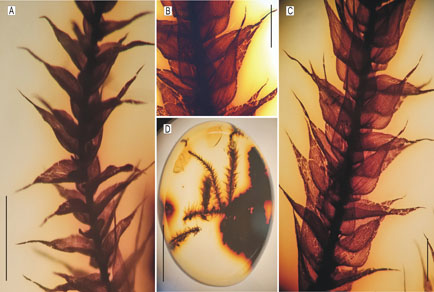
A pleurocarpous moss preserved in amber is described as a new species, Meteoriella parvicella sp. nov. This is the first record of a moss with double costae in Baltic amber. The specimen consists of a 7-mm fragment of the stem with several regularly arranged branches and imbricate leaves. The leaves are ovate to ovate-lanceolate, serrate, 1.0–1.1 × 0.3–0.4 mm, distinctly auriculate at the base, concave, and abruptly tapering into a long apex. A thin, forked double costa extends to approximately one-third of the leaf length. Comparisons of this specimen with Meteoriella soluta demonstrate clear morphological differences, including smaller leaves, erecto-patent rather than squarrose leaf orientation, straight and sparsely spaced teeth on the apex, and consistently shorter and narrower laminal cells. These characters support the placement of the specimen within the genus Meteoriella and justify its recognition as a distinct species. Meteoriella parvicella sp. nov. represents a new fossil member of Hylocomiaceae from Baltic amber (Eocene age), contributing valuable information to the diversity and morphological variation of the family in deep time.
References
- Buck, W.R. (1979) A revision of the moss genus Trachyphyllum Gepp (Thuidiaceae). Brittonia 31: 379–394. https://doi.org/10.2307/2806131
- Buck, W.R. & Goffinet, B. (2000) Morphology and classification of mosses. In: Shaw, A.J. & Goffinet, B. (Eds.) Bryophyte Biology. Cambridge University Press, Cambridge, pp. 71–123. https://doi.org/10.1017/CBO9781139171304.004
- Caspary, R. (1907) Die Flora des Bernsteins und anderer fossiler Harze des ostpreussischen Tertiärs. Bearbeitet von R. Klebs. Abhandlungen der Königlich Preussischen Geologischen Landesanstalt 4: 1–181. https://doi.org/10.5962/bhl.title.7578
- Dandotiya, D., Govindapyari, H., Suman, S. & Uniyal, P.L. (2011) Checklist of the bryophytes of India. Archive for Bryology 88: 1–126.
- Frahm, J.-P. & Gröhn, C. (2013) More fossil bryophytes from Baltic amber. Archive for Bryology 159: 1–9.
- Frahm, J.-P. & Gröhn, C. (2015) Neue Nachweise von Moosen aus baltischem Bernstein. Archive for Bryology 175: 1–8.
- Frahm, J.-P. (1994) Die Identität von Muscites hauchecornei Caspary & Klebs (Musci) aus Baltischem Bernstein. Nova Hedwigia 58: 239–243.
- Frahm, J.-P. (1996a) Laubmoose aus Baltischem Bernstein. Palaeontographica B 241: 127–135.
- Frahm, J.-P. (1996b) Mosses newly recorded from Saxonian amber. Nova Hedwigia 63: 525–527. https://doi.org/10.1127/nova.hedwigia/63/1996/525
- Frahm, J.-P. (2000a) New and interesting mosses from Baltic and Saxon amber. Lindbergia 25: 33–39. https://doi.org/10.1016/j.revpalbo.2003.11.004
- Frahm, J.-P. (2000b) Neue Laubmoosfunde aus baltischem Bernstein. Cryptogamie, Bryologie 21: 121–132. https://doi.org/10.1016/S1290-0796(00)00113-9
- Frahm, J.-P. (2001a) Hypnodontopsis confertus from Baltic amber. Tropical Bryology 20: 79–82. https://doi.org/10.11646/bde.20.1.13
- Frahm, J.-P. (2001b) Neue Laubmoosfunde aus sächsischen und baltischem Bernstein. Nova Hedwigia 72: 271–281. https://doi.org/10.1127/nova.hedwigia/72/2001/271
- Frahm, J.-P. (2004a) A new contribution to the moss flora of Baltic and Saxon amber. Review of Palaeobotany and Palynology 129: 81–101. https://doi.org/10.1016/j.revpalbo.2003.11.004
- Frahm, J.-P. (2004b) The genus Atrichum in Baltic amber. Journal of the Hattori Botanical Laboratory 95: 219–227.
- Frahm, J.-P. (2005a) Neue Laubmoosfunde in baltischem Bernstein. Palaeontographica B 271: 159–168. https://doi.org/10.1127/palb/271/2005/159
- Frahm, J.-P. (2005b) The genus Hypnodontopsis (Bryopsida, Rhachitheciaceae) in Baltic and Saxon amber. The Bryologist 108: 228–235.
- Frahm, J.-P. (2006) Neue Moosfunde aus baltischem Bernstein. Limprichtia 29: 119–129.
- Frahm, J.-P. (2008) New record of bryophytes from Baltic and Bitterfeld amber. Acta Palaeobotanica 48: 183–190.
- Frahm, J.-P. (2009) The first record of Sphagnum from the Tertiary in Baltic amber and other new records of mosses from Baltic and Dominican amber. Cryptogamie, Bryologie 30: 259–263.
- Frahm, J.-P. (2010) Die Laubmoosflora des Baltischen Bernsteinwaldes. Weissdorn-Verlag, Jena, 101 pp.
- Goeppert, H.R. & Berendt, G.C. (1845) Der Bernstein und die in ihm befindlichen Pflanzenreste der Vorwelt. Commission der Nicolaischen Buchhandlung, Berlin, 123 pp.
- Goffinet, B. & Shaw, A.J. (Eds.) (2009) Bryophyte Biology. 2nd ed. Cambridge University Press, Cambridge, 450 pp. https://doi.org/10.1017/CBO9780511754807
- Gradstein, S.R., Churchill, S.P. & Salazar Allen, N. (2001) Guide to the bryophytes of tropical America. Memoirs of the New York Botanical Garden 86: 1–577.
- Grolle, R. & Meister, K. (2004) The liverworts in Baltic and Bitterfeld amber. Weissdorn-Verlag, Jena, 223 pp.
- Hedenäs, L. & Buck, W.R. (1999) A phylogenetic analysis of the Sematophyllaceae. Lindbergia 24: 103–132.
- Heinrichs, J., Hedenäs, L., Schäfer-Verwimp, A., Feldberg, K. & Schmidt, A.R. (2014) An in situ preserved moss community in Eocene Baltic amber. Review of Palaeobotany and Palynology 210: 113–118. https://doi.org/10.1016/j.revpalbo.2014.08.005
- Ignatov, M.S., Gardiner, A.A., Bobrova, V.K., Milyutina, I.A., Huttunen, S. & Troitsky, A.V. (2007) On relationships of mosses of the order Hypnales, with the special reference to taxa traditionally classified in Leskeaceae. In: Newton, A.E. & Tangney, R.S. (Eds.) Pleurocarpous mosses: systematics and evolution, Systematics Association Special Volume, 71. CRC Press, Boca Raton, pp. 177–213. https://doi.org/10.1201/9781420005592.ch9
- Ignatov, M.S. & Perkovsky, E.E. (2011) Mosses from Rovno amber (Ukraine). Arctoa 20: 1–18. https://doi.org/10.15298/arctoa.20.01
- Ignatov, M.S. & Perkovsky, E.E. (2013) Mosses from Rovno amber (Ukraine) 2. Arctoa 22: 83–92. https://doi.org/10.15298/arctoa.22.12
- Ignatov, M.S., Heinrichs, J., Schäfer-Verwimp, A. & Perkovsky, E.E. (2016) The first record of a bryophyte in Upper Cretaceous amber from Taimyr, northern Siberia: Taimyrobryum martynoviorum gen. et sp. nov. (Bryopsida). Cretaceous Research 65: 25–31. https://doi.org/10.1016/j.cretres.2016.04.005
- Ignatov, M.S., Lamkowski, P., Ignatova, E.A. & Perkovsky, E.E. (2019b) Mosses from Rovno amber (Ukraine) 4. Sphagnum heinrichsii, a new moss species from Eocene. Arctoa 28: 1–11. https://doi.org/10.15298/arctoa.28.01
- Ignatov, M.S., Lamkowski, P., Ignatova, E.A., Kulikovskiy, M.S., Mamontov, Yu.S. & Vasilenko, D.V. (2019a) Mosses from Rovno Amber (Ukraine) 5. New findings and comparison of mosses from Rovno and Baltic amber. Paleontological Journal 53: 1084–1094. https://doi.org/10.1134/S0031030119100071
- Ignatov, M.S., Vasilenko, D.V., Legalov, A.A. & Perkovsky, E.E. (2025) Mosses from Rovno amber (Ukraine), 6. New genus of the family Pylaisiadelphaceae. Ecologica Montenegrina 89: 87–97. https://doi.org/10.37828/em.2025.89.4
- Ignatov, M.S., Ignatova, E.A., Kuznetsova, O.I. & Fedosov, V.E. (2019) On moss genera Hylocomiadelphus Ochyra & Stebel and Rhytidiadelphus (Limpr.) Warnst. Acta Musei Silesiae, Scientiae Naturales 68: 123–134. https://doi.org/10.2478/cszma-2019-0012
- Ignatova, E.A., Fedosov, V.E., Kuznetsova, O.I., Fedorova, A.V. & Ignatov, M.S. (2024) On the genus Didymodon s. str. (Pottiaceae, Bryophyta) in Russia. Arctoa 33: 129–155. https://doi.org/10.15298/Arctoa.33.14
- Ihsiba, E. (1929) Nihonsan senrui sosetsu [Catalog of Mosses of Japan]. Nishigahara Kankokai, Tokyo, 235 pp.
- Noguchi, A. (1989) Illustrated Moss Flora of Japan. Part 3. Hattori Botanical Laboratory, Japan, 300 pp.
- Okamura, S. (1915) Contributiones novae ad floram bryophyton Japonicam. I. The Journal of the College of Science, Imperial University of Tokyo 36 (7): 1–51.
- Okamura, S. (1916) Contributiones novae ad floram bryophyton Japonicam. II. The Journal of the College of Science, Imperial University of Tokyo 38 (4): 1–100.
- Sakurai, K. (1933) Beobachtungen über japanische Moosflora (IV). The Botanical Magazine, Tokyo 47: 733–747. https://doi.org/10.15281/jplantres1887.47.733
- Seyfullah, L.J., Beimforde, Ch., Corso, J.D., Perrichot, V., Rikkinen, J. & Schmidt, A.R. (2018) Production and preservation of resins—past and present. Biological Reviews 93: 1684–1714. https://doi.org/10.1111/brv.12414
- Weitschat, W. & Wichard, W. (1998) Atlas der Pflanzen und Tiere im Baltischen Bernstein. Verlag Dr. Friedrich Pfeil, München, 256 pp.
- Wolski, G.J. (2025) A new species of the genus Sematophyllites J.-P. Frahm (Sematophyllaceae Broth.) from Baltic amber. Herzogia 38: 147–155. https://doi.org/10.13158/heia.38.1.2025.147
- Wu, P.-C., Crosby, M.R. & He, S. (Eds.) (2011) Moss Flora of China (English version), Volume 5: Erpodiaceae to Climaciaceae. Missouri Botanical Garden Press & Science Press, St. Louis & Beijing, 504 pp.