
Abstract
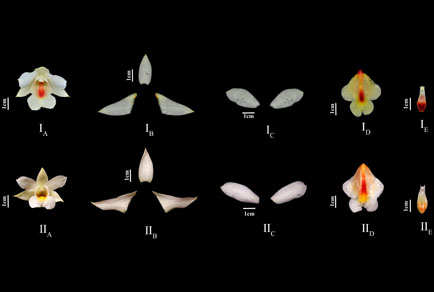
Dendrobium sinense Tang & F.T.Wang (Orchidaceae) was treated as a synonym of D. christyanum Rchb.f. Critical observations of herbarium materials together with living plants in the wild, however, revealed stable morphological differences between the two taxa. D. sinense differs from D. christyanum by the longer (5.0–21.0 cm vs. 2.0–5.0 cm) and slender (0.3–0.4 cm vs. 0.6–1.0 cm) stems, and the broadly ovate (vs. obliquely rhombic) lateral lobes of labellum. Additionally, the two species exhibit geographically allopatric distributions and distinct, non-overlapping flowering periods. Phylogenetic reconstructions derived from nuclear region ITS and four plastid markers (matK, rbcL, trnH–psbA, and trnL) consistently recover them as separate and well-supported lineages. Consequently, these lines of evidence substantiate the recognition of D. sinense as a distinct species, and its specific status is therefore reinstated.
References
- Averyanov, L.V., Ponert, J., Nguyen, P.T., Van Duy, N., Khang, N.S. & Nguyen, V.C. (2016) A survey of Dendrobium Sw. sect. Formosae (Benth. & Hook. f.) Hook. f. in Cambodia, Laos and Vietnam. Adansonia sér. 3 38 (2): 199–217. https://doi.org/10.5252/a2016n2a5
- Bentham, G. & Hooker, J.D. (1883) Genera plantarum ad exemplaria imprimis in herbariis kewensibus servata definite, vol. 3. Venit apud Reeve & Company. London, 1258pp. https://doi.org/10.5962/bhl.title.105370
- Jiang, H. & Yang, S. (2005) Dendrobium christyanum (Orchidaceae), a little known species from China. Acta Botanica Yunnanica 27 (2): 134–136. https://doi.org/10.3969/j.issn.2095-0845.2005.02.014
- Li, M.H., Liu, D.K., Zhang, G.Q., Deng, H., Tu, X.D., Wang, Y., Lan, S.R. & Liu, Z.J. (2019) A perspective on crassulacean acid metabolism photosynthesis evolution of orchids on different continents: Dendrobium as a case study. Journal of Experimental Botany 70: 6611–6619. https://doi.org/10.1093/jxb/erz461
- Liu, D.K., Tu, X.D., Zhao, Z., Zeng, M.Y., Zhang, S., Ma, L., Zhang, G.Q., Wang, M.M., Liu, Z.J., Lan, S.R., Li, M.H. & Chen, S.P. (2020) Plastid phylogenomic data yield new and robust insights into the phylogeny of Cleisostoma–Gastrochilus clades (Orchidaceae, Aeridinae). Molecular Phylogenetics and Evolution 145: 106729. https://doi.org/10.1016/j.ympev.2019.106729
- Miller, M.A., Pfeiffer, W. & Schwartz, T. (2010) Creating the CIPRES Science Gateway for inference of large phylogenetic trees. 2010 Gateway Computing Environments Workshop (GCE), New Orleans, LA, USA, pp. 1–8. https://doi.org/10.1109/GCE.2010.5676129
- Pridgeon, A.M., Cribb, P.J., Chase, M.W. & Rasmussen, F.N. (eds.) (2014) Genera Orchidacearum, vol. 6: Epidendroideae. Oxford University Press, Oxford, 608 pp.
- Reichenbach, H.G. (1882) New garden plants. The Gardeners’ Chronicle: a Weekly Illustrated Journal of Horticulture and Allied Subjects 17: 178–179.
- Swartz, O. (1799) Dendrobium. Nova Acta Regiae Societatis Scientiarum Upsaliensis 6: 82–85.
- Tang, T. & Wang, F.T. (1974) Plantae novae orchidacearum Hainanensium. Acta Phytotaxonomica Sinica 12 (1): 35–49.
- Takamiya, T., Wongsawad, P., Sathapattayanon, A., Tajima, N., Suzuki, S., Kitamura, S., Shioda, N., Handa, T., Kitanaka, S., Iijima, H. & Yukawa, T. (2014) Molecular phylogenetics and character evolution of morphologically diverse groups, Dendrobium section Dendrobium and allies. AoB Plants 6: plu045. https://doi.org/10.1093/aobpla/plu045
- Tamura, K., Stecher, G., Peterson, D., Filipski, A. & Kumar, S. (2013) MEGA6: Molecular Evolutionary Genetics Analysis version 6.0. Molecular Biology and Evolution 30: 2725–2729. https://doi.org/10.1093/molbev/mst197
- Xiang, X.G., Schuiteman, A., Li, D.Z., Huang, W.C., Chung, S.W., Li, J.W., Zhou, H.L., Jin, W.T., Lai, Y.J., Li, Z.Y. & Jin, X.H. (2013) Molecular systematics of Dendrobium (Orchidaceae, Dendrobieae) from mainland Asia based on plastid and nuclear sequences. Molecular Phylogenetics and Evolution 69: 950–960. https://doi.org/10.1016/j.ympev.2013.06.009
- Xu, S.W., Gao, X.Y., Zeng, M.Y., Zhou, C.Y., Liu, Z.J. & Li, M.H. (2023) Phylogenetics of two rhizomatous epiphytic species of Cymbidium (Orchidaceae; Cymbidieae): evidence from analyses of nuclear and plastid DNA. Phytotaxa 598: 97–104. https://doi.org/10.11646/phytotaxa.598.1.8
- Zhang, D., Gao, F., Jakovlić, I., Zou, H., Zhang, J., Li, W.X. & Wang, G.T. (2020) PhyloSuite: An integrated and scalable desktop platform for streamlined molecular sequence data management and evolutionary phylogenetics studies. Molecular Ecology Resources 20 (1): 348–355. https://doi.org/10.1111/1755-0998.13096