
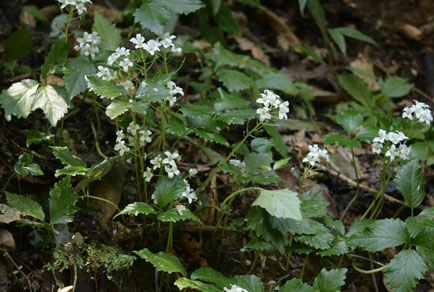

Abstract
Cardamine cheotaiyienii Al-Shehbaz & G.Yang, a rare scapose perennial with leafless flowering stems, was first described based on a single collection made in 1940 in Malipo County, southeastern Yunnan, China. After 85 years without subsequent records, we rediscovered the species in Xichou County in 2025. Here, we provide an amended morphological description, the first documentation of fruit and seed characteristics, field images, updated phenological data, and a conservation assessment. This rediscovery highlights the need for enhanced botanical surveys in under-sampled microhabitats of southeastern Yunnan, a region of high conservation value.
References
- Al-Shehbaz, I.A. & Yang, G. (1998) Notes on Chinese Cardamine (Brassicaceae). Harvard Papers in Botany 3 (1): 73–77.
- Al-Shehbaz, I.A. & Boufford, D.E. (2008) Cardamine tianqingiae (Brassicaceae), a new species from Gansu Province, China. Harvard Papers in Botany 13 (1): 89–91. https://doi.org/10.3100/1043-4534(2008)13[89:CTBANS]2.0.CO;2
- Al-Shehbaz, I.A. (2015a) Aphragmus pygmaeus and Cardamine pseudotrifoliolata (Brassicaceae), new species from Himalayan China. Novon 24 (1): 1–5. https://doi.org/10.3417/2015002
- Al-Shehbaz, I.A. (2015b) Cardamine hongdeyuana (Brassicaceae), a new species from Xizang, China. Kew Bulletin 70: 1–4. https://doi.org/10.1007/S12225-014-9556-3
- Al-Shehbaz, I.A. (2015c) Cardamine xinfenii (Brassicaceae), a new species from Sichuan (China). Harvard Papers in Botany 20 (2): 145–146. https://doi.org/10.3100/hpib.v20iss2.2015.n3
- An, M.T., Lin, Y., Yu, L.F., Yang, Y.B., Cheng, G.P. & Li, J.Q. (2016) Cardamine kuankuoshuiense (Brassicaceae), a new species from Guizhou, China. Phytotaxa 267 (3): 233–236. https://doi.org/10.11646/phytotaxa.267.3.7
- Bachman, S., Moat, J., Hill, A.W., de la Torre, J. & Scott, B. (2011) Supporting Red List threat assessments with GeoCAT: geospatial conservation assessment tool. ZooKeys 150: 117–126. https://doi.org/10.3897/zookeys.150.2109
- Bai, H.F., Chen, L.B., Liu, K.M. & Liu, L.H. (2008) A new species of Cardamine (Brassicaceae) from Hunan, China. Novon 18 (2): 135–137. https://doi.org/10.3417/2006129
- Beentje, H. (2016) The Kew Plant Glossary, An Illustrated Dictionary of Plant Terms (second edition). Royal Botanic Gardens Kew, Kew Publishing, 184 pp.
- Chen, W.L., Smirnov, S.V., Kamelin, R.V., Zhang, S.R., Wang, J., Liu, J.Q., Shmakov, A.I. & German, D.A. (2011) Some new or noteworthy plant species for China found in North West Xinjiang. Turczaninowia 14 (1): 75–80.
- Diao, Y., Zhao, C.F., Chen, Y.B. & Hu, Z.L. (2023) Cardamine libagouensis, a new species from Hubei, China. Nordic Journal of Botany 2023: e03914. https://doi.org/10.1111/njb.03914
- Guo, Y.J., Li, J.L., Al-Shehbaz, I.A., Qian, L.S., Feng, M.J., Yue, J.P. & Liu, Q.R. (2024) Cardamine sichuanensis (Brassicaceae), a new species from Sichuan, China. Phytotaxa 663: 15–25. https://doi.org/10.11646/phytotaxa.663.1.2
- Harris, J.G. & Harris, M.W. (1994) Plant Identification Terminology: An Illustrated Glossary. Spring Lake Publishing, Spring Lake, Utah, 206 pp.
- IUCN (2024) Guidelines for using the IUCN Red List categories and criteria, version 16. IUCN Standards and Petitions Committee. [http://www.iucnredlist.org/resources/redlistguidelines]
- Linnaeus, C. (1753) Species Plantarum. Laurentius Salvius, Holmiae [Stockholm], 1200 + [31] pp.
- Li, J., Zhang, C., He, Y. & Liu, Q. (2024) Cardamine zhangjiajieensis, a new species of Brassicaceae in China. PhytoKeys 248: 293–304. https://doi.org/10.3897/phytokeys.248.119678
- Li, J.L., He, Y & Liu, Q.R. (2025) Cardamine tangutorum O.E.Schulz (Brassicaceae), a new synonym of Cardamine macrophylla Willd. PhytoKeys 255: 123–141. https://doi.org/10.3897/phytokeys.255.146179
- Liu, A., Li, X., Deng, G.X., Chen, J., Liu, Z., Yu, X.L. & Wu, L. (2025) Cardamine mangshanensis, a new species of Brassicaceae from limestone landform in Southern Hunan, China. PhytoKeys 256: 131–139. https://doi.org/10.3897/phytokeys.256.153110
- Marhold, K., Lihova, J., Al-Shehbaz, I.A. & Kudoh, H. (2007) The correct interpretation and lectotypification of the name Cardamine fallax (Brassicaceae). Journal of Plant Research 120: 655–660. https://doi.org/10.1007/s10265-007-0107-y
- Marhold, K., Slenker, M., Kudoh, H. & Zozomova-Lihova, J. (2016) Cardamine occulta, the correct species name for invasive Asian plants previously classified as C. flexuosa, and its occurrence in Europe. PhytoKeys 62: 57–72. https://doi.org/10.3897/phytokeys.62.7865
- Šlenker, M., Zozomová-Lihová, J., Mandáková, T., Kudoh, H., Zhao, Y.P., Soejima, A., Yahara, T., Skokanová, K., Španiel, S. & Marhold, K. (2018) Morphology and genome size of the widespread weed Cardamine occulta: how it differs from cleistogamic C. kokaiensis and other closely related taxa in Europe and Asia. Botanical Journal of the Linnean Society 187: 456–482. https://doi.org/10.1093/botlinnean/boy030
- Wu, L., Liu, W.J., Mu, C. & Al-Shehbaz, I.A. (2021) Cardamine hunanensis (Brassicaceae), a remarkable new species from Hunan (China) with fully bracteate racemes. Phytotaxa 512 (1): 79–82. https://doi.org/10.11646/phytotaxa.512.1.7
- Zhang, Y.H. (1986) Hilliella, a new genus of Cruciferae. Acta Botanica Yunnanica 8 (4): 397–406.
- Zhou, T.Y., Lu, L.L., Yang, G. & Al-Shehbaz, I.A. (2001) Brassicaceae. In: Wu, C.Y. & Raven, P.H. (Eds.) Flora of China. Volume 8. Science Press, Beijing, the Missouri Botanical Garden Press, St. Louis, pp. 1–193.