

Abstract
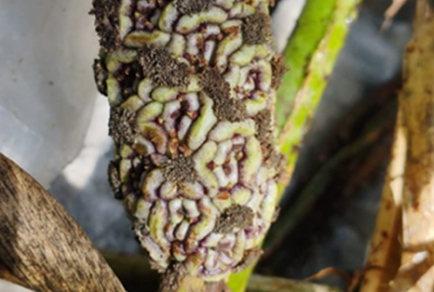
Cyclanthaceae (Pandanales) comprises 12 genera and approximately 230 species endemic to the Neotropical region, with its greatest diversity in northwestern South America and southern Central America. Brazil harbors 37 species of the family, most of them occurring in Amazonia. In contrast, the Atlantic Forest of eastern Brazil, despite being predominantly forested, the preferred environment for Cyclanthaceae, holds a lower species richness. Recent fieldwork in the Atlantic Forest of Espírito Santo state, combined with herbarium studies, revealed a set of specimens belonging to Asplundia, the richest genus of Cyclanthaceae, that does not match any described species. Thus, based on morphological evidence, we describe and illustrate Asplundia capixaba. We also discuss its affinities, provide notes on its distribution and ecology, and present a preliminary assessment of its conservation status as Endangered. We also provide an identification key for the Asplundia species from the Atlantic Forest, including Asplundia gardneri and A. rivularis, the species most closely related to the new taxon. This new discovery updates the knowledge of Cyclanthaceae in the Atlantic Forest and contributes to underscores the urgent need to conserve this biodiversity hotspot.
References
- Almeida, R.F. & Mamede, M.C.H. (2014) Checklist, conservation status, and sampling effort analysis of Malpighiaceae in Espírito Santo State, Brazil. Brazilian Journal of Botany 37 (3): 329–337. https://doi.org/10.1007/s40415-014-0078-x
- Antar, G.M., Lírio, E.J., Freitas, J. & Fraga, C.N. (2022a) Vitex pomerana (Lamiaceae;Viticoideae), a new unifoliolate species from the Brazilian Atlantic Forest. Kew Bulletin 77: 941–952. https://doi.org/10.1007/s12225-022-10064-x
- Antar, G.M., Lírio, E.J., Almeida, R.B.P. & Sano, P.T. (2022b) Bixa atlantica sp. nov. (Bixaceae), a new species of wildannatto from the Atlantic Forest of eastern Brazil. Phytotaxa 544: 171–184. https://doi.org/10.11646/phytotaxa.544.2.3
- Bachman, S., Moat, J., Hill, A.W., de la Torre, J., Scott, B. (2011) Supporting Red List threat assessments with Geo- CAT: Geospatial conservation assessment tool. ZooKeys 150: 117–126. https://doi.org/10.3897/zookeys.150.2109
- Daru, B.H., Park, D.S., Primack, R.B., Willis, C.G., Barrington, D.S., Whitfeld, T.J.S., Seidler, T.G., Sweeney, P.W., Foster, D.R., Ellison, A.M. & Davis, C.C. (2018) Widespread sampling biases in herbaria revealed from large-scale digitization. New Phytologist 217: 939–955. https://doi.org/10.1111/nph.14855
- Dutra, V.F., Carrijo, T.T. & Alves-Araújo, A. (2022) Projeto Flora do Espírito Santo: revelando a flora capixaba. Rodriguésia 73: e730002022. https://doi.org/10.1590/2175-7860202273000
- Fontaine, B., Perrard, A. & Bouchet, P. (2012) 21 years of shelf life between discovery and description of new species. Current Biology 22 (22): R943–R944. https://doi.org/10.1016/j.cub.2012.10.029
- Gaem, P.H., Fernandes, T., Valdemarin, K.S., Lucas, E. & Mazine, F.F. (2021) Myrcia excelsa (Myrtaceae), a new species from Espírito Santo, Brazil. Phytotaxa 501 (2): 293–296. https://doi.org/10.11646/phytotaxa.501.2.4
- Goldenberg, R., Bacci, L.F., Bochorny, T. & Reginato, M. (2021) Two new species of Miconia s.lat. (Melastomataceae) from Espírito Santo, Brazil. Nordic Journal of Botany 2022: e03396. https://doi.org/10.1111/njb.03396
- Hammel, B.E. (1987) The origami of botany: a guide to collecting and mounting specimens of Cyclanthaceae. Annals of the Missouri Botanical Garden 74: 897–902. https://doi.org/10.2307/2399456
- Hammel, B.E. & Grayum, M.H. (2022) A species of Asplundia (Cyclanthaceae) from Panama. Phytoneuron 40: 1–5.
- Harling, G.W. (1954) Taxonomical studies in the genus Carludovica R. & P. A preliminar report. Acta Horti Bergiani 17: 39–45.
- Harling, G.W. (1958) Monograph of the Cyclanthaceae. Acta Horti Bergiani 18: 1–428.
- Harling, G.W., Wilder, G.J. & Eriksson, R. (1998) Cyclanthaceae. In: Kubitzki, K. (Ed.) The families and genera of vascular plants. Flowering plants Monocotyledons-Lilianae (except Orchidaceae). Springer Verlag, Berlin, pp. 202–215. https://doi.org/10.1007/978-3-662-03533-7_27
- INCT (2025) Herbário Virtual da Flora e dos Fungos. Available from: http://inct.splink.org.br/ (accessed 18 May 2025)
- IUCN (2012) IUCN Red List categories and criteria: Version 3.1. Second edition. IUCN, Gland, Switzerland and Cambridge, UK, 33 pp.
- IUCN (2024) Guidelines for using the IUCN Red List Categories and Criteria, version 16. Cambridge. Available from: http://www.iucnredlist.org/documents/RedListGuidelines.pdf (accessed 11 Jan 2026)
- JSTOR (2019) Jstor Global Plants, Ithaka. Available from: https://plants.jstor.org/ (accessed 18 May 2021)
- Leal, E.S. (2011) Asplundia altiscandens sp. nov. (Cyclanthaceae) from the Brazilian Amazon. Nordic Journal of Botany 29: 687–690. https://doi.org/10.1111/j.1756-1051.2011.01220.x
- Leal, E.S. (2025) Cyclanthaceae in Flora e Funga do Brasil. Jardim Botânico do Rio de Janeiro. Available from: https://floradobrasil.jbrj.gov.br/FB98 (accessed 27 August 2025)
- Leal, E.S., Vasconcelos, T.N.C., Tuberquia, D., Gomez, M.S., Michelangeli, F.A., Forzza, R.C. & Mello-Silva, R. (2022) Phylogeny and historical biogeography of the Panama-hat family (Cyclanthaceae, Pandanales). Taxon 71 (5): 963–980. https://doi.org/10.1002/tax.12769
- Lindman, C.A.M. (1900) Einige neue brasilianishe Cyclanthaceen. Bihang til Kongliga Svenska VetenskapsAkademiens Handlingar 26 (3, 8): 9.
- Luber, J., Tuler, A.C., Leite, F.T., Christ, J.A., Guidoni-Martins, K.G., Zanetti, M., Holunder, R.K., da Cunha Manhães, V., Zorzanelli, J.P.F., de Sá Mendonça, E., Garbin, M.L. & Carrijo, T.T. (2016) List of angiosperm species in an Atlantic Forest fragment reveals collection gaps in Espirito Santo state, Brazil. Check List 12: 1835. https://doi.org/10.15560/12.1.1835
- Marques, M.C.M., Trindade, W., Bohn, A. & Grelle, C.E.V. (2020) The Atlantic Forest: an introduction to the megadiverse forest of Southern America. In: Marques, M.C.M. & Grelle, C.E.V. (Eds.) The Atlantic Forest: history, biodiversity, threats and opportunities of the megadiverse forest. Springer International Publishing, Switzerland, pp. 3–23.
- Mittermeier, R.A., Turner, W.R., Larsen, F.W., Brooks, T.M. & Gascon, C. (2011) Global biodiversity conservation: the critical role of hotspots. In: Zachos, E. & Habel, J.C. (Eds.) Biodiversity hotspots. Springer Publishers, London, pp. 3–22. https://doi.org/10.1007/978-3-642-20992-5_1
- Muylaert, R.L., Vancine, M.H., Bernardo, R., Oshima, J.E.F., Sobral-Souza, T., Tonetti, V.R., Niebuhr, B.B. & Ribeiro, M.C. (2018) Uma nota sobre os limites territoriais da Mata Atlantica. Oecologia Australis 22: 302–311. https://doi.org/10.4257/oeco.2018.2203.09
- Oliveira, E.V., Alves, D.M.C., Landim, M.F. & Gouveia, S.F. (2021) Sampling effort and the drivers of plant species richness in the Brazilian coastal regions. Oecologia 195: 163–171. https://doi.org/10.1007/s00442-020-04805-7
- POWO (2025) Plants of the World Online. Facilitated by the Royal Botanic Gardens, Kew. Published on the Internet. Available from: https://powo.science.kew.org/ (accessed 1 September 2025)
- QGIS Development Team (2018) QGIS Geographic Information System. Open Source Geospatial Foundation Project. Available from: https://qgis.org/en/site/ (accessed 23 May 2024)
- Reflora—Herbário Virtual (2025) Available from: http://reflora.jbrj.gov.br/reflora/herbarioVirtual (accessed 15 May 2024)
- Rezende, C.L., Scarano, F.R., Assad, E.D., Joly, C.A., Metzger, J.P., Strassburg, B.B.N., Tabarelli, M., Fonseca, G.A. & Mittermeier, R.A. (2018) From hotspot to hopespot: An opportunity for the Brazilian Atlantic Forest. Perspectives in ecology and conservation 16 (4): 208–214. https://doi.org/10.1016/j.pecon.2018.10.002
- Schultes, R.E. (1941) Planta mexicanae X: New or critical Species from Oaxaca. Botanical Museum Leaflets [Harvard University] 9 (9): 165–215. https://doi.org/10.5962/p.168422
- SOS Mata Atlântica (2024) Atlas dos remanescentes florestais da Mata Atlântica: período 2022–2023. INPE, São José dos Campos. Available from: http://urlib.net/ibi/8JMKD3MGP3W34T/4C2JEEE (accessed 18 May 2025)
- Teles, A.M., Manhães, V.C. & Couto, D.R. (2024) Half a century later, a new species of Wunderlichia (Wunderlichieae, Asteraceae) from the Atlantic Forest inselbergs of Espírito Santo, Brazil. Phytotaxa 664 (3): 172–180. https://doi.org/10.11646/phytotaxa.664.3.2
- Thiers, B. (2025) Index Herbariorum: A global directory of public herbaria and associated staff. New York Botanical Garden’s Virtual Herbarium. Available from: http://sweetgum.nybg.org/science/ih/ (accessed 2 March 2025)
- Trindade, W.C.F. & Marques, M.C.M. (2024) The Invisible Species: Big Data Unveil Coverage Gaps in the Atlantic Forest Hotspot. Diversity and Distributions 30: e13931. https://doi.org/10.1111/ddi.13931
- Tuberquia, D. & Leal, E.S. (2018) A new long-leaved species of Asplundia (Cyclanthaceae) from Colombia. Brittonia 70: 399–404. https://doi.org/10.1007/s12228-018-9543-3
- Zorzanelli, J.P.F., Dias, H.M., Silva, A.G. & Kunz, S.H. (2017) Vascular plant diversity in a Brazilian hotspot: floristic knowledge gaps and tools for conservation. Brazilian Journal of Botany 40 (3): 819–827. https://doi.org/10.1007/s40415-017-0386-z