

Abstract
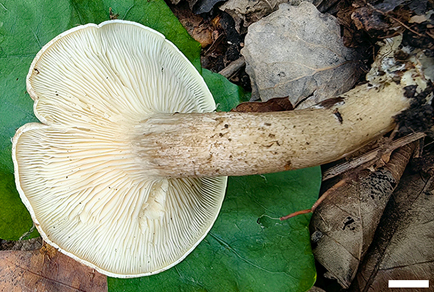
A new Lulesia species, namely Lulesia hebeiensis, collected from northern China, is described and illustrated based on morphological characteristics and molecular evidence. It is characterized by pale cream, pale olivaceous buff to light vinaceous grey pileus, pale cream to clay-buff stipe, white to cream decurrent lamellae, a negative reaction to KOH, regular lamellae trama, subglobose to broadly ellipsoid angular basidiospores (4.7–5.4 × 3.9–4.5 μm), and the absence of clamp connections. Molecular phylogeny inferred from the combined 5-gene dataset (ITS + nLSU + RPB2 + TEF1 + ATP6) showed that samples of L. hebeiensis formed a distinctive lineage in L. subg. Lulesia, and it is nested as a sister group to L. densifolia.
References
- Angelini, C. & Contu, M. (2012) Lulesia densifolia (Basidiomycota, Agaricomycetes) rinvenuta nella Repubblica Dominicana (Caraibi). Rivista Micologica Romana, Bollettino dell’Associazione Micologica Ecologica Romana 86: 20–24.
- Baroni, T.J. & Matheny, P.B. (2011) A re-evaluation of gasteroid and cyphelloid species of Entolomataceae from Eastern North America. Harvard Papers in Botany 16: 293–310. https://doi.org/10.3100/0.25.016.0205
- Carbone, I. & Kohn, L.M. (1999) A method for designing primer sets for speciation studies in filamentous ascomycetes. Mycologia 91 (3): 553–556. https://doi.org/10.1080/00275514.1999.12061051
- Co-David, D., Langeveld, D. & Noordeloos, M.E. (2009) Molecular phylogeny and spore evolution of Entolomataceae. Persoonia 23: 147–176. https://doi.org/10.3767/003158509X480944
- Gross, G. (1972) Kernzahl und sporenvolumen bei einigen Hymenogasterarten. Zeitschrift für Pilzkunde 38: 109–158.
- Cubeta, M.A., Echandi, E., Abernethy, T. & Vilgalys, R. (1991) Characterization of anastomosis groups of binucleate Rhizoctonia species using restriction analysis of an amplified ribosomal RNA gene. Phytopathology 81: 1395–1400. https://doi.org/10.1094/Phyto-81-1395
- Hall, T.A. (1999) Bioedit: A user-friendly biological sequence alignment editor and analysis program for windows 95/98/NT. Nucleic Acids Symposium Series 41: 95–98.
- Han, M.L., Chen, Y.Y., Shen, L.L., Song, J., Vlasák, J., Dai, Y.C. & Cui, B.K. (2016) Taxonomy and phylogeny of the brown-rot fungi: Fomitopsis and its related genera. Fungal Diversity 80 (1): 343–373. https://doi.org/10.1007/s13225-016-0364-y
- Hillis, D.M. & Bull, J.J. (1993) An empirical test of bootstrapping as a method for assessing confidence in phylogenetic analysis. Systematics and Biodiversity 42: 182–192. https://doi.org/10.1093/sysbio/42.2.182
- Jian, S.P., Bau, T., Zhu, X.T., Deng, W.Q., Yang, Z.L. & Zhao, Z.W. (2020) Clitopilus, Clitocella, and Clitopilopsis in China. Mycologia 112: 371–399. https://doi.org/10.1080/00275514.2019.1703089
- Kluting, K.L., Baroni, T.J. & Bergemann, S.E. (2014) Toward a stable classification of genera within the Entolomataceae: a phylogenetic re-evaluation of the Rhodocybe-Clitopilus clade. Mycologia 106: 1127–1142. https://doi.org/10.3852/13-270
- Kretzer, A.M. & Bruns, T.D. (1999) Use of atp6 in fungal phylogenetics: an example from the Boletales. Molecular Phylogenetics and Evolution 13: 483–492. https://doi.org/10.1006/mpev.1999.0680
- Liu, S., Cui, B.K. & Zhu, B. (2025) Morphological characters and molecular data reveal ten new forest macrofungi species from Hebei Province, North China. Mycology 16 (2): 690–737. https://doi.org/10.1080/21501203.2024.2390967
- Liu, S.L., Zhao, P., Cai, L., Shen, S., Wei, H.W., Na, Q., Han, M., Wei, R., Ge, Y., Ma, H., Karunarathna, S.C., Tibprommab, S., Zhang, B., Dai, D., Lin, L., Fan, X.L., Luo, Z.L., Shen, H.W., Lu, L., Lu, W., Xu, R.F., Tohtirjap, A. & Wu, F. & Zhou, L.W. (2025) Catalogue of fungi in China 1. New taxa of plant-inhabiting fungi. Mycology 16 (1): 1–58. https://doi.org/10.1080/21501203.2024.2316066
- Liu, Y.J., Whelen, S. & Hall, B.D. (1999) Phylogenetic relationships among Ascomycetes: Evidence from an RNA polymerase II subunit. Molecular Biology and Evolution 16 (12): 1799–1808. https://doi.org/10.1093/oxfordjournals.molbev.a026092
- Mao, N., Lv, J.C., Xu, Y.Y., Zhao, T.Y. & Fan, L. (2022) Two new Clitocella species from North China revealed by phylogenetic analyses and morphological characters. MycoKeys 88: 151–170. https://doi.org/10.3897/mycokeys.88.80068
- Matheny, P.B., Wang, Z., Binder, M., Curtis, J.M., Lim, Y.W., Nilsson, R.H., Hughes, K.W., Hofstetter, V., Ammirati, J.F., Schoch, C.L., Langer, E., Langer, G., McLaughlin, D.J., Wilson, A.W., Frøslev, T., Ge, Z.W., Kerrigan, R.W., Slot, J.C., Yang, Z.L., Baroni, T.J., Fischer, M., Hosaka, K., Matsuura, K., Seidl, M.T., Vauras, J. & Hibbett, D.S. (2007) Contributions of rpb2 and tef1 to the phylogeny of mushrooms and allies (Basidiomycota, Fungi). Molecular Phylogenetics and Evolution 43 (2): 430–451. https://doi.org/10.1016/j.ympev.2006.08.024
- Meerts, P. (1999) The evolution of spores in agarics: do big mushrooms have big spores? Journal of Evolutionary Biology 12: 161–165.
- https://doi.org/10.1046/j.1420-9101.1999.00020.x
- Nylander, J.A.A. (2004) MrModeltest v2. Program distributed by the author. Evolutionary Biology Centre, Uppsala University.
- Page, R.D.M. (1996) Treeview: an application to display phylogenetic trees on personal computers. Bioinformatics 12: 357–358. https://doi.org/10.1093/bioinformatics/12.4.357
- Petersen, J.H. (1996) The Danish Mycological Society´s colour-chart. Foreningen til Svampekundskabens Fremme, Greve, pp. 1–6.
- Posada, D. & Crandall, K.A. (1998) Modeltest: testing the model of DNA substitution. Bioinformatics 14: 817–818. https://doi.org/10.1093/bioinformatics/14.9.817
- Rehner, S.A. & Buckley, E. (2005) A Beauveria phylogeny inferred from nuclear ITS and EF1-α sequences: evidence for cryptic diversification and links to Cordyceps teleomorphs. Mycologia 97: 84–98. https://doi.org/10.1080/15572536.2006.11832842
- Ren, J., Wang, K., Niu, C.Y., Kang, X., Li, S.M., Wang, L.A., Liu, T.Z., Wei, T.Z. & Li, G.J. (2024) Species diversity and funga of macrofungi in Yanshan area, North China. Mycosystema 43 (11): 240184. https://doi.org/10.13346/j.mycosystema.240184
- Ronquist, F. & Huelsenbeck, J.P. (2003) MrBayes 3: bayesian phylogenetic inference under mixed models. Bioinformatics 19: 1572–1574. https://doi.org/10.1093/bioinformatics/btg180
- Shi, L.Y., Guo, Y.B., Wei, T.Z., Li, M., Li, S.M. & Li, G.J. (2022) Species diversity of macrofungi in the northern Taihang Mountains of Hebei Province. Journal of Hebei Agricultural University 45 (5): 56–66. https://doi.org/10.13320/j.cnki.jauh.2022.0078
- Silva-Filho, A.G.S., Teixeira-Silva, M.A. & Cortez, V.G. (2018) New species, new combination and notes on Clitocella and Rhodocybe (Entolomataceae) from Paraná State, Brazil. Darwiniana 6: 58–67. https://doi.org/10.14522/darwiniana.2018.61.775
- Singer, R. (1970) Omphalineae (Clitocybeae—Tricholomataceae, Agaricales). Flora Neotropica 3: 1–80.
- Stamatakis, A. (2006) RAxML-VI-HPC: maximum likelihood-based phylogenetic analyses with thousands of taxa and mixed models. Bioinformatics 22: 2688–2690. https://doi.org/10.1093/bioinformatics/btl446
- Thompson, J.D., Gibson, T.J., Plewniak, F., Jeanmougin, F. & Higgins, D.G. (1997) The Clustal_X windows interface: fexible strategies for multiple sequence alignment aided by quality analysis tools. Nucleic Acids Research 25: 4876–4882. https://doi.org/10.1093/nar/25.24.4876
- Vizzini, A., Alvarado, P., Consiglio, G., Angelini, C. & Marchetti, M. (2024) Lulesia Singer (1970), an older name for Clitocella Kluting, T.J. Baroni & Bergemann (2014, Entolomataceae). Rivista Micologica Romana, Bollettino dell’Associazione Micologica Ecologica Romana 2023: 3–23. https://doi.org/10.57624/AMER.2023.18
- Vizzini, A., Consiglio, G. & Marchetti, M. (2023) Overview of the European species of the genus Clitocella (Entolomataceae, Agaricales) with notes on extralimital taxa. Persoonia 50: 123–157. https://doi.org/10.3767/persoonia.2023.50.04
- Wang, L.A. & Tong, Z.Y. (2011) Photographs of wild macrofungi in Hebei Province. Science Press, Beijing, pp. 1–311.
- White, T.J., Bruns, T.D., Lee, S.B. & Taylor, J.W. (1990) Amplification and direct sequencing of fungal ribosomal RNA genes for phylogenetics. In: Innis, M.A., Gelfand, D.H., Sninsky, J.J. & White, T.J. (Eds.) PCR protocols: a guide to methods and applications. Academic Press, New York, pp. 315–322. https://doi.org/10.1016/b978-0-12-372180-8.50042-1
- Xiao, Y.Q., Xu, Y.D., Chen, Z.H. & He, Z.M. (2024) Lulesia umbrinomarginata (Entolomataceae, Agaricales), a newly discovered species from Southern China. Phytotaxa 650 (1): 60–72. https://doi.org/10.11646/phytotaxa.650.1.5
- Yang, M., Zhang, J., Bai, J.W., Guo, J.G., Qu, Y.H. & Li, H.P. (2021) Species diversity of macrofungi in the Wuling Mountain National Nature Reserve. Biodiversity Science 29 (9): 1229–1235. https://doi.org/10.17520/biods.2021020