
Abstract
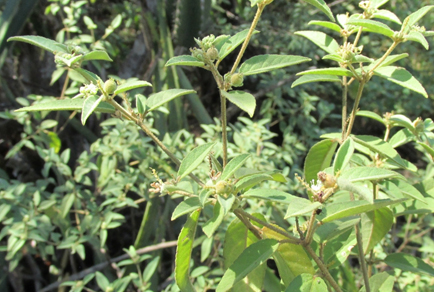
Croton pantaneiro, a new species from ferruginous rocky outcrops of the Brazilian and Bolivian Pantanal, is described, illustrated, and placed in Croton sect. Geiseleria. It is morphologically similar to C. adenodontus and C. glandulosus, but it differs from both by its pinnate leaf venation, serrulate or crenulate leaf margin, pistillate flowers with pedicels 0.8–1.3 mm long and sepals 1.8−2.7 mm long, uniformly green capsules, and ecarunculate seeds. Information on its distribution, habitat, conservation status, and systematic placement is provided.
References
- Bachman, S., Moat, J., Hill, A.W., de la Torre, J. & Scott, B. (2011) Supporting Red List threat assessments with GeoCAT: geospatial conservation assessment tool. ZooKeys 150: 117–126. https://doi.org/10.3897/zookeys.150.2109
- Baillon, H.E. (1858) Étude générale du groupe des Euphorbiacées. Librairie de Victor Masson, Paris, 684 pp. https://doi.org/10.5962/bhl.title.50439
- Bigarella, J.J., Becker, R.D. & Santos, G.F. (2007) Estrutura e origem das paisagens tropicais e subtropicais, 2 ed. 1. Editora da UFSC, Florianópolis, 426 pp.
- Carrión, J.F. & Amorim, A.M. (2024) A new species of Bernardia (Euphorbiaceae, Acalyphoideae) with stellate trichomes from South America. Phytotaxa 650: 1–7. https://doi.org/10.11646/phytotaxa.650.1.1
- Dehgan, B. (2012) Jatropha (Euphorbiaceae). Flora Neotropica. Monograph 110. New York Botanical Garden Press, New York, 274 pp.
- Dubs, B. (1998) Prodomus Florae Matogrossensis. Betrona Verlag, Küsnacht, 444 pp.
- Feio, A.C., Riina, R. & Meira, R.M.S.A. (2016) Secretory structures in leaves and flowers of two dragon’s blood Croton (Euphorbiaceae): new evidence and interpretations. International Journal of Plant Sciences 177: 511–522. https://doi.org/10.1086/685705
- Feio, A.C., Meira, R.M. & Riina, R. (2018) Leaf anatomical features and their implications for the systematics of dragon’s blood, Croton section Cyclostigma (Euphorbiaceae). Botanical Journal of the Linnean Society 187: 614–632. https://doi.org/10.1093/botlinnean/boy038
- Flora e Funga do Brasil (2025) Euphorbiaceae. In: Flora e Funga do Brasil. Jardim Botânico do Rio de Janeiro. Available from: https://floradobrasil.jbrj.gov.br/FB113 (accessed 29 June 2025)
- Guimarães, E., Manoel, P.S. & Trevelin, C.C. (2014) Pantanal: paisagens, flora e fauna. Cultura Acadêmica/ Ed. UNESP, São Paulo.
- Gray, A. (1856) A manual of the botany of the Northern United States. 2nd ed. George P. Putnam & Co., New York, 739 pp. https://doi.org/10.5962/bhl.title.50405
- Inocencio, L.S. & Silva, M.J. (2016) A vine-like species of Manihot (Euphorbiaceae) from the state of Mato Grosso, Brazil. Systematic Botany 41: 983–988. https://doi.org/10.1600/036364416X694107
- IUCN (2024) Guidelines for using the IUCN red list categories and criteria. Version 16. Prepared by the Standards and Petitions Subcommittee of the IUCN Species Survival Commission. IUCN, Gland and Cambridge. Available from: http://cmsdocs.s3.amazonaws.com/RedListGuidelines.pdf (accessed 1 May 2025)
- Jacobi, C.M. & Carmo, F.F. (2008) Diversidade dos campos rupestres ferruginosos no Quadrilátero Ferrífero, MG. Megadiversidade 4: 24–32. [https://institutopristino.org.br/wp-content/uploads/2020/04/17_Diversidade_dos_campos_rupestres_ferruginosos-1.pdf]
- Jacobi, C.M., Carmo, F.F., Vincent, R.C. & Stehmann, J.R. (2007) Plant communities on ironstone outcrops—a diverse and endangered Brazilian ecosystem. Biodiversity and Conservation 16: 2185–2200. https://doi.org/10.1007/s10531-007-9156-8
- Linnaeus, C. (1753) Species plantarum. Laurentius Salvius, Stockholm, 1200 pp.
- Linnaeus, C. (1759) Systema Naturae ed. 10, 2. Laurentius Salvius, Stockholm, pp. 825–1384.
- Machado, S.R., Paleari, L.M., Paiva, É.A. & Rodrigues, T.M. (2015) Colleters on the inflorescence axis of Croton glandulosus (Euphorbiaceae): structural and functional characterization. International Journal of Plant Sciences 176: 86–93. https://doi.org/10.1086/678469
- Müller Argoviensis, J. (1866) Euphorbiaceae (excl. Euphorbieae). In: de Candolle, A.P. (Ed.) Prodromus systematis naturalis regni vegetabilis 15 (2): pp. 189–1261.
- Müller Argoviensis, J. (1873) Euphorbiaceae. In: Martius, C.F.P. von & Eichler, A.W. (Eds.) Flora Brasiliensis 11 (2). Fleischer, München, 752 pp.
- Pinto-Silva, N.P., De Souza, K.F., Silva, O.L.M., Vitarelli, N.C., Pereira, A.P.N., Soares, D.A., Sodré, R.C., Medeiros, D., Caruzo, M.B.R., Carneiro-Torres, D.S., Silva, M.J., Meira, R.M.S.A., Riina, R. & Feio, A.C. (2023) Trichomes in the megadiverse genus Croton (Euphorbiaceae): a revised classification, identification parameters and standardized terminology. Botanical Journal of the Linnean Society 203: 37–49. https://doi.org/10.1093/botlinnean/boad008
- Pott, A. & Pott, V.J. (2021) Flora of the Pantanal. In: Damasceno-Junior, G.A. & Pott, A. (Eds.) Flora and vegetation of the Pantanal wetland. Springer, Utrecht, pp. 39–288. https://doi.org/10.1007/978-3-030-83375-6_3
- Pott, A., Pott, V.J. & Moreira, S.N. (2012) Flora and vegetation of Mato Grosso do Sul, Brazil. Glalia 4: 19–50.
- Rayol, B.P. (2006) Análise florística e estrutural da vegetação xerofítica das savanas metalófilas na Floresta Nacional de Carajás: subsídios à conservação. Master’s dissertation. Universidade Rural da Amazônia e Museu Paraense Emílio Goeldi, Pará, Belém, 74 pp.
- Riina, R., Van Ee, B.W., Caruzo, M.B.R., Carneiro-Torres, D.S., dos Santos, R.F. & Berry, P.E. (2021) The neotropical Croton sect. Geiseleria (Euphorbiaceae): classification update, phylogenetic framework, and seven new species from South America. Annals of Missouri Botanical Garden 106: 111–166. https://doi.org/10.3417/2021669
- Rogers, D. & Appan, S.G. (1973) Manihot, Manihotoides (Euphorbiaceae). In: Flora Neotropica 13. New York Botanical Garden, New York, 273 pp.
- Secco, R.S. (2004) Alchorneae (Euphorbiaceae): Alchornea, Aparisthmium e Conceveiba. In: Flora Neotropica 93. New York Botanical Garden, New York, 195 pp.
- Secco, R.S., Bigio, N.C., Cordeiro, I., Pscheidt, A.C., Marques, O. & Caruzo, M.B.R. (2018) Check-list de Euphorbiaceae s. str., Phyllanthaceae e Peraceae de Mato Grosso do Sul, Brasil. Iheringia, Série Botânica 73: 207–215. https://doi.org/10.21826/2446-8231201873s207
- Sodré, R.C. (2018) Estudos taxonômicos sobre Croton sect. Geiseleria (A. Gray) Baill. (Euphorbiaceae) no Brasil, com ênfase nas espécies ocorrentes na Região Centro-Oeste. Master’s dissertation. Universidade Federal de Goiás, Goiânia, 378 pp.
- Sodré, R.C. & Silva, M.J. (2017) Croton rhodotrichus: A new species of Croton section Geiseleria (A. Gray) Baill. (Euphorbiaceae) from the state of Mato Grosso, Brazil. Systematic Botany 42: 338–345. https://doi.org/10.1600/036364417X695600
- Sodré, R.C., Sales, M.F., Berry, P.E. & Silva, M.J. (2019) Taxonomic synopsis of Croton section Geiseleria (Euphorbiaceae) in Brazil, including description of a new species. Phytotaxa 417: 1–105. https://doi.org/10.11646/phytotaxa.417.1.1
- Takahasi, A. (2010) Ecologia da vegetação em bancadas lateríticas em Corumbá, MS. Doctoral thesis. Universidade de São Paulo, São Paulo, 255 pp.
- Takahasi, A. & Meirelles, S.T. (2014) Ecologia da vegetação herbácea de bancadas lateríticas (cangas) em Corumbá, MS, Brasil. Hoehnea 41: 515–528. https://doi.org/10.1590/2236-8906-63/2013
- Thiers, B. (2025 [continuously updated]) Index Herbariorum: a global directory of public herbaria and associated staff. New York Botanical Garden’s Virtual Herbarium. Available from: http://sweetgum.nybg.org/ih/ (accessed 28 June 2025)
- van Ee, B.W., Riina, R. & Berry, P.E. (2011) A revised infrageneric classification and molecular phylogeny of New World Croton (Euphorbiaceae). Taxon 60: 791–823. https://doi.org/10.1002/tax.603013
- Viana, P.L. & Lombardi, J.A. (2007) Florística e caracterização dos campos rupestres sobre canga na Serra da Calçada, Minas Gerais, Brasil. Rodriguésia 58: 159–177.
- Vitarelli, N.C., Riina, R., Caruzo, M.B.R., Cordeiro, I., Fuertes‐Aguilar, J. & Meira, R.M. (2015) Foliar secretory structures in Crotoneae (Euphorbiaceae): diversity, anatomy, and evolutionary significance. American Journal of Botany 102: 833–847. https://doi.org/10.3732/ajb.1500017
- Webster, G.L. & Armbruster, W.S. (1991) A synopsis of the neotropical species of Dalechampia (Euphorbiaceae). Botanical Journal of the Linnean Society 105: 137–177. https://doi.org/10.1111/j.1095-8339.1991.tb00202.x
- Webster, G.L. (2002) A synopsis of the Brazilian taxa of Phyllanthus section Phyllanthus (Euphorbiaceae). Lundellia 5: 1–26. https://doi.org/10.25224/1097-993X-5.1.1