

Abstract
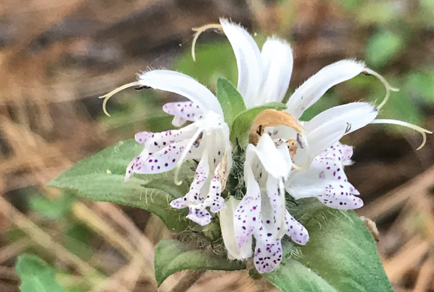
Monarda mexicana, a taxon from the high-elevation Sierra Madre Occidental of Durango, Mexico, is rediscovered based on a recent observation from the community science platform iNaturalist. This observation led to targeted fieldwork, herbarium study, and cultivation. Two present-day, geographically isolated, high-elevation populations are documented, including a new specimen and two previously unrecognized historical collections. These populations exhibit diagnostic characters matching the original circumscription of M. mexicana, including exceptionally broad involucral bracts with acuminate apices, triangular-subulate calyx lobes, yellow pollen, distinctive corolla morphology, and characteristic vestiture. Plants cultivated from seed differ from Monarda citriodora var. austromontana in vegetative traits and belowground morphology. The morphological coherence, ecological specialization, and persistence of these populations support recognition of Monarda mexicana as a distinct species, rather than as a morphological extreme of M. citriodora var. austromontana. Recognition of M. mexicana has implications for conservation, as it appears to be restricted to a small number of isolated mountaintop localities.
References
- Adams, R.P., Bartel, J.A. & Price, R.A. (2009) A new genus, Hesperocyparis, for the cypresses of the western hemisphere (Cupressaceae). Phytologia 91: 160–185.
- Bachman, S., Moat, J., Hill, A.W., Torre, J. & Scott, B. (2011) Supporting Red List threat assessments with GeoCAT: Geospatial conservation assessment tool. ZooKeys 150: 117–126. https://doi.org/10.3897/zookeys.150.2109
- Blanco, C.E. (1949) Pinus cooperi Blanco sp. nova. Anales del Instituto de Biología, Universidad Nacional Autónoma de México, serie Botánica 20: 185–187.
- Bonpland, A. (1809) Alexandri de Humboldt et Amati Bonpland plantae aequinoctiales 2. F. Schoell & J.G. Cotta, Paris & Tübingen, 191 pp.
- Carrière, E.-A. (1867) Traité général des conifères 1. E.-A. Carrière, Paris, 510 pp.
- Cuervo-Robayo, A.P., Téllez-Valdés, O., Gómez-Albores, M.A., Venegas-Barrera, C.S., Manjarrez, J. & Martínez-Meyer, E. (2014a) Temperatura media anual en México (1910-2009). Comisión Nacional para el Conocimiento y Uso de la Biodiversidad, Mexido, D.F. Available from: http://geoportal.conabio.gob.mx/metadatos/doc/html/tman13gw.html (accessed 19 September 2025)
- Cuervo-Robayo, A.P., Téllez-Valdés, O., Gómez-Albores, M.A., Venegas-Barrera, C.S., Manjarrez, J. & Martínez-Meyer, E. (2014b) Precipitación anual en México (1910–2009). Comisión Nacional para el Conocimiento y Uso de la Biodiversidad, Mexido, D.F. Available from: http://geoportal.conabio.gob.mx/metadatos/doc/html/preanu13gw.html (accessed 19 September 2025)
- Dirnböck, T., Essl, F. & Rabitsch, W. (2011) Disproportional risk for habitat loss of high-altitude endemic species under climate change. Global Change Biology 17: 990–96. https://doi.org/10.1111/j.1365-2486.2010.02266.x
- Ehrhart, J.F. (1784) Bestimmung einiger Bäume und Sträucher aus unsern Lustgebüschen. Gartenkalender auf das Jahr 1784 3: 283–290.
- Epling, C. (1935) Notes on Monarda: The subgenus Cheilyctis. Madroño 3: 20–31.
- Fernald, M.L. (1901) Some new spermatophytes from Mexico and Central America. Proceedings of the American Academy of Arts and Sciences 36: 491–506.
- Flores, L. (1924) La Dirección de Estudios Biológicos: su organización, fines y resultados que ha alcanzado. Herrero Hermanos Sucesores, Mexico D.F., 67 pp. [https://agris.fao.org/search/en/providers/122376/records/647472d1425ec3c088f3066f]
- Franco, J.M.A.A. (1950) Coniferarum duarum nominibus. Boletim da Sociedade Broteriana, sér. 2, 24: 74.
- Gilly, C.L. (1944) A new Monarda (Labiatae) and a new Calocarpum (Sapotaceae) from Mexico. Bulletin of the Torrey Botanical Club 71: 658–659.
- INIFAP & CONABIO (1995) Edafología. Comisión Nacional para el Conocimiento y Uso de la Biodiversidad, Mexico, D.F. Available from: http://geoportal.conabio.gob.mx/metadatos/doc/html/eda251mgw.html (accessed 19 September 2025).
- Lagasca, M. (1816) Genera et species plantarum. Royal Press, Madrid, 35 pp.
- Ledesma-Mateos, I. (2007) De Balderas a La Casa Del Lago: la institucionalización de la biología en México 1a. ed. Universidad Autónoma de la Ciudad de México, Mexico D.F., 351 pp.
- Linnaeus, C. (1753) Species plantarum. Salvius, Stockholm, 560 pp.
- Linnaeus, C. (1753) Species plantarum 2. Salvius, Stockholm, pp. 561–1200.
- Martínez, M. (1942a) Tres especies nuevas mexicanas del género Abies. Anales del Instituto de Biología, Universidad Nacional Autónoma de México, serie Botánica 13: 621–634.
- Martínez, M. (1942b) Una nueva pinácea mexicana, Pinus durangensis. Anales del Instituto de Biología, Universidad Nacional Autónoma de México, serie Botánica 13: 23–29.
- McClintock, E. & Epling, C. (1942) A review of the genus Monarda (Labiatae). University of California Publications in Botany 20: 147–194.
- Miller, P. (1754) The gardeners dictionary. Ed. 4. P. Miller, London, s.p..
- Miller, P. (1768) The gardeners dictionary. Ed. 8. P. Miller, London, s.p..
- Mirbel, M. (1825) Essai sur la distribution géographique des conifères. Mémoires du Muséum d’Histoire Naturelle 13: 28–76.
- Rafinesque, C.S. (1830) Medical Flora 2. S.C. Atkinson, Philadelphia, 276 pp.
- Ruacho-González, L., González-Elizondo, M.S., González-Elizondo, M. & López-González, C. (2013) Diversidad florística en cimas de la Sierra Madre Occidental, México, y su relación con variables ambientales. Botanical Sciences 91: 193–205. https://doi.org/10.17129/botsci.414
- Sammons, N.J. (2011) Morphometric analysis and monograph of Monarda subgenus Cheilyctis (Lamiaceae). Michigan State University, 299 pp.
- Scora, R.W. (1965) New taxa in the genus Monarda (Labiatae). Madroño 18: 119–22.
- Scora, R.W. (1967) Interspecific relationships in the genus Monarda (Labiatae). University of California Press, Berkeley, 71 pp.
- Shaw, R.E., Farquharson, K.A., Bruford, M.W., Coates, D.J., Elliott, C.P., Mergeay, J., Ottewell, K.M., Segelbacher, G., Hoban, S., Hvilsom, C., Pérez-Espona, S., Ruņģis, D., Aravanopoulos, F., Bertola, L.D., Cotrim, H., Cox, K., Cubric-Curik, V., Ekblom, R., Godoy, J.A., Konopiński, M.K., Laikre, L., Russo, I-R.M., Veličković, N., Vergeer, P., Vilà, C., Brajkovic, V., Field, D.L., Goodall-Copestake, W.P., Hailer, F., Hopley, T., Zachos, F.E., Alves, P.C., Biedrzycka, A., Binks, R.M., Buiteveld, J., Buzan, E., Byrne, M., Huntley, B., Iacolina, L., Keehnen, N.L.P., Klinga, P., Kopatz, A., Kurland, S., Leonard, J.A., Manfrin, C., Marchesini, A., Millar, M.A., Orozco-terWengel, P., Ottenburghs, J., Posledovich, D., Spencer, P.B., Tourvas, N., Unuk Nahberger, T., van Hooft, P., Verbylaite, R., Vernesi, C. & Grueber, C.E. (2025) Global meta-analysis shows action is needed to halt genetic diversity loss. Nature 638: 704–710. https://doi.org/10.1038/s41586-024-08458-x
- Standley, P.C. (1937) Studies of American Plants – VII. Field Museum of Natural History: Botanical Series 17: 155–224.
- Steudel, E.T. (1840) Nomenclator botanicus. J.G. Cotta, Stuttgart & Tübingen, 810 pp.
- Thiers, B. (2026) Index Herbariorum: A global directory of public herbaria and associated staff. New York Botanical Garden’s Virtual Herbarium. Available from: https://doi.org/10.1007/s12228-016-9423-7 (accessed 3 February 2026). https://doi.org/10.1007/s12228-016-9423-7
- Turner, B.L. (1994) Taxonomic treatment of Monarda (Lamiaceae) for Texas and Mexico. Phytologia 77: 56–79.
- Wagensommer, R.P. (2023) Floristic studies in the light of biodiversity knowledge and conservation. Plants 12: 2973. https://doi.org/10.3390/plants12162973
- Wagensommer, R.P., Bartolucci, F., Fiorentino, M., Licht, W., Peccenini, S., Perrino, E.V. & Venanzoni, R. (2017) First record for the flora of Italy and lectotypification of the name Linum elegans (Linaceae). Phytotaxa 296 (2): 161–170. https://doi.org/10.11646/phytotaxa.296.2.5
- Wislizenus, A. (1848) Memoir of a tour to northern Mexico. Trippin & Streeper, Washington, 242 pp.