

Abstract
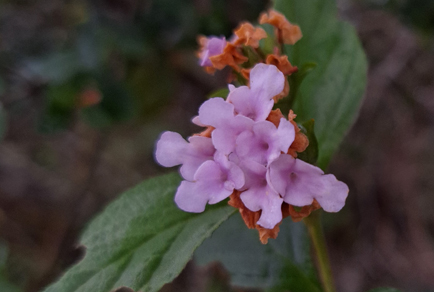
Based on fieldwork and examination of Lantaneae herbarium collections, Lippia agrestis is here described as a new species. It is characterized by the unique combination of the following traits: leaves with margin entire near the base and conspicuously serrate towards the apex, spikes with peduncles 0.7‒1.5 cm long, basal bracts 0.5‒0.7 × 0.3‒0.4 cm, ovate, internal bracts 0.5‒0.6 × 0.2‒0.3 cm, lanceolate, corolla tubes 1‒1.2 cm long, well surpassing the bracts in length, externally densely pubescent-glandulous, densely sericeous ovary, and drupaceous fruits with a strigose dorsal surface. The species is found in the Raso da Catarina Ecoregion, within the Caatinga domain (Bahia state, Brazil). It grows in sandy, bushy caatinga, at elevations between 405 and 430 m. Illustrations, a distribution map, and comparisons with similar species (Lippia carrascoana, Lantana restingensis, Lippia maximilianii) are provided. A preliminary conservation status assessment suggests that Lippia agrestis qualifies as Endangered (EN).
References
- Abranches, S. (2020) Biological megadiversity as a tool of soft power and development for Brazil. Brazilian Political Science Review 14: e0006. https://doi.org/10.1590/1981-3821202000020006
- Albuquerque, U.P., Araújo, E.L., El-Deir, A.C.A., Lima, A.L.A., Souto, A., Bezerra, B.M., Ferraz, E.M.N., Freire, E.M.X., Sampaio, E.V.S.B., Las-Casas, F.M.G., Moura, G.J.B., Pereira, G.A., Melo, J.G., Ramos, M.A., Rodal, M.J.N., Schiel, N., Lyra-Neves, R.M., Alves, R.R.N., Azevedo-Júnior, S.M., Telino Júnior, W.R. & Severi, W. (2012) Caatinga revisited: ecology and conservation of an important seasonal dry forest. The Scientific World Journal 2012: 205182. https://doi.org/10.1100/2012/205182
- Amorim, V.O. & Bautista, H.P. (2016) Asteraceae da Ecorregião Raso da Catarina, Bahia, Brasil. Rodriguésia 67: 785–94. https://doi.org/10.1590/2175-7860201667317
- Antongiovanni, M., Venticinque, E.M. & Fonseca, C.R. (2018) Fragmentation patterns of the Caatinga drylands. Landscape Ecology 33: 1353–1367. https://doi.org/10.1007/s10980-018-0672-6
- Atkins, S. (2004) Verbenaceae. In: Kubitzki, K. & Kadereit, J.W. (Eds.) The families and Genera of Vascular Plants. Vol. 7. Springer-Verlag, Berlin, pp. 449–468. https://doi.org/10.1007/978-3-642-18617-2_25
- Bachman, S., Moat, J., Hill, A.W., de la Torre, J. & Scott, B. (2011) Supporting Red List threat assessments with GeoCAT: geospatial conservation assessment tool. ZooKeys 150: 117–126. https://doi.org/10.3897/zookeys.150.2109
- Beentje, H. (2010) The Kew Plant Glossary, an illustrated dictionary of plant terms. Kew Publishing, London, Royal Botanic Gardens, 160 pp.
- Bezerra, D.S., Gonzaga, D.R. & Conceição, A.S. (2024) Flora da APA Serra Branca/Raso da Catarina (Estado da Bahia, Brasil): Cactaceae Juss. Hoehnea 51: e642023. https://doi.org/10.1590/2236-8906e642023
- BFG (The Brazil Flora Group) (2022) Brazilian Flora 2020: Leveraging the power of a collaborative scientific network. Taxon 71: 178–198. https://doi.org/10.1002/tax.12640
- Brito, A.F.S., Souza, E.R. & Conceição, A.S. (2019) The tribes Acacieae and Ingeae (Leguminosae: Caesalpinioideae) in the environmental protection area Serra Branca, Raso da Catarina, Jeremoabo, Bahia, Brazil. Biota Neotropica 19: e20180720. https://doi.org/10.1590/1676-0611-BN-2018-0586
- Cardoso, P.H. & Salimena, F.R.G. (2019) Notas taxonômicas em Verbenaceae da Flora do Brasil. Hoehnea 46: e032019. https://doi.org/10.1590/2236-8906-03/2019
- Cardoso, P.H., Santos-Silva, F., Menini Neto, L., Saraiva, R.V.C. & Salimena, F.R.G. (2020a) Heterophylly and post-fire flowering of Lippia horridula (Verbenaceae): a “phoenix” of Brazilian Cerrado. Phytotaxa 441: 95–102. https://doi.org/10.11646/phytotaxa.441.1.9
- Cardoso, P.H., Valério, V.I.R., Menini Neto, L., Trovó, M. & Salimena, F.R.G. (2020b) Novelties in Lippia (Verbenaceae) from Minas Gerais State, Brazil. Phytotaxa 455: 47–52. https://doi.org/10.11646/phytotaxa.455.1.6
- Cardoso, P.H., O’Leary, N., Olmstead, R.G., Moroni, P. & Thode, V. (2021a) An update of the Verbenaceae genera and species numbers. Plant Ecology and Evolution 154: 80–86. https://doi.org/10.5091/10.5091/plecevo.2021.1821
- Cardoso, P.H., Menini Neto, L., Trovó, M. & Salimena, F.R.G. (2021b) Checklist and a new species of Lippia (Verbenaceae) from the Diamantina Plateau, Minas Gerais, Brazil. European Journal of Taxonomy 733: 42–55. https://doi.org/10.5852/ejt.2021.733.1211
- Cardoso, P.H., Salimena, F.R.G., Somavilla, N., Menini Neto, L. & Trovó, M. (2023) Verbenaceae from the Serra do Cipó, Minas Gerais, Brazil: recognition of the new and rare Stachytarpheta odorata and an update of the species richness. Tropical Plant Biology 16: 123–134. https://doi.org/10.1007/s12042-023-09334-0
- Cardoso, P.H., Gonzaga, D.R. & Trovó, M. (2024) Stachytarpheta meninii (Verbenaceae), a new micro‐endemic and threatened species from the Diamantina Plateau in Minas Gerais state, Brazil. Nordic Journal of Botany 2024: e04200. https://doi.org/10.1111/njb.04200
- Cardoso, P.H., Silva, G.B., Trovó, M. & Salimena, F.R.G. (2025a) Lippia carrascoana (Verbenaceae), an enigmatic new species from the Brazilian Caatinga. Phytotaxa 706: 47–60. https://doi.org/10.11646/phytotaxa.706.1.3
- Cardoso, P.H., Silva, G.B., Melo, P.H.A., Salimena, F.R.G. & Silva, T.R.S. (2025b) Lantana calcicola: a new and threatened Verbenaceae species from Lajedão, a limestone outcrop in northern Minas Gerais state, Brazil. Phytotaxa 690: 107–115. https://doi.org/10.11646/phytotaxa.690.1.9
- Chamisso, L.K.A. (1832) Verbenaceae. Linnaea 7: 105–723.
- Correia, C.L.S.B. & Conceição, A.S. (2017a) The genus Chamaecrista Moench in a fragment of the Ecological Station Raso da Catarina, Bahia, Brazil. Biota Neotropica 17: e20160225. https://doi.org/10.1590/1676-0611-BN-2016-0225
- Correia, C.L.S.B. & Conceição, A.S. (2017b) The genus Senna Mill. (Leguminosae: Caesalpinioideae) in a fragment of the Ecological Station Raso da Catarina, Bahia, Brazil. Acta Scientiarum, Biological Sciences 39: 357–372. https://doi.org/10.4025/actascibiolsci.v39i3.32850
- de Queiroz, K. (2007) Species concepts and species delimitation. Systematic Biology 56: 879–886. https://doi.org/10.1080/10635150701701083
- Dourado, D.A.O., Conceição, A.S. & Silva, J.S. (2013) O gênero Mimosa L. (Leguminosae: Mimosoideae) na APA Serra Branca/Raso da Catarina, Bahia, Brasil. Biota Neotropica 13: 225–239. [http://www.biotaneotropica.org.br/v13n4/en/abstract?inventory+bn01713042013]
- Fernandes, M.F., Cardoso, D. & Queiroz, L.P. (2020) An updated plant checklist of the Brazilian Caatinga seasonally dry forests and woodlands reveals high species richness and endemism. Journal of Arid Environments 174: 104079. https://doi.org/10.1016/j.jaridenv.2019.104079
- Gomes‐da‐Silva, J. & Forzza, R.C. (2021) Two centuries of distribution data: detection of areas of endemism for the Brazilian angiosperms. Cladistics 37: 442–458. https://doi.org/10.1111/cla.12445
- Gonçalves, E.G. & Lorenzi, H. (2007) Morfologia vegetal: organografia e dicionário ilustrado de morfologia das plantas vasculares. Instituto Plantarum, Nova Odessa, 416 pp.
- Harris, J.G. & Harris, M.W. (2003) Plant identification terminology: an illustrated glossary. 2nd ed. Spring Lake Publ., Spring Lake, 216 pp.
- Hauff, S.N. (2010) Representatividade do Sistema Nacional de Conservação de Unidades de Conservação na Caatinga. PNUD, Programa das Nações Unidas para o Desenvolvimento, Brasília, 110 pp.
- Hochkirch, A., Samways, M.J., Gerlach, J., Böhm, M., Williams, P., Cardoso, P., Cumberlidge, N., Stephenson, P.J., Seddon, M.B., Clausnitzer, V., Borges, P.A.V., Mueller, G.M., Pearce-Kelly, P., Raimondo, D.C., Danielczak, A. & Dijkstra, K.B. (2021) A strategy for the next decade to address data deficiency in neglected biodiversity. Conservation Biology 35: 502–509. https://doi.org/10.1111/cobi.13589
- IUCN (2012) IUCN Red List categories and criteria. Version 3.1. Second edition. Gland and Cambridge, IUCN Press. Available from: https://www.iucnredlist.org/resources/categories-and-criteria (accessed: September 2025)
- IUCN Standards and Petitions Subcommittee (2024) Guidelines for Using the IUCN Red list Categories and Criteria. Version 15.1. Prepared by the Standards and Petitions Subcommittee. Available from: http://www.iucnredlist.org/documents/RedListGuidelines.pdf (accessed 1 September 2025)
- Lima, J.B., Bovini, M.G. & Conceição, A.S. (2019) Bombacoideae, Byttnerioideae, Grewioideae and Helicterioideae (Malvaceae s.l.) in the Raso da Catarina Ecoregion, Bahia, Brazil. Biota Neotropica 19: e20180569. https://doi.org/10.1590/1676-0611-bn-2018-0569
- Lima, J.B. & Conceição, A.S. (2016) Malvoideae Burnett (Malvaceae) in the Environmental Protection Area Serra Branca, Raso da Catarina, Jeremoabo, Bahia, Brazil. Biota Neotropica 16: e20160187. https://doi.org/10.1590/1676-0611-BN-2016-0187
- Link, J.H.F. (1822) Enumeratio plantarum horti regii botanici Berolinensis II. G. Reimer, Berlin, 478 pp. https://doi.org/10.5962/bhl.title.66
- Linnaeus, C. (1753) Species Plantarum 2. L. Salvius, Stockholm, pp. 561–1200.
- Lu-Irving, P. & Olmstead, R.G. (2013) Investigating the evolution of Lantaneae (Verbenaceae) using multiple loci. Botanical Journal of the Linnean Society 171: 103–119. https://doi.org/10.1111/j.1095-8339.2012.01305.x
- Lu-Irving, P., Bedoya, A.M., Salimena, F.R., Silva, T.R.S., Viccini, L.F., Bitencourt, C., Thode, V.A., Cardoso, P.H., O’Leary, N. & Olmstead, R.G. (2021) Phylogeny of Lantana, Lippia, and related genera (Lantaneae: Verbenaceae). American Journal of Botany 108: 1354–1373. https://doi.org/10.1002/ajb2.1708
- Marx, H., O’Leary, N., Yuan, Y., Lu-Irving, P., Tank, D., Múlgura, M.E. & Olmstead, R. (2010) A molecular phylogeny and classification of Verbenaceae. American Journal of Botany 97: 1647–1663. https://doi.org/10.3732/ajb.1000144
- Moro, M.F., Amorim, V.O., de Queiroz, L.P., Costa, L.R.F., Maia, R.P., Taylor, N.P. & Zappi, D.C. (2024) Biogeographical districts of the Caatinga dominion: a proposal based on geomorphology and endemism. The Botanical Review 90: 376–429. https://doi.org/10.1007/s12229-024-09304-5
- O’Leary, N., Moroni, P., Lu-Irving, P., Mirra, F. & Olmstead, R.G. (2023a) Salimenaea and Troncosoa (Verbenaceae, Lantaneae), two new monotypic genera from southern South America. Novon 31: 95–107. https://doi.org/10.3417/2023817
- O’Leary, N., Lu‐Irving, P., Moroni, P., Salimena, F.R., Silva, T.R.S., Cardoso, P.H., Mirra, F., Schaefer, J., Bedoya, A.M., Viccini, L.F., Bitencourt, C., Thode, V.A. & Olmstead, R.G. (2023b) Making Lantaneae (Verbenaceae) taxonomy useful: A phylogenetic classification. Taxon 72: 572–589. https://doi.org/10.1002/tax.12934
- Queiroz, L.P., Cardoso, D., Fernandes, M.F. & Moro, M.F. (2017) Diversity and evolution of flowering plants of the Caatinga Domain. In: Silva, J.M.C, Leal, I.R. & Tabarelli, M. (Eds.) Caatinga: the largest tropical dry forest region in South America. Springer, Berlin, pp. 23–63. https://doi.org/10.1007/978-3-319-68339-3_2
- Rusby, H.H. (1896) An enumeration of the plants collected in Bolivia by Miguel Bang.–III. Memoirs of the Torrey Botanical Club 6: 1–130.
- Salimena, F.R.G. & Cardoso, P.H. (2025) Lippia in Flora e Funga do Brasil. Jardim Botânico do Rio de Janeiro. Available from: https://floradobrasil.jbrj.gov.br/FB15170 (accessed 16 September 2025)
- Santos, J.V., Amorim, A.M. & Conceição, A.S. (2018) Malpighiaceae in the Raso da Catarina Ecoregion, Bahia, Brazil. Biota Neotropica 18: e20170429. https://doi.org/10.1590/1676-0611-bn-2017-0429
- Schauer, J.C. (1847) Verbenaceae. In: De Candolle, A.P. (Ed.) Prodromus systematis naturalis regni vegetabilis 11. Treuttel & Würtz, Paris, pp. 522–700.
- Silva, L.R., Castro, M.M.S. & Conceição, A.S. (2016) The family Bignoniaceae in the Environmental Protection Area Serra Branca, Raso da Catarina, Jeremoabo, Bahia, Brazil. Acta Scientiarum, Biological Sciences 38: 395–409. https://doi.org/10.4025/actascibiolsci.v38i4.31581
- Silva, L.R., Castro, M.M.S. & Conceição, A.S. (2018) Bignoniaceae in the Raso da Catarina Ecoregion, Bahia, Brazil. Biota Neotropica 18: e20170466. https://doi.org/10.1590/1676-0611-bn-2017-0466
- Silva, T.R.S. & Salimena, F.R. (2002) Novas combinações e novos sinônimos em Lippia e Lantana (Verbenaceae). Darwiniana 40: 57–59.
- Silva, T.R.S., Salimena, F.R.G. & Lima, C.T. (2017) Two new species of Lantana (Verbenaceae) from Brazil. Phytotaxa 299: 125–131. https://doi.org/10.11646/phytotaxa.299.1.11
- Teixeira, L.P., Lughadha, E.N., Silva, M.V.C.D. & Moro, M.F. (2021) How much of the Caatinga is legally protected? An analysis of temporal and geographical coverage of protected areas in the Brazilian semiarid region. Acta Botanica Brasilica 35: 473–485. https://doi.org/10.1590/0102-33062020abb0492
- Turland, N.J., Wiersema, J.H., Barrie, F.R., Gandhi, K.N., Gravendyck, J., Greuter, W., Hawksworth, D.L., Herendeen, P.S., Klopper, R.R., Knapp, S., Kusber, W.-H., Li, D.-Z., May, T.W., Monro, A.M., Prado, J., Price, M.J., Smith, G.F. & Zamora Señoret, J.C. (2025) International Code of Nomenclature for algae, fungi, and plants (Madrid Code). Regnum Vegetabile 162. University of Chicago Press, Chicago, 344 pp. https://doi.org/10.7208/chicago/9780226839479.001.0001
- Varjão, R.R., Jardim, J.G. & Conceição, A.S. (2013) Rubiaceae Juss. de caatinga na APA Serra Branca/Raso da Catarina, Bahia, Brasil. Biota Neotropica 13: 1–19. [http://www.biotaneotropica.org.br/v13n2/pt/abstract? inventory+bn00313022013]
- Velloso, A.L., Sampaio, E.V.S.B. & Pareyn, F.G.C. (2002) Ecorregiões propostas para o bioma Caatinga. Associação Plantas do Nordeste, The Nature Conservancy do Brasil, Recife, 76 pp.
- Vieira, D.D., Conceição, A.S., Melo, J.I.M. & Stapf, M.N.S. (2013) A família Boraginaceae sensu lato na APA Serra Branca/Raso da Catarina, Bahia, Brasil. Rodriguésia 64: 151–168. https://doi.org/10.1590/S2175-78602013000100013
- Vieira, D.D., Melo, J.I.M. & Conceição, A.S. (2015) Boraginales Juss. ex Bercht. & J.Presl in the Ecoregion Raso da Catarina, Bahia, Brazil. Biota Neotropica 15: e20140201. https://doi.org/10.1590/1676-0611-BN-2014-0201
- Zavatin, D.A., Ramos, R., Salimena, F.R.G. & Cardoso, P.H. (2024) A new species of Lippia (Verbenaceae) from the Espinhaço Range, Minas Gerais, Brazil. Acta Botanica Brasilica 38: e20240024. https://doi.org/10.1590/1677-941x-abb-2024-0024