

Abstract
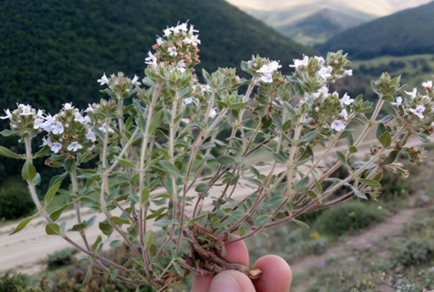
Following extensive botanical fieldwork and herbarium studies, Thymus coriifolius and T. jankae (both in northwestern Iran), and Thymus syriacus (in western Iran), are reported as new records for the flora of Iran. These species are described in detail, with emphasis on their taxonomic, ecological, phenological, and biogeographical characteristics. The documentation of T. syriacus extends the known distribution of Thymus sect. Hyphodromii subsect. Thymbropsis from Morocco to Iran, suggesting a floristic connection between the Irano-Turanian (West Asia) and Mediterranean (North Africa) phytogeographical regions. The Caucasian endemic T. coriifolius and the submediterranean element T. jankae are reported from the Arasbaran Biosphere Reserve in northwestern Iran, a region biogeographically integral to the Iranian highlands of the Caucasus ecoregion. These findings underscore the biogeographical homogeneity of the Caucasus ecoregion. Furthermore, the newly discovered population of T. jankae indicates a disjunction in its distribution range, a pattern discussed in the context of potential biogeographical events. Notably, northwestern Iran is recognized for containing the highest diversity of the genus Thymus in Iran. This study provides an updated distribution map for the studied species.
References
- Akhani, H., Djamali, M., Ghorbanalizadeh, A. & Ramezani, E. (2010) Plant biodiversity of Hyrcanian relict forests, N Iran: an overview of the flora, vegetation, palaeoecology and conservation. Pakistan Journal of Botany 42: 231–258. https://doi.org/10.1016/j.pld.2021.07.005
- Alarcón, M., Vargas, P., Sáez, L., Molero, J. & Aldasoro, J.J. (2012) Genetic diversity of mountain plants: Two migration episodes of Mediterranean Erodium (Geraniaceae). Molecular Phylogenetics and Evolution 63: 866–876. https://doi.org/10.1016/j.ympev.2012.02.031
- Assadi, M. (1987) Plants of Arasbaran protected area, NW. Iran (part I). Iranian Journal of Botany 3: 129–175.
- Assadi, M. (1988) Plants of Arasbaran Protected Area, NW. Iran (Part II). Iranian Journal of Botany 4: 1–59.
- Bartolucci, F. & Peruzzi, L. (2014) Thymus paronychioides (Lamiaceae), a neglected species from Sicily belonging to Thymus sect. Hypodromi. Folia Geobotanica 49: 83–106. https://doi.org/10.1007/s12224-013-9156-2
- Batsatsashvili, K., Nersesyan, A., Mehdiyeva, N., Murtazaliev, R., Eminağaoğlu, Ö. & Kavousi, K. (2020) Flora and vegetation of the Caucasus. In: Zazanashvili, N., Garforth, M. & Bitsadze, M. (Eds.) Ecoregional conservation plan for the Caucasus, 2020 Edition: Supplementary Reports. WWF, KfW, Tbilisi, pp. 106–118.
- Bentham, G. (1829) Micromeria, gen. nov. In: Lindley, J. (Ed.) Edward’s botanical register 15. London, pp. 1282.
- Bentham, G. (1834) Thymus L. In: Bennett, J.J. (Ed.) Labiatarum genera et species. James Ridgway and Sons, London, pp. 340–341.
- Bentham, G. (1835) Salvia palaestina. In: Bennett, J.J. (Ed.) Labiatarum genera et species. James Ridgway and Sons, London, pp. 718.
- Bieberstein, M. (1808) Sedum spurium. In: Fischer, F.E.L. & Meyer, C.A. (Eds.) Flora taurico-caucasica exhibens stirpes phaenogamas: in Chersoneso Taurica et regionibus caucasicis sponte crescents. Vol. 1. Academic Press, St. Petersburg, pp. 352. [https://www.biodiversitylibrary.org/page/11268432]
- Bitsadze, M., Manvelyan, K., Askerov, E., Mousavi, M., Shmunk, V., Kalem, S., Zazanashvili, N., Mnatsekanov, R., Devranoglu Tavsel, S., Cevik, M., Ahmadova, K., Beruchashvili, G., Kandaryan, A. & Garforth, M. (2020) Key biodiversity areas in the Caucasus Ecoregion. In: Zazanashvili, N., Garforth, M. & Bitsadze, M. (Eds.) Ecoregional conservation plan for the Caucasus 2020 Edition. Supplementary Reports. WWF, KfW, Tbilisi, pp. 21–28.
- Boissier, P.E. (1843) Capparis parviflora. In: Boissier, P.E. (Ed.) Diagnoses plantarum orientalium novarum, Ser. 1, N.º 1. B. Herrmann, Leipzig & Geneva, pp. 4.
- Boissier, P.E. (1844) Zataria. In: Boissier, P.E. (Ed.) Diagnoses plantarum orientalium novarum, Ser. 1, N.º 5. B. Herrmann, Leipzig & Geneva, pp. 18.
- Boissier, P.E. & Hohenacker, R.F. (1844) Thymus kotschyanus. In: Boissier, P.E. (Ed.) Diagnoses plantarum orientalium novarum, Ser. 1, N.º 5. B. Herrmann, Leipzig & Geneva, pp. 16.
- Boissier, P.E. (1846a) Ranunculus isthmicus. In: Boissier, P.E. (Ed.) Diagnoses plantarum orientalium novarum, Ser. 1, N.º 6. B. Herrmann, Leipzig & Geneva, pp. 4.
- Boissier, P.E. (1846b) Onosma dasytricha. In: Boissier, P.E. (Ed.) Diagnoses plantarum orientalium novarum, Ser. 1, N.º 7. B. Herrmann, Leipzig & Geneva, pp. 33.
- Boissier, P.E. (1853) Thymus syriacus. In: Boissier, P.E. (Ed.) Diagnoses plantarum orientalium novarum, Ser. 1, N.º 12. B. Herrmann, Leipzig & Geneva, pp. 47.
- Boissier, P.E. & Heldreich, T. (1854) Polygala anatolica. In: Boissier, P.E. (Ed.) Diagnoses plantarum orientalium novarum, Ser. 2, N.º 1. B. Herrmann, Leipzig & Geneva, pp. 57.
- Boissier, P.E. (1867) Cerastium szowitsii. In: Boissier, P.E. & Buser, R. (Eds.) Flora Orientalis. Vol. 1. H. Georg, Geneva & Basel, pp. 717. [https://www.biodiversitylibrary.org/page/18093441]
- Boissier, P.E. & Haussknecht, H.C. (1875) Heliotropium denticulatum. In: Boissier, P.E. & Buser, R. (Eds.) Flora Orientalis. Vol. 1. H. Georg, Geneva & Basel, pp. 145. [https://www.biodiversitylibrary.org/page/18114817]
- Bozkurt, M., Calleja Alarcón, J.A., Uysal, T., Garcia-Jacas, N., Ertuğrul, K. & Susanna, A. (2022) Biogeography of Rhaponticoides, an Irano-Turanian element in the Mediterranean flora. Scientific Reports 12: 22019. https://doi.org/10.1038/s41598-022-24947-3
- Bräuchler, C., Meimberg, H. & Heubl, G. (2010) Molecular phylogeny of Menthinae (Lamiaceae, Nepetoideae, Mentheae)–taxonomy, biogeography and conflicts. Molecular Phylogenetics and Evolution 55: 501–523. https://doi.org/10.1016/j.ympev.2010.01.016
- Bräuchler, C. (2018) Delimitation and revision of the genus Thymbra (Lamiaceae). Phytotaxa 369: 15–27. https://doi.org/10.11646/phytotaxa.369.1.2
- Browicz, K. (1989) Chorology of the Euxinian and Hyrcanian element in the woody flora of Asia. Plant Systematics and Evolution 162: 305–314. https://doi.org/10.1007/BF00936923
- Bunge, A. (1868) Generis Astragali species Gerontogeae pars prior claves diagnosticae. Mémoires de l’Académie Impériale des Sciences de St.-Pétersbourg ser. 7, 11: 71.
- Candolle, A.P. de (1846) Onosma bulbotricha. In: Candolle, A.P. de & Candolle, A. de (Eds.) Prodromus systematis naturalis regni vegetabilis. Vol. 10. Treuttel & Würtz, Paris, pp. 64. [https://www.biodiversitylibrary.org/page/161745]
- Čelakovský, L. (1883) Ueber einige Arten resp. Rassen der Gattung Thymus (Fortsetzung) [On Some Species and Races of the Genus Thymus (Continuation)]. Flora 66: 145–160.
- Choisy, J.D. (1845) Convolvulus reticulatus. In: Candolle, A.P. de & Candolle, A. de (Eds.) Prodromus systematis naturalis regni vegetabilis Vol. 9. Treuttel & Würtz, pp. 399. [https://www.biodiversitylibrary.org/page/55703974]
- Christe, C., Kozlowski, G., Frey, D., Bétrisey, S., Maharramova, E., Garfì, G., Pirintsos, S. & Naciri, Y. (2014) Footprints of past intensive diversification and structuring in the genus Zelkova (Ulmaceae) in south‐western Eurasia. Journal of Biogeography 41: 1081–1093. https://doi.org/10.1111/jbi.12276
- Cosson, E. & Durieu, De M. (1853) Description d’un genre nouveau de la famille des Labiées, Saccocalyx. Annales Sciences Naturelles 3 (20): 80–81.
- Davis, P.H. & Hedge, I.C. (1971) Floristic links between NW Africa and SW Asia. Annalen des Naturhistorischen Museums in Wien 75: 43–57.
- Dering, M., Baranowska, M., Beridze, B., Chybicki, I.J., Danelia, I., Iszkuło, G., Kvartskhava, G., Kosiński, P., Rączka, G., Thomas, P.A. & Tomaszewski, D. (2021) The evolutionary heritage and ecological uniqueness of Scots pine in the Caucasus ecoregion is at risk of climate changes. Scientific Reports 11: 22845. https://doi.org/10.1038/s41598-021-02098-1
- Desfontaines, R.L. (1798) Ziziphus spina-christi. In: Desfontaines, R.L., Redouté, H.J. & Redouté, P.J. (Eds.) Flora atlantica, Vol. 1. L.G. Desgranges, Paris, pp. 201.
- Desvaux, N.A. (1814) Plantes Nouvelles. Journal de Botanique Appliquée à l’Agriculture, à la Pharmacie, à la Médecine et aux Arts 3: 81.
- Djamali, M., Akhani, H., Khoshravesh, R., Andrieu-Ponel, V., Ponel, P. & Brewer, S. (2011) Application of the global bioclimatic classification to Iran: implications for understanding the modern vegetation and biogeography. Ecologia Mediterranea 37: 91–114. https://doi.org/10.3406/ecmed.2011.1350
- Doostmohammadi, M., Samadi, N. & Ghorbanalizadeh, A. (2018) Phytogeography of Genu and Homag, two mountains with an Irano—Turanian flora in the Saharo–Sindian regional zone, south Iran. Nordic Journal of Botany 36: e01808. https://doi.org/10.1111/njb.01808
- Drew, B.T. & Sytsma, K.J. (2012) Phylogenetics, biogeography, and staminal evolution in the tribe Mentheae (Lamiaceae). American Journal of Botany 99: 933–953. https://doi.org/10.3732/ajb.1100549
- Dumont de Courset, G.L.M. (1802) Helianthemum lippii. In: Dumont de Courset, G.L.M. (Ed.) Le botaniste cultivateur. Vol. 3. Deterville, Goujon, pp. 130.
- Dunal, M.F. (1824) Helianthemum procumbens. In: Candolle, A.P. de & Candolle, A. de (Eds.) Prodromus systematis naturalis regni vegetabilis. Vol. 1. Treuttel et Würtz, Paris, pp. 275.
- Emadzade, K., Gehrke, B., Linder, H.P. & Hörandl, E. (2011) The biogeographical history of the cosmopolitan genus Ranunculus L. (Ranunculaceae) in the temperate to meridional zones. Molecular Phylogenetics and Evolution 58: 4–21. https://doi.org/10.1016/j.ympev.2010.11.002
- Emami Bistgani, Z., Mamedov, N. & Lotfy Ashour, M. (2022) Genus Thymus in Iran -ethnobotany, phytochemical, molecular, and pharmacological features. In: Öztürk, M., Khan, S.M., Altay, V., Efe, R., Egamberdieva, D. & Khassanov, F.O. (Eds.) Biodiversity, conservation and sustainability in Asia. Vol. 2. Prospects and challenges in South and Middle Asia. Springer, Cham, pp. 817–848. https://doi.org/10.1007/978-3-030-73943-0_45
- Federici, S., Galimberti, A., Bartolucci, F., Bruni, I., De Mattia, F., Cortis, P. & Labra, M. (2013) DNA barcoding to analyse taxonomically complex groups in plants: the case of Thymus (Lamiaceae). Botanical Journal of the Linnean Society 171: 687–699. https://doi.org/10.1111/boj.12034
- Fischer, F.E.L. & Meyer, C.A. (1836) Cotoneaster nummularius. In: Fischer, F.E.L. (Ed.) Index seminum, St. Petersburg Imperial Botanical Garden. Vol. 2. St. Petersburg, pp. 34.
- Ghorbanalizadeh, A. & Akhani, H. (2022) Plant diversity of Hyrcanian relict forests: An annotated checklist, chorology and threat categories of endemic and near endemic vascular plant species. Plant Diversity 44: 39–69. https://doi.org/10.1016/j.pld.2021.07.005
- Giron, V., Garnatje, T., Vallès, J., Pérez-Collazos, E., Catalán, P. & Valdés, B. (2012) Geographical distribution of diploid and tetraploid cytotypes of Thymus sect. Mastichina (Lamiaceae) in the Iberian Peninsula, genome size and evolutionary implications. Folia Geobotanica 47: 441–460. https://doi.org/10.1007/s12224-012-9126-0
- Global Biodiversity Information Facility (GBIF) (2025) GBIF Backbone Taxonomy. Available from: https://www.gbif.org (accessed 14 August 2025)
- Godron, D.A. & Grenier, J.C.M. (1847) Fumana procumbens. In: Flore de France. Vol. 1. J.B. Baillire, Paris, pp. 173.
- Govaerts, R., Nic Lughadha, E., Black, N., Turner, R. & Paton, A. (2021) The world checklist of vascular plants. Scientific Data 8: a215. https://doi.org/10.1038/s41597-021-00997-6
- Grossheim, A.A. (1944) Thymus sosnowskyi. In: Grossheim, A.A. (Ed.) Izvestiya Azerbaidzhanskogo filiala. Vol. 10. Akademii Nauk SSSR, Baku, pp. 43.
- Halácsy, E.V. (1894) Botanische Ergebnisse einer im Auftrage der Hohen Kaiserl, Akademie der Wissenschaften unternommenen Forschungsreise, In Griechenland. I. Beitrag zur Flora Von Epirus. Denkschriften der Kaiserlichen Akademie der Wissenschaften/Mathematisch-Naturwissenschaftliche Classe, Wien, pp. 252. https://doi.org/10.5962/bhl.title.9838
- Handel-Mazzetti, H. (1913) Pentapleura, novum genus Labiatarum ex Oriente. Oesterreichische botanische Zeitschrift 63: 225–226. [https://www.biodiversitylibrary.org/page/9609002]
- Jalas, J. & Kaleva, K. (1970) Supraspezifische Gliederung und Verbreitungstypen in der Gattung Thymus L. (Labiatae). Feddes Repertorium 81: 93–106.
- Jalas, J. (1971) Notes on Thymus L. (Labiatae) in Europe. I. Supraspecific classification and nomenclature. Botanical Journal of the Linnean Society 64: 199–215.
- Jalas, J. (1972) Thymus L. In: Tutin, T., Heywood, V.H., Burges, N.A., Moore, D.M. & Valentine, D.H. (Eds.) Flora Europaea Vol. 3. Cambridge University Press, Cambridge, pp. 172–182.
- Jalas, J. (1980) Turkish taxa of Thymus (Labiatae) described as new or revised. Annales Botanici Fennici 17: 315–324.
- Jalas, J. (1982a) Thymus L. In: Rechinger, K.H. (Ed.) Flora Iranica, Vol. 150. Akademische Druck- u. Verlagsanstalt, Graz, pp. 532–551.
- Jalas, J. (1982b) Thymus L. In: Davis, P.H. (Ed.) Flora of Turkey and the East Aegean Islands, Vol. 7. Edinburgh University Press, Edinburgh, pp. 349–382.
- Jamzad, Z. (2009) New species and new plant records of Lamiaceae from Iran. Iranian Journal of Botany 15: 51–56.
- Jamzad, Z. (2012) Thymus L. In: Assadi, M., Maassoumi, A.A. & Mozaffarian, V. (Eds.) Flora of Iran. Vol. 76. Research Institute of Forests & Rangelands, Tehran, pp. 714–756.
- Jussieu, A. (1825) Mémoire sur le groupe des Rutacées, seconde partie. Mémoires du Museum d’Histoire Naturelle (Paris) 12: 449–542.
- Juzepczuk, S.V. (1934) Alchemilla pseudocartalinica. In: Grossheim, A.A. (Ed.) Flora Kavkaza, Vol. 4. Academy of Sciences of the USSR, Baku, pp. 327.
- Kerner, A. (1874) Schedae ad floram exsiccatam Austro-Hungaricum. Österreichische Botanische Zeitschrift 24: 185.
- Klokov, M.V. & Desjatova-Shostenko, N.A. (1936) Chabretsy Kavkaza. Trudy Botanicheskogo instituta/Akademiya nauk SSSR, Azerbaidzhanskii filial 2: 281–310.
- Klokov, M.V. (1954) Thymus L. In: Schischkin, B.K. (Ed.) Flora of the USSR. Vol. 21. Publishers of Academy of Sciences of the USSR, Moscow & Leningrad, pp. 335–423.
- Koch, K. (1849) Beiträge zu einer Flora des Orientes. Linnaea: Ein Journal für die Botanik in ihrem ganzen Umfange 21: 609–736. [https://www.biodiversitylibrary.org/page/110546]
- Koyuncu, O., Yaylaci, O., Öztürk, D., Potoglu Erkara, I., Savaroglu, F., Akcoskun, O. & Ardic, M. (2010) Risk categories and ethnobotanical features of the Lamiaceae taxa growing naturally in Osmaneli (Bilecik/Turkey) and environs. Biological Diversity and Conservation 3: 31–45.
- Lamarck, J.-B. de. (1793) Primula auriculata. In: Lamarck, J.-B. & Poiret, J.-L. (Eds.) Tableau encyclopédique et méthodique des trois règnes de la nature. Botanique: Vol. Tabl. Encycl. 1. Panckoucke, Paris, pp. 429.
- Li, X., He, T., Wang, X., Shen, M., Yan, X., Fan, S., Wang, L., Wang, X., Xu, X., Sui, H. & She, G. (2019) Traditional uses, chemical constituents and biological activities of plants from the genus Thymus. Chemistry & Biodiversity 16: e1900254. https://doi.org/10.1002/cbdv.201900254
- Linnaeus, C. (1753a) Species plantarum. Vol. 1. Salvius, Stockholm, pp. 27–552.
- Linnaeus, C. (1753b) Species plantarum. Vol. 2. Salvius, Stockholm, pp. 561–1040.
- Linnaeus, C. (1763) Species plantarum, editio secunda. Salvius, Stockholm, pp. 837–1060.
- Linnaeus, C. (1771) Cistus lippii. In: Mantissa plantarum. Vol. 2, editionis 2. Salvius, Stockholm, pp. 245.
- Maharramova, E., Huseynova, I., Kolbaia, S., Gruenstaeudl, M., Borsch, T. & Muller, L.A. (2018) Phylogeography and population genetics of the riparian relict tree Pterocarya fraxinifolia (Juglandaceae) in the South Caucasus. Systematics and Biodiversity 16: 14–27. https://doi.org/10.1080/14772000.2017.1333540
- Manafzadeh, S., Salvo, G. & Conti, E. (2014) A tale of migrations from east to west: The Irano‐Turanian floristic region as a source of Mediterranean xerophytes. Journal of Biogeography 41 (2): 366–379. https://doi.org/10.1111/jbi.12185
- Mansion, G., Selvi, F., Guggisberg, A. & Conti, E. (2009) Origin of Mediterranean insular endemics in the Boraginales: integrative evidence from molecular dating and ancestral area reconstruction. Journal of Biogeography 36: 1282–1296. https://doi.org/10.1111/j.1365-2699.2009.02082.x
- Médail, F. & Diadema, K. (2009) Glacial refugia influence plant diversity patterns in the Mediterranean Basin. Journal of Biogeography 36: 1333–1345. https://doi.org/10.1111/j.1365-2699.2008.02051.x
- Miller, Ph. (1754) The Gardener’s Dictionary, 4th edition. Miller, London.
- Mittermeier, R.A., Gil, P.R., Hoffman, M., Pilgrim, J., Brooks, T., Mittermeier, C.G., Lamoreux, J. & da Fonseca, G.A.B. (2005) Hotspots revisited: Earth’s biologically richest and most endangered terrestrial ecoregions. CEMEX, Mexico City; Conservation International, Washington, DC.
- Molins, A., Bacchetta, G., Rosato, M., Rosselló, J.A. & Mayol, M. (2011) Molecular phylogeography of Thymus herba-barona (Lamiaceae): insight into the evolutionary history of the flora of the western Mediterranean islands. Taxon 60: 1295–1305. https://doi.org/10.1002/tax.605006
- Morales, R. (1988) Thymus neurophyllus (Rech. fil.) R. Morales, comb. nov. Anales del Jardín Botánico de Madrid 45 (2): 562.
- Morales, R. (1997) Synopsis of the genus Thymus L. in the Mediterranean area. Lagascalia 19: 249–262.
- Morales, R. (2002) The history, botany and taxonomy of genus Thymus. In: Stahl-Biskup, E. & Sáez, F. (Eds.) Thyme. The genus Thymus. Taylor & Francis, London & New York, pp. 1–43.
- Nachychko, V.O., Sosnovsky, Y.V. & Honcharenko, V.I. (2019) First record of Balkan Thymus jankae (Lamiaceae) from Ukraine, with taxonomic remarks on the species. Botany Letters 166 (1): 41–50. https://doi.org/10.1080/23818107.2018.1544507
- Nakhutsrishvili, G., Zazanashvili, N., Batsatsashvili, K. & Montalvo, C.S. (2015) Colchic and Hyrcanian forests of the Caucasus: similarities, differences and conservation status. Flora Mediterranea 25 (Special Issue): 185–192. https://doi.org/10.7320/FlMedit25SI.185
- Naqinezhad, A., Noroozi, J., Bidarlord, M. & Englmaier, P. (2016) First evidence of a heterophyllous water crowfoot (Ranunculus peltatus, Ranunculaceae) in Iran, its phytogeographical implications and a new determination key for Iranian Batrachium. Annalen des Naturhistorischen Museums in Wien, Serie B für Botanik und Zoologie 118: 135–145.
- Noroozi, J., Talebi, A., Doostmohammadi, M., Manafzadeh, S., Asgarpour, Z. & Schneeweiss, G.M. (2019) Endemic diversity and distribution of the Iranian vascular flora across phytogeographical regions, biodiversity hotspots and areas of endemism. Scientific Reports 9: 12991. https://doi.org/10.1038/s41598-019-49417-1
- Noroozi, J., Talebi, A., Doostmohammadi, M. & Bagheri, A. (2020) The Zagros mountain range. In: Noroozi, J. (Ed.) Plant biogeography and vegetation of high mountains of central and south-west Asia. Springer International Publishing, Cham, pp. 185–214. https://doi.org/10.1007/978-3-030-45212-4_6
- Opiz, P.M. (1824) Thymus praecox. In: Opiz, P.M. (Ed.) Naturalientausch, Vol. 6. Carl Wilhelm Enders, Prague, pp. 40. [https://www.biodiversitylibrary.org/page/53917039]
- Parolly, G. (2020) The Anatolian high-mountain ranges—plant diversity between two seas. In: Noroozi, J. (Ed.) Plant biogeography and vegetation of high mountains of central and south-west Asia. Springer International Publishing, Cham, pp. 215–286. https://doi.org/10.1007/978-3-030-45212-4_7
- Pereira, O.R. & Cardoso, S.M. (2013) Overview on Mentha and Thymus polyphenols. Current Analytical Chemistry 9: 382–396. [https://www.eurekaselect.com/article/50646]
- POWO (2025) Thymus L. Plants of the World Online. Royal Botanic Gardens, Kew. Available from: https://powo.science.kew.org (accessed 26 January 2025)
- Rechinger, K.H. (1954) Die Gattung Thymus in Persien und angrenzenden Gebieten. Phyton, Annales Rei Botanicae Horn 5: 280–303.
- Richard, L.C. (1817) De Orchideis Europaeis Annotationes, praesertim ad genera dilucidanda spectantes. Ex typ. A. Berlin, Paris, pp. 33. https://doi.org/10.5962/bhl.title.15465
- Ronniger, K. (1932a) Die Thymus‐Arten des Kaukasus und der südlich angrenzenden Gebiete. Repertorium Novarum Specierum Regni Vegetabilis 31 (1): 135–157. https://doi.org/10.1002/fedr.19320310114
- Ronniger, K. (1932b) Rod Thymus L.—Timyan, Chebrets. In: Grossheim, A.A. (Ed.) Flora Kavkaza. Vol. 3. Narodnyy komissariat zemledeliya SSRA Armenii, Tbilisi, pp. 334–347.
- Sáez, F. & Stahl-Biskup, E. (2002) Essential oil polymorphism in the genus Thymus. In: Stahl-Biskup, E. & Sáez, F. (Eds.) Thyme. The genus Thymus. Taylor & Francis, London & New York, pp. 125–143.
- Schönswetter, P., Stehlik, I., Holderegger, R. & Tribsch, A. (2005) Molecular evidence for glacial refugia of mountain plants in the European Alps. Molecular Ecology 14: 3547–3555. https://doi.org/10.1111/j.1365-294X.2005.02683.x
- Sękiewicz, K., Danelia, I., Farzaliyev, V., Gholizadeh, H., Iszkuło, G., Naqinezhad, A., Ramezani, E., Thomas, P.A., Tomaszewski, D., Walas, Ł. & Dering, M. (2022) Past climatic refugia and landscape resistance explain spatial genetic structure in Oriental beech in the South Caucasus. Ecology and Evolution 12: e9320. https://doi.org/10.1002/ece3.9320
- Solomon, J.C., Shulkina, T. & Schatz, G.E. (2014) Red list of endemic plants of the Caucasus: Armenia, Azerbaijan, Georgia, Iran, Russia, and Turkey. Missouri Botanical Garden Press, Saint Louis, 452 pp.
- Sonboli, A., Mirjalili, M.H., Bakhtiar, Z. & Jamzad, Z. (2013) Molecular authentication of Thymus persicus based on nrDNA ITS sequences data. Iranian Journal of Botany 19: 179–185. https://doi.org/10.22092/ijb.2013.4155
- Sostaric, I., Liber, Z., Grdisa, M., Marin, P.D., Stevanovic, Z.D. & Satovic, Z. (2012) Genetic diversity and relationships among species of the genus Thymus L. (section Serpyllum). Flora-Morphology, Distribution, Functional Ecology of Plants 207: 654–661. https://doi.org/10.1016/j.flora.2012.06.018
- Stahl-Biskup, E. (2002) Essential oil chemistry of the genus Thymus-a global view. In: Stahl-Biskup, E. & Sáez, F. (Eds.) Thyme. The genus Thymus. Taylor & Francis, London & New York, pp. 75–124. https://doi.org/10.4324/9780203216859
- Takhtajan, A. (1986) Floristic regions of the world. University of California Press, Berkeley, 521 pp.
- Talebi, A., Naqinezhad, A. & Attar, F. (2022) Trisetum spicatum (Poaceae: Pooideae): an interglacial relict in the Iranian mountains. Phytotaxa 532: 85–92. https://doi.org/10.11646/phytotaxa.532.1.7
- Tenore, M. (1812) Euphrasia pectinata. In: Tenore, M. (Ed.) Flora Napolitana, Vol. 1. Stamperia Francese, Naples, pp. 36.
- Thompson, J.D. (2002) Population structure and the spatial dynamics of genetic polymorphism in thyme. In: Stahl-Biskup, E. & Sáez, F. (Eds.) Thyme. The genus Thymus. Taylor & Francis, London & New York, pp. 44–74.
- Trautvetter, E.R. (1871) observationes in plantas a Dre. G. Radde anno 1870 in Turcomania et Transcaucasia lectas, nec non in alias quasdam. Trudy Imperatorskago S.-Peterburgskago botanicheskago sada, Acta Horti Petropolitani 1: 15–34.
- Vaillant, S. (1754) Neue Kennzeichen dreyer Classen von Pflanzen mit zusammengesetzeten Blumen, nämlich: der Cynarocephalarum, derer mit Artischockenhäuptern; Corymbiferarum, die zusammengesetzte, scheibenförmige Blumen tragen; Cichoracearum, wegwartartiger. Der Königl. Akademie der Wissenschaften in Paris. Anatomische, Chymische und Botanische Abhandlungen 5: 143–194, 333–377, 545–613, 697–750.
- Vanden Broeck, A., Ceulemans, T., Kathagen, G., Hoffmann, M., Honnay, O. & Mergeay, J. (2015) Dispersal constraints for the conservation of the grassland herb Thymus pulegioides L. in a highly fragmented agricultural landscape. Conservation Genetics 16: 765–776. https://doi.org/10.1007/s10592-015-0698-0
- Velenovský, J. (1906) Vorstudien zu einer Monographie der Gattung Thymus L. Botanisches Centralblatt 19: 271–287.
- Ventenat, É.P. (1801) Oliveria decumbens. In: Ventenat, É.P., Cels, J.M. & Redouté, P.J. (Eds.) Description des plantes nouvelles et peu connues: cultivées dans le jardin de J.M. Cels. Crapelet, Paris, pp. 21.
- Willdenow, C.L. (1799) Mémoire sur les diverses espèces de Tragacanthe. Mémoires de l’Académie Royale des Sciences et des Belles-Lettres 10: 16–31.
- Willdenow, C.L. (1802) Linnaeus, C., Willdenow, K.L., Link, H.F., Nauck, G.C. & Schwaegrichen, F. (Eds.) Caroli a Linné Species plantarum exhibentes plantas rite cognitas, ad genera relatas, cum differentiis specificis, nominibus trivialibus, synonymis selectis, locis natalibus, secundum systema sexuale digestas, Vol. 3, Issue 2. G.C. Nauk, Berlin, pp. 1332–1369.
- Willkomm, M. (1870) Labiatae. In: Willkomm, M. & Lange, J. (Eds.) Prodromus florae hispanicae, seu synopsis methodica omnium plantarum in Hispania, Vol. 2. E. Schweizerbart, Stuttgart, pp. 404.
- Zazanashvili, N., Manvelyan, K., Askerov, E., Mousavi, M., Krever, V., Kalem, S. & Garforth, M. (2020a) The boundaries and bio-physical features of the Caucasus Ecoregion. In: Zazanashvili, N., Garforth, M. & Bitsadze, M. (Eds.) Ecoregional conservation plan for the Caucasus 2020 Edition. Supplementary Reports. WWF, KfW, Tbilisi, pp. 9–20.
- Zazanashvili, N., Manvelyan, K., Askerov, E., Mousavi, M., Shmunk, V., Kalem, S., Beruchashvili, G., Bitsadze, M. & Garforth, M. (2020b) Conservation landscapes in the Caucasus Ecoregion. In: Zazanashvili, N., Garforth, M. & Bitsadze, M. (Eds.) Ecoregional conservation plan for the Caucasus 2020 Edition. Supplementary Reports. WWF, KfW, Tbilisi, pp. 29–36.
- Zohary, M. (1973) Geobotanical foundations of the Middle East. Vol. 2. Gustav Fischer, Stuttgart, 765 pp.