
Abstract
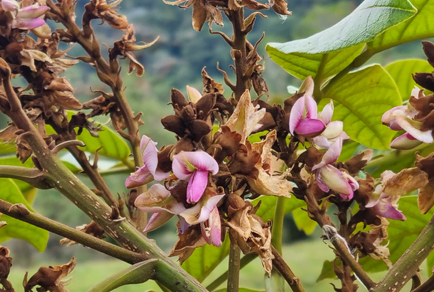
The neotropical genus Dussia (Fabaceae, Papilionoideae) comprises 11 species distributed from Mexico to the Brazilian Amazon. During fieldwork, we collected a morphologically distinct specimen exhibiting characteristics not found in any known species, suggesting a taxonomic novelty. Subsequent herbaria revision and morphological analysis confirmed it as a new species, here named Dussia filibracteolata. The new species is endemic to the Andean forest slopes in Colombia and is distinguished by its filiform bracteoles, subequal calyx lobes, a light pink standard with yellow nectar guides, and dark pink wings and keel petals. We provide illustrations, a distribution map, taxonomic comparisons, and an identification key for the Dussia species of northern South America.
References
- Allemão, F. (1847) Myrocarpus. In: Allemão, F.F & Cysneiro (eds.) Flora oder allgemeine botanische Zeitung, v. 30. pp. 5.
- ANT (2025) Agência Nacional de Terras. Available from: https://www.presidencia.gov.co/prensa/Paginas/Con-entrega-de--311-hectareas-para-resguardo-indigena-La-Estacion-Talaga-250320.aspx/ (accessed 8 October 2025)
- Ariza, W. (2022) Sinopsis de los géneros de Leguminosae-Papilionoideae en Colombia: Árboles y arbustos. In: Forero, E. & C Castellanos (eds.) Estudios en Leguminosas Colombianas IV. Biblioteca Jorge Alvarez Lleras N° 43. Academia Colombiana de Ciencias Exactas, Físicas y Naturales & Fundación Universitaria de San Gil—UNISANGIL, Colombia, pp. 15–136.
- Bonpland, A.J.A. (1809) Quercus tolimensis. In: Second, T. (Ed.) Plantae Aequinoctiales 2. pp. 155–156.
- Cardoso, D., Wallace, M.B.S.M., Cruz, T.D., Zartman, E.C., Komura, L.D., Kite, G., Prenner, G., Wieringa, J.J., Clark, A., Lewis, G. & Pennington, T. (2015) Filling in the gaps of the papilionoid legume phylogeny: The enigmatic Amazonian genus Petaladenium is a new branch of the early-diverging Amburaneae clade. Molecular Phylogenetics and Evolution 84: 112–124. https://doi.org/10.1016/j.ympev.2014.12.015
- Choi, I., Cardoso, D., Queiroz, L.P., Lima, H.C., Lee, C., Ruhlman, T.A., Jansen, R.K. & Wojciechowski, M.F. (2022) Highly Resolved Papilionoid Legume Phylogeny Based on Plastid Phylogenomics. Frontier Plant Science 13 (823190): 1–22. https://doi.org/10.3389/fpls.2022.823190
- Cai, L., Cardoso, D., Tressel, L.G., Lee, C., Shrestha, B., Choi, I.S., de Lima, H.C., de Queiroz, L.P., Ruhlman, T.A., Jansen, R.K. & Wojciechowski, M.F. (2024) Well-resolved phylogeny reveals multiple origins of keel flowers as a synergistic contributor to papilionoid legume diversification. bioRxiv. https://doi.org/10.1101/2024.10.07.617045
- Ducke, W.A. (1938) Plantes Nouvelles ou peu connues de la region amazonienne. Archivos do Jardim Botânico do Rio de Janeiro 4 (1): 5.
- FLORA E FUNGA DO BRASIL. (2025) Jardim Botânico do Rio de Janeiro. Available from: http://floradobrasil.jbrj.gov.br/ (accessed 19 June 2025)
- Harms, H.A.T. (1911) Mildbraediodendron Harms n. gen. In: Adolf, F. & Herzogs, Z.M. (eds.) Wissenschaftliche Ergebnisse der Deutschen Zentral-Afrika-Expedition, v. 2. pp. 241–242.
- Harms, H.A.T. (1926) Plantae Tessmannianae peruvianae III. In: Mildbraed, J. (ed.) Notizblatt des Botanischen Gartens und Museums zu Berlin-Dahlem 9 (89): 964–977. https://doi.org/10.2307/3994448
- Harms, H.A.T. (1928) Leguminosae americanae novae VIII. In: Fedde, F.P. (ed.) Repertorium specierum novarum regni vegetabilis. Selbstverlag des Herausgebers, Berlin-Dahlem, pp. 209–213. https://doi.org/10.1002/fedr.19280241402
- Hutchinson, J. (1964) Leguminales. In: The Genera of Flowering Plants (Angiospermae). I Da cones. Clarendon Press, Oxford, pp. 221–489.
- IUCN Standards and Petitions Committee. (2019) Guidelines for Using the IUCN Red List Categories and Criteria Version 14. Prepared by the Standards and Petitions Committee. Available from: http://www.iucnredlist.org/documents/RedListGuidelines.pdf (accessed 19 June 2025).
- Jacquin, N.J. (1760) Dedacandria monogynia. In: Haak, T. (ed.) Enumeratio Systematica Plantarum. pp. 4.
- Krug, C.W.L. & Urban, I. (1892) Leguminosae. In: Engler, A. & Prantl, K. (eds.) Die Natürlichen Pflanzenfamilien, 3 ed., vol. 3. pp. 70–193.
- Lewis, G.P., Schrire, B., Mackinder, B.E. & Lock, M. (2005) Legumes of the World. Royal Botanic Gardens Kew, 577 pp.
- Linnaeus, C.V. (1781) Dedacandria monogyni. In: Carolo. Supplementum plantarum systematis vegetabilium, 13 ed. pp. 34–233.
- Loureiro, J. (1790) Flora Cochinchinensis. In: Loreiro, J. (eds.) Flora cochinchinensis: sistens plantas in regno cochinchina nascentes, 3 ed., pp. 402–411.
- Pierce, H.J. (1942) A new Dussia and Ormosia avilensis. Bulletin of the Torrey Botanical Club 69 (8): 589–592. https://doi.org/10.2307/2481357
- Polhill, R.M. & Raven, P.H. (Eds.) Advances in Legume Systematics, Part 1. Proceedings of the International Legume Conference, Kew, 24–29 July 1978. Royal Botanic Gardens, Kew, Richmond, pp. 123–145.
- QGIS Development Team. (2023) QGIS Geographic Information System. Open Source Geospatial Foundation. Available from: https://qgis.org (accessed 6 July 2025).
- Radford, A.E., Dickison, W.C., Massey, J.R. & Bell, C.R. (1974) Vascular Plant Systematics. Harper Collins, New York, 891 pp.
- Rudd, V.E. (1963) The genus Dussia (Leguminosae). Contributions from the United States National Herbarium 32 (4): 247–277.
- Schwacke, C.A.W. & Taubert, P.H.W. (1894) Nachträge und Verbesserungen. In: Engler, A. & Prantl, K. (eds.) Die Natürlichen Pflanzenfamilien, 3 ed., vol. 3. pp. 385–387.
- Thiers, B.M. (2025) [continuously updated] Index Herbariorum: A global directory of public herbaria and associated staff. New York Botanical Garden’s Virtual Herbarium. Available from: http://sweetgum.nybg.org/ih/ (accessed 18 June 2025)
- Zhang, R., Stull, G.W., Jin, J.-J., Wang, Y.-H., Guo, Y., Yang, Z.-Y., Li, H.-T., An, K.-L., Charboneau, J.L.M., Folk, R.A., Cardoso, D., Queiroz, L.P. de, Bruneau, A., Soltis, P.S., Soltis, D.E., Smith, S.A. & Li, D.-Z. (2025) Phylogenetic resolution and conflict in the species-rich flowering plant family Leguminosae. Systematic Biology 74: syaf057. https://doi.org/10.1093/sysbio/syaf057
- Zamora, N., Pennington, T.R. & Stirton, S.C. (1999) Dussia atropurpurea (Leguminosae-Papilionoideae), a new species from Central America and notes on sarcotesta coloration in Dussia systematics. Edinburgh Journal of Botany 56 (2): 175–180. https://doi.org/10.1017/S0960428600001050