

Abstract
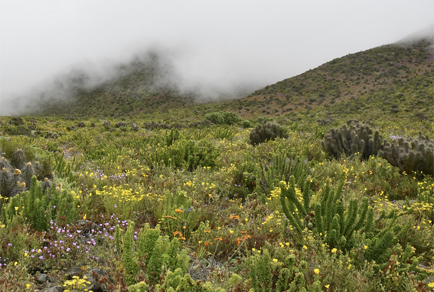
The Atacama Desert in northern Chile is one of the oldest and driest desert ecosystems on the planet and harbors a flora characterized by high levels of endemism and key adaptations such as succulence. Within this flora, Oxalis is among the most diverse genera, and Chile represents an important center of diversification, particularly for section Carnosae, distinguished by unequal sepals, pachycaulous stems, succulent leaves, and thickened roots. Here we describe Oxalis bifurcatifolia, a new succulent species of O. sect. Carnosae endemic to the coastal desert of the Atacama Region, discovered during fieldwork carried out in a Desierto Florido event in 2025. The species differs from morphologically similar taxa—particularly O. tortuosa, O. novemfoliolata, O. ovalleana, and O. leucophylla—by a combination of traits including trifoliolate leaves with obtriangular leaflets, a deeply emarginate apex forming two long bifurcate lobes, markedly larger sepals, and dichasial cymes with strongly contracted cincinni internodes that produce an umbel-like inflorescence. Oxalis bifurcatifolia inhabits open xerophytic scrublands influenced by coastal fog, within a narrow altitudinal belt between 200–870 m a.s.l. and is currently known only from three localities situated outside protected areas. Because of its extremely restricted distribution, low number of known populations, and exposure to threats such as mining activities, livestock grazing, and road construction, the species is assessed as Endangered (EN) under IUCN criterion B2ab(iii). A detailed morphological description, distribution map, photographic material, and an updated key to the Chilean species of O. sect. Carnosae are provided.
References
- Armesto, J.J., Vidiella, P.E. & Gutiérrez, J.R. (1993) Plant communities of the fog-free coastal desert of Chile: plant strategies in a fluctuating environment. Revista Chilena de Historia Natural 66: 271–282.
- Bachman, S., Moat, J., Hill, A.W., de la Torre, J. & Scott, B. (2011) Supporting Red List threat assessments with GeoCAT: geospatial conservation assessment tool. ZooKeys 150: 117–126. https://doi.org/10.3897/zookeys.150.2109
- Frodin, D.G. (2004) History and concepts of big plant genera. Taxon 53: 753–776. https://doi.org/10.2307/4135449
- Gajardo, R. (1994) La vegetación natural de Chile: clasificación y distribución geográfica. Editorial Universitaria, Santiago, 165 pp.
- Gardner, A.G., Vaio, M., Guerra, M. & Emshwiller, E. (2012) Diversification of the American bulb-bearing Oxalis (Oxalidaceae): Dispersal to North America and modification of the tristylous breeding system. American Journal of Botany 99: 152–164. https://doi.org/10.3732/ajb.1100152
- Guerrero, P.C., Rosas, M., Arroyo, M.T. & Wiens, J.J. (2013) Evolutionary lag times and recent origin of the biota of an ancient desert (Atacama–Sechura). Proceedings of the National Academy of Sciences 110: 11469–11474. https://doi.org/10.1073/pnas.1308721110
- Hartley, A.J., Chong, G., Houston, J. & Mather, A.E. (2005) 150 million years of climatic stability: evidence from the Atacama Desert, northern Chile. Journal of the Geological Society 162: 421–424. https://doi.org/10.1144/0016-764904-071
- Heibl, C. (2005) Studies on the systematics, evolution, and biogeography of Oxalis sections Caesiae, Carnosae, and Giganteae, endemic to the Atacama Desert of northern Chile. Diploma thesis, Department of Biology, University of Munich, Germany, 110 pp.
- Heibl, C. & Marticorena, C. (2008) Oxalis novemfoliolata, a new species of Oxalis sect. Carnosae endemic to the Atacama Desert of northern Chile. Gayana Botánica 65: 115–118. https://doi.org/10.4067/S0717-66432008000100012
- Heibl, C. & Renner, S.S. (2012) Distribution models and a dated phylogeny for Chilean Oxalis species reveal occupation of new habitats by different lineages, not rapid adaptive radiation. Systematic Biology 61: 823–834. https://doi.org/10.1093/sysbio/sys034
- Hoffmann, A., Watson, J. & Flores, A. (2015) Flora silvestre de Chile. Cuando el desierto florece, Vol. 1. Monocotiledóneas y otros taxones. Fundación Claudio Gay, Santiago, 261 pp.
- IUCN (2022) Guidelines for using the IUCN Red List categories and criteria, Version 15.1. Standards and Petitions Committee. Available from: https://www.iucnredlist.org/documents/RedListGuidelines.pdf (accessed 23 July 2025)
- Lindley, J. (1829) Edwards’s botanical register; ornamental flower-garden and shrubbery, London, 15: 1249.
- Linnaeus, C. (1753) Species plantarum. L. Salvius, Stockholm, 1200 pp.
- Lourteig, A. (2000) Oxalis L. subgéneros Monoxalis (Small) Lourt., Oxalis y Trifidus Lourt. Bradea 7 (2): 201–629.
- Luebert, F. & Pliscoff, P. (2017) Sinopsis Bioclimática y Vegetacional de Chile, 2ª ed. Editorial Universitaria, Santiago, 381 pp.
- Moreira-Muñoz, A. (2011) Plant Geography of Chile. Springer, Dordrecht, 351 pp. https://doi.org/10.1007/978-90-481-8748-5
- Morello, S., Sassone, A.B. & López, A. (2018) Leaflet shape in the endemic South American Oxalis sect. Alpinae: An integrative approach using molecular phylogenetics and geometric morphometrics. Perspectives in Plant Ecology, Evolution and Systematics 35: 22–30. https://doi.org/10.1016/j.ppees.2018.09.003
- Oberlander, K.C., Dreyer, L.L. & Bellstedt, D.U. (2011) Molecular phylogenetics and origins of southern African Oxalis. Taxon 60: 1667–1677. https://doi.org/10.1002/tax.606011
- Ochoa, J.J. & Ladio, A.H. (2018) Oxalis adenophylla Gillies ex Hook. & Arn. In: Albuquerque, U., Patil, U. & Máthé, Á. (Eds.) Medicinal and Aromatic Plants of South America. Medicinal and Aromatic Plants of the World, vol. 5. Springer, Dordrecht, pp. 639–650. https://doi.org/10.1007/978-94-024-1552-0_32
- Philippi, R.A. (1893) Plantas nuevas Chilenas de la familia de las Tropeóleas i Oxalídeas. Anales de la Universidad de Chile 82: 895–915. https://doi.org/10.4067/S0717-66432008000100012
- Reiche, K. (1894) Zur Kenntnis der chilenischen arten der gattung Oxalis. Botanische Jahrbucher Fur Systematik, Pflanzengeschichte Und Pflanzengeographie 18: 259–305.
- Rodríguez, R., Marticorena, C., Alarcón, D., Baeza, C., Cavieres, L., Finot, V.L., Fuentes, N., Kiessling, A., Mihoc, M., Pauchard, A., Ruiz, E., Sánchez, P. & Marticorena, A. (2018) Catálogo de las plantas vasculares de Chile. Gayana Botánica 75: 1–430. https://doi.org/10.4067/S0717-66432018000100001
- Royal Botanic Garden Edinburgh (2025) The Endemic Plants of Chile: A Checklist of the Endemic Plants of Chile. Available from: https://chileanendemics.rbge.org.uk (accessed 11 November 2025)
- Royal Botanic Gardens, Kew (2025) Plants of the World Online. Available from: https://powo.science.kew.org (accessed 11 November 2025)
- Sarricolea, P., Herrera-Ossandon, MJ. & Meseguer-Ruiz, O. (2017) Climatic regionalisation of continental Chile. Journal of Maps 13: 66–73. https://doi.org/10.1080/17445647.2016.1259592
- SEIA (Servicio de Evaluación de Impacto Ambiental) (2025) Ficha Proyecto COPIAPORT-E. Available from: https://seia.sea.gob.cl/expediente/ficha/fichaPrincipal.php?modo=normal&id_expediente=2148047518 (accessed 28 November 2025)
- SERNAGEOMIN (Servicio Nacional Geología y Minería) (2025) Catastro de concesiones mineras. Available from: https://catastro.sernageomin.cl/ (accessed 28 November 2025)
- Shaw, J.M.H. (2021) An Oxalis lost and found after 140 years. International Rock Gardener 144: 3–12.
- Shaw, J.M.H. (2023) Oxalis (Oxalidaceae). In: Eggli, U. & Nyffeler, R. (Eds.) Dicotyledons: Rosids. Illustrated Handbook of Succulent Plants. Springer Nature Switzerland AG, Cham, pp. 967–1000. https://doi.org/10.1007/978-3-030-93492-7_98
- SONAMI (Sociedad Nacional de Minería de Chile) (2025) Mapa minero de Chile. Available from: https://www.sonami.cl/mapaminero (accessed 21 November 2025)
- Thiers, B. (2025 [continuously updated]) Index Herbariorum: a global directory of public herbaria and associated staff. New York Botanical Garden’s Virtual Herbarium. Available from: http://sweetgum.nybg.org/science/ih/ (accessed 1 December 2025)