

Abstract
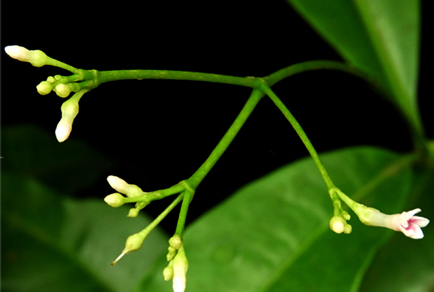
Rauvolfia hookeri (Apocynaceae), a critically endangered species of the Western Ghats, is closely allied with R. micrantha in several morphological attributes. Owing to this similarity, the taxonomic identity of the species has remained uncertain. Since its original publication, distinguishing the two taxa solely on morphological grounds has proven challenging. Traditionally, peduncle length and the number of lateral nerves has been employed as the primary diagnostic characters to separate R. hookeri from R. micrantha. The present study provides a revised description of R. hookeri, supplemented with colour photographs, illustrations, and a detailed comparative account of diagnostic characters between the two species. In addition, the lectotypification of the name R. hookeri is discussed herein.
References
- Anil, K.C., Bindu, S., Chithra, C.R. & Mathew, P.J. (2011) Taxonomic significance of fruits and seed morphology in identification of south Indian Rauvolfia L. (Apocynaceae). Rheedea 21 (2): 160–166.
- Baillon, H.E. (1888) Sur le Dissolaena verticillata Lour. Bulletin Mensuel de la Societe Linneenne de Paris 1: 768.
- Beddome, R.H. (1871) Flora Sylvatica for Southern India. Gantz Brothers, Madras, 159 pp.
- Bindhu, S., Ramesh, K.K.B., Brijesh, K., Awantika, S. & Anilkumar, C. (2014) Distribution of Reserpine in Rauvolfia species from India: HPTLC & LC-MS studies. Industrial Crops and Products 62: 430–436. https://doi.org/10.1016/j.indcrop.2014.09.018
- Gamble, J.S. (1923) Flora of The Presidency of Madras. London: Adlard & Son Limited, 2, pp. 806–807.
- Hooker, J.D. (1882) The Flora of British India. London: Reeve & Co., 3, pp. 632–633.
- Kulloli, S.K. & Sreekala, A.K. (2009) Pollination Ecology of Rauvolfia micrantha Hook.f. (Apocynaceae): A Critically Endangered Medicinal Plant from the Southern Western Ghats. Phytomorphology: An International Journal of Plant Morphology 59 (3&4): 96–101.
- Kurz, W.S. (1877) Forest Flora of British Burma. Government Printing, Calcutta, 2, pp. 171. https://doi.org/10.5962/bhl.title.52413
- Linnaeus, C. (1753) Species Plantarum. Holmiae: Laurentii Salvii, 1, pp. 208.
- Lobay, D. (2015) Rauvolfia in the Treatment of Hypertension. Integrative Medicine 14 (3): 40–46.
- Loureiro, J. (1790) Flora Cochinchinensis: sistens plantas in regno Cochinchina nascentes Ulyssipone Typis, ET Expensis Academicis Lisbon, 1, pp. 138.
- Mabberley, D.J. (2008) Plant Book: A Portable Dictionary of Plants, Their Classification and Uses. 3rd edn. Cambridge: Cambridge University Press, 1021 pp.
- Middleton, D.J. (2006) Nomenclatural notes on Asian Apocynaceae, subfamilies Rauvolfioideae and Apocynoideae. Taxon 55: 502–506. https://doi.org/10.2307/25065598
- Nayar, M.P. (1997) Biodiversity challenges in Kerala and science of conservation biology. In: Pushpangadan, P. & Nair, K.S.S. (eds.) Biodiversity of Tropical Forests – The Kerala Scenario. The State Committee on Science, Technology and Environment (STEC), Govt. of Kerala, pp. 7–23.
- Plants of the World Online (2025) Plants of the World Online. Available from: https://powo.science.kew.org/ (accessed 22 September 2025).
- Santhosh Kumar, E.S., Bindu, S., Anil Kumar, C. & Suchithra, G.K. (2016) Reinstatement of Rauvolfia membranifolia Kerr and a note on R. micrantha Hook.f. (Apocynaceae). An International Journal of Environment and Biodiversity 7 (4): 166–169.
- Srinivasan, S.R. (1987) Apocynaceae. In: Henry, A.N., Chithra, V. & Balakrishnan, N.P. (eds.) Flora of Tamil Nadu, India. Coimbatore: Botanical Survey of India, 2, pp. 78–79.
- Turland, N.J., Wiersema, J.H., Barrie, F.R., Greuter, W., Hawksworth, D.L., Herendeen, P.S., Knapp, S., Kusber, W.-H., Li, D.-Z., Marhold, K., May, T.W., McNeill, J., Monro, A.M., Prado, J., Price, M.J. & Smith, G.F. (Eds.) (2025) International Code of Nomenclature for algae, fungi, and plants (Madrid Code) adopted by the Twentieth International Botanical Congress Madrid, Spain, 2024. Regnum Vegetabile 169. Glashütten: Koeltz Botanical Books.
- Wennberg, E.S. (1818) Stirpium in Guinea medicinalium species novae. Quarum fasciculum primum [secundum] praeside Adam Afzelio, 1, pp. 1.