
Abstract
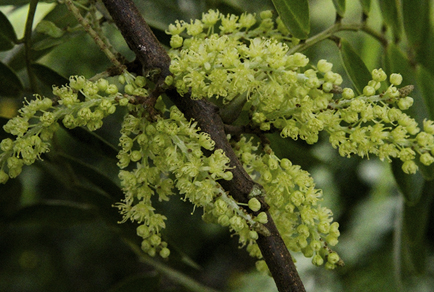
Pterogyne (Fabaceae) is a monospecific genus of trees native to South America. Its sole species, P. nitens, was described by Tulasne in 1843, in reference to its winged fruit and shiny leaflets, with no subsequent taxonomic studies published since. The species is distributed across the Caatinga, semideciduous Atlantic Forest and Gran Chaco, where it favors drier climates and is commonly found in second-growth forests. These trees can reach over 35 m tall and are characterized by leaves ranging from paripinnate to imparipinnate, adaxially glossy leaflets, and axillary fascicles of racemes bearing numerous small, pentamerous, yellow flowers. The fruit is a brown samara with a single well-developed wing. Given the lack of taxonomic studies and the intense morphological plasticity of the genus varying in number, shape and size of leaflets, types of inflorescences, and fruit shapes and sizes, we refined the taxonomic circumscription and describe the phenotypical plasticity of Pterogyne, based on fieldwork in Brazil and analysis of 462 herbarium specimens. Our data, drawn from ecological, geographical, and morphological evidence, support the genus as monospecific and include a more complete description with newly documented morphological traits, as well as preliminary conservation assessment of Least Concern (LC). Notable findings include the andromonoecious inflorescences—a rare condition in Fabaceae—and a correlation between pubescence density and wetter climates, which may suggest an ongoing speciation process. We provided a detailed description of the genus, along with an illustration, photographs, distribution maps, and a nomenclatural treatment that includes a lectotypification, accompanied by a discussion of all new data gathered in this study.
References
- Aublet, F. (1775) Histoire des plantes de la Guiane Françoise. Vol. 2. P.F.Didot jeune, Londres. Available from: [https://www.biodiversitylibrary.org/page/361509].
- Bachman, S., Moat, J., Hill, A.W., De La Torre, J. & Scott, B. (2011) Supporting Red List threat assessments with GeoCAT: geospatial conservation assessment tool. ZooKeys 150: 117–126. https://doi.org/10.3897/zookeys.150.2109
- Baker, W.J., Bailey, P., Barber, V., Barker, A., Bellot, S., Bishop, D., Botigué, L.R., Brewer, G., Carruthers, T., Clarkson, J.J., Cook, J., Cowan, R.S., Dodsworth, S., Epitawalage, N., Françoso, E., Gallego, B., Johnson, M.G., Kim, J.T., Leempoel, K., Maurin, O., Mcginnie, C., Pokorny, L., Roy, S., Stone, M., Toledo, E., Wickett, N.J., Zuntini, A.R., Eiserhardt, W.L., Kersey, P.J., Leitch, I.J. & Forest, F. (2021) A comprehensive phylogenomic platform for exploring the angiosperm tree of life. Systematic Biology 71: 301–319. https://doi.org/10.1093/sysbio/syab035
- Barrett, S. (2002) Sexual interference of the floral kind. Heredity 88: 154–159. https://doi.org/10.1038/sj.hdy.6800020
- Beauvois, P.de (1806) Anthonotha in Flore d’Oware et de Benin, en Afrique vol. 1, pp. 70.
- Bruneau, A., de Queiroz, L.P., Ringelberg, J.J., Borges, L.M., da Costa Bortoluzzi, R.L., Brown, G.K., Cardoso, D.B.O.S., Clark, R.P., de Souza Conceição, A., Cota, M.M.T., Demeulenaere, E., Duno de Stefano, R., Ebinger, J.E., Ferm, J., Fonseca-Cortés, A., Gagnon, E., Grether, R., Guerra, E., Haston, E., Herendeen, P.S., Hernández, H.M., Hopkins, H.C.F., Huamantupa-Chuquimaco, I., Hughes, C.E., Ickert-Bond, S.M., Iganci, J., Koenen, E.J.M., Lewis, G.P., de Lima, H.C., de Lima, A.G., Luckow, M., Marazzi, B., Maslin, B., Morales, M., Morim, M.P., Murphy, D.J., O’Donnell, S.A., Oliveira, F.G., da Silva Oliveira, A.C., Rando, J.G., Ribeiro, P.G., Ribeiro, C.L., da Silva Santos, F., Seigler, D.S., da Silva, G.S., Simon, M.F., Soares, M.V.B. & Terra, V. (2024) Advances in Legume Systematics 14. Classification of Caesalpinioideae. Part 2: Higher-level classification. PhytoKeys 240: 1–552. https://doi.org/10.3897/phytokeys.240.101716
- Burmeister, C.H.C. (1837) Detarieae. Handbuch der Naturgeschichte 319.
- Candolle, A.P.de (1825a) Prodromus systematis naturalis regni vegetabilis, vol. 2. Parisii (Paris), 94 pp.
- Candolle, A.P.de (1825b) Prodromus systematis naturalis regni vegetabilis, vol. 2, 473 pp. Parisii (Paris).
- Carvalho, P.E.R. (1994) Espécies florestais brasileiras: recomendações silviculturais, potencialidades e uso da madeira. EMBRAPA-CNPF, Colombo. Available from: [https://www.cnpf.embrapa.br/pesquisa/efb/temp/index_especies.htm].
- Carvalho, P.E.R. (2003) Espécies arbóreas brasileiras. Embrapa Informação Tecnológica, Brasília; Embrapa Florestas, Colombo. Available from: [https://ainfo.cnptia.embrapa.br/digital/bitstream/item/231652/1/Especies-Arboreas-Brasileiras-vol-1-Amendoim.pdf].
- Chodat, R.H. & Hassler, E. (1904) Plantae Hasslerianae soit énumération des plantes recoltées au Paraguay par le Dr. Emile Hassler d’Asrau (Suisse) de 1885 a 1902. Bulletin de L’Herbier Boissier. sér 2 4 (6): 563.
- Crivos, M., Martínez, M.R., Pochettino, M.L., Remorini, C., Sy, A. & Teves, L. (2007) Pathways as “signatures in landscape”: towards an ethnography of mobility among the Mbya-Guaraní (Northeastern Argentina). Journal of Ethnobiology and Ethnomedicine 3 (2): 2. https://doi.org/10.1186/1746-4269-3-2
- Cronk, Q. & Borges, L.M. (2024) Sexual system variation in legumes (Leguminosae): underpinning genomic study with new tools to describe inflorescence morphology. Braz. J. Bot 47: 1101–1114. https://doi.org/10.1007/s40415-024-01031-w
- Falcão, M.J., Paulino, J.V., Kochanovski, F.J., Figueiredo, R.C., Basso-Alves, J.P. & Mansano, V.F. (2020) Development of inflorescences and flowers in Fabaceae subfamily Dialioideae: an evolutionary overview and complete ontogenetic series for Apuleia and Martiodendron. Botanical Journal of the Linnean Society 193 (1): 19–46. https://doi.org/10.1093/botlinnean/boz098
- GBIF.org (2021) Pterogyne Tul. GBIF. Available from: [https://www.gbif.org/species/2954266].
- Gunn, C.R. (1991) Fruits and seeds of genera in the subfamily Caesalpinioideae (Fabaceae). U.S. Department of Agriculture Research Service. Technical Bulletin 1755: 1–416.
- Harris, J.G. & Harris, M.W. (2001) Plant identification terminology: an illustrated glossary. Spring Lake Publishing, Spring Lake, Utah, 206 pp.
- IUCN Standards and Petitions Committee. (2024) Guidelines for Using the IUCN Red List Categories and Criteria. Version 16. Prepared by the Standards and Petitions Committee. Available from: [https://www.iucnredlist.org/documents/RedListGuidelines.pdf].
- Kates, H.R., O’Meara, B.C., LaFrance, R., Stull, G.W., James, E.K., Liu, S.Y., Tian, Q., Yi, T.S., Conde, D., Kirst, M., Ané, J.M., Soltis, D.E., Guralnick, R.P., Soltis, P.S. & Folk, R.A. (2024) Shifts in evolutionary lability underlie independent gains and losses of root-nodule symbiosis in a single clade of plants. Nat Commun 15 (1): 4262. https://doi.org/10.1038/s41467-024-48036-3
- Kunth, K.S. (1837) Enumeratio Plantarum Omnium Hucusque Cognitarum, Secundum Familias Naturales Disposita, Adjectis Characteribus, Differentiis et Synonymis.
- Legume Phylogeny Working Group (LPWG) (2017) A new subfamily classification of the Leguminosae based on a taxonomically comprehensive phylogeny. Taxon 66: 44–77. https://doi.org/10.12705/661.3
- Legume Phylogeny Working Group (LPWG) (2023) WCVP: Fabaceae checklist (2023v.4). Zenodo. (Retrieved 23 November 2025).
- Lewis, G., Schrire, B., Mackinder, B. & Lock, M. (2005) Legumes of the World. Royal Botanic Gardens, Kew.
- Lewis, G.P. (1987) Legumes of Bahia. Royal Botanic Gardens, Kew.
- Lindley, J. (1836) A Natural System of Botany Ed. 2. London, pp. 148.
- Linnaeus, f. (1781) Myroxylon Supplementum Plantarum Systematis Vegetabilium editionis decimae tertiae, pp. 34, 233.
- Loureiro, J. (1790) Cordyla in Flora 20 (2 Beibl.): 123.
- Martius, C.Von. (1837) Apuleia praecox Mart. Herbarium Florae Brasiliensis. Flora 20, Beibl.: 123.
- Mori, S.A., Silva, L.A.M., Lisboa, G. & Coradin, L. (1989) Manual de manejo de herbário fanerogâmico. 2nd ed. Centro de Pesquisas do Cacau, Ilhéus.
- Pasquini-Netto, H., Manente, F.A., Moura, E.L., Regasini, L.O., Pinto, M.E.F., Bolzani, V.S., Oliveira, O.M.M.F. & Vellosa, J.C.R. (2012) Avaliação das atividades antioxidante, anti e pró-hemolítica do extrato etanólico das folhas de Pterogyne nitens Tul. (Fabaceae—Caesalpinioideae). Revista Brasileira de Plantas Medicinais 14: 666–672. https://doi.org/10.1590/S1516-05722012000400014
- Rando, J.G., Carvalho, D.A.S. & Silva, T.S. (2020) Flora e Funga do Brasil—Pterogyne Tul. Jardim Botânico do Rio de Janeiro. Available from: [http://servicos.jbrj.gov.br/flora/search/Pterogyne].
- Santos, M.J.C., Nascimento, A.V.S. & Mauro, R.A. (2008) Germinação do amendoim bravo (Pterogyne nitens Tul.) para utilização na recuperação de áreas degradadas. Revista Brasileira de Ciências Agrárias 3: 31–34. https://doi.org/10.5039/agraria.v3i1a182
- Schrader, H.A. (1842) Pterogyne in Flora Brasiliensis vol. 2 (1), pp. 62.
- Spalik, K. (1991) On evolution of andromonoecy and ‘‘overproduction’’ of flowers: a resource allocation model. Biol J Linn Soc 42: 325–336. https://doi.org/10.1111/j.1095-8312.1991.tb00566.x
- Thompson, J.M. (1925) Studies in advancing sterility. Pt 2. The Cassieae. Liverpool University, Liverpool.
- Stafleu, F.A. & Cowan, R.S. (1986) Taxonomic literature : a selective guide to botanical publications and collections with dates, commentaries and types (Vol. 6, pp. 530). Bohn, Scheltema & Holkema. Available from: [https://www.biodiversitylibrary.org/page/33212572].
- Tropicos (2025) Tropicos. Connecting the World to Botanical data since 1982. Pterogyne Schrad. Ex Nees. Available from: [https://www.tropicos.org/name/40037938].
- Tulasne, L.R. (1843) Nova Leguminosarum Genera. Annales des Sciences Naturelles; Botanique sér. 2 20: 140. https://www.biodiversitylibrary.org/bibliography/5010
- Turland, N.J., Wiersema, J.H., Barrie, F.R., Gandhi, K.N., Gravendyck, J., Greuter, W., Hawksworth, D.L., Herendeen, P.S., Klopper, R.R., Knapp, S., Kusber, W.-H., Li, D.-Z., May, T.W., Monro, A.M., Prado, J., Price, M.J., Smith, G.F. & Zamora Señoret, J.C. (2025) International Code of Nomenclature for algae, fungi, and plants (Madrid Code). Regnum Vegetabile 162. University of Chicago Press, Chicago. https://doi.org/10.7208/chicago/9780226839479.001.0001
- Vidal, W.N. (1978) Considerações sobre as sâmaras que têm ala para nuclear. Rodriguésia 30: 109–168. Available from: [http://www.jstor.org/stable/23493246].
- Vogel, J.R.T. (1837) Peltogyne in Linnaea: Ein Journal für die Botanik in ihrem ganzen Umfange vol 11, pp. 410.
- Zimmerman, E., Prenner, G. & Bruneau, A. (2013) Floral morphology of Apuleia leiocarpa (Dialiinae: Leguminosae), an unusual andromonoecious legume. International Journal of Plant Sciences 174: 154–160. https://doi.org/10.1086/668789
- Zhao, Y., Zhang, R., Jiang, K., Qi, J., Yi, Hu, Guo, J., Zhu, R., Zhang, T., Egan, A.N., Yi, T., Huang, C. & Ma, H. (2021) Nuclear phylotranscriptomics and phylogenomics support numerous polyploidization events and hypotheses for the evolution of rhizobial nitrogen-fixing symbiosis in Fabaceae. Molecular Plant 14 (5): 748–773. https://doi.org/10.1016/j.molp.2021.02.006
- Zhang, R., Wang, Y., Jin, J., Stull, G.W., Bruneau, A., Cardoso, D., Queiroz, L.P., Moore, M.J., Zhang, S., Chen, S., Wang, J., Li, D. & Yi, T. (2020) Exploration of Plastid Phylogenomic Conflict Yields New Insights into the Deep Relationships of Leguminosae. Systematic Biology 69 (4): 613–622. https://doi.org/10.1093/sysbio/syaa013
- Zhang, R., Stull, G.W., Jin, J.J., Wang, Y.H., Guo, Y., Yang, Z.Y., Li, H.-T., An, K.-L., Charboneau, J.L.M., Folk, R.A., Cardoso, D., de Queiroz, L.P., Bruneau, A., Soltis, P.S., Soltis, D.E., Smith, S.A., Li, D.-Z. & Yi, T.S. (2025) Phylogenetic resolution and conflict in the species-rich flowering plant family Leguminosae. Systematic Biology. https://doi.org/10.1093/sysbio/syaf057