

Abstract
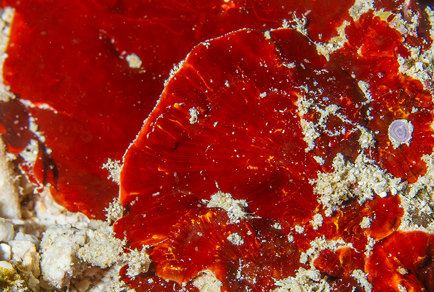
The red algal genus Seiria (order Peyssonneliales) is newly reported from the western Pacific based on collections from Guam, Japan, and Kosrae. Three new species are described based on morphological observations and molecular analyses: Seiria guamensis sp. nov., S. japonica sp. nov., and S. kosraeana sp. nov. All species are attached by unicellular rhizoids, the only vegetative feature shared among all known species of the genus. Seiria japonica sp. nov. and S. kosraeana sp. nov. produce serially arranged tetrasporangia characteristic of the genus, whereas the examined specimen of S. guamensis sp. nov. was not reproductive. The three new species are distinguished from one another and from their congeners by unique combinations of morphological traits and by significant sequence divergence in COI-5P and rbcL molecular markers. Seiria and other peyssonnelioid algae are severely under-reported globally, underscoring the need for expanded collections to reveal their true diversity.
References
- Akita, S., Takano, Y., Nagai, S., Kuwahara, H., Kajihara, R., Tanabe, A.S. & Fujita, D. (2019) Rapid detection of macroalgal seed bank on cobbles: Application of DNA metabarcoding using next-generation sequencing. Journal of Applied Phycology 31: 2743–2753. https://doi.org/10.1007/s10811-018-1730-9
- Boo, G.H. & Kim, K.M. (2020) A new species of marine algae from Korea based on morphology and molecular data: Gelidium palmatum sp. nov. (Gelidiales, Rhodophyta). Algae 35: 33–43. https://doi.org/10.4490/algae.2020.35.3.6
- Chen, P.-C., Perez, C.J.J. & Liu, S.-L. (2022) DNA-assisted inventory and community structure of benthic marine algae in Taiping Island (or Itu Aba Island), South China Sea. Regional Studies in Marine Science 55: 102496. https://doi.org/10.1016/j.rsma.2022.102496
- Darriba, D., Taboada, G.L., Doallo, R. & Posada, D. (2012) jModelTest 2: more models, new heuristics and parallel computing. Nature Methods 9: 772. https://doi.org/10.1038/nmeth.2109
- Dixon, K.R. & Saunders, G.W. (2013) DNA barcoding and phylogenetics of Ramicrusta and Incendia gen. nov., two early diverging lineages of the Peyssonneliaceae (Rhodophyta). Phycologia 52: 82–108. https://doi.org/10.2216/12-62.1
- Dixon, K.R. (2018) Peyssonneliales. In: Huisman,J.M. (Ed.) Algae of Australia. Marine benthic algae of north-western Australia. 2. Red algae. ABRS & CSIRO Publishing, Canberra & Melbourne, pp. 208–244.
- Dutra, E., Koch, M., Peach, K. & Manfrino, C. (2016) Tropical crustose coralline algal individual and community responses to elevated pCO2 under high and low irradiance. ICES Journal of Marine Science 73: 803–813. https://doi.org/10.1093/icesjms/fsv213
- Edgar, R.C. (2004) MUSCLE: multiple sequence alignment with high accuracy and high throughput. Nucleic Acids Research 32: 1792–1797. https://doi.org/10.1093/nar/gkh340
- Edmunds, P.J., Zimmermann, S.A. & Bramanti, L. A spatially aggressive peyssonnelid algal crust (PAC) threatens shallow coral reefs in St. John, US Virgin Islands. Coral Reefs 38: 1329–1341. https://doi.org/10.1007/s00338-019-01846-0
- Edmunds, P.J., Schils, T. & Wilson, B. (2023) The rising threat of peyssonnelioid algal crusts on coral reefs. Current Biology 33: R1140–R1141. https://doi.org/10.1016/j.cub.2023.08.097
- Freshwater, D.W. & Rueness, J. (1994) Phylogenetic relationships of some European Gelidium (Gelidiales, Rhodophyta) species, based on rbcL nucleotide sequence analysis. Phycologia 33: 187–194. https://doi.org/10.2216/i0031-8884-33-3-187.1
- Guiry, M.D. & Guiry, G.M. (2025) AlgaeBase. World-wide electronic publication, National University of Ireland, Galway. Available from: http://www.algaebase.org (accessed 5 May 2025)
- Heydrich, F. (1905) Polystrata, eine Squamariacee aus den Tropen. Berichte der deutsche botanischen Gesellschaft 23: 30–36. https://doi.org/10.1111/j.1438-8677.1905.tb06368.x
- Kato, A., Baba, M., Kawai, H. & Masuda, M. (2006) Reassessment of the little-known crustose red algal genus Polystrata (Gigartinales), based on morphology and SSU rDNA sequences. Journal of Phycology 42: 922–933. https://doi.org/10.1111/j.1529-8817.2006.00238.x
- Kato, A., Guimarães, S.M.P.B., Kawai, H. & Masuda, M. (2009) Characterization of the crustose red alga Peyssonnelia japonica (Rhodophyta, Gigartinales) and its taxonomic relationship with Peyssonnelia boudouresquei based on morphological and molecular data. Phycological Research 57: 74–86. https://doi.org/10.1111/j.1440-1835.2008.00523.x
- Katoh, K., Misawa, K., Kuma, K. & Miyata, T. (2002) MAFFT: a novel method for rapid multiple sequence alignment based on fast Fourier transform. Nucleic Acids Research 30: 3059–3066. https://doi.org/10.1093/nar/gkf436
- Katoh, K. & Standley, D.M. (2013) MAFFT multiple sequence alignment software version 7: Improvements in performance and usability. Molecular Biology and Evolution 30: 772–780. https://doi.org/10.1093/molbev/mst010
- Kearse, M., Moir, R., Wilson, A., Stones-Havas, S., Cheung, M., Sturrock, S., Buxton, S., Cooper, A., Markowitz, S., Duran, C., Thierer, T., Ashton, B., Meintjes, P. & Drummond, A. (2012) Geneious Basic: an integrated and extendable desktop software platform for the organization and analysis of sequence data. Bioinformatics 28: 1647–1649. https://doi.org/10.1093/bioinformatics/bts199
- Krayesky, D.M., Norris, J.N., Gabrielson, P.W., Gabriel, D. & Fredericq, S. (2009) A new order of red algae based on the Peyssonneliaceae, with an evaluation of the original classification of the Florideophyceae (Rhodophyta). Proceedings of the Biological Society of Washington 122: 364–391. https://doi.org/10.2988/08-43.1
- Kucera, H. & Saunders, G.W. (2012) A survey of Bangiales (Rhodophyta) based on multiple molecular markers reveals cryptic diversity. Journal of Phycology 48: 869–882. https://doi.org/10.1111/j.1529-8817.2012.01193.x
- Manghisi, A., Miladi, R., Minicante, S.A., Genovese, G., Le Gall, L., Abdelkafi, S., Saunders, G.W. & Morabito, M. (2019) DNA barcoding sheds light on novel records in the Tunisian red algal flora. Cryptogamie, Algologie 40: 5–27. https://doi.org/10.5252/cryptogamie-algologie2019v40a3
- Mills, M.S. & Schils, T. (2021) The habitat-modifying red alga Ramicrusta on Pacific reefs: A new generic record for the Tropical Northwestern Pacific and the description of four new species from Guam. PLoS ONE 16: e0259336. https://doi.org/10.1371/journal.pone.0259336
- Mills, M.S., Deinhart, M.E., Heagy, M.N. & Schils, T. (2022) Small tropical islands as hotspots of crustose calcifying red algal diversity and endemism. Frontiers in Marine Science 9: 898308. https://doi.org/10.3389/fmars.2022.898308
- Nelson, W., Ngauma, B., Norman, J.H., Ringham, S. & Sutherland, J. (2022) Agissea teruruhau sp. nov. (Peyssonneliales, Rhodophyta) and epiphyte Piriora waewaeiti gen. & sp. nov. (Gigartinales, Rhodophyta) from Manawatāwhi, New Zealand. Phycologia 62: 1–18. https://doi.org/10.1080/00318884.2022.2132054
- Nguyen, L.-T., Schmidt, H.A., von Haeseler, A. & Minh, B.Q. (2015) IQ-TREE: A fast and effective stochastic algorithm for estimating maximum-likelihood phylogenies. Molecular Biology and Evolution 32: 268–274. https://doi.org/10.1093/molbev/msu300
- Pestana, E.M.S., Lyra, G.M., Santos, G.N., Dos Santos, C.C., Casano, V. & Nunes, J.M.C. (2020) Integrative approach reveals underestimated Peyssonneliales diversity in Brazil: registering the first occurrence of Ramicrusta and Incendia, with the description of three new species. Phytotaxa 439: 39–55. https://doi.org/10.11646/phytotaxa.439.1.2
- Pestana, E.M.S., Nunes, J.M.C., Cassano, V. & Lyra, G.M. (2021) Taxonomic revision of the Peyssonneliales (Rhodophyta): circumscribing the authentic Peyssonnelia clade and proposing four new genera and seven new species. Journal of Phycology 57: 1749–1767. https://doi.org/10.1111/jpy.13207
- Pestana, E.M.S., Lyra, G.M., Zhang, H., Davis, C.C. & Nunes, J.M.C. (2025) Conflicting placements shed doubts on the ordinal status of the Peyssonneliales: Is it a clade in the mega diverse Gigartinales? Taxon: 70001. https://doi.org/10.1002/tax.70001
- Ronquist, F. & Huelsenbeck, J.P. (2003) MrBayes 3: Bayesian phylogenetic inference under mixed models. Bioinformatics 19: 1572–1574. https://doi.org/10.1093/bioinformatics/btg180
- Saunders, G.W. & McDevit, D.C. (2012) Methods for DNA barcoding photosynthetic protists emphasizing the macroalgae and diatoms. Methods in Molecular Biology 858: 207–222. https://doi.org/10.1007/978-1-61779-591-6_10
- Sherwood, A.R., Paiano, M.O., Spalding, H.L. & Kosaki, R.K. (2020) Biodiversity of Hawaiian Peyssonneliales (Rhodophyta). 2. Sonderophycus copusii, a new species from the Northwestern Hawaiian Islands. ALGAE 35: 145–155. https://doi.org/10.4490/algae.2020.35.5.20
- Sherwood, A.R., Cabrera, F.P., Spalding, H.L., Alvarado, E.A., Smith, C.M., Hauk, B.B., Matadobra, S.J., Kosaki, R.K. & Paiano, M.O. (2021) Biodiversity of Hawaiian Peyssonneliales (Peyssonneliaceae, Rhodophyta): new species in the genera Incendia and Seiria. Phytotaxa 524: 14–26. https://doi.org/10.11646/phytotaxa.524.1.2
- Sherwood, A.R., Paiano, M.O., Wade, R.M., Cabrera, F.C., Spalding, H.L. & Kosaki, R.K. (2020) Biodiversity of Hawaiian Peyssonneliales (Rhodophyta). 1. Two new species in the genus Ramicrusta from Lehua Island. Pacific Science 75: 185–195. https://doi.org/10.2984/75.2.2
- Stockton, L. & Edmunds, P.J. (2021) Spatially aggressive peyssonnelid algal crusts (PAC) constrain coral recruitment to Diadema grazing halos on a shallow Caribbean reef. Journal of Experimental Marine Biology and Ecology 541: 151569. https://doi.org/10.1016/j.jembe.2021.151569
- Suzuki, M. & Terada, R. (2025) DNA-based floristic survey of red algae (Rhodophyta) growing in the mesophotic coral ecosystems (MCEs) offshore of Tanegashima Island, northern Ryukyu Archipelago, Japan. PLoS ONE 20: e0316067. https://doi.org/10.1371/journal.pone.0316067
- Taylor, K.E. & Saunders, G.W. (2025) Assessment of rhodolith-forming species diversity in British Columbia uncovers novel cryptic diversity in the genera Boreolithothamnion and Rhodolithia gen. nov. (Florideophyceae, Rhodophyta) and the occurrence of hybrid rhodoliths. Journal of Phycology 61: 1371–1393. https://doi.org/10.1111/jpy.70066
- Yang, E.C., Boo, S.M., Bhattacharya, D., Saunders, G.W., Knoll, A.H., Fredericq, S., Graf, L. & Yoon, H.S. (2016) Divergence time estimates and the evolution of major lineages in the florideophyte red algae. Scientific Reports 6: 21361. https://doi.org/10.1038/srep21361
- Yoon, H.S., Hackett, J.D. & Bhattacharya, D. (2002) A single origin of the peridinin- and fucoxanthin-containing plastids in dinoflagellates through tertiary endosymbiosis. Proceedings of the National Academy of Sciences 99: 11724–11729. https://doi.org/10.1073/pnas.172234799
- Zhang, D.R. & Zhou, J.H. (1981) Ramicrusta, a new genus of Peyssonneliaceae. Oceanologia Limnologia Sinica 12: 538–544.