
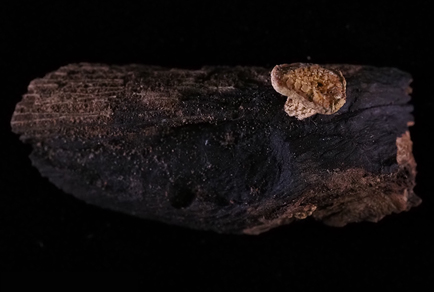

Abstract
Phillipsia straminea has not been reported since its original description from Chichijima Island in 1937. Examination of the Fungal Herbarium of the Hokkaido University Museum, Hokkaido University located specimens corresponding to the original materials, and one specimen was designated as the lectotype. Morphological observations of the lectotype clarified its diagnostic features, supporting its distinction from related species.
References
- Berkeley, M.J. (1852) Enumeration of some fungi from St. Domingo. Annals and Magazine of Natural History Series 9 (2): 192–203.
- Berkeley, M.J. & Curtis, M.A. (1860) Characters of new fungi, collected in the North Pacific exploring expedition by Charles Wright. Proceedings of the American Academy of Arts and Sciences 4: 111–130.
- Berkeley, M.J. (1868) On a collection of fungi from Cuba. Part II, including those belonging to the families Gasteromycetes, Coniomycetes, Hyphomycetes, Physomycetes, and Ascomycetes. Journal of the Linnean Society, Botany 10: 341–392. https://doi.org/10.1111/j.1095-8339.1868.tb00648a.x
- Denison, W.C. (1969) Central American Pezizales. III. The genus Phillipsia. Mycologia 61 (2): 289–304. https://doi.org/10.2307/3757123
- Eckblad, F.E. (1968) The genera of the operculate discomycetes: A re-evaluation of their taxonomy, phylogeny, and nomenclature. Nytt Magasin for Botanikk 15 (1–2): 1–191.
- Ekanayaka, A.H., Bhat, D.J., Hyde, K.D., Gareth, J.E.B. & Zhao, Q. (2017) The genus Phillipsia from China and Thailand. Phytotaxa 316 (2): 138–148. https://doi.org/10.11646/phytotaxa.316.2.3
- Engler, H.G.A. & Prantl, K.A.E. (1897) Die Natürlichen Pflanzenfamilien nebst ihren Gattungen und wichtigeren Arten, insbesondere den Nutzpflanzen. Nachträge zum II. IV. Teil 1. Leipzig, 513 pp.
- Hosaka, K., Kobayashi, T., Castellano, M.A. & Orihara, T. (2018) The status of voucher specimens of mushroom species thought to be extinct from Japan. Bulletin of the National Museum of Nature and Science. Series B, Botany 44: 53–66. [https://www.kahaku.go.jp/albums/abm.php?d=1292&f=abm00001738.pdf&n=L_BNMNS_B44-2_53.pdf]
- Kobayashi, T. (2020) Fungi. In: Hokkaido University Museum (Ed.) Amazing Specimens of the Hokkaido University Museum. Hokkaido Shimbun Press, Sapporo, pp. 44–64. [in Japanese]
- Kuntze, C.E.O. (1891) Revisio Generum Plantarum. Vol. 2. Arthur Felix, Leipzig, 429 pp.
- Ito, S. & Imai, S. (1937a) Fungi of the Bonin Islands I. Transactions of the Sapporo Natural History Society 15: 1–12. [http://hdl.handle.net/2115/64209]
- Ito, S. & Imai, S. (1937b) Fungi of the Bonin Islands II. Transactions of the Sapporo Natural History Society 15: 52–59. [http://hdl.handle.net/2115/64218]
- Ito, S. & Imai, S. (1939) Fungi of the Bonin Islands III. Transactions of the Sapporo Natural History Society 16: 9–20. [http://hdl.handle.net/2115/64254]
- Ito, S. & Imai, S. (1940a) Fungi of the Bonin Islands IV. Transactions of the Sapporo Natural History Society 16: 45–56. [http://hdl.handle.net/2115/64264]
- Ito, S. & Imai, S. (1940b) Fungi of the Bonin Islands V. Transactions of the Sapporo Natural History Society 16: 120–137. [http://hdl.handle.net/2115/64271]
- Le Gal., M. (1953) Les discomycètes de Madagascar. Prodrome à une flore mycologique de Madagascar et dépendances. IV. Muséum national d’histoire naturelle, Paris, 465 pp.
- Ministry of the Environment, Japan (2025) The 5th Red Databook Fungi: Threatened wildlife of Japan. Ministry of the Environment. Tokyo, 529 pp.
- Ohmae, M. (2019) A record of the eld trip of sequestrate fungi in Bonin Islands, Japan. Truffology 2 (1): 26–32. [in Japanese] [https://jats-truffles.org/wp-content/uploads/truffology/vol_2/T2019-07_Ohmae.pdf]
- Paden, J.W. (1977) Two new species of Phillipsia from Central America. Canadian Journal of Botany 55 (21): 2685–2692. https://doi.org/10.1139/b77-307
- Rick, J. (1904) Über einige neue und kritische Pilze Süd-Amerikas. Annales Mycologici 2 (3): 242–247.
- Seaver, F.J. (1928) The North American cup-fungi (Operculates). Self-published, New York, 377 pp. https://doi.org/10.2307/3753859
- Turland, N.J., Wiersema, J.H., Barrie, F.R., Gandhi, K.N., Gravendyck, J., Greuter, W., Hawksworth, D.L., Herendeen, P.S., Klopper, R.R., Knapp, S., Kusber, W.-H., Li, D.-Z., May, T.W., Monro, A.M., Prado, J., Price, M.J., Smith, G.F. & Zamora Señoret, J.C. (2025) International Code of Nomenclature for algae, fungi, and plants (Madrid Code). Accepted by the Twentieth International Botanical Congress, Madrid, Spain, July 2024. The University of Chicago Press, Chicago, 303 pp.
- Yano, O., Shimizu, A. & Ikeda, H. (2011) Cyperaceae collected from Tokyo Prefecture in the Herbarium of the University of Tokyo (TI) I. From Ogasawara (Bonin) Islands. The journal of Japanese Cyperology 16: 41–68. [in Japanese]