
Abstract
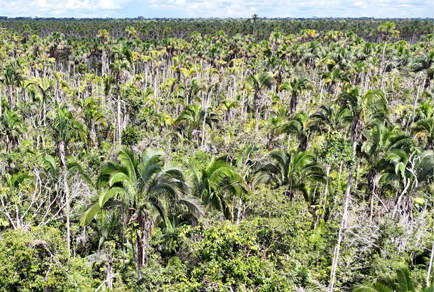
We describe and illustrate Zamia urarinorum, a new species of arborescent cycad from wetland forests in the Tigrillo and Urituyacu river basins of Loreto, Peru. It is the only cycad known to inhabit permanently waterlogged wetland forests, a unique and ecologically challenging environment. Morphologically, the species most closely resembles Zamia multidentata, but differs in both vegetative and reproductive traits. Vegetative distinctions include fewer leaves per stem and longer, more narrowly shaped leaflets with marginal teeth confined to the distal portion. Reproductive differences include significantly smaller pollen strobili with a tomentose rachis, and ovulate strobili with shorter peduncles and smaller seeds. We also document a range extension of Z. multidentata into Peru, expanding its known distribution beyond Acre, Brazil. These findings highlight the underexplored diversity of Amazonian Zamia and contribute to a growing understanding of its biogeographic and ecological complexity.
References
- Adobe Inc. (2025) Adobe Photoshop. Available from: https://www.adobe.com/products/photoshop.html (accessed 14 May 2025)
- Álvarez Alonso, J. (2015) Biodiversidad y ecosistemas amazónicos. In: Roca Alcázar, F., et al. (eds.) La Amazonía: sílabas del agua, el hombre y la naturaleza. Banco de Crédito del Perú, Lima, pp. 139–166.
- Aublet, J.B.C.F. (1775) Histoire des Plantes de la Guiane Françoise, vol. 2. Pierre-François Didot jeune, London & Paris.
- Bachman, S., Moat, J., Hill, A.W., de la Torre, J. & Scott, B. (2011) Supporting Red List threat assessments with GeoCAT: Geospatial Conservation Assessment Tool. ZooKeys 150: 117–126. https://doi.org/10.3897/zookeys.150.2109
- Bès de Berc, S., Baby, P., Soula, J.-C., Souris, M., Christophoul, F. & Rosero, J. (2005) Geomorphic evidence of active deformation and uplift in a modern continental wedge‑top: Uplift and active deformation of the Pastaza alluvial megafan (Subandean zone of Ecuador). Tectonophysics 399 (1–2): 85–87. https://doi.org/10.1016/j.tecto.2004.12.030
- Boisduval, J.B.C.F. (1870) Considérations sur des Lépidoptères envoyés du Guatemala à M. de l’Orza, 100 pp.
- Britton, N.L. (1907) Contributions to the flora of the Bahama Islands, IV. Bulletin of the New York Botanical Garden 5 (18): 311–318.
- Burret, M. (1926) Beiträge zur Kenntnis der Tiliaceae I. Notizblatt des Botanischen Gartens und Museums zu Berlin-Dahlem 9: 592–880. https://doi.org/10.2307/3994327
- Calonje, M. (2009) A new cliff‑dwelling species of Zamia (Zamiaceae) from Belize. Journal of the Botanical Research Institute of Texas 3 (1): 23–29.
- Calonje, M., Esquivel, H.E., Stevenson, D.W., Calonje, C. & Pava, D. (2011) A new arborescent species of Zamia from the Central Cordillera of Tolima, Colombia (Cycadales, Zamiaceae), with comments on the Z. poeppigiana species complex. Brittonia 63: 442–451. https://doi.org/10.1007/s12228-011-9190-4
- Calonje, M., Meerow, A.W., Griffith, M.P., Salas-Leiva, D.E., Vovides, A.P., Coiro, M. & Ortega, F. (2019) A time‑calibrated species tree phylogeny of the New World cycad genus Zamia L. (Zamiaceae, Cycadales). International Journal of Plant Sciences 180: 286–314. https://doi.org/10.1086/702642
- Calonje, M., Stevenson, D.W. & Osborne, R. (2025) The World List of Cycads (Version 2025.09.04‑r1). Coral Gables, FL: Montgomery Botanical Center. https://doi.org/10.5281/zenodo.17059408
- Calonje, M., Stevenson, D.W., Calonje, C., Ramos, Y.A. & Lindström, A.J. (2010) A new species of Zamia from Chocó, Colombia (Zamiaceae, Cycadales). Brittonia 62 (1): 80–85. https://doi.org/10.1007/s12228-009-9094-8
- de Candolle, A.P. (1868) Cycadaceae. Prodromus 16 (2): 522–548.
- Cortés, S. (1897) Flora de Colombia, vol. 1. Imprenta Nacional, Bogotá, 319 pp.
- Dammer, U. (1907) Cycadaceae. Beiträge zur Flora der Hylaea nach den Sammlungen von Ule’s Amazonas‑Expedition. Verhandlungen des Botanischen Vereins der Provinz Brandenburg 48: 117–118.
- Dávila, N. & Kinoshita‑Gouvea, L.S. (2016) A new species of Platycarpum (Rubiaceae, Henriquezieae) from Peruvian Amazon. Phytotaxa 260: 276–282. https://doi.org/10.11646/phytotaxa.260.3.7
- Ducke, A. (1915) Plantes nouvelles ou peu connues de la région Amazonienne 2. Archives of the Botanical Garden of Rio de Janeiro 1: 5–59.
- Draper, F.C., Roucoux, K.H., Lawson, I.T., Mitchard, E.T.A., Honorio Coronado, E.N., Lähteenoja, O., Torres Montenegro, L., Valderrama Sandoval, E., Zárate, R. & Baker, T.R. (2014) The distribution and amount of carbon in the largest peatland complex in Amazonia. Environmental Research Letters 9: 124017. https://doi.org/10.1088/1748-9326/9/12/124017
- Draper, F.C., Honorio Coronado, E.N., Roucoux, K.H., Lawson, I.T., Pitman, N.C.A., Fine, P.V.A., Phillips, O.L., Torres Montenegro, L.A., Valderrama Sandoval, E., Mesones, I., García-Villacorta, R., Ramirez Arévalo, F.R. & Baker, T.R. (2017) Peatland forests are the least diverse tree communities documented in Amazonia, but contribute to high regional beta‑diversity. Ecography 41: 1256–1269. https://doi.org/10.1111/ecog.03126
- Eichler, A.W. (1863) Cycadeae et Coniferae. Flora Brasiliensis (Martius) 4 (1): 414–416.
- Flores Llampazo, G., Honorio Coronado, E.N., del Águila‑Pasquel, J., Córdova Oroche, C.J., Díaz Narváez, A., Reyna Huaymacari, J., Grandez Ríos, J., Lawson, I.T., Hastie, A., Baird, A.J. & Baker, T.R. (2022) The presence of peat and variation in tree species composition are under different hydrological controls in Amazonian wetland forests. Hydrological Processes 36 (9): e14690. https://doi.org/10.1002/hyp.14690
- Honorio Coronado, E.N., Hastie, A., Reyna, J., Flores, G., Grández, J., Lähteenoja, O., Draper, F.C., Åkesson, C.M., Baker, T.R., Bhomia, R.K., Cole, L.E.S., Dávila, N., del Águila, J., del Águila, M., del Castillo Torres, D., Lawson, I.T., Martín Brañas, M., Mitchard, E.T.A., Monteagudo, A., Phillips, O.L., Ramírez, E., Ríos, M., Ríos, S., Rodriguez, L., Roucoux, K.H., Tagle Casapia, X., Vasquez, R., Wheeler, C.E. & Montoya, M. (2021) Intensive field sampling increases the known extent of carbon‑rich Amazonian peatland pole forests. Environmental Research Letters 16: 074048. https://doi.org/10.1088/1748-9326/ac0e65
- Honorio Coronado, E.N., Schulz, C., Martín Brañas, M., del Águila Pasquel, J., del Águila Villacorta, M., Dávila Cardozo, N., Córdova Oroche, C.J., García Mendoza, G., Rios Paredes, M.A., Cole, L.E.S., Charpentier Uraco, E., Valdivia Alarcón, S., Vargas Bernuy, V., Delgado Amasifuen, D., Paima Roque, R., Marín Reyna, W., Isla Reátegui, G.M., Dávila Tuesta, W., Baker, T.R., Reed, M.S. & Roucoux, K.H. (2023) Los humedales y turberas en los territorios indígenas urarinas: usos, manejo y carbono almacenado. In: Martín Brañas, M., Fabiano, E. & Del Castillo Torres, D. (Eds.) Donde habitan los neba: naturaleza, cultura e impactos ambientales en los territorios del pueblo urarina. Instituto de Investigaciones de la Amazonía Peruana (IIAP) & Universidad de St Andrews, Iquitos, pp. 57–86.
- Humboldt, A., Bonpland, A. & Kunth, C.S. (1821) Nova Genera et Species Plantarum 5. Apud N. Maze, Lutetiae Parisiorum.
- IUCN Standards and Petitions Committee (2024) Guidelines for Using the IUCN Red List Categories and Criteria. Version 16. [https://www.iucnredlist.org/documents/RedListGuidelines.pdf]
- Kunth, C.S. (1816) Nova Genera et Species Plantarum, vol. 1. Librairie Grecque‑Latine‑Allemande, Paris, 377 pp.
- Linnaeus, C. fil. (1782) Supplementum Plantarum Systematis Vegetabilium. Orphanotropheum, Brunsvigae, 467 pp.
- Linden, J. (1873) Zamia roezlii. Catalogue Général 90: 10.
- Lindström, A., Habib, S., Dong, S., Gong, Y., Liu, J., Calonje, M., Stevenson, D.W. & Zhang, S. (2024) Transcriptome sequencing data provide a solid base to understand the phylogenetic relationships, biogeography and reticulated evolution of the genus Zamia L. (Cycadales: Zamiaceae). Annals of Botany 134 (5): 747–768. https://doi.org/10.1093/aob/mcae065
- Linnaeus, C. (1763) Zamia. In: Species Plantarum, ed. 2, vol. 2. Laurentius Salvius, Stockholm, pp. 1659.
- Linnaeus, C. (1825) Systema Vegetabilium, 16th ed., vol. 2. Libraria Dieterichiana, Göttingen. https://doi.org/10.5962/bhl.title.822
- Martín Brañas, M., Fabiano, E. & Del Castillo Torres, D. (Eds.) (2023) Donde habitan los neba: naturaleza, cultura e impactos ambientales en los territorios del pueblo urarina. Instituto de Investigaciones de la Amazonía Peruana (IIAP) & Universidad de St. Andrews, Iquitos, 256 pp.
- Martín Brañas, M., Fabiano, E. & Del Castillo Torres, D. (2023) Introducción. In: Martín Brañas, M., Fabiano, E. & Del Castillo Torres, D. (Eds.) Donde habitan los neba: naturaleza, cultura e impactos ambientales en los territorios del pueblo urarina. Instituto de Investigaciones de la Amazonía Peruana (IIAP) & Universidad de St Andrews, Iquitos, pp. 13–18.
- Martius, C.F.P. (1824) Historia Naturalis Palmarum, vol. 2. T.O. Weigel, Leipzig, 152 pp.
- Martius, C.F.P. (1842 [“1847”]) Palmetum Orbignianum: descriptio palmarum in Paraguaria et Bolivia crescentium, secundum Alcide d’Orbigny exempla, schedulas et icones digessit. J.B. Baillière, Paris, 140 pp.
- Ministerio de Cultura del Perú (2025) Base de Datos de Pueblos Indígenas u Originarios: Urarina. Available from: https://bdpi.cultura.gob.pe/pueblos/urarina (accessed 9 May 2025)
- Norstog, K.J. & Nicholls, T.J. (1997) The Biology of the Cycads. Cornell University Press (Comstock Pub. Associates), Ithaca, NY, 363 pp.
- R Core Team (2022) R: A language and environment for statistical computing. R Foundation for Statistical Computing, Vienna. Available from: https://www.R-project.org/ (accessed 14 May 2025)
- Ramsar Convention Secretariat (2002) Complejo de humedales del Abanico del río Pastaza (Ramsar Site No. 1174). Ramsar Sites Information Service. [https://rsis.ramsar.org/ris/1174]
- Räsänen, M., Neller, R., Salo, J. & Jungner, H. (1992) Recent and ancient fluvial deposition systems in the Amazonian foreland basin, Peru. Geological Magazine 129 (3): 293–306. https://doi.org/10.1017/S0016756800019233
- Reitter, E. (1875) Revision der europäischen Cryptophagiden. Deutsche Entomologische Zeitschrift 19: 1–86. https://doi.org/10.1002/mmnd.48018750303
- Roucoux, K.H., García Mendoza, G., Georgiou, S., Honorio Coronado, E.N., Hastie, A., Hoorn, C., Gloor, E. & Lawson, I.T. (2023) Introducción al medio físico y biológico del pueblo urarina. In: Martín Brañas, M., Fabiano, E. & Del Castillo Torres, D. (Eds.) Donde habitan los neba: naturaleza, cultura e impactos ambientales en los territorios del pueblo urarina. Instituto de Investigaciones de la Amazonía Peruana (IIAP) & Universidad de St Andrews, Iquitos, pp. 19–56.
- Royal Horticultural Society (2015) R.H.S. Colour Chart, Sixth edition. RHS Media, Royal Horticultural Society.
- Schulz, C., Martín Brañas, M., Núñez Pérez, C, Del Águila Villacorta, M., Laurie, N., Lawson, I.T. & Roucoux, K. (2019) Peatland and wetland ecosystems in Peruvian Amazonia: indigenous classifications and perspectives. Ecology and Society 24 (2): 12. https://doi.org/10.5751/ES-10886-240212
- Sánchez Beeckman, M. (2021) ColorNameR: Give Colors a Name. R package version 0.1.0. Available from: https://CRAN.R-project.org/package=ColorNameR (accessed 14 May 2025)
- Seemann, B. (1854) Flora of the Isthmus of Panama. In: Botany of the Voyage of H.M.S. Herald under the command of Captain H. Kellett, R.N., C.B., during the years 1845–51. Lovell Reeve, London, pp. 57–204. https://doi.org/10.5962/bhl.title.425
- Segalla, R. & Morellato, L.P.C. (2019) New report of Eumaeus (Lepidoptera: Lycaenidae) associated with Zamia boliviana, a cycad from Brazil and Bolivia. Cycads 4 (1): 5–6.
- Segalla, R. & Calonje, M. (2019) Zamia brasiliensis, a new species of Zamia (Zamiaceae, Cycadales) from Mato Grosso and Rondônia, Brazil. Phytotaxa 404: 1–11. https://doi.org/10.11646/phytotaxa.404.1.1
- Segalla, R., Pinheiro, F. & Morellato, L.P.C. (2021) Reproductive biology of the South American cycad Zamia boliviana, involving broodsite pollination. Plant Species Biology 36 (2): 348–360. https://doi.org/10.1111/1442-1984.12322
- Segalla, R., Pimenta, R.S. & Calonje, M. (2023) Zamia multidentata (Cycadales, Zamiaceae), a new arborescent species of Zamia from Acre, Brazil. Phytotaxa 598 (1): 21–31. https://doi.org/10.11646/phytotaxa.598.1.2
- Sierra‑Botero, L., Calonje, M., Robbins, R.K., Rosser, N., Pierce, N.E., López‑Gallego, C. & Valencia‑Montoya, W.A. (2023) Cycad phylogeny predicts host plant use of Eumaeus butterflies. Ecology and Evolution 13 (4): e9978. https://doi.org/10.1002/ece3.9978
- Skelley, P.E. & Segalla, R. (2019) A new species of Pharaxonotha Reitter (Coleoptera: Erotylidae) from central South America. Zootaxa 4590 (1): 184–190. https://doi.org/10.11646/zootaxa.4590.1.9
- Skelley, P.E. & Tang, W. (2020) Two new species of Pharaxonotha Reitter among the early‑diverging lineages, with a key to the species of the genus (Coleoptera: Erotylidae: Pharaxonothinae). Insecta Mundi 0784: 1–20.
- Stevenson, D.W. (2001) Orden Cycadales. In: Flora de Colombia 21. pp. 1–91.
- Stevenson, D.W. (2004) Zamiaceae of Bolivia, Ecuador and Peru. In: Walters, T. & Osborne, R. (Eds.) Cycad classification: Concepts and recommendations. CABI, Oxfordshire, pp. 173–194. https://doi.org/10.1079/9780851997414.0173
- Stevenson, D.W., Cárdenas López, D. & Castaño Arboleda, N. (2018) A new Zamia (Zamiaceae) from Colombia. Brittonia 70 (3): 364–368. https://doi.org/10.1007/s12228-018-9535-3
- Swart, J.J. (1942) Novitates Burseracearum. Recueil des Travaux Botaniques Néerlandais 39: 189–210.
- UPOV (2019) Color Names for the RHS Colour Chart. International Union for the Protection of New Varieties of Plants. Available from: https://www.upov.int/edocs/mdocs/upov/en/tc_55/tc_55_14.pdf (accessed 14 May 2025)
- Valencia‑Montoya, W.A., Tuberquia, D., Guzmán, P.A. & Cardona‑Duque, J. (2017) Pollination of the cycad Zamia incognita A. Lindstr. & Idárraga by Pharaxonotha beetles in the Magdalena Medio Valley, Colombia: a mutualism dependent on a specific pollinator and its significance for conservation. Arthropod–Plant Interactions 11: 717–729. https://doi.org/10.1007/s11829-017-9511-y
- Wendland, H. (1860) Bemerkungen über einige Palmengattungen Amerika’s. Bonplandia 8: 100–106.
- Whitaker, M.R.L. & Salzman, S. (2020) Ecology and evolution of cycad‑feeding Lepidoptera. Ecology Letters 23 (12): 1862–1874. https://doi.org/10.1111/ele.13581