

Abstract
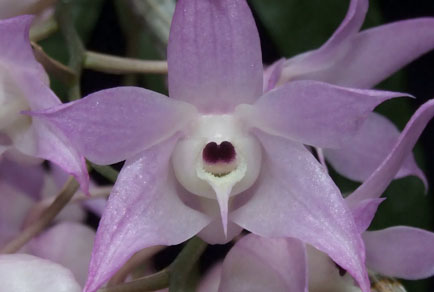
A new orchid species, Dendrobium laoshanense, from Yunnan, China, is described and illustrated in this study based on morphological evidence. Morphological analysis indicates that D. laoshanense is similar to D. hercoglossum and D. aduncum, but it can be distinguished from the former by a lip with a broader base that gradually narrows to an acute apex and bears dense yellow short hairs at the base, and from the latter by leaves that are apically obtuse and unevenly bilobed, together with narrower, more elongate sepals and petals, each with a hooked apical tip.
References
- Clements, M.A. & Jones, D.L. (2002) Nomenclatural changes in the Dendrobieae (Orchidaceae) 1: the Australasian region. Orchadian 13: 485–497.
- Clements, M.A. (2003) Molecular phylogenetic systematics in the Dendrobiinae (Orchidaceae), with emphasis on Dendrobium section Pedilonum. Telopea 10: 247–298. https://doi.org/10.1016/j.ympev.2013.06.009
- Clements, M.A. (2006) Molecular phylogenetic systematics in Dendrobieae (Orchidaceae). Aliso 22: 465–480. https://doi.org/10.5642/aliso.20062201.37
- Li, Y., Zhang, B., Zhang, S., Wong, C.E., Liang, Q., Pang, S., Wu, Y., Zhao, M. & Yu, H. (2025) Pangeneric genome analyses reveal the evolution and diversity of the orchid genus Dendrobium. Nature plants 11 (3): 421–437. https://doi.org/10.1038/s41477-024-01902-w
- Lindley, J. (1842) Edwards’s botanical register. 28 (Misc): 58.
- Niu, Z., Zhu, F., Fan, Y., Li, C., Zhang, B., Zhu, S., Hou, Z., Wang, M., Yang, J., Xue, Q., Liu, W. & Ding, X. (2021) The chromosome-level reference genome assembly for Dendrobium officinale and its utility of functional genomics research and molecular breeding study. Acta pharmaceutica Sinica. B 11 (7): 2080–2092. https://doi.org/10.1016/j.apsb.2021.01.019
- Reichenbach, H.G.L. (1886) Gardeners' Chronicle: a weekly illustrated journal of horticulture and allied subjects, new series. New Garden Plants 26: 486–487.
- Schuiteman, A. (2011) Dendrobium (Orchidaceae): to split or not to split? Gardens’ Bulletin Singapore 63: 245–257.
- Wei, C.-Y., Li, R.-Y., Wu, Y.-W., Huang, M.-Z. & Li, M.-H. (2024) Dendrobium tetrapterum, a cryptic species in the D. lindleyi alliance (Orchidaceae; Dendrobiinae): evidence from morphological and molecular data. Phytotax 655 (2): 209–218. https://doi.org/10.11646/phytotaxa.655.2.8
- Wood, H.P. (2006) The dendrobiums. Gantner, Ruggell, pp. 3–10.
- Xiang, X.G., Schuiteman, A., Li, D.Z., Huang, W.C., Chung, S.W., Li, J.W., Zhou, H.L., Jin, W.T., Lai, Y.J., Li, Z.Y. & Jin, X.H. (2013) Molecular systematics of Dendrobium (Orchidaceae, Dendrobieae) from mainland Asia based on plastid and nuclear sequences. Molecular Phylogenetics and Evolution 65: 950–960. http://dx.doi.org/10.1016/j.ympev.2013.06.009
- Xu, Q., Zhang, G.Q., Liu, Z.J. & Luo, Y.B. (2014) Two new species of Dendrobium (Orchidaceae: Epidendroideae) from China: evidence from morphology and DNA. Phytotaxa 174 (3): 129–143. https://doi.org/10.11646/phytotaxa.174.3.1
- Zhang, G.Q., Liu, K.W., Chen, L.J., Xiao, X.J., Zhai, J.W., Li, L.Q., Cai, J., Hsiao, Y.Y., Rao, W.H., Huang, J., Ma, X.Y., Chung, S.W., Huang, L.Q., Tsai, W.C. & Liu, Z.J. (2013) A new molecular phylogeny and a new genus, Pendulorchis, of the Aerides—Vandaalliance (Orchidaceae: Epidendroideae). PloS One 8: e60097. https://doi.org/10.1371/journal.pone.0060097
- Zheng, B.-Q., Yang, H.-B., Wang, Q. & Chen, X.-L. (2024) Dendrobium moniliforme var. hongbinii (Orchidaceae: Epidendroideae), a new variety from Sichuan, China. Phytotaxa 678 (1): 55–64. https://doi.org/10.11646/phytotaxa.678.1.5
- Zhu, G.H., Ji, Z.H., Wood, J.J. & Wood, H.P. (2009) Dendrobium. In: Wu, C.Y., Raven, P.H. & Hong, D.Y. (Eds.) Flora of China. Scientific Press, Beijing, pp. 367–397.