

Abstract
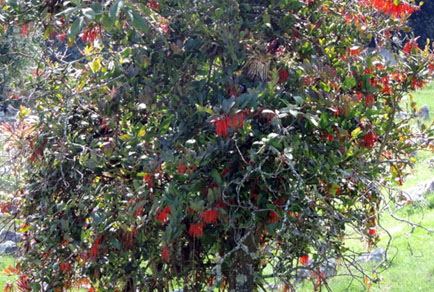
Aetanthus confusus, a new species of hemiparasite from the northern part of the Eastern Cordillera of Colombia, is described and illustrated. This species can be recognized by the combination of percurrent branches, stems trigonous, becoming pseudo-quadrangular at maturity, oblanceolate to lanceolate leaf blades with an obtuse or acute apex, and inflorescences composed of triple dyads. The most similar species is A. colombianus, which differs by having stems always trigonous, widely elliptic leaf blades with a rounded apex, and inflorescences composed of double dyads. The new taxon is restricted to the Eastern Cordillera of the Colombian Andes and is considered endangered due to habitat loss. The morphological affinities of Aetanthus confusus with the remaining Aetanthus species are discussed.
References
- Beentje, H. (2016) The Kew Plant Glossary, an illustrated dictionary of plant terms (2nd ed.). Royal Botanic Gardens Kew, Richmond, 160 pp.
- Bonpland, A.J.A. (1809) Plantae Aequinoctiales, vol. 2. F. Schoell, Paris, 191 pp.
- Dueñas-Gómez, H. & Franco-Roselli, P. (2001) Sinopsis de las Loranthaceae de Colombia. Caldasia 23: 81–99.
- Eichler, A.W. (1868) Loranthaceae. In: Martius, C.F.P. von & Eichler, A.W. (Eds.) Flora brasiliensis. Vol. V, pars II. F. Fleischer, Leipzig, pp. 1–136. https://doi.org/10.5962/bhl.title.454
- Engler, A. (1889) Loranthaceae. In: Engler, A. & Prantl, K. (Eds.) Die Natürlichen Pflanzenfamilien, III. Teil. 1. Abteilung. Engelmann, Leipzig, pp. 156–198. https://doi.org/10.5962/bhl.title.4635
- Engler, A. (1897) Loranthaceae. In: Engler, A. & Prantl, K. (Eds.) Die Natürlichen Pflanzenfamilien, Nachträge zum III. Teil 1. Engelmann, Leipzig, pp. 124–140. https://doi.org/10.5962/bhl.title.4635
- González, F., Roldán, F.J. & Pabón-Mora, N. (2016) Psittacanthus corderoi, a new species of Loranthaceae from the Colombian Amazonia. Caldasia 38: 250–256. https://doi.org/10.15446/caldasia.v38n2.60919
- González, F. & Pabón-Mora, N. (2023) The Remarkable Diversity of Parasitic Flowering Plants in Colombia. The Botanical Review 89: 331–385. https://doi.org/10.1007/s12229-023-09294-w
- Horaninov, P.F. (1847) Characteres essentiales familiarum ac tribuum regni vegetabilis et amphorganici ad leges tetractydis naturae conscripti accedit enumeratio generum magis notorum et organographiae supplementum. Typis K. Wienhöberianis, Petropoli, 301 pp. https://doi.org/10.5962/bhl.title.7697
- IUCN Standards and Petitions Committee. (2024) Guidelines for Using the IUCN Red List Categories and Criteria. Version 16. Prepared by the Standards and Petitions Committee. Available from: https://www.iucnredlist.org/es/resources/redlistguidelines (accessed 15 June 2024)
- Kuijt, J. (1982) Seedling morphology and its systematic significance in Loranthaceae of the New World, with supplementary comments on Eremolepidaceae. Botanische Jahrbücher fur Systematik, Pflanzengeschichte und Pflanzengeographie 103: 305–342. https://doi.org/10.3417/2010121
- Kuijt, J. (2009) Monograph of Psittacanthus (Loranthaceae). Systematic Botany Monographs 86: 1–361.
- Kuijt, J. (2014) A monograph of the genus Aetanthus (Loranthaceae). Plant Diversity and Evolution 131: 1–51. https://doi.org/10.1127/1869-6155/2014/0131-0063
- Kuijt, J. & Hansen, B. (2015) Loranthaceae. In: Kubitzki, K. (Ed.) The Families and Genera of Vascular Plants. Springer, Hamburg, pp. 13–119. https://doi.org/10.1007/978-3-319-09296-6_14
- Kunth, K.S. (1820) Lorantheae. In: Humboldt, F.W.H.A. & Bonpland, A.J.A. (Eds.) Nova Genera et Species Plantarum, vol. 3. Librairie Graeco-Latino-Germanieae, Paris, pp. 432–445.
- Linnaeus, C. (1753) Species Plantarum. Laurentius Salviius, Stockholm, 1200 pp. https://doi.org/10.5962/bhl.title.669
- Liu, B., Le, C.T., Barrett, R.L., Nickrent, D.L., Chen, Z., Lu, L. & Vidal-Russell, R. (2018) Historical biogeography of Loranthaceae (Santalales): Diversification agrees with emergence of tropical forests and radiation of songbirds. Molecular Phylogenetics and Evolution 124: 199–212. https://doi.org/10.1016/j.ympev.2018.03.010
- Murillo-Serna, J.S., Roldán-Palacio, F.J., Carmona-Gallego, I. & Alzate, F. (2021) A new species of Aetanthus (Loranthaceae) from Colombia with notes on A. engelsii. Candollea 76: 71–76.
- Nickrent, D.L., Malécot, V., Vidal-Russell, R. & Der, J.P. (2010) A revised classification of Santalales. Taxon 59: 538–558. https://doi.org/10.1002/tax.592019
- Smith, A.C. (1932) Studies of South American Plants. II. New Loranthaceae and Monimiaceae from the Northern Andes. Bulletin of the Torrey Botanical Club 59: 513–524. https://doi.org/10.2307/2480745
- Van Tieghem, M.Ph. (1895) Sur le groupement des espèces en genres dans la tribu des Psittacanthées de la famille des Loranthacées. Bulletin de la Société Botanique de France 42: 343–362. https://doi.org/10.1080/00378941.1895.10830607
- Vidal-Russell, R. & Nickrent, D.L. (2008) Evolutionary relationships in the showy mistletoe family (Loranthaceae). American Journal of Botany 95: 1015–1029. https://doi.org/10.3732/ajb.0800085
- Wilson, C.A. & Calvin, C.L. (2006) An origin of aerial branch parasitism in the mistletoe family, Loranthaceae. American Journal of Botany 93: 787–796. https://doi.org/10.3732/ajb.93.5.787