

Abstract
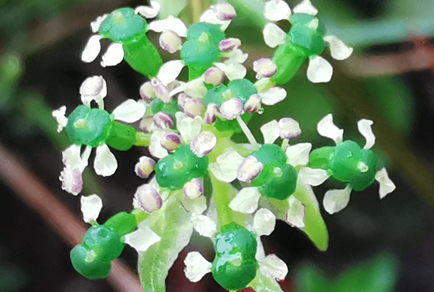
Physospermopsis deqinensis X.L.Guo & X.J.He, a new species from Deqin County, Yunnan, China, is described and illustrated. It resembles P. rubrinervis and P. shaniana by having leaf-like bracts and bracteoles with purplish margins, but differs in its stems 3–5 mm thick, pinnately divided bracts, longer bracteoles, umbels with 13–20 rays, and oblong to ovoid mericarps with linear, slightly sinuate ribs. The new species also has more vittae per furrow (3–4) and an irregular endosperm that is ventrally concave and dorsally undulate. Phylogenetic analyses using nrITS and plastid introns (rpl16, rps16) place P. deqinensis as sister to the clade comprising P. delavayi and P. alepidioides in the nuclear tree, and sister to a clade of six Physospermopsis species in the plastid tree. The species is currently known only from the Biluo Snow Mountains, Yunnan, and is preliminarily assessed as Data Deficient (IUCN).
References
- Calviño, C.I., Tilney, P.M., van Wyk, B.E. & Downie, S.R. (2006) A molecular phylogenetic study of southern African Apiaceae. American Journal of Botany 93 (12): 1828–1847. https://doi.org/10.3732/ajb.93.12.1828
- Diels, L. (1912) Plantae Chinenses Forrestianae: enumeration and description of species of Saxifragaceae, Umbelliferae, and Cornaceae collected by George Forrest in Yunnan and Eastern Tibet. Notes from the Royal Botanic Garden, Edinburgh 5 (25): 281–295.
- Downie, S.R. & Katz-Downie, D.S. (1999) Phylogenetic analysis of chloroplast rps16 intron sequences reveals relationships within the woody southern African Apiaceae subfamily Apioideae. Canadian Journal of Botany 77 (8): 1120–1135. https://doi.org/10.1139/b99-086
- Downie, S.R., Katz-Downie, D.S. & Watson, M.F. (2000) A phylogeny of the flowering plant family Apiaceae based on chloroplast DNA rpl16 and rpoc1 intron sequences: towards a suprageneric classification of subfamily Apioideae. American Journal of Botany 87: 273–292. https://doi.org/10.2307/2656915
- Downie, S.R., Spalik, K., Katz-Downie, D.S. & Reduron, J.P. (2010) Major clades within Apiaceae subfamily Apioideae as inferred by phylogenetic analysis of nrDNA ITS sequences. Plant Diversity and Evolution 128 (1–2): 111–136. https://doi.org/10.1127/1869-6155/2010/0128-0005
- Doyle, J.J. & Doyle, J.L. (1987) A rapid DNA isolation procedure for small amounts of fresh leaf tissue. Phytochemical Bulletin 19: 11–15.
- Farille, M.A. & Malla, S.B. (1985) Apiaceae Himalayenses, III. Candollea 40: 512–520.
- Franchet, A. (1894) Trachydium Lindl. Bulletin mensuel de la Société Linnéenne de Paris 2: 110–115.
- Hoffmann, G.F. (1814) Genera Plantarum Umbelliferarum eorumque characteres naturales secundum numerum, figuram, situm et proportionem omnium fructificationis partium. Sumtibus Auctoris, Mosquae, pp. viii.
- IUCN Standards and Petitions Committee. (2024) Guidelines for using the IUCN red list categories and criteria. Version 16. Prepared by the standards and petitions committee. Available from: https://www.iucnredlist.org/documents/RedListGuidelines.pdf (accessed March 2024)
- Jordan, W.C., Courtney, M.W. & Neigel, J.E. (1996) Low levels of intraspecific genetic variation at a rapidly evolving chloroplast DNA locus in North American Duckweeds (Lemnaceae). American Journal of Botany 83 (4): 430–439. https://doi.org/10.2307/2446212
- Kalyaanamoorthy, S., Minh, B.Q., Wong, T.K.F., von Haeseler, A. & Jermiin, L.S. (2017) ModelFinder: fast model selection for accurate phylogenetic estimates. Nature Methods 14: 587–589. https://doi.org/10.1038/nmeth.4285
- Kelchner, S.A. & Clark, L.G. (1997) Molecular evolution and phylogenetic utility of the chloroplast rpl16 intron in Chusquea and the Bambusoideae (Poaceae). Molecular Phylogenetics and Evolution 8 (3): 385–397. https://doi.org/10.1006/mpev.1997.0432
- Minh, B.Q., Schmidt, H.A., Chernomor, O., Schrempf, D., Woodhams, M.D., von Haeseler, A. & Lanfear, R. (2020) IQ-TREE 2: new models and efficient methods for phylogenetic inference in the genomic era. Molecular Biology and Evolution 37: 1530–1534. https://doi.org/10.1093/molbev/msaa015
- Nguyen, L.T., Schmidt, H.A., von Haeseler, A. & Minh, B.Q. (2015) IQ-TREE: a fast and effective stochastic algorithm for estimating maximum-likelihood phylogenies. Molecular Biology and Evolution 32 (1): 268–274. https://doi.org/10.1093/molbev/msu300
- Norman, C. (1938) The genus Trachydium. Journal of Botany, British and Foreign 76: 229–233.
- Pimenov, M.G. & Kljuykov, E.V. (2000) Taxonomic revision of Pleurospermum Hoffm. and related genera of Umbelliferae III. The genera Physospermopsis and Hymenidium. Feddes Repertorium 111 (7–8): 535–552. https://doi.org/10.1002/fedr.20001110719
- Pimenov, M.G. (2017) Updated checklist of Chinese Umbelliferae: nomenclature, synonymy, typification, distribution. Turczaninowia 20: 106–239. https://doi.org/10.14258/turczaninowia.20.2.9
- Pu, F.T. (1993) Umbelliferae (Apiaceae). In: Wang, W.T. (Ed.) Vascular plants of the Hengduan Mountains, Vol. 1. Science Press, Beijing, pp. 1282–1349.
- Pu, F.D. & Watson, M.F. (2005) Apiaceae (Umbelliferae). In: Wu, Z.Y., Raven, P.H. & Hong, D.Y. (Eds.) Flora of China, Vol. 14 (Apiaceae through Ericaceae). Science Press, Beijing & Missouri Botanical Garden Press, St. Louis, pp. 1–205.
- Ronquist, F., Teslenko, M., van der Mark, P., Ayres, D.L., Darling, A., Höhna, S., Larget, B., Liu, L., Suchard, M.A. & Huelsenbeck, J.P. (2012) MrBayes 3.2: efficient bayesian phylogenetic inference and model choice across a large model space. Systematic Biology 61: 539–542. https://doi.org/10.1093/sysbio/sys029
- Shan, R.H. (1941) On reduction of the genus Haploseseli Wolff et Handel Mazzetti. Sinensia 12 (1–6): 185–187.
- Tamura, K., Stecher, G., Peterson, D., Filipski, A. & Kumar, S. (2013) MEGA6: molecular evolutionary genetics analysis version 6.0. Molecular Biology and Evolution 30 (12): 2725–2729. https://doi.org/10.1093/molbev/mst197
- Thiers, B. (2025, continuously updated) Index Herbariorum: a global directory of public Herbaria and associated staff. New York Botanical Garden’s Virtual Herbarium. Available from: http://sweetgum.nybg.org/science/ih/ (accessed 16 March 2025)
- White, T.J., Bruns, T., Lee, S. & Taylor, J. (1990) Amplification and direct sequencing of fungal ribosomal RNA genes for phylogenetics. In: Innis, M.A., Gelfand, D.H. & Sninsky, J.J. (Eds.) PCR Protocols: A Guide to Methods and Applications. Academic Press, San Diego, pp. 315–322. https://doi.org/10.1016/B978-0-12-372180-8.50042-1
- Wolff, H. (1925) Neue Umbelliferen-Gattungen aus Ostasien. Notizblatt des Königlichen Botanischen Gartens und Museums zu Berlin-Dahlem 9 (84): 275–280. https://doi.org/10.2307/3994550
- Handel-Mazzetti, H. (1933) Symbolae Sinicae: botanische Ergebnisse der Expedition der Akademie der Wissenschaften in Wien nach Südwest-China 1914/1918. VII. Teil: Anthophyta, 3. Lieferung. Verlag von Julius Springer, Wien, pp. 449–730.
- Wolff, H. (1929) Umbelliferae Asiaticae novae relictae, VII. Repertorium Specierum Novarum Regni Vegetabilis 27: 121–192. https://doi.org/10.1002/fedr.4870270109
- Xu, X.R., Guo, X.L., Price, M., He, X.J. & Zhou, S.D. (2021) New insights into the phylogeny and taxonomy of Chinese Physospermopsis (Apiaceae). PhytoKeys 175: 67–88. https://doi.org/10.3897/phytokeys.175.57681
- Zhou, J., Peng, H., Downie, S.R., Liu, Z.W. & Gong, X. (2008) A molecular phylogeny of Chinese Apiaceae subfamily Apioideae inferred from nuclear ribosomal DNA internal transcribed spacer sequences. Taxon 57: 402–416. https://doi.org/10.2307/25066012
- Zhou, J., Gong, X., Downie, S.R. & Peng, H. (2009) Towards a more robust molecular phylogeny of Chinese Apiaceae subfamily Apioideae: additional evidence from nrDNA ITS and cpDNA intron (rpl16 and rps16) sequences. Molecular Phylogenetics and Evolution 53 (1): 56–68. https://doi.org/10.1016/j.ympev.2009.05.029