

Abstract
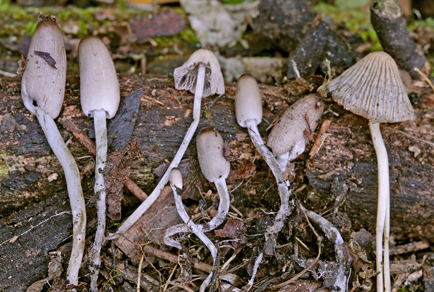
Based on two European collections and an ITS phylogenetic analysis, Coprinopsis roseolofusca sp. nov. is described based on morphology and ITS phylogenetic analysis. It had already been isolated by Nagy in 2012 as Coprinopsis aff. krieglsteineri from Hungary. Voto’s recent study of a Spanish collection by Suárez highlighted the connection between the two materials. The new species is characterized by a delicate lilac-pinkish pileus with a dark purplish brown disc and a copious fibrillose-flocculent hairy velar covering, collared gills, and nodulose to diverticulate hyphae in the stipe veil. The veil was also initially present on the pileus. The collaboration that followed ultimately led to the description of this new species. A full description, illustrations, and phylogenetic analysis results of the new species are presented.
References
- Löytynoja, A. (2014) Phylogeny-aware alignment with PRANK. In: Multiple Sequence Alignment Methods, Methods in Molecular Biology, vol. 1079. Humana Press. https://doi.org/10.1007/978-1-62703-646-7_10
- Nagy, L.G., Desjardin, D.E., Vágvölgyi, C., Kemp, R & Papp, T. (2013) Phylogenetic analyses of Coprinopsis sections Lanatuli and Atramentarii identify multiple species within morphologically defined taxa. Mycologia 105 (1): 112–124. [https://pubmed.ncbi.nlm.nih.gov/23074175/]
- Noordeloos, M.E. (2005) Coprinaceae Overeem. In: Noordeloos, M.E., Kuyper, T.W. & Vellinga, E.C. (Eds.) Flora agaricina Neerlandica. Critical monographs on families of agarics and boleti occurring in the Netherlands, vol. 6. Taylor & Francis Group, Boca Raton, pp. 21–109.
- Stamatakis, A. (2014) RAxML version 8: a tool for phylogenetic analysis and post-analysis of large phylogenies. Bioinformatics 30 (9): 1312–1313. https://doi.org/10.1093/bioinformatics/btu033
- Ronquist, F., Teslenko, M., van der Mark, P., Ayres, D.L., Darling, A., Höhna, S., Larget, B., Liu, L., Suchard, M.A. & Huelsenbeck, J.P. (2012) MrBayes 3.2: Efficient Bayesian phylogenetic inference and model choice across a large model space. Systematic Biology 61 (3): 539–542. https://doi.org/10.1093/sysbio/sys029
- Voto, P. (2020) [continuously updated] Key to Psathyrellaceae. A.M.E.R. Associazione Micologica Ecologica Romana. Available from: https://www.ameronlus.it/chiavi_micologia.php (last accessed 1 August 2025)