

Abstract
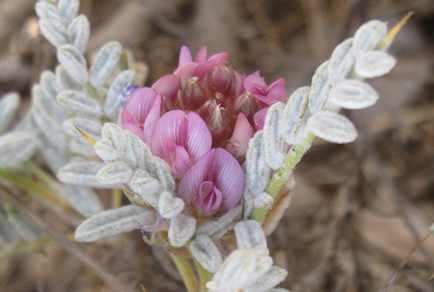
A new species of Astragalus sect. Microphysa, A. montis-hashtadi Akhavan & Maassoumi, is described and illustrated from Hashtad Mountain in the Central Zagros range, western Isfahan Province, Iran. The species is characterized by its compact cushion habit, densely silvery tomentose indumentum completely covering the leaf surface, very short peduncles, and small, globose racemes. Morphological comparisons with closely related taxa (A. microphysa, A. microphysopsis, and A. reuterianus) confirm its distinctness, supported by consistent diagnostic differences in indumentum texture and calyx morphology. Phylogenetic analysis based on combined nuclear ITS and plastid rpl32-trnL sequences places A. montis-hashtadi within A. sect. Microphysa, forming a subclade close to A. microphysa. The species is narrowly endemic to calcareous rocky slopes at elevations around 3000 m a.s.l., where it occurs in alpine habitats. Because of its extremely limited range, small population size, and habitat disturbance from grazing and mining, it is assessed as Critically Endangered (CR) under the IUCN criteria. This discovery highlights the Central Zagros as an important center of micro-endemism and diversification within the spiny taxa of Astragalus.
References
- Akhavan Roofigar, A., Amini Rad, M. & Bagheri, A. (2024) Alpine and sub‐alpine floristic survey of Hashtad Mountain (Central Zagros), Iran. The Iranian Journal of Botany 30 (2): 109–126. https://doi.org/10.22092/ijb.2024.366109.1473
- Akhavan, A., Bagheri, A. & Maassoumi, A.A. (2019) Taxonomy of the genus Astragalus L. (Fabaceae) in Isfahan Province. Taxonomy and Biosystematics 11 (39): 97–114. https://doi.org/10.22108/tbj.2020.123361.1114
- Avazzadeh, A., Bagheri, A., Maassoumi, A.A., Harpke, D. & Blattner, F.R. (2025) Discovery of a new species of the genus Astragalus (Fabaceae) in the Zagros oak forests: insights from morphological and molecular data. Plant Biosystems 159 (5): 1252–1260. https://doi.org/10.1080/11263504.2025.2531887
- Azani, N., Bruneau, A., Wojciechowski, M.F. & Zarre, S. (2017) Molecular phylogenetics of annual Astragalus (Fabaceae) and its systematic implications. Botanical Journal of the Linnean Society 184 (3): 347–365. https://doi.org/10.1093/botlinnean/box032
- Azani, N., Bruneau, A., Wojciechowski, M.F. & Zarre, S. (2019) Miocene climate change as a driving force for multiple origins of annual species in Astragalus (Fabaceae, Papilionoideae). Molecular Phylogenetics and Evolution 137: 210–221. https://doi.org/10.1016/j.ympev.2019.05.008
- Bagheri, A., Maassoumi, A.A., Brassac, J. & Blattner, F.R. (2023) Dated phylogeny of Astragalus section Stereothrix (Fabaceae) and allied taxa in the Hypoglottis clade. Biology 12: 138. https://doi.org/10.3390/biology12010138
- Bagheri, A., Maassoumi, A.A., Rahiminejad, M.R., Brassac, J. & Blattner, F.R. (2017) Molecular phylogeny and divergence times of Astragalus section Hymenostegis: An analysis of a rapidly diversifying species group in Fabaceae. Scientific reports 7 (1): 14033. https://doi.org/10.1038/s41598-017-14614-3
- Bagheri, A., Rahiminejad, M.R. & Maassoumi, A.A. (2014) A new species of the genus Astragalus (Leguminosae-Papilionoideae) from Iran. Phytotaxa 178 (1): 38–42. https://doi.org/10.11646/phytotaxa.178.1.4
- Ben Mahmoud, K., Mezzapesa, G.N., Abdelkefi, F. & Perrino, E.V. (2024) Nutritional value and functional properties of an underexploited Tunisian wild beet (Beta macrocarpa Guss.) in relation to soil characteristics. Euro-Mediterranean Journal for Environmental Integration 9: 705–720. https://doi.org/10.1007/s41207-024-00468-5
- Blattner, F.R. (1999) Direct amplification of the entire ITS region from poorly preserved plant material using recombinant PCR. BioTechniques 27 (6): 1180–1186. https://doi.org/10.2144/99276st04
- Boissier, E. (1843) Diagnoses Plantarum Orientalium Novarum ser. 1, 2: 71–72. Lipsiae [Leipzig].
- Boissier, E. (1846) Astragalus campylanthus. Diagnoses Plantarum Orientalis ser. 1, 6: 42. Lipsiae [Leipzig].
- Boissier, E. (1849) Diagnoses Plantarum Orientalium Novarum ser. 1, 9: 98. Lipsiae [Leipzig].
- Boissier, E. (1875) Flora Orientalis sive enumeratio plantarum in Oriente a Graecia et Aegypto ad Indiae fines hucusque observatarum. Vol. 3. H. Georg, Geneva & Basilea, 1019 pp.
- Brullo, S., Tomaselli, V. & Wagensommer, R.P. (2015) A new species of Odontites (Orobanchaceae) from southern Italy. Phytotaxa 213 (3): 271–281. https://doi.org/10.11646/phytotaxa.213.3.7
- Bunge, A. (1868) Generis Astragali spec. Gerontogeae. Pars altera, Specierum enumeration. Mémoires de l’Académie Impériale des Sciences de Saint Pétersbourg, Septième série 7, 11: 1–140.
- Bunge, A. (1869) Generis Astragali species Gerontogeae. Pars altera, Specierum enumeration. Mémoires de l’Académie Impériale des Sciences de Saint Pétersbourg, Septième série 15: 1–245.
- Candolle, A.P. de (1802) Astragalogia nempe Astragali, Biserrulae et Oxytropidis, nec non Phacae, Colutae et Lessertiae, Historia iconibus illustrata. J.B. Garnery, Paris, 269 pp.
- Candolle, A.P. de (1825) Prodromus systematis naturalis regni vegetabilis. Vol. 2. Paris, 640 pp.
- Delaroche, F. (1807) Nouveau Bulletin des Sciences, Publié par la Société Philomatique de Paris 1: 87.
- Di Pietro, R., Di Marzio, P., Medagli, P., Misano, G., Silletti, G.N., Wagensommer, R.P. & Fortini, P. (2016) Evidence from multivariate morphometric study of the Quercus pubescens complex in southeast Italy. Botanica Serbica 40 (1): 83–100. https://doi.org/10.5281/zenodo.48865
- Fischer, F.E.L. (1853) Synopsis Astragalarum Tragacantharum. Bulletin de la Société Impériale des Naturalistes de Moscou 26 (2): 314–486.
- Folk, R.A., Maassoumi, A.A., Siniscalchi, C.M., Kates, H.R., Soltis, D.E., Soltis, P.S., Belitz, M.B. & Guralnick, R.P. (2024) Phylogenetic diversity and regionalization in the temperate arid zone. Journal of Systematics and Evolution 62 (6): 1201–1217. https://doi.org/10.1111/jse.13077
- Forsskål, P. (1775) Flora Aegyptiaco-Arabica, sive descriptiones plantarum, quas per Aegyptum inferiorem et Arabiam felicem detexit, post mortem auctoris edidit Carsten Niebuhr. Hauniae, 220 pp. https://doi.org/10.5962/bhl.title.6625
- Ghahremaninejad, F., Alirezaei, Z., Mohammadi, M. & Nejad Falatoury, A. (2025) Updated catalogue of Iran’s endemic angiosperms. Taxonomy and Biosystematics 17 (64): 23–70. https://doi.org/10.22108/tbj.2025.146441.1314
- IUCN (2024) Guidelines for Using the IUCN Red List Categories and Criteria. Version 16. Prepared by the Standards and Petitions Committee. Gland, Switzerland and Cambridge, UK. Available from: http://www.iucnredlist.org/documents/RedListGuidelines.pdf (accessed 20 September 2025)
- Karbalaei, Z., Bagheri, A., Maassoumi, A.A., Rutten, T. & Blattner, F.R. (2025) A new species of Astragalus (Fabaceae) from the Irano-Turanian biodiversity hotspot: an integrative approach. Botanical Studies 66 (1): 1. https://doi.org/10.1186/s40529-024-00448-6
- Kazempour Osaloo, S.H., Maassoumi, A.A. & Murakami, N. (2005) Molecular systematics of the Old World Astragalus (Fabaceae) as inferred from nrDNA ITS sequence data. Brittonia 57 (4): 367–381. https://doi.org/10.1663/0007-196X(2005)057[0367:MSOTOW]2.0.CO;2
- Khalili, Z., Ghalenoyi, S., Maassoumi, A.A. & Kazempour-Osaloo, S. (2021) Phylogenetic relationships, biogeography and taxonomic delimitation of Astragalus sect. Acanthophace (Fabaceae) using cpDNA and nrDNA ITS sequences analyses. Plant Biosystems 155 (2): 291–301. https://doi.org/10.1080/11263504.2020.1739162
- Lamarck, J.B.P.A. de (1783) Encyclopédie Méthodique. Botanique 1 (1). Paris, pp. 322. https://doi.org/10.5962/bhl.title.824
- Lamarck, J.B.P.A. de (1791) Tableau encyclopédique et méthodique. Botanique. Vol. 1. Paris, pp. 63.
- Linnaeus, C. von (1753) Species Plantarum. Laurentius Salvius, Stockholm, 1200 pp.
- Lyskov, D., Akalın, E., Bagheri, A., Terentieva, E., Tuncay, H.O., Kroupsky, I. & Samigullin, T. (2025) Break it and better it: molecular and morphological data support the split of Ferulago (Apiaceae) into four genera. Botanical Journal of the Linnean Society boaf049. https://doi.org/10.1093/botlinnean/boaf049
- Maassoumi, A.A. (2016) Flora of Iran, Fabaceae (Astragalus II). Vol. 85. Research Institute of Forests and Rangelands, Tehran.
- Maassoumi, A.A., Ashouri, P. & Khajoei Nasab, F. (2022) An overview of the evolution of the genus Astragalus (Fabaceae) in the Old World. Taxonomy and Biosystematics 14: 1–24. https://doi.org/10.22108/tbj.2022.133218.1196
- Olivier, G.A. (1807) Voyage dans l’empire Othoman, l’Égypte et la Perse, fait par ordre du gouvernement, pendant les six premières années de la République. Vol. 5 (édition octavo). H. Agasse, Paris, 342 pp., Atlas 3: t. 44.
- Parsa, A. (1948) New species and varieties of the Persian flora: II. Kew Bulletin 3 (2): 191–228. https://doi.org/10.2307/4119762
- Perrino, E.V., Signorile, G. & Marvulli, M. (2013) A first checklist of the vascular flora of the Polignano a Mare coast (Apulia, southern Italy). Natura Croatica 22 (2): 295–318.
- Perrino, E.V., Wagensommer, R.P., Mezzapesa, G.N. & Trani, A. (2024) Stachys italica Mill.: synecology, functional compounds and potential use of an Italian endemic taxon. Planta 260: 138. https://doi.org/10.1007/s00425-024-04571-3
- Podlech, D. & Zarre, S. (2013) A taxonomic revision of the genus Astragalus L. (Leguminosae) in the Old World. Vols. 1–3. Naturhistorisches Museum, Wien, 2439 pp.
- Ronquist, F., Teslenko, M., van der Mark, P., Ayres, D.L., Darling, A., Höhna, S., Larget, B., Liu, L., Suchard, M.A. & Huelsenbeck, J.P. (2012) MrBayes 3.2: Efficient Bayesian phylogenetic inference and model choice across a large model space. Systematic Biology 61: 539–542. https://doi.org/10.1093/sysbio/sys029
- Shaw, J., Lickey, E.B., Schilling, E.E. & Small, R.L. (2007) Comparison of whole chloroplast genome sequences to choose noncoding regions for phylogenetic studies in angiosperms: the tortoise and the hare III. American Journal of Botany 94 (3): 275–288. https://doi.org/10.3732/ajb.94.3.275
- Siti-Munirah, M.Y. & Dome, N. (2023) Thismia kenyirensis (Thismiaceae), a new species from Taman Negeri Kenyir, Terengganu, Peninsular Malaysia. PhytoKeys 221: 61–72. https://doi.org/10.3897/phytokeys.221.98571
- Stinca, A., Chianese, G., D’Auria, G., Fascetti, S., Ravo, M., Romano, V.A., Salerno, G., Astuti, G., Bartolucci, F., Bernardo, L., Bonari, G., Bouvet, D., Cancellieri, L., Carli, E., Caruso, G., Catalano, I., Cennamo, G.D., Ciaschetti, G., Conti, F., Di Pietro, R., Fortini, P., Gangale, C., Lapenna, M.R., Lattanzi, E., Marcucci, R., Peccenini, S., Pennesi, R., Perrino, E.V., Peruzzi, L., Roma-Marzio, F., Scoppola, A., Tilia, A., Villani, M. & Rosati, L. (2019) Contribution to the floristic knowledge of eastern Irpinia and Vulture-Melfese area. Italian Botanist 8: 1–16. https://doi.org/10.3897/italianbotanist.8.37818
- Thiers, B. (2025) Index Herbariorum: A global directory of public herbaria and associated staff. New York Botanical Garden’s Virtual Herbarium. Available from: http://sweetgum.nybg.org/ih/ (accessed 2 November 2025)
- Vural, C. & Şapçı, H. (2012) A single locality, endemic species, Astragalus argaeus (Fabaceae). Kew Bulletin 67 (1): 89–92. https://doi.org/10.1007/s12225-012-9335-y
- Wagensommer, R.P., Marrese, M., Perrino, E.V., Bartolucci, F., Cancellieri, L., Carruggio, F., Conti, F., Di Pietro, R., Fortini, P., Galasso, G., Lattanzi, E., Lavezzo, P., Longo, D., Peccenini, S., Rosati, L., Russo, G., Salerno, G., Scoppola, A., Soldano, A., Stinca, A., Tilia, A., Turco, A., Medagli, P. & Forte, L. (2014) Contributo alla conoscenza floristica della Puglia: resoconto dell’escursione del Gruppo di Floristica (S.B.I.) nel 2011 nel settore meridionale dei Monti della Daunia. Informatore Botanico Italiano 46 (2): 175–208.
- Yaselyani, M., Bagheri, A., Saeidi, H. & Noroozi, J. (2024) Vascular plant diversity of the high mountains of Fereydunshahr, Central Zagros, Iran. Vegetation Classification and Survey 5: 329–346. https://doi.org/10.3897/VCS.110546
- Zeraatkar, A., Maassoumi, A.A., Nasab, F.K. & Shirmardi, H.A. (2024) Astragalus boldajiensis and Astragalus centro-zagrosicus (Fabaceae), two new species from west of Iran. The Iranian Journal of Botany 30 (1): 28–34. https://doi.org/10.22092/ijb.2024.365845