

Abstract
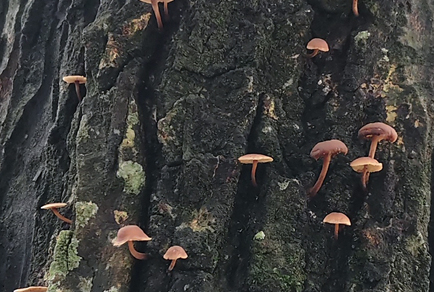
A novel species of Collybiopsis was discovered during an investigation on the diversity of agaricoid fungi in Kerala State, India. The identification and characterization of this taxon were carried out through detailed morphological examinations, coupled with a two-locus phylogenetic analysis. A combined dataset of nucleotide sequences from the internal transcribed spacer (nrITS) and the large subunit (nLSU) regions confirmed the distinct phylogenetic placement of the species within the genus Collybiopsis. Herein, we provide a comprehensive description, detailed illustrations, and phylogenetic analysis results of C. brunneigalera, highlighting its unique diagnostic features and phylogenetic affinities.
References
- Antonín, V. & Noordeloos, M.E. (1993) A monograph of Marasmius, Collybia, and related genera in Europe: Marasmius, Setulipes, and Marasmiellus. Libri Botanici 8: 1–229.
- Choudhary, S., Sharma, Y.P. & Uniyal, P. (2025) Collybiopsis himalayensis sp. nov. (Omphalotaceae), a new white-spored agaric from the Indian Himalaya. Lilloa 62 (2): 425–436. https://doi.org/10.30550/j.lil/2003
- Cho, M., Kwon, S.L., Kim, C. & Kim, J.J. (2024) Notes of five wood-decaying fungi from Juwangsan National Park in Korea. Mycobiology 52: 30–41. https://doi.org/10.1080/12298093.2023.2299098
- Cho, M., Yoo, Y., Lee, S.H., Kwon, D.Y., Kim, C., Lee, Y.M., Kwon, S.L. & Kim, J.J. (2025) Two new species of Collybiopsis (Agaricales, Omphalotaceae) from Mudeungsan National Park in Korea. Mycobiology 53 (5): 676–683. https://doi.org/10.1080/12298093.2025.2538925
- Corner, E.J.H. (1996) The agaric genera Marasmius, Chaetocalathus, Crinipellis, Heimiomyces, Resupinatus, Xerula, and Xerulina in Malesia. Beihefte Nova Hedwigia 111: 1–175.
- Darriba, D., Taboada, G.L., Doallo, R. & Posada, D. (2012) jModelTest 2: more models, new heuristics and parallel computing. Nature Methods 9: 772. https://doi.org/10.1038/nmeth.2109
- Ding, L., Zhong, B.-J., Zeng, H., Wang, S.-N. & Yan, J.-Q. (2025) Four new species of Collybiopsis (Omphalotaceae, Agaricales) from subtropical regions of China. MycoKeys 118: 289–311. https://doi.org/10.3897/mycokeys.118.155560
- Dutta, A.K., Wilson, A.W., Antonín, V. & Acharya, K. (2015) Taxonomic and phylogenetic study on gymnopoid fungi from Eastern India. I. Mycological Progress 14: 79. https://doi.org/10.1007/s11557-015-1094-3
- Earle, F.S. (1909) The genera of the North American gill fungi. Bulletin of the New York Botanical Garden 5: 373–451.
- Farris, J.S., Källersjö, M., Kluge, A.G. & Bult, C. (1994) Testing phylogenetic congruence. Cladistics 10: 315–319. https://doi.org/10.1111/j.1096-0031.1994.tb00181.x
- Hall, T. (2011) BioEdit: an important software for molecular biology. GErF Bulletin of Biosciences 2 (1): 60–61.
- Hughes, K.W. & Petersen, R.H. (2015) Transatlantic disjunction in fleshy fungi III: Gymnopus confluens. MycoKeys 9: 37–63. https://doi.org/10.3897/mycokeys.9.4700
- Izumitsu, K., Hatoh, K., Sumita, T., Kitade, Y., Morita, A., Gafur, A., Ohta, A., Kawai, M., Yamanaka, T., Neda, H., Ota, Y. & Tanaka, C. (2012) Rapid and simple preparation of mushroom DNA directly from colonies and fruiting bodies for PCR. Mycoscience 53: 396–401. https://doi.org/10.1007/S10267-012-0182-3
- Katoh, K. & Standley, D.M. (2013) MAFFT multiple sequence alignment software version 7: improvements in performance and usability. Molecular Biology and Evolution 30 (4): 772–780. https://doi.org/10.1093/molbev/mst010
- Kim, J.S., Cho, Y., Park, K.H., Park, J.H., Kim, M., Kim, C.S. & Lim, Y.W. (2022) Taxonomic study of Collybiopsis (Omphalotaceae, Agaricales) in the Republic of Korea with seven new species. MycoKeys 88: 79–108. https://doi.org/10.3897/mycokeys.88.79266
- Kornerup, A. & Wanscher, J.H. (1978) Methuen Handbook of Colour. Eyre Methuen Ltd., London, UK, 252 pp.
- Lennox, D.H. (1979) The genus Rhodocollybia (Agaricales). Mycotaxon 9 (1): 1–85. https://doi.org/10.5962/p.417191
- Li, J.P., Oliveira, J.J.S., Pan, M.C., Deng, C.Y., Antonín, V., Xiao, Z.D., Li, F.F., Li, T.H., Li, C.T., Dai, Y.T. & Li, Y. (2024) Notes on all genera of Omphalotaceae: expanding the taxonomic spectrum in China and revisiting historical type specimens. Mycosphere 15 (1): 1522–1594. https://doi.org/10.5943/mycosphere/15/1/13
- Liu, X.C., Lin, Z.J., Liang, Y.S., Cao, L.X. & Qiu, L.H. (2024) Collybiopsis baiyunensis sp. nov. (Omphalotaceae, Agaricales) from Baiyun Mountain, southern China. Phytotaxa 640 (2): 183–195. https://doi.org/10.11646/phytotaxa.640.2.7
- Mata, J.L., Hughes, K.W. & Petersen, R.H. (2004) Phylogenetic placement of Marasmiellus juniperinus. Mycoscience 45: 214–221. https://doi.org/10.1007/S10267-004-0170-3
- Murrill, W.A. (1915) Agaricaceae (pars). Flora of North America 9: 286–296.
- Oliveira, J.J., Vargas-Isla, R., Cabral, T.S., Rodrigues, D.P. & Ishikawa, N.K. (2019) Progress on the phylogeny of the Omphalotaceae: Gymnopus s. str., Marasmiellus s. str., Paragymnopus gen. nov. and Pusillomyces gen. nov. Mycological Progress 18 (5): 713–739. https://doi.org/10.1007/s11557-019-01483-5
- Petersen, R.H. & Hughes, K.W. (2014) New North American species of Gymnopus. North American Fungi 9: 1–22. https://doi.org/10.2509/naf2014.009.003
- Petersen, R.H. & Hughes, K.W. (2021) Collybiopsis and its type species, Co. ramealis. Mycotaxon 136 (2): 263–349. https://doi.org/10.5248/136.263
- Petersen, R.H. & Hughes, K.W. (2024) Two new species of Collybiopsis (Agaricales, Omphalotaceae) from eastern North America. MycoKeys 107: 95–124. https://doi.org/10.3897/mycokeys.107.122634
- Rambaut, A. (2009) FigTree v1.3.1. Institute of Evolutionary Biology, University of Edinburgh. [http://tree.bio.ed.ac.uk/software/figtree/]
- Rambaut, A., Drummond, A.J., Xie, D., Baele, G. & Suchard, M.A. (2018) Posterior summarization in Bayesian phylogenetics using Tracer 1.7. Systematic Biology 67 (5): 901–904. https://doi.org/10.1093/sysbio/syy032
- Razzaq, F., Khalid, A.N. & Ashraf, S. (2023) Collybiopsis pakistanica (Omphalotaceae, Agaricales, Basidiomycota), a new mushroom species from Margalla Hills, Pakistan and two new combinations. Nordic Journal of Botany 4: e03849. https://doi.org/10.1111/njb.03849
- Retnowati, A. (2018) The species of Marasmiellus (Agaricales: Omphalotaceae) from Java and Bali. Gardens’ Bulletin Singapore 70 (1): 191–258. https://doi.org/10.26492/gbs70(1).2018-17
- Ronquist, F., Teslenko, M., van der Mark, P., Ayres, D.L., Darling, A., Höhna, S., Larget, B., Liu, L., Suchard, M.A. & Huelsenbeck, J.P. (2012) MrBayes 3.2: efficient Bayesian phylogenetic inference and model choice across a large model space. Systematic Biology 61: 539–542. https://doi.org/10.1093/sysbio/sys029
- Singer, R. (1939) Neue und interessante Agaricales aus dem Herbarium Singer. Schweizerische Zeitschrift für Pilzkunde 17: 71.
- Singer, R. (1973) The genera Marasmiellus, Crepidotus and Simocybe in the Neotropics. Nova Hedwigia Beihefte 44: 1–517. https://doi.org/10.2307/3758379
- Trifinopoulos, J., Nguyen, L.-T., von Haeseler, A. & Minh, B.Q. (2016) W-IQ-TREE: a fast online phylogenetic tool for maximum likelihood analysis. [Online] https://doi.org/10.1093/nar/gkw256
- Vilgalys, R. & Hester, M. (1990) Rapid genetic identification and mapping of enzymatically amplified ribosomal DNA from several Cryptococcus species. Journal of Bacteriology 172 (8): 4238–4246. https://doi.org/10.1128/jb.172.8.4238-4246.1990
- Wei, Y.L. & Dai, Y.C. (2004) Ecological function of wood-inhabiting fungi in forest ecosystem. Chinese Journal of Applied Ecology 15 (10): 1935–1938.
- White, T.J., Bruns, T.D., Lee, S.B., Taylor, J.W., Innis, M.A., Gelfand, D.H. & Sninsky, J. (1990) Amplification and direct sequencing of fungal ribosomal RNA genes for phylogenetics. In: Innis, M.A., Gelfand, D.H., Sninsky, J.J. & White, T.J. (Eds.) PCR Protocols: A Guide to Methods and Applications. Academic Press, San Diego, pp. 315–322. https://doi.org/10.1016/B978-0-12-372180-8.50042-1
- Yang, W.Q., Zhang, J.R., Cao, M.T., Hu, Z.L. & Zhao, R.L. (2025) Two new species of Collybiopsis (Agaricales, Omphalotaceae) from Beijing, China. Phytotaxa 715 (1): 47–60. https://doi.org/10.11646/phytotaxa.715.1.3